A pause in rates, a change in priorities
The Bank of Japan voted 8 to 1 on October 30, 2026, to keep its policy interest rate at about 1.25%, while judging that underlying inflation had reached a level broadly consistent with its 2% target. It also unanimously approved faster sales of its exchange traded funds, raising the annual pace from 330 billion yen to 860 billion yen from January 2027.
Contents
- A pause in rates, a change in priorities
- What reaching 2% means
- Why Takata wanted a faster increase
- Higher inflation forecasts, modest growth
- Oil, the yen and AI pull on prices
- ETF sales rise to 2.6 times their previous pace
- Sales could also increase payments to the Treasury
- AI concerns drive the stock market retreat
- December is in focus, with no commitment
- Key Points
Governor Kazuo Ueda described a change in the central bank's task: after years of trying to lift inflation, policymakers now need to guard against prices and expectations of future price increases climbing too far. Yet he stopped short of declaring that Japan had achieved 2% inflation in a lasting, stable way.
Board member Hajime Takata wanted an immediate increase to 1.5%. The other eight members preferred to wait, following the September 18 increase from 1% to 1.25%, and assess how higher borrowing costs were affecting households, companies and financial conditions.
The decision brought together two parts of Japan's withdrawal from extraordinary monetary support. Interest rates stayed unchanged for now, but the bank strengthened its assessment of inflation and shortened the estimated time needed to sell its ETF holdings from about 112 years to 43 years.
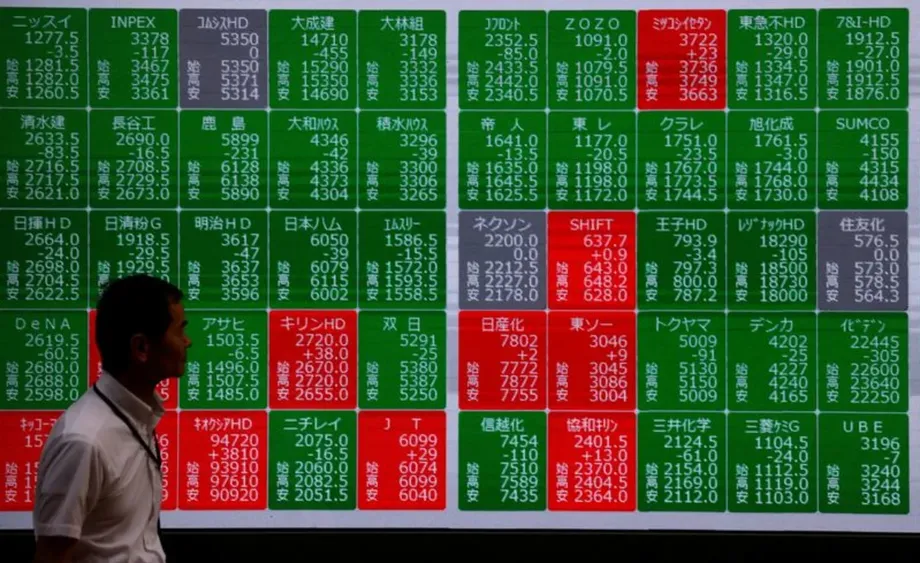
Financial markets focused more heavily on another concern that day: whether enormous spending on artificial intelligence would generate enough profit. The Nikkei share average closed down 2.1% at 63,290.11, while the yen strengthened, trading at 157.06 per dollar at one point, a gain of about 0.4%.
What reaching 2% means
The BOJ's October Outlook for Economic Activity and Prices changed its description of underlying inflation from approaching the target to being broadly consistent with it. The shift came more than 13 years after the bank and the government of then Prime Minister Shinzo Abe adopted the 2% goal in January 2013.
Underlying inflation means the more persistent movement in prices after allowing for temporary influences, such as oil price swings or government subsidies. The BOJ assesses it through several indicators, including wages, business pricing and expectations about future inflation, rather than relying on a single monthly reading.
Wage increases spreading through the economy and companies passing higher costs into service prices supported the new assessment. The bank also judged that expectations for inflation over the medium and longer term were around 2%.
Ueda said all board members shared the assessment that underlying inflation was broadly at the target. Their disagreement concerned the speed of policy adjustment. He still wanted to confirm that wage increases and price setting would sustain that level, including whether annual wage negotiations routinely incorporated an assumption of 2% inflation.
The practical goal is a steady relationship between pay and prices: workers receive higher wages, businesses can cover rising costs, and household purchasing power keeps pace. Ueda said the bank needed more evidence that this pattern would remain firmly in place before making a formal declaration of lasting success.
Why Takata wanted a faster increase
Takata argued that reaching the inflation target put policy in a new phase. He wanted the bank to move more quickly toward a neutral interest rate, the level that neither stimulates nor slows economic activity, giving policymakers greater flexibility to respond to later changes.
Ueda also said rates should move gradually toward neutral, but stressed that its precise level is uncertain. The BOJ would have to watch how the economy responded as borrowing costs rose, including whether smaller companies faced tighter access to credit or difficulty managing their cash.
Earlier increases can take time to affect business financing, investment and household spending. Ueda therefore rejected a fixed schedule for further moves. Asked about the pace of increases, the BOJ governor said:
I cannot say in advance that it will be once every few months.
The BOJ continued to describe financial conditions as accommodative, meaning they still supported spending and borrowing. If economic activity and prices developed as expected, it intended to keep raising rates and reduce that support.
Higher inflation forecasts, modest growth
The BOJ raised its median forecast for consumer inflation excluding fresh food in fiscal 2027 to 2.6%, from 2.4% in July. Forecasts remained at 2.5% for fiscal 2026 and 2% for fiscal 2028. Japan's fiscal year runs from April through March.
The measure excluding both fresh food and energy was forecast at 2.4% in fiscal 2026, 2.7% in fiscal 2027 and 2.3% in fiscal 2028. Compared with July, the first forecast fell by 0.1 percentage point, while the following two each rose by 0.1 percentage point.
Growth projections changed only slightly. The median forecast for real gross domestic product, which measures economic output after adjusting for prices, rose from 0.6% to 0.7% for fiscal 2026. The fiscal 2027 forecast fell from 0.8% to 0.7%, while fiscal 2028 stayed at 0.8%.
The bank described a moderate recovery with pockets of weakness, partly connected to developments in the Middle East. Wage growth and demand associated with AI supported activity, but rising living costs weighed on households. Private consumption was recovering gradually, and business investment had recently weakened.
September consumer inflation excluding fresh food was 2.1% compared with a year earlier. Inflation adjusted wages rose 1.5% in August, their eighth consecutive monthly increase compared with a year earlier. Together, those figures showed improving pay alongside continuing pressure on household budgets.
Oil, the yen and AI pull on prices
Oil prices, exchange rates and global AI investment were central to the BOJ's assessment that inflation risks leaned upward. Japan depends heavily on imported energy, especially from the Middle East, making fuel costs an important influence on both business expenses and family spending.
A weaker yen makes goods priced in foreign currencies more expensive in Japan. Ueda said businesses were more willing than in the past to pass higher costs into selling prices, potentially strengthening the effect of currency depreciation on consumer inflation.
AI investment works through several channels at once. Orders for Japanese machinery and semiconductor equipment support exports, company earnings and investment. Strong demand can also raise semiconductor, equipment and raw material prices, adding to costs elsewhere in the economy.
The BOJ expected consumer inflation excluding fresh food to move distinctly above 2% before easing toward the target later in its forecast period. Ueda also noted that government measures to reduce living costs could leave inflation for the calendar year slightly below 2%, a development he would watch for its effect on the next wage negotiations.
Those different readings matter for workers and businesses. Subsidies can lower the inflation number used as a reference in pay talks, even while firms and households continue to face persistent cost pressures.
ETF sales rise to 2.6 times their previous pace
The BOJ will increase annual ETF sales by 530 billion yen on a book value basis, from 330 billion yen to 860 billion yen. The new pace is about 2.6 times the old one, an increase of roughly 161%.
ETFs are investment funds traded on an exchange, often holding baskets of shares. Book value records the value of assets in the bank's accounts. Market value reflects what those assets are worth at current prices. Using recent valuations, the new annual sales pace corresponds to about 2.46 trillion yen at market value.
The bank began selling ETFs in January 2026. It said those operations had proceeded smoothly without major market disruption, while stock market trading had expanded. Under the revised arrangement, sales would represent about 0.1% of market trading value, compared with about 0.05% under the previous framework.
Ueda said sales would be spread over time, and the BOJ retained the ability to adjust or temporarily suspend them as market conditions required. Annual sales of Japanese real estate investment trusts, known as J-REITs, would remain at about 5 billion yen.
The bank's ETF holdings stood at 36.9557 trillion yen in book value at the end of September 2026. Dividing that balance by annual sales of 860 billion yen gives roughly 43 years, compared with 112 years at the former pace. Completion therefore remains decades away even after the acceleration.
Sales could also increase payments to the Treasury
The gap between the estimated 2.46 trillion yen market value of annual ETF sales and their 860 billion yen book value is about 1.6 trillion yen. At those valuations, disposals would generate gains of that approximate size.
Higher policy rates also increase the interest the BOJ pays on eligible balances that financial institutions hold at the central bank. ETF gains could help offset that expense and support the surplus the bank transfers to the national Treasury.
Finance Minister Satsuki Katayama said the additional surplus and its treatment would be considered during budget preparation. The eventual amount available to the government would depend on the BOJ's income and expenses, as well as the prices achieved when assets were sold.
The BOJ's stated reasons for accelerating sales were the smooth operation of the existing programme and greater market trading capacity. The possible fiscal benefit adds another consequence of the decision as Japan moves away from the policies used to combat low inflation.
AI concerns drive the stock market retreat
Tokyo shares showed little immediate reaction to either the rate hold or the faster ETF disposal plan. Instead, technology stocks followed losses on Wall Street as investors questioned the profitability of large AI spending programmes.
Maki Sawada, an equities strategist at Nomura Securities, linked the selling pressure to doubts about returns from AI investment:
This can be seen as a sign of growing concerns regarding the profitability of AI investments, which is weighing on share prices,
Advantest fell 5.9% and Tokyo Electron lost 5.2%. Ibiden dropped 15.2%, Lasertec declined 8.8%, and SoftBank Group fell 6%. The Nikkei had fallen as much as 3% during the session before closing 2.1% lower.
The broader Topix declined 1%. Despite Friday's losses, the Nikkei gained 1% for the week, while the Topix finished the week flat. Earnings produced gains elsewhere: Konami rose 15%, and Tokyo Disney Resort operator Oriental Land advanced 8.5%.
AI therefore presented the BOJ with a challenge visible in both its forecasts and market prices. Strong spending supported Japanese exports and raised some input costs, while doubts about future profits created pressure on shares. Ueda maintained the direction toward higher rates while keeping the timing flexible.
December is in focus, with no commitment
The next BOJ policy meeting is scheduled for December 17 and 18. Ueda left an increase open but gave no commitment, saying decisions would depend on the economic outlook, wages, pricing behaviour, financial conditions and risks at each meeting.
Investment firms offered different timetables. BlackRock Investment Institute expected another increase before the end of 2026. J.P. Morgan Asset Management's Asia Pacific chief market strategist Tai Hui projected increases of 25 basis points in December 2026 and March 2027, taking the rate to 1.75%. A basis point is one hundredth of a percentage point.
Kazuo Momma, executive economist at Mizuho Research Institute and a former senior BOJ official, also expected increases in December and March. Hirofumi Suzuki, chief foreign exchange strategist at Sumitomo Mitsui Banking Corporation, considered January a possibility if the bank adopted a more explicit waiting stance.
Tai Hui expected a less predictable pace after March as earlier increases worked through the economy and the contribution from energy prices weakened. His forecast put rates near 1.75% thereafter, with further increases possible if Middle East tensions intensified or the yen remained weak.
The main policy and publication dates show how the next assessment will develop:
- September 18, 2026: The BOJ raised its policy rate from about 1% to 1.25%.
- October 29 and 30: Policymakers met, held rates and approved faster ETF sales.
- November 2: The full October Outlook Report was scheduled for publication.
- November 10: The meeting's Summary of Opinions was scheduled for release.
- December 17 and 18: The next monetary policy meeting is scheduled.
- December 23: Minutes of the October meeting are scheduled for publication.
- January 2027: The faster ETF sales pace begins.
For households and smaller companies, the immediate result is time to adjust to September's increase. The next decision will turn on whether wage growth can sustain spending while inflation stays close to 2%, and how much further borrowing costs need to rise to keep that balance.
Key Points
- The BOJ held its policy rate at about 1.25% by an 8 to 1 vote; Hajime Takata preferred 1.5%.
- Underlying inflation was judged broadly consistent with 2%, while Ueda sought further evidence that it would remain stable.
- The fiscal 2027 inflation forecast excluding fresh food rose from 2.4% to 2.6%.
- Annual ETF sales will rise from 330 billion yen to 860 billion yen in book value from January 2027.
- The revised sales pace would take about 43 years to clear September's ETF holdings.
- The next policy meeting is December 17 and 18, with no commitment to an increase.