A $5.375 billion deal hits a Chinese security barrier
China has prohibited SoftBank's acquisition of ABB's robotics business in the country, putting a major obstacle in the way of the Japanese investment group's planned $5.375 billion purchase of the Swiss company's global robotics division. China is the division's largest market, accounting for about 30% of its business.
Contents
- A $5.375 billion deal hits a Chinese security barrier
- Why China matters so much to the purchase
- Competition clearance came before the security decision
- What China's investment rules allow
- Why robotics data is part of the dispute
- SoftBank's plan reaches beyond chatbots
- ABB's Shanghai factory shows the industrial goal
- October's confidence gives way to November's prohibition
- The Bottom Line
ABB said on Thursday, November 5, that SoftBank had informed it of the decision by China's Office of the Working Mechanism for Foreign Investment Security Review. The companies have not announced the termination of the global transaction. ABB said they remain in close dialogue and continue working constructively on it.
The decision puts control of factories, industrial technology and data at the center of a deal intended to bring artificial intelligence closer to machines doing physical work. Chinese authorities were concerned that robotics data could be transferred overseas and used to train AI models, including models developed by OpenAI, according to people familiar with the review. SoftBank is a major OpenAI investor.
ABB's statement did not give the reasons for the prohibition. The reported concerns also extended to the business's Chinese supply chain and whether manufacturing capacity would remain in China.
SoftBank agreed to buy the robotics division in October 2025. Its purchase still requires regulatory approvals and other conditions to be met, with SoftBank responsible for managing the approval process. The Chinese decision now stands between the signed agreement and completion.
Why China matters so much to the purchase
China represents roughly three out of every ten parts of ABB's robotics business. A restriction affecting that market therefore reaches a substantial portion of the operation SoftBank agreed to acquire, rather than a small overseas outpost.
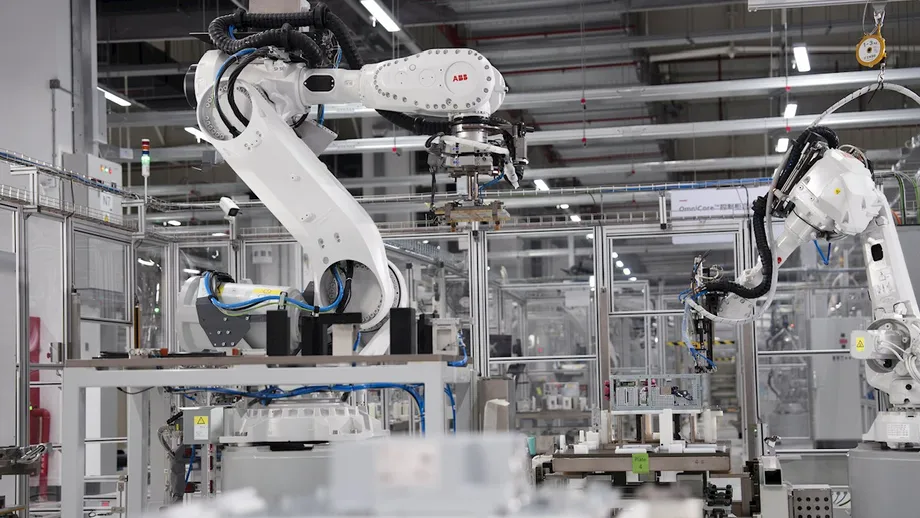
Shanghai is central to the business. ABB's global robotics headquarters is located there, alongside a major base for research and production. More than 90% of the robots ABB sells in China are produced locally, according to accounts of its operations.
Han Chen, president of ABB Robotics in China, gave a closely aligned figure in October: 90% of the company's robot products sold in the Chinese market came from its Shanghai factory. He said that proportion would rise as the company deepened its use of local manufacturing and suppliers.
ABB's broader Chinese operations extend well beyond robotics. Estimates put its workforce in China at about 12,700, while another account citing company information gives about 15,000 employees across roughly 30 entities. The latter describes operations reaching nearly 130 cities and sales channels covering nearly 700 cities.
For customers and suppliers, the immediate issue is who will own and control a deeply established industrial network. ABB has announced no change to its Chinese production operations following the prohibition.
Competition clearance came before the security decision
The transaction reportedly cleared China's competition review in February before undergoing a foreign investment security review. Those processes examine different questions. A competition review considers how a purchase might affect rivalry between businesses; a security review examines risks associated with foreign investment and control.
China's National Development and Reform Commission, known as the NDRC, examined the acquisition and recently communicated the blocking decision to SoftBank, according to people familiar with the process. SoftBank had expected approval until it received notice of the prohibition the previous week.
ABB named the foreign investment security review office in its confirmation. That office sits within the NDRC, which leads the review mechanism together with the Ministry of Commerce. The institutional structure explains why both the office and the commission appear in accounts of the decision.
SoftBank is assessing whether it can apply again for approval. No revised transaction structure, new application date or replacement completion deadline has been announced.
What China's investment rules allow
China's Foreign Investment Security Review Measures, issued by the NDRC and Ministry of Commerce on December 19, 2020, cover foreign investment that affects or might affect national security. Their scope includes acquisitions of equity or assets in domestic enterprises.
The measures identify important equipment manufacturing, important information technology and key technologies among the sectors where investments obtaining actual control can require a declaration. Control can involve holding more than half a company's shares, having decisive voting influence, or exercising major influence over business decisions, personnel, finances or technology.
The rules provide for ordinary and special reviews. Following a special review, the authorities may approve an investment, prohibit it if it affects national security, or approve it with conditions when those conditions can remove the security impact and the parties agree to accept them.
A special review generally has a limit of 60 working days, with extensions permitted in special circumstances. Time spent supplying additional requested documents is excluded. Companies may also revise their investment plans during a review, which starts the review clock again when the revised plan is received.
Those provisions explain the tools available to regulators and companies. Any renewed effort by SoftBank would still need to address the Chinese authorities' decision on this particular acquisition.
Why robotics data is part of the dispute
Chinese authorities' reported concern centers on information generated through robotics operations moving outside the country and becoming material for AI training. Training is the process through which an AI system learns patterns from examples so it can recognize objects, predict outcomes or choose actions.
Industrial robots increasingly combine cameras, software and information about movements and production tasks. Such information can help machines learn how to handle objects or complete a sequence of actions. In a factory, it can also be closely connected to how products are made.
SoftBank's investment in OpenAI adds a corporate connection to the reported concern about where that information could go. ABB's public confirmation focused on the prohibition and the continuing transaction discussions, leaving the detailed security reasoning undisclosed.
The reported examination of supply chains and manufacturing capacity gives the review a second practical dimension. Chinese authorities were looking at the future location of industrial capabilities as well as the movement of information. ABB's extensive local production makes both questions consequential for its Chinese business.
SoftBank's plan reaches beyond chatbots
SoftBank sought the acquisition as part of founder and chief executive Masayoshi Son's push into physical AI. The term describes artificial intelligence operating through machines that sense and act in the physical world, rather than simply producing text or images on a screen.
ABB would bring an established robotics business to that strategy. The division recorded $2.3 billion in revenue in 2024, about 7% of ABB's group revenue, and an operating EBITA margin of 12.1%. That margin measures operating earnings before interest, taxes and amortization against sales.
The agreed enterprise value of $5.375 billion is about 2.3 times the division's 2024 revenue of $2.3 billion. Enterprise value describes the value of the business in the transaction, taking account of debt and cash under the deal's terms. The comparison gives a sense of the purchase's scale alongside the operation's annual sales.
SoftBank already owns British chip designer Arm and holds a substantial investment in OpenAI. Buying ABB Robotics would add industrial machines, engineering expertise and factory customers to that technology portfolio.
Competition in this field is also growing within China. February's Chinese robotics model launches included Alibaba's RynnBrain, designed to help machines track space, time and progress through tasks. The race increasingly concerns how AI performs useful physical work, alongside improvements in software models.
ABB's Shanghai factory shows the industrial goal
Han described a concrete use for physical AI at ABB's Shanghai factory: a controller production line capable of making more than 200 product configurations. Switching between products previously required lengthy changeovers and substantial inventories.
According to Han, a flexible line using physical AI can adapt to orders with different models, specifications and configurations, allowing production to follow demand more closely. The intended benefit is straightforward: spend less time resetting equipment and keep fewer products waiting in storage.
ABB also demonstrated a GoFa collaborative robot making pour over coffee. The machine learned movements, timing and pouring patterns through imitation, combining vision, training tools and autonomous path planning. A collaborative robot is designed to work alongside people under appropriate safety arrangements.
The demonstration illustrates the difference between following a fixed sequence of positions and learning a task that depends on observation and timing. Han forecast that physical AI applications in industrial production would grow substantially over the following two to three years.
China already has more than two million industrial robots operating in factories, while roughly 120 million people work in manufacturing, as described in August's factory automation expansion. That installed base helps explain why access to Chinese customers, suppliers and production experience matters to a global robotics buyer.
October's confidence gives way to November's prohibition
Han sounded confident about the acquisition during an industrial fair on October 12. He said the processes were proceeding normally and that the project remained within its planned time window. The companies had expected completion in the middle to latter part of 2026.
The main steps now span more than a year:
- October 8, 2025: ABB and SoftBank announce the agreement to sell the robotics business for an enterprise value of $5.375 billion.
- February 2026: The transaction reportedly clears China's competition review.
- October 12, 2026: Han says the transaction is progressing and remains within its planned completion window.
- November 5, 2026: ABB confirms that SoftBank has informed it of China's prohibition concerning the robotics business in China.
Han also said in October that ABB Robotics would maintain its commitment to the Chinese market regardless of ownership. He pointed to products developed and manufactured locally, including the IRB 6720 Lite+ large robot and an additional PoWa collaborative robot model with a payload capacity of seven kilograms.
ABB's latest statement keeps the global transaction open while the companies discuss how to proceed. The original schedule now sits alongside a security prohibition affecting the division's largest market.
The Bottom Line
- China has prohibited SoftBank's acquisition of ABB's robotics business in China, complicating the $5.375 billion global purchase.
- China accounts for about 30% of ABB's robotics business, and more than 90% of robots sold there are produced locally.
- Reported security concerns involve robotics data moving overseas, AI training, supply chains and the retention of manufacturing capacity.
- The transaction reportedly passed competition review in February before the foreign investment security decision.
- ABB and SoftBank continue discussions. SoftBank is assessing whether it can seek approval again.