Breaking New Ground in Orbit
Singapore is preparing to launch its first artificial intelligence-powered nanosatellite in 2026, marking a watershed moment in the city-state’s campaign to become a competitive force in the global space economy. The compact spacecraft, roughly the size of a shoebox, will carry advanced edge computing capabilities that allow it to analyze images and filter data while orbiting 500 kilometers above Earth, transmitting only essential information back to ground stations rather than raw, unprocessed imagery.
This mission represents the inaugural project under Singapore’s Space Access Programme, a critical component of the national Space Technology Development Programme backed by over S$200 million in government funding committed since 2022. The initiative signals a strategic pivot toward smaller, more intelligent satellites that process information in orbit rather than serving as simple data collectors dependent on ground-based computing power.
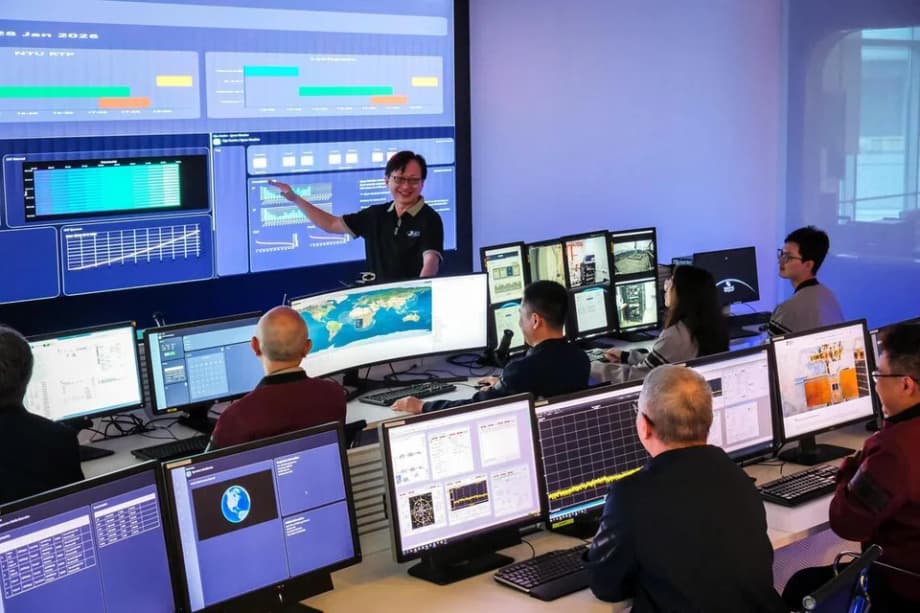
The Satellite Research Centre at Nanyang Technological University leads the project, collaborating with local space technology firm Satoro Space to build the 3U nanosatellite. Measuring just 30 centimeters by 10 centimeters by 10 centimeters and weighing under 5 kilograms, this CubeSat format spacecraft promises to revolutionize how data moves between space and Earth, potentially transforming applications from disaster response to environmental monitoring while demonstrating Singapore’s growing technical autonomy in space systems.
The Intelligence Behind the Mission
Traditional satellites function much like digital cameras with external storage, capturing vast quantities of raw imagery and transmitting everything back to Earth for processing. This approach creates significant bottlenecks that limit operational effectiveness. Satellites in low Earth orbit maintain contact with ground stations for only about 10 minutes during each 100-minute orbital pass, and raw satellite imagery can accumulate to gigabytes daily, straining limited bandwidth and creating delays between image capture and actionable insight.
The new AI-powered satellite addresses these constraints through edge computing, a paradigm that brings data processing directly to the source rather than shipping raw information to distant servers. Onboard artificial intelligence will analyze images in real time, distinguishing between cloud-covered and clear views, identifying urgent events such as forest fires or oil spills, and transmitting only actionable intelligence rather than massive data dumps.
SaRC executive director Lim Wee Seng explained the operational advantages of this approach.
Instead of sending everything back to Earth, the satellite can make decisions on board, filtering, analysing, and transmitting information, not just raw data. This dramatically reduces latency and makes space systems far more efficient. Intelligent satellites can decide what matters on board, ensuring precious space bandwidth is used to deliver answers, not noise.
The practical impact is substantial. Rather than downlinking hundreds of megabytes or gigabytes of raw imagery, the satellite can transmit compact outputs, including key coordinates, image analysis summaries, and selected image snippets totaling just kilobytes or a few megabytes. This efficiency proves crucial for time-sensitive scenarios such as earthquake recovery efforts or maritime disaster response, where rapid decision-making saves lives and resources while communication windows remain brief.
A Trilogy of Innovation
The AI nanosatellite represents just one component of a broader three-project initiative announced by NTU under the Space Access Programme. Each mission targets distinct technological frontiers, with launches scheduled annually between 2026 and 2028, plus an additional payload destined for the International Space Station that will validate Singaporean optical technology in the harsh environment of orbital operations.
Smart Data Processing and Novel Power Systems
The flagship 2026 mission combines artificial intelligence with experimental solar technology. Beyond its edge computing capabilities, the satellite will test next-generation perovskite solar cells, developed collaboratively by NTU’s School of Electrical and Electronic Engineering, the School of Materials Science and Engineering, and local startup Singfilm. These cells offer distinct advantages over traditional silicon panels, being cheaper to manufacture, easier to produce, and printable onto flexible, lightweight substrates that suit small spacecraft where every gram of mass affects launch costs.
Perovskite solar cells utilize organic-inorganic hybrid structures that can be manufactured using simple printing techniques rather than the energy-intensive crystal growth processes required for silicon cells. This manufacturing flexibility allows these cells to be deposited on lightweight, flexible substrates, reducing overall spacecraft mass. The orbital test will provide critical data on how these materials degrade under constant radiation exposure and extreme temperature fluctuations, information necessary before commercial adoption in future satellite constellations.
Maverick Shih, chairman of Satoro Space, emphasized the value of local collaboration in advancing these capabilities.
We are very happy to be a part of NTU’s joint project, as the cooperation between NTU’s Satellite Research Centre and SATORO not only allows us to build up the proven and reliable CubeSat solutions, but also implement the project locally with SaRC in Singapore, which helps Singapore research institutes to develop cutting-edge space technology rapidly.
Advanced Propulsion and Materials Testing
The second project, slated for 2028, will deploy a larger 16U nanosatellite measuring 40 centimeters by 30 centimeters by 30 centimeters and weighing up to 30 kilograms. This spacecraft will test the MUlti-Stage Ignition Compact engine, developed by NTU spin-off Aliena, which uses electric and magnetic fields to ionize gas propellant and accelerate ions for efficient thrust generation. The MUSIC engine represents a gridded ion thruster design that offers high fuel efficiency compared to chemical rockets. By accelerating ions through electrostatic grids, the system achieves specific impulses, a measure of fuel efficiency, several times higher than conventional thrusters. This efficiency allows small satellites to change orbits, avoid debris, or maintain positions using minimal propellant, extending operational lifespans and enabling new mission profiles previously reserved for larger spacecraft.
Dr Lim Jian Wei, co-founder and CEO of Aliena, highlighted the growing necessity for such capabilities as orbital traffic increases.
With the growing number of satellites in low Earth orbit, advanced in-orbit mobility is no longer optional. It opens up new mission possibilities that are critical for emerging space applications and an absolute necessity for satellite constellations to operate effectively and sustainably.
This satellite will also carry an Atomic Oxygen Detector developed by NTU Temasek Laboratories to study how advanced materials withstand highly corrosive atomic oxygen in Very Low Earth Orbit. Atomic oxygen consists of single oxygen atoms created when ultraviolet radiation breaks apart oxygen molecules in the upper atmosphere. These atoms react aggressively with spacecraft materials, causing erosion and degradation. Understanding material durability in this regime proves critical for designing long-lived spacecraft operating at lower altitudes where atmospheric drag is stronger but observation resolution improves.
Next-Generation Optical Imaging
The third initiative will send a Singapore-developed electro-optical imaging payload called LEOCAM to the International Space Station in 2027 for a six-month validation mission. Using a unique triple-mirror optical design rather than traditional lenses, LEOCAM promises high-resolution Earth observation capabilities, with each pixel capturing ground details as small as one meter wide. This mirror-based approach reduces optical aberrations and weight compared to refractive lens systems while maintaining image clarity.
Dr Phua Poh Boon, Chief Technology Officer of LightHaus Photonics, framed the significance for local industry development.
We are excited to test our optical imaging payload on the International Space Station, which will be a key milestone for LightHaus as the first Singaporean company to build a space-based optical system.
Building a National Space Ecosystem
These technological advances occur within a rapidly evolving institutional landscape that restructures how Singapore manages its growing space sector. On April 1, 2026, Singapore will formally establish the National Space Agency of Singapore, consolidating and expanding functions previously handled by the Office of Space Technology and Industry. This new agency arrives as the global space market projects growth to $2.43 trillion by 2035, positioning the city-state to capture value from this expanding economy.
Ngiam Le Na, appointed chief executive designate with 25 years of public service experience including leadership roles at DSO National Laboratories and the Defence Science and Technology Agency, will helm the organization. She has previously overseen the development of Earth observation satellites and digital solutions for national security and disaster relief. The agency inherits responsibility for the Space Technology Development Programme’s S$200 million-plus research allocation while gaining authority to develop national space legislation, coordinate licensing, and foster international partnerships, particularly with emerging space nations across the Equatorial Belt and within ASEAN.
Singapore’s space sector currently comprises approximately 70 companies and 2,000 professionals. With NSAS coordination and sustained funding, officials aim to expand opportunities in geospatial analytics, climate monitoring, maritime surveillance, and space situational awareness. The agency will also address growing concerns about orbital debris and collision risks by developing space situational awareness capabilities to protect assets in an increasingly congested orbital environment.
Professor Warren Chan, Dean of the NTU College of Engineering, connected the university’s efforts to this national strategy.
This new programme reflects how space technologies are evolving towards faster development and smarter operations. With over two decades of experience, NTU has built a strong track record in co-developing and deploying satellite technologies rapidly and cost-effectively. Developing AI capabilities in orbit reduces reliance on ground-based processing and enables quicker, more intelligent decision-making. This is a strategic advantage for Singapore as it builds a more agile and competitive space ecosystem, and it will help our partners bring innovations to market sooner.
From Laboratory to Commercial Application
While the technologies demonstrated in these missions promise immediate research value, full commercialization requires additional development and validation. Lim Wee Seng indicated that bringing the AI satellite’s cutting-edge systems to market will take several years, though the foundation laid by these orbital tests proves essential for attracting investment and validating performance in the actual space environment where radiation, vacuum, and thermal cycling create challenges impossible to fully replicate on Earth.
Singapore enters a field where similar capabilities have already demonstrated viability. The European Space Agency’s PhiSat-1 CubeSat, launched around 2020, pioneered onboard machine learning to filter cloudy imagery, establishing proof of concept for edge computing in small satellites. Singapore’s approach extends these capabilities while integrating novel power systems and fostering local commercial capacity through partnerships between universities and private firms.
Maritime surveillance represents one immediate application domain where onboard AI offers distinct advantages. Monitoring shipping lanes, detecting illegal fishing, and tracking oil spills require rapid alert generation. Current systems often delay critical notifications until ground stations process raw data hours after collection. The Singaporean approach aims to deliver actionable intelligence within minutes of image capture, allowing authorities to deploy response vessels or aircraft while events remain active rather than conducting after-the-fact investigations.
Similarly, climate monitoring applications benefit from selective data transmission. Tracking deforestation, assessing agricultural health, or monitoring urban heat islands generates vast image libraries where only anomalies or changes matter for immediate policy decisions. The AI filtering capability ensures ground teams receive alerts about new forest clearing or crop stress without wading through thousands of routine images showing stable conditions. This targeted approach reduces storage costs and analyst workload while accelerating response times to environmental changes.
The Bottom Line
- Singapore will launch its first AI-powered nanosatellite in 2026, capable of processing and filtering data in orbit to reduce transmission bottlenecks and enable faster response to emergencies
- The 3U CubeSat, built by Satoro Space and led by NTU’s Satellite Research Centre, will test edge computing AI and perovskite solar cells during a one-year mission at 500km altitude
- Two additional projects include a 2028 propulsion system test using Aliena’s MUSIC ion engine and a 2027 International Space Station mission for the LEOCAM optical imaging payload
- The National Space Agency of Singapore launches April 1, 2026, overseeing more than S$200 million in Space Technology Development Programme funding and national space legislation
- The initiatives target a global space market projected to reach $2.43 trillion by 2035, with immediate applications spanning disaster response, maritime surveillance, and environmental monitoring