A 15.4 Trillion Yuan Engine for China's Economy
Solar panels, electric vehicles and battery technology accounted for more than 90% of China's investment growth in 2025, making clean energy a central driver of the world's second largest economy. These industries generated a record 15.4 trillion yuan ($2.1 trillion) in business, equivalent to 11.4% of China's gross domestic product, according to an analysis by the Centre for Research on Energy and Clean Air.
Contents
- A 15.4 Trillion Yuan Engine for China's Economy
- Wind and Solar Reach Their Target Six Years Early
- Electric Vehicles Spread From Cars to Trucks
- Batteries and Grids Become the Next Investment Focus
- Why Coal Construction Keeps Growing
- Chinese Technology Changes Energy Costs Abroad
- Overseas Investment Grows Alongside Factory Oversupply
- Market Rules Change the Pace of Construction
- Climate Diplomacy Meets the Emissions Challenge
- The Essentials
China's clean energy economy now rivals the entire economic output of Brazil or Canada. Treated as a country, it would rank as the world's eighth largest economy and be roughly half the size of India's economy. Its value has nearly doubled since 2022, when it represented 7.3% of Chinese GDP. GDP measures the value of goods and services produced across an economy.
Clean energy contributed more than a third of China's economic growth in 2025, the second time it had done so in three years. Without that expansion, the analysis estimates that the economy would have grown by 3.5%, rather than the reported 5.0%. That would have left growth below the government's target of around 5%.
The boom has helped drive China's recovery after the pandemic, while spreading cheaper energy technology abroad. Yet the same country commissioned 78 gigawatts of new coal power capacity in 2025, its highest annual total in a decade. China is building an increasingly large clean energy system while continuing to expand the fossil fuel infrastructure that officials regard as necessary for reliable electricity.
China's clean energy investment reached $625 billion in 2024, representing 31% of the global total. The scale helps explain why decisions about Chinese factories, electricity grids and energy policy affect both domestic economic growth and the cost of the transition elsewhere.
Wind and Solar Reach Their Target Six Years Early
China's combined wind and solar generation capacity more than doubled between 2022 and 2024, rising from 635 gigawatts to 1,408 gigawatts, according to research from Ember. Capacity describes how much electricity equipment can produce at a given moment under suitable conditions; generation describes the electricity it actually produces over time.
China reached its wind and solar capacity target for 2030 in 2024, six years ahead of schedule. By early 2025, combined wind and solar capacity had surpassed coal capacity for the first time.
China installed 315 gigawatts of solar capacity and 119 gigawatts of wind capacity in 2025. Those additions exceeded the combined additions of the rest of the world, and China's solar installations alone were greater than those outside China.
Electricity production also increased. Solar generation grew 33% compared with the previous year, while wind generation rose 13%. Clean sources met 84% of the growth in electricity demand in 2024. In the first half of 2025, their additional output exceeded the entire increase in demand, allowing fossil fuel generation to fall by 2%.
Those figures describe two connected changes: China is installing equipment rapidly, and the electricity produced by clean sources is increasingly meeting new demand that might otherwise have required more fossil fuel generation.
Electric Vehicles Spread From Cars to Trucks
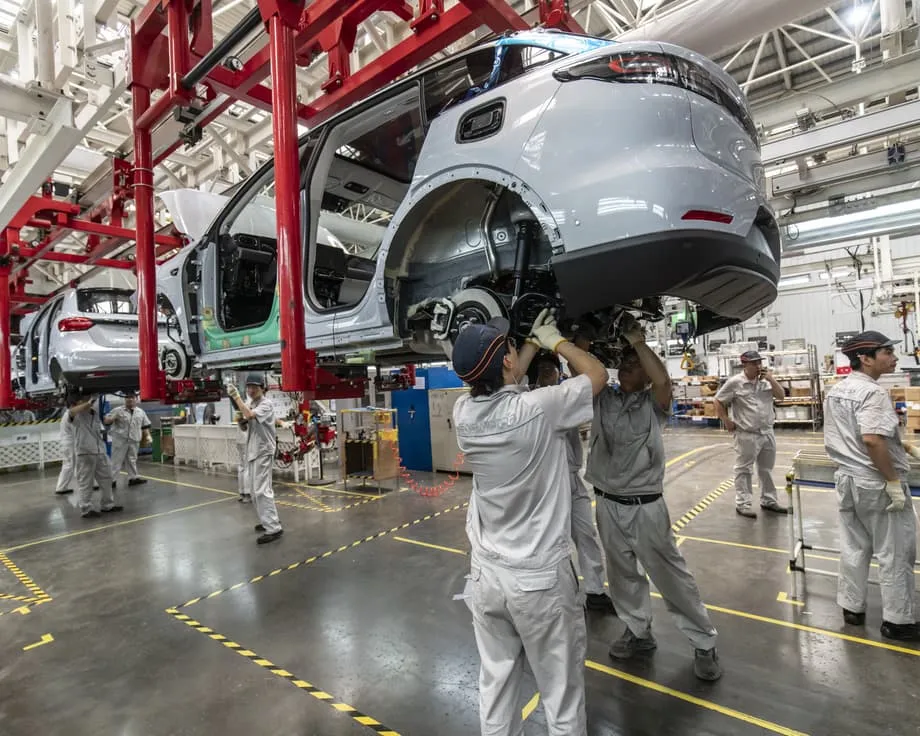
China produced 16.6 million electric vehicles in 2025, an increase of 29% from the previous year. Electric vehicles accounted for 48% of all new vehicle sales during the year, with their share crossing 60% in November.
The change is becoming visible across the existing vehicle fleet. Electric vehicles made up 12% of vehicles on Chinese roads by the end of 2025, compared with just 2% five years earlier. The share was six times its earlier level, although replacing vehicles already in use takes longer than changing the mix of new sales.
Electric trucks are also gaining ground. They captured 23% of the truck market in 2025, up from 8% in 2024. That expansion extends electrification beyond passenger transport into vehicles used by businesses and heavy industry.
Vehicle production, batteries and electricity infrastructure are closely connected parts of the boom. More electric vehicles increase the need for batteries and charging electricity, while battery manufacturing also supplies storage systems that support renewable power.
Batteries and Grids Become the Next Investment Focus
Investment in battery manufacturing rose 35% in 2025 to 277 billion yuan. China added 66 gigawatts of battery storage capacity during the year, accounting for more than 40% of global additions.
Battery storage allows electricity produced at one time to be used later. That is useful for wind and solar power because their output changes with weather and daylight. Storage can help match electricity supply with the hours when homes and businesses need it.
China's grid investment climbed to a record 639.5 billion yuan ($92 billion). Electricity grids move power from generating facilities to users, so expanding generation without sufficient transmission can leave electricity unable to reach the places that need it.
Grid development had lagged behind new generation capacity in recent years. Some western provinces faced renewable energy curtailment rates of 30%, with projects awaiting transmission connections. Curtailment means potential electricity production is reduced because the system cannot take or deliver all the power available.
Beijing has begun shifting investment from expanding manufacturing capacity toward grids and storage. Investment in pumped hydropower and battery storage accelerated sharply, and 15 gigawatts of new pumped hydropower capacity received permits in the first half of 2025 alone. Pumped storage uses electricity to move water uphill, then releases it through turbines when power is needed.
Why Coal Construction Keeps Growing
China commissioned 78 gigawatts of coal power capacity in 2025 despite the rapid growth of renewables. More than 50 large coal units, each exceeding 1 gigawatt, came online. During the previous decade, fewer than 20 units of that size had opened annually.
Developers also submitted proposals for another 161 gigawatts of plants burning coal. Around 290 gigawatts were already permitted or under construction, creating a substantial pipeline alongside China's expanding wind, solar and storage systems.
Energy security concerns help explain the continued construction. Power shortages during droughts in 2021 and 2022 temporarily stopped factory production and led to rolling blackouts. Those experiences reinforced official concern about whether the electricity system could reliably meet demand.
Chinese government advisers describe coal as providing "training wheels" for the renewable transition: backup stability while a stronger clean electricity system develops. The National Development and Reform Commission has stated that coal power will remain essential to electricity system stability for years, even as other energy sources replace it.
Large domestic coal companies, including CHN Energy and Shaanxi Coal and Chemical, also wield considerable political influence. They promote coal as necessary for reliability and energy independence.
Continued construction carries economic risks. Renewable energy already supplies cheaper electricity than fossil fuel alternatives in most settings, and further coal expansion could leave plants unable to earn back their costs while increasing electricity system expenses. Such facilities are often called stranded assets. The unresolved issue is whether the new plants will supply electricity routinely as baseload generation or mainly serve as backup during periods of high demand.
Andreas Sieber, head of political strategy at 350.org, described the transition as a historic turning point and set out his expectation for solar power in 2026.
This is a historic turning point: solar power is set to overtake coal in China for the first time in 2026. This is maybe the clearest demonstration yet that clean energy has won – on cost, scale, and air quality.
Chinese Technology Changes Energy Costs Abroad
Chinese factories produce approximately 80% of the world's solar panels and 60% of its wind turbines. That manufacturing scale has helped drive technology costs down by 60% to 90% since 2010, making equipment more affordable for countries expanding clean electricity.
The International Energy Agency has described the resulting solar electricity as the "cheapest electricity in history". More than 90% of wind and solar projects commissioned worldwide in 2025 produced electricity more cheaply than the cheapest available fossil fuel alternative.
African solar panel imports from China rose 60% over the preceding 12 months, with 20 countries importing record amounts. Affordable Chinese technology has also supported renewable electricity adoption in Mexico, Bangladesh and Malaysia, which have surpassed the United States in that adoption.
Lauri Myllyvirta, lead author of the analysis at the Centre for Research on Energy and Clean Air, described how the spread of solar equipment and electric vehicles was reaching countries where rapid uptake had been less expected.
In a lot of other countries things are accelerating. Many of the African countries have imported a lot of solar. EVs are just starting to be bought in places where no one had an EV breakthrough on their bingo card for last year or maybe not even this decade.
Richard Black, editor of the Ember report, described China's role in changing electricity systems at home and abroad.
China is the engine. And it is changing the energy landscape not just domestically but in countries across the world.
Overseas Investment Grows Alongside Factory Oversupply
Chinese energy engagement through the Belt and Road Initiative reached record levels in 2025, totaling $124 billion in the first half alone. Africa became the largest market, receiving $61.2 billion worth of engagement, an increase of 283% from 2024.
Fossil fuel projects dominated that overseas energy investment. Renewable energy engagement nevertheless reached a new high of $21.4 billion, compared with $12.3 billion in 2024. China's international energy activity therefore included expanding support for renewables alongside substantial fossil fuel projects.
Chinese companies now account for 75% of global patent applications in clean energy technology, up from 5% in 2000. Patents protect inventions, and this concentration of applications points to China's growing role in developing technologies as well as manufacturing them. It suggests China will continue influencing cost reductions and deployment globally.
Solar manufacturing faces a different problem: factories can produce more equipment than buyers currently need. China's annual solar manufacturing capacity reached 1,200 gigawatts by late 2025, against global demand of approximately 650 gigawatts. Factory capacity was therefore nearly twice worldwide demand.
The imbalance has triggered intense price competition. Manufacturers' operating income fell 200% between 2022 and 2024, illustrating the financial pressure behind the shift toward investment in grids and storage. Lower equipment prices help buyers, while making it harder for producers to sustain earnings.
Market Rules Change the Pace of Construction
China changed the economics of renewable development in 2025 by repealing fixed feed-in tariffs. Those tariffs had provided a set price for electricity supplied to the grid. New renewable projects instead had to compete on price against existing coal generation in electricity markets that were still only partly developed.
The policy change prompted developers to bring installations forward, creating a rush before the new arrangements took effect. It also created uncertainty about how quickly renewable construction would grow afterward.
China's recent energy transition can be traced through several connected milestones:
- In 2021 and 2022, drought related power shortages interrupted factory production and prompted rolling blackouts.
- Between 2022 and 2024, wind and solar capacity increased from 635 gigawatts to 1,408 gigawatts.
- In 2024, China met its wind and solar capacity target for 2030, six years early.
- In early 2025, combined wind and solar capacity surpassed coal capacity.
- During 2025, tariff changes prompted an installation rush, while clean energy supplied more than 90% of investment growth.
- In November 2025, electric vehicles exceeded 60% of new vehicle sales.
Grid capacity, storage investment and electricity pricing now sit alongside manufacturing as practical constraints on further growth. China has demonstrated that it can build renewable equipment at enormous scale; moving and selling the electricity from that equipment is an increasingly central part of the transition.
Climate Diplomacy Meets the Emissions Challenge
China's clean energy expansion is taking place as the United States moves in the opposite direction under the Trump administration, eliminating federal support for renewables and promoting fossil fuel exports. Washington has withdrawn from international climate negotiations as a participant and attends as an observer, while Beijing has presented itself as a reliable partner for multilateral cooperation.
European Commission President Ursula von der Leyen led a delegation to Beijing in summer 2025 to coordinate climate policy ahead of the COP30 summit in Brazil. China affirmed that it would work with the European Union toward ambitious outcomes at the conference, even as trade tensions continued over Chinese electric vehicle and battery exports.
China's economic success in clean energy sits alongside a demanding climate assessment. Climate Action Tracker estimates that its current policies would push global heating toward 4 degrees Celsius. Chinese emissions may already have peaked in 2025, but bringing them down fast enough requires a further change in direction.
To align with the Paris Agreement's target of limiting warming to 1.5 degrees Celsius, China would need to cut emissions by 30% by 2035. That reduction is considered unlikely on current trajectories.
As of February 6, 2026, whether China would strengthen its commitments in its revised nationally determined contribution, expected that year, remained unresolved. A nationally determined contribution is a country's climate pledge under the Paris Agreement. The economic weight of clean energy gives Beijing a strong stake in its expansion, while continued coal construction shows the competing pressures shaping its energy decisions.
The Essentials
- Clean energy generated 15.4 trillion yuan ($2.1 trillion) in business in 2025, equivalent to 11.4% of China's GDP.
- The sector supplied more than 90% of investment growth and more than a third of economic growth.
- Without clean energy expansion, estimated GDP growth would have been 3.5%, rather than the reported 5.0%.
- China met its wind and solar capacity target for 2030 in 2024 and added 315 gigawatts of solar and 119 gigawatts of wind in 2025.
- Electric vehicle production reached 16.6 million, while electric vehicles accounted for 48% of new vehicle sales in 2025.
- Grid investment reached 639.5 billion yuan, and battery storage additions totaled 66 gigawatts.
- China also commissioned 78 gigawatts of coal capacity, with around 290 gigawatts permitted or under construction.
- Chinese factories produce about 80% of global solar panels and 60% of wind turbines, while excess manufacturing capacity is putting pressure on earnings.
- A revised Chinese climate pledge was expected in 2026, with its level of ambition still unresolved as of February 6.