The Luffy Candidate and a New Political Language
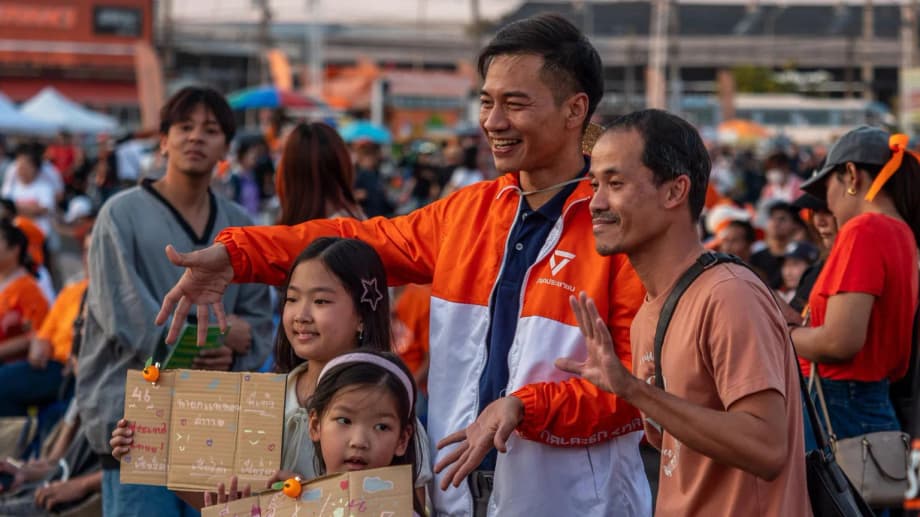
Suttasitt “Macky” Pottasak traverses his rural constituency in Nakhon Ratchasima on an electric scooter, wearing a straw hat that marks him as a disciple of Monkey D. Luffy, the optimistic pirate captain from the Japanese anime One Piece. The 37-year-old former television drama producer creates light-hearted daily videos explaining policy that garner millions of views on social media, a stark contrast to the stiff formality of traditional Thai politics. “Politics is something past generations made boring. I want to make it fun,” Macky explains during a break between visiting wooden houses and irrigation canals in his north-eastern Thai village. “We don’t have money to buy votes. We are just ordinary citizens, but with a strong determination to solve the persistent problems. I think the villagers can see that.”
- The Luffy Candidate and a New Political Language
- From Future Forward to People’s Party: A Cycle of Dissolution
- The Unelected Architecture of Veto Power
- Leadership Candidates Navigating Legal Minefields
- Economic Stagnation Meets Structural Reform
- Rivals, Referendums, and Coalition Calculations
- A Generational Shift in Representation
- What Happens After the Votes Are Counted
- The Essentials
Macky’s campaign style exemplifies the People’s Party’s approach to the February 8 general election. The party has captured the imagination of young and urban Thais through its mastery of social media and pop culture references, while building grassroots networks in rural provinces that were once strongholds of established political machines. In village after village, Macky encounters stories of economic distress: young people leaving for Bangkok or overseas manufacturing jobs, elderly residents left without caregivers as families fragment, and farmers trapped in debt cycles. Thailand’s household debt now ranks among the highest in Asia, while GDP growth has stalled below 2% annually, far behind neighboring Vietnam and Indonesia. Last year, the country’s birth rate plummeted by 10%, the sharpest decline globally, signaling a demographic crisis that threatens to overwhelm the economy.
From Future Forward to People’s Party: A Cycle of Dissolution
Macky represents the third incarnation of Thailand’s progressive reform movement in less than a decade. The journey began in 2019 with Future Forward, founded by charismatic automobile heir Thanathorn Juangroongruangkit, which stunned the establishment by finishing third in its electoral debut. The Constitutional Court dissolved Future Forward in 2020 over campaign finance technicalities, banning Thanathorn from politics for a decade. The party reformed as Move Forward, winning a plurality of 151 parliamentary seats in the 2023 election on a platform promising to break up monopolies, end military conscription, and reform the draconian lese majeste law that criminalizes criticism of the monarchy.
Despite its electoral victory, Move Forward never touched the levers of power. The 2017 constitution, drafted under military rule, granted an appointed Senate the power to join the elected House in selecting the prime minister. Conservative senators, alongside military-aligned parties, blocked Move Forward from forming a government, allowing Pheu Thai to instead assemble a coalition with pro-military parties. In August 2024, the Constitutional Court dissolved Move Forward entirely, ruling that its proposal to amend the lese majeste law amounted to an attempt to overthrow the political system, and banned 11 leaders including former chief Pita Limjaroenrat from politics for ten years.
Within days, the remaining lawmakers regrouped as the People’s Party, a name deliberately evoking the Khana Ratsadon, the People’s Party that launched the 1932 revolution ending Thailand’s absolute monarchy. “The most sacred and enduring institution in a democratic political system is the people, who hold the highest power in governing the country,” the party declared upon its launch, adopting an inverted orange triangle as its logo representing “liberty, equality and fraternity.” Opinion polls now show the People’s Party commanding the support of roughly one-third of the electorate, with recent surveys by Suan Dusit Poll and NIDA placing it substantially ahead of rivals Bhumjaithai and Pheu Thai.
The Unelected Architecture of Veto Power
Winning elections has never guaranteed governing power in contemporary Thailand. The 2017 constitution established what political scientists call an “electoral autocracy” framework, embedding unelected institutions with extraordinary powers to constrain or overrule popular mandates. Although the Senate no longer votes on prime ministerial selections in this election cycle, it retains substantial influence through confirmation powers over Constitutional Court judges and Election Commissioners. These “referee” institutions have repeatedly reshaped the political landscape through party dissolution petitions, disqualification rulings, and the removal of sitting prime ministers.
Over the past three years, the Constitutional Court has sacked two Pheu Thai prime ministers, including Paetongtarn Shinawatra in August 2025 for ethical violations related to a phone call with Cambodian leader Hun Sen. The same court removed her predecessor Srettha Thavisin in August 2024. Siripan Nogsuan Sawasdee, a political scientist at Chulalongkorn University, describes the systematic constraints.
“If Thailand was a functional democracy, none of this would have happened. We have regular elections, sometimes punctuated by military coups. But elections only determine the representatives in the lower house of parliament. They do not determine who governs. That is determined by elite networks, and unelected institutions which have played a veto role against the will of the voters.”
The veto architecture extends beyond the courts. The National Anti-Corruption Commission (NACC) currently investigates 44 former Move Forward lawmakers, including 15 current People’s Party parliamentary candidates, over their 2021 endorsement of a proposal to amend the lese majeste law. This investigation hangs like a sword over the party’s leadership, potentially providing grounds for mass disqualification from politics.
Leadership Candidates Navigating Legal Minefields
The People’s Party has nominated three prime ministerial candidates as a strategic hedge against anticipated legal attacks. Party leader Natthaphong Ruengpanyawut, a 38-year-old former software engineer and IT executive, currently faces investigation in the 44 MPs case alongside deputy leader Sirikanya Tansakun, a 44-year-old economist who spearheaded the party’s budget reform initiatives. Both are among the 25 current MPs named in the NACC inquiry regarding the Section 112 amendment submission.
This legal vulnerability leaves Veerayooth Kanchoochat, the party’s 46-year-old deputy leader for strategy, as the only prime ministerial candidate without active legal cases. An industrial policy expert who taught for eleven years at Tokyo’s National Graduate Institute for Policy Studies, Veerayooth has historically maintained a low profile as the party’s strategic architect. Political observers are watching Veerayooth closely. He is seen as the most likely successor to lead the party after the 44 MPs case concludes. The key question is whether he can rebuild the Orange movement together with remaining leaders free of legal cases.
Thanathorn Juangroongruangkit, the banned founder who remains the movement’s spiritual leader, remains defiant despite the legal siege. “They are afraid of us,” he told the BBC while preparing to join a campaign bus tour. “They are afraid of change. They want tomorrow to be just like yesterday. They think dissolving our parties, banning our leaders from politics, would make us smaller. In fact, we are getting bigger.”
Economic Stagnation Meets Structural Reform
The People’s Party’s popularity stems partly from its diagnosis of Thailand’s structural economic malaise, contrasting sharply with the short-term stimulus packages offered by rivals. While Bhumjaithai promotes co-payment subsidy schemes and Pheu Thai promises a “millionaire-maker” lottery creating nine daily millionaires, the People’s Party has unveiled a comprehensive “Transform Thailand” economic roadmap. The plan phases implementation across the first 100 days, first year, and full four-year term, targeting the bureaucratic red tape and monopolies that stifle competition.
The immediate 100-day agenda includes injecting 250 billion baht in liquidity through targeted credit lines, including 100 billion baht for first home loans and 100 billion baht for digital and AI industrial transformation. The party pledges a “Regulatory Guillotine” operation to eliminate obsolete laws within 18 months, utilizing a unified digital “Biz Portal” to streamline permits and reduce corruption opportunities. Long-term plans include developing “Orange Megaprojects” such as electric bus deployment in 15 major cities and a 10 billion baht upgrade to Ranong Port to enable trade with India.
Professor Apichat Satitniramai of Thammasat University argues that rival parties are “barking up the wrong tree” with stimulus packages that function like increasingly ineffective painkillers. “These stimulus packages are like painkillers, which are less effective the more we use them,” he says. “In his view the People’s Party is the only one thinking long term, rather than just about what is needed to win the election.”
Rivals, Referendums, and Coalition Calculations
The February 8 ballot presents voters with two simultaneous decisions: selecting the 500-member House of Representatives and determining via referendum whether to replace the 2017 constitution. The referendum represents merely the first step in a grueling three-stage process required by the Constitutional Court. A “yes” vote would authorize parliament to begin drafting, but subsequent referenda must endorse the drafting approach and ratify the final text, with the Senate retaining influence over amendment thresholds under Section 256.
Prime Minister Anutin Charnvirakul, leading the conservative Bhumjaithai Party, dissolved parliament in December to preempt a no-confidence vote, positioning himself as a wartime leader during recent border clashes with Cambodia. “I promise you I will protect our soil with my life,” Anutin declared at a Bangkok rally. “If you want a prime minister the enemy cannot intimidate, choose my party.” The 59-year-old political dealmaker has attracted numerous defectors from other parties and cultivated technocratic credibility, aiming to expand substantially beyond the 71 seats Bhumjaithai held in 2023.
Pheu Thai, the populist juggernaut founded by billionaire Thaksin Shinawatra, enters the election diminished after two prime ministers were ousted by courts within two years. Campaigning under the slogan of creating daily millionaires and promising cash handouts, the party has pivoted away from its previous reformist stance toward accommodation with the establishment. Analysts suggest that a post-election coalition between Bhumjaithai and Pheu Thai remains probable, potentially freezing out the People’s Party despite its electoral lead.
A Generational Shift in Representation
Beyond policy platforms, the People’s Party represents a demographic transformation in Thai politics. The movement has attracted unprecedented numbers of young women to candidacies, addressing gender imbalances that have historically marginalized female representation. In the 2023 election, Move Forward led all parties with 36 women elected to parliament, while Pheu Thai followed with 29. The 2026 contest continues this trend, with candidates like Karanic Chantada, a 32-year-old former pharmacist and flight attendant, bringing professional backgrounds distinct from traditional political lineages.
“It’s a new generation, a new paradigm shift,” says Ruengrawee Pichaikul, director of the Gender and Development Research Institute. “The more Thailand democratises, the more women will get involved in politics. If there is a more open society women will have more chances. Compared to military rule this is very, very different.” Young candidates stress that their gender informs their approach to constituent services and policy priorities, including menstrual leave provisions and compassionate care policies in the party’s labor platform.
What Happens After the Votes Are Counted
Even if the People’s Party secures the most seats as polls predict, forming a stable government remains mathematically and politically daunting. No party is expected to win the 251 seats required for an outright majority, forcing coalition negotiations where conservative parties enjoy structural advantages. The People’s Party has ruled out supporting a second Anutin term or joining with the conservative Kla Tham Party, limiting its potential partners primarily to Pheu Thai and smaller progressive factions. Yet memories remain fresh of Pheu Thai’s 2023 betrayal, when it abandoned the reformist bloc to form a government with pro-military parties.
The constitutional referendum adds another layer of uncertainty. Even voter approval merely opens a multi-year process requiring parliamentary supermajorities and further popular votes. Conservative parties including Bhumjaithai have framed constitutional change as partial amendment only, seeking to maintain the Senate’s one-third control over future amendments and protect the military’s political role.
For Macky and his constituents in Nakhon Ratchasima, these institutional abstractions translate into concrete uncertainties about whether their votes will actually deliver change. As he tours rice fields on his e-scooter, the Luffy hat signals both optimism and resistance against seemingly impossible odds. Whether Thailand’s third progressive party in seven years can finally break through the veto architecture, or whether the cycle of dissolution and rebranding continues, will be determined not just by Sunday’s vote count, but by whether the country’s unelected power centers choose to respect the electorate’s verdict.
The Essentials
- The People’s Party leads opinion polls ahead of the February 8 election, representing the third iteration of a progressive movement previously dissolved as Future Forward (2020) and Move Forward (2024).
- The Constitutional Court and National Anti-Corruption Commission present ongoing legal threats, with 44 former MPs including two of the party’s three prime ministerial candidates under investigation that could trigger disqualification.
- Thailand’s economy faces structural challenges including household debt among Asia’s highest levels, GDP growth below 2%, and a declining birth rate that fell 10% last year.
- The election coincides with a constitutional referendum on replacing the 2017 military-drafted charter, though full reform requires three separate referenda and parliamentary approval.
- Conservative Prime Minister Anutin Charnvirakul seeks re-election through his Bhumjaithai Party, campaigning on nationalism and economic stimulus, while former ruling party Pheu Thai promotes populist cash giveaways.
- No party is expected to win an outright majority of 500 parliamentary seats, making post-election coalition negotiations decisive in determining who governs.
- The People’s Party proposes replacing military conscription with voluntary service, breaking up business monopolies, and implementing a “Regulatory Guillotine” to cut bureaucratic red tape.