The Paradox of Record Earnings
China has reached a staggering economic milestone, logging a trade surplus that exceeds US$1 trillion in the first 11 months of the year. This figure represents a historic high for the world’s second largest economy and underscores its dominance in global manufacturing. Yet this financial achievement presents a complex puzzle. While export earnings have surged to unprecedented levels, the growth in China’s official foreign exchange reserves has not kept pace. This discrepancy raises a critical question about the destination of these massive funds.
Trade data typically shows that a surplus accumulates as foreign reserves held by the central bank. In China’s case, however, something different is occurring. The country is earning more from trade than ever before, but these earnings are not showing up in the official reserves managed by the People’s Bank of China. This divergence has prompted economists to examine the changing nature of China’s relationship with the global economy.
Analysts suggest the gap reflects how much of the surplus has flowed back overseas through asset investment, largely driven by private sector players. This leaves China’s external accounts more balanced than the headline trade figures suggest. Han Shen Lin, capstone director for the quantitative finance master’s programme at New York University Shanghai, explains this transformation.
“The trade surplus doesn’t automatically mean a rise in official reserves any more,” Lin said. “What we’re seeing is a shift from state led reserve accumulation to market led capital outflows.”
Lin notes that Chinese firms are actively paying down foreign debt, building overseas assets, or keeping earnings offshore. “The money hasn’t disappeared; it’s just no longer sitting on the People’s Bank of China’s balance sheet.” This trend has accelerated as Chinese companies expand their international presence, driven by narrowing domestic profit margins and excess production capacity that compel them to seek opportunities beyond China’s borders.
An Imbalance of Production and Demand
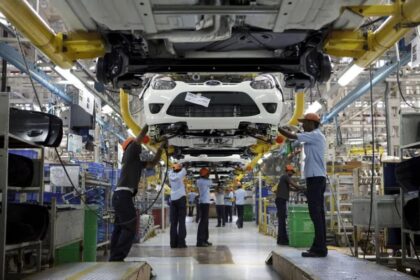
To understand the scale of China’s surplus, one must look at the fundamental imbalance within its economy. China produces approximately 32% of the world’s manufactured goods, yet accounts for only about 12% of global consumption. This structural gap between production capabilities and domestic demand creates an inevitable oversupply of goods that must find markets elsewhere. The result is a massive influx of foreign currency from exports.
This dynamic has characterized China’s economic model for decades, but the scale has become unprecedented. The country’s manufacturing capacity continues expanding even as domestic consumption growth remains relatively modest. Chinese households maintain high savings rates, spending less on goods than consumers in other major economies. This combination of immense productive capacity and restrained domestic purchasing power naturally channels output toward international markets.
The situation is further complicated by the nature of China’s evolving exports. The country has moved beyond low cost manufactured goods toward advanced manufacturing and higher technology products. This shift includes electric vehicles, advanced electronics, and other sophisticated goods that directly compete with products from Western nations. As Chinese manufacturing climbs the value chain, it has triggered protective responses from trading partners concerned about competition in strategic industries.
Deutsche Bank Research highlights that China’s real effective exchange rate has depreciated by roughly 13% over the past two years. This depreciation makes Chinese exports significantly more profitable in international markets compared to domestic sales. For Chinese producers, the financial incentive remains skewed toward exporting rather than selling domestically, even when domestic demand shows signs of recovery.
The Limits of Tariffs and Trade Wars
Tariffs and trade restrictions can dramatically alter bilateral trade relationships, as seen in the case between the United States and China. However, these measures do not necessarily change overall trade balances. The fundamental determinants of trade surpluses and deficits are the balance between savings and investment within each economy, not tariff policies or administrative measures.
Capital Economics points out that despite the trade war, China’s overall exports have remained robust. China’s share of global export volumes has climbed from 12% in 2018 to roughly 18% today. While Chinese firms have lost ground in the US, they have gained it elsewhere. The US trade deficit with China has narrowed, but America’s overall current account deficit remains stubbornly large, running at around $1.2 trillion or roughly 4% of GDP.
This apparent contradiction resolves when examining how the global economy adapts. The US runs persistent trade deficits because its economy combines large fiscal deficits with robust private sector demand. Americans spend heavily on consumption while the government runs budget shortfalls, creating demand that exceeds domestic production capacity. This gap is filled by imports from trading partners worldwide. China’s situation presents the mirror image. High savings rates among Chinese households, combined with relatively subdued domestic consumption, create excess production capacity that naturally flows toward export markets.
Unless these structural factors change, China will continue running large trade surpluses regardless of tariff regimes or political tensions. The global economy has adapted to these realities through complex supply chains that route goods through third countries. Emerging markets have absorbed some of China’s export capacity, acting as intermediaries in the production process.
The Rise of the Global South
China’s trade relationships are evolving rapidly in response to geopolitical tensions and changing economic dynamics. Tariffs imposed by the United States have significantly reduced direct Chinese exports to American markets. Despite this reduction in bilateral trade with the United States, China’s overall exports continue to grow. This apparent contradiction resolves when examining how Chinese goods reach international markets through alternative pathways.
A significant portion of China’s surplus now flows through the Global South, a term referring to developing countries primarily in Asia, Africa, and Latin America. More than half of China’s current trade surplus involves these nations, representing a shift from historical patterns where developed economies absorbed the majority of Chinese exports. The value of trade between China and Global South countries has increased by more than US$200 billion since 2021.
Many Global South economies have functioned as “connectors” between Chinese manufacturing and Western consumers. These countries import intermediate goods from China, add value through processing or assembly, and then ship the finished products to Western markets. This arrangement allows Chinese goods to effectively reach Western consumers while bypassing direct tariffs and restrictions. This connector role creates both opportunities and vulnerabilities for the participating countries. While it generates export revenue and employment, it also establishes dependency on Chinese supply chains.
However, this role is changing. As the West raises barriers to taking Chinese goods, and clamps down on connector trade, the Global South may become more the destination than the conduit for Chinese goods. Global South nations have smaller GDPs but by 2050 will account for some 75% of the world’s population, so there is a logic in assuming they will become core consumer markets for Chinese goods in the coming years.
Potential Economic Paths
Economists have identified three main scenarios that could shape the future of China’s trade surplus and capital flows. The first scenario involves China significantly boosting domestic consumption to better match its production capacity. This would require Chinese households to spend more on domestically produced goods, reducing the need to export such large volumes. Policymakers have pursued this goal for years, recognizing that a more balanced economy would be sustainable in the long term. However, obstacles persist, including deeply ingrained savings habits and a cultural preference for services over goods consumption.
The second scenario sees China increasingly exporting to the Global South as these regions become final destinations rather than transit points. With Global South nations projected to account for 75% of the world’s population by 2050, they represent substantial potential markets for Chinese goods. This path might sustain China’s export machine while developing new consumer bases outside Western markets.
The third scenario involves China shifting production capacity to third countries through overseas investment. This approach follows historical precedents set by other major trading powers. In the 1980s, Japan responded to US trade pressure by building production bases in the United States and Southeast Asia. China appears to be pursuing a version of this strategy today. Chinese companies are investing abroad for various reasons, including circumventing trade barriers, reducing costs, and establishing local service networks. These individual corporate decisions, when viewed collectively, generate significant macroeconomic effects.
Investment data suggests this process is already underway. Emerging markets’ trade surpluses against developed markets have been increasing since 2017, indicating that some countries are stepping in to absorb production that might otherwise flow from China directly to Western markets. This geographical diversification of manufacturing capacity represents a structural change in global trade patterns.
The Bottom Line
- China has recorded a trade surplus exceeding US$1 trillion, but official foreign exchange reserves have not grown proportionately
- Private sector capital outflows, including overseas investment and debt repayment, account for much of the gap between trade surplus and reserve growth
- China produces 32% of global manufacturing but accounts for only 12% of consumption, creating structural export pressure
- More than half of China’s trade surplus is now with Global South countries, representing a shift in trade patterns
- Tariffs have reduced direct China US trade but not overall imbalances, which are determined by savings and investment patterns
- China’s currency has depreciated roughly 13% in real terms over two years, reinforcing export incentives
- China’s overall export share has grown from 12% to 18% of global volumes despite US tariffs