The Crown and the Crisis
Bali stands at a confusing crossroads. In January 2026, the island claimed the top spot in Tripadvisor’s Travelers’ Choice Awards: Best of the Best Destinations, cementing its status as the planet’s most coveted vacation spot. Yet weeks later, Indonesian President Prabowo Subianto delivered a scathing public rebuke that exposed an ugly truth beneath the tropical paradise marketing. The island is drowning in garbage, threatening to undermine the very tourism industry that earned it global acclaim.
The contradiction could not be sharper. While international travelers voted Bali as the world’s premier destination, senior foreign dignitaries were telling a different story to the president. During a recent visit to South Korea, Prabowo encountered ministers and generals who did not mince words about what they had witnessed on the island’s legendary beaches. Their blunt assessment triggered a national crisis that now threatens Indonesia’s tourism crown jewel and has forced the government into emergency action.
Bali recorded 7.05 million foreign tourist arrivals in 2025, representing the highest figure in the past decade. Each visitor generates revenue that supports local economies from Ubud’s rice terraces to Seminyak’s beach clubs. However, this economic success has created an environmental catastrophe that the island’s infrastructure cannot manage. The tourism boom has produced a waste explosion that now washes ashore daily, turning the white sand beaches that appear in travel brochures into landscapes of plastic bottles and food containers.
A President’s Ultimatum
Speaking at the 2026 National Coordination Meeting of Central and Regional Governments in Bogor, West Java, Prabowo transformed what could have been routine policy remarks into a theatrical dressing down of Bali’s leadership. With television cameras rolling and the nation watching, he displayed photographs taken in December 2025 showing Kuta Beach and other tourist areas blanketed with refuse, the golden sand invisible beneath piles of debris that stretched for kilometers.
The president singled out Bali Governor Wayan Koster and regional regents, accusing them of moving too slowly despite having authority over 4.5 million residents. Prabowo did not merely criticize; he issued an ultimatum that blurred the line between civilian governance and military intervention, threatening to deploy troops if local officials failed to mobilize the population for immediate cleanup operations.
I accepted that as a criticism. Indonesia is beautiful. Tourists want to come, but they see slums. They want to go to Bali, but Bali’s beaches are full of trash. How can tourists come if they see such garbage?
The president recounted his uncomfortable conversations in Seoul, where Korean officials spoke with military frankness about the conditions they encountered. They told me, ‘Your Excellency, I just came from Bali. Oh, Bali is so dirty now. Bali is not nice,’ Prabowo relayed to the assembled officials. He stressed that he took these remarks not as diplomatic niceties but as valid criticism requiring immediate correction.
The threat was explicit and unprecedented in its directness. Prabowo warned that if local authorities failed to act within a reasonable timeframe, he would order the district military commanders and regional military commanders to mobilize their troops for daily or multi-day cleanup operations. He declared a war on waste, framing environmental degradation as nothing less than a national emergency threatening Indonesia’s economic future and international reputation.
The Seasonal Defense vs Structural Reality
Governor Koster offered a defense that highlights the complexity of Bali’s waste dilemma while acknowledging the scale of the challenge. He explained that seasonal ocean currents between December and February carry marine debris from outside Bali to the island’s main beaches, creating a situation where cleanup efforts face natural forces beyond local control. The strong currents bring waste from Java and other neighboring islands, depositing it on Bali’s shores faster than crews can remove it.
From December to February, ocean currents tend to be strong, bringing waste from outside Bali, Koster explained. He noted that cleanup operations often take up to three hours after heavy rainfall, creating a frustrating cycle where beaches are cleaned only to be refilled with garbage within hours. The governor pledged to establish a dedicated task force stationed at Kuta Beach specifically to respond to marine debris arrivals, with a target response time of one hour to restore cleanliness.
However, experts point to structural problems that extend far beyond seasonal weather patterns. Bali generates approximately 3,500 tons of waste daily, with plastic comprising 17 percent of the total. Nearly all of the island’s landfill sites have reached maximum capacity, creating a crisis where collected waste has nowhere to go. The Suwung landfill stopped receiving waste in August 2025 after repeated fires and severe accumulation exceeding 30 meters in height, forcing authorities to scramble for alternative disposal methods.
A 2019 study revealed that only around 48 percent of Bali’s waste receives proper management through recycling or landfilling. This management gap results in an estimated 33,000 tonnes of plastic entering the island’s waterways annually, eventually washing up on the beaches that attract millions of visitors. The problem reflects a national crisis, as Indonesia generates 140,000 tonnes of waste daily across its 17,000 islands, with waste handling decentralized under more than 500 regional governments that often lack coordination or resources.
Mobilizing an Island
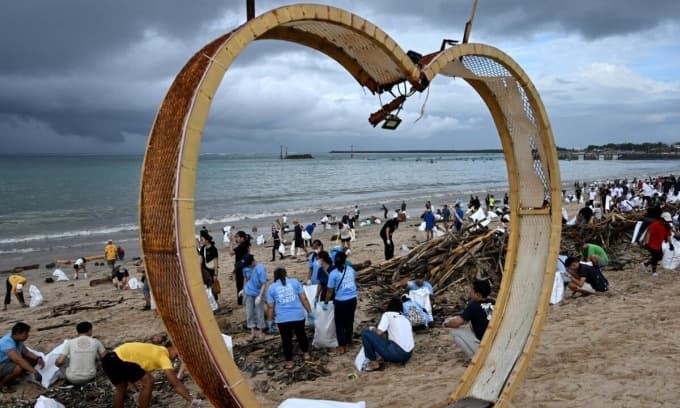
The presidential criticism sparked immediate and visible action across the island. Within days, hundreds of personnel from the Bali Police and local military commands joined students and volunteers to collect trash from Kuta Beach, Kedonganan in Badung Regency, Delod Berawah Beach in Jembrana, and Saba Beach in Gianyar. These coordinated operations removed several tonnes of waste while serving as public demonstrations of government responsiveness.
Bali Police spokesperson Senior Commissioner Ariasandy explained that authorities invited public participation because community involvement remains crucial for preserving marine ecosystems. Today’s activity aims to raise awareness about environmental protection and to create clean, healthy and welcoming beaches for visitors, he said. Keeping the beaches clean not only benefits the environment but also supports economic activity and has a positive impact on tourism.
Prabowo had specifically suggested mobilizing students from elementary through senior high school levels for regular Friday or Saturday cleanup activities, using the authority that regional governments hold over educational institutions. What is so difficult about gathering all the students at the beach on either Saturday or Friday? the president asked. This is our beach, let’s clean it together.
Governor Koster embraced this directive, announcing that the special task force would involve the Environmental Agency, Regional Disaster Management Agency, Education Office, as well as military and police personnel. Vice President Gibran Rakabuming Raka praised Bali’s rapid response, calling on all Indonesian regions to share the island’s spirit and emulate its commitment to environmental cleanliness. Tourism Minister Widiyanti Putri Wardhani announced the expansion of the Clean Tourism Movement to popular destinations nationwide, building on programs initiated in 2025.
The ASRI Movement and National Solutions
Beyond immediate beach cleanups, Prabowo unveiled a broader strategy to address Indonesia’s waste crisis through the ASRI Indonesia Movement. This initiative requires leaders within ministries, agencies, state-owned enterprises, and regional governments to conduct waste collection operations for at least half an hour before beginning their official workdays. The president stressed that this would become a specialized program within his administration, not merely ceremonial gestures or opportunities for mutual blame.
I do not want to see any plastic waste or trash around the offices of state-owned enterprises, Prabowo stated. All officials in ministries and agencies should spend at least half an hour cleaning their surroundings before starting work.
The government is also betting on technological solutions for the underlying infrastructure crisis. Indonesia plans to construct 34 waste to energy incinerators across 34 cities over the next two years, including one in Bali set to begin construction in March 2026 with operations expected the following year. These facilities, each costing between two trillion and three trillion rupiah (approximately $156 million), can burn about 1,000 tonnes of solid waste daily while generating electricity for local grids.
The technology transfers heat from burning garbage to boil water, creating steam that spins turbines to generate power. According to Daya Anagata Nusantara (Danantara), the government’s sovereign wealth fund launched in February 2025, each plant could shrink landfill needs by 90 percent over time while potentially powering mid-sized cities. The fund is working with private sector partners including potentially France’s Veolia Environment and China’s Zhejiang Weiming Environment Protection to develop these facilities.
However, concerns persist about emissions and health risks for communities near incinerators. While modern plants include scrubbers to convert pollutant gases into less harmful substances in closed systems with air controls, emissions cannot be 100 percent contained. Communities near landfills already face severe health burdens, including a 40 percent increased risk of asthma, sevenfold higher risk of dengue fever, and 72 percent increase in diarrhoea from polluted waters according to government data.
Redefining Tourism for Survival
Beyond technological fixes and military mobilizations, Bali is reconsidering who it welcomes through its airport gates. In January 2026, the provincial government proposed regulations requiring international visitors to declare their financial status over the previous three months. This represents the island’s strongest effort yet to curb low-spending tourism and promote a quality tourism model that generates higher revenue per visitor while potentially reducing overall visitor numbers.
The proposal stems from recognition that mass tourism creates proportional mass waste. If Bali cannot manage the garbage generated by 7 million annual visitors, the solution may lie in attracting fewer visitors who spend more money while generating less environmental impact per capita. This shift aligns with broader initiatives launched by Governor Koster in 2025, including bans on single use plastic bags, cups, straws and Styrofoam in businesses, government offices, schools, hotels, restaurants, markets and places of worship.
Private sector initiatives are also emerging to address the crisis at its source. Shiva Industries, a manufacturer of on site rapid composters, has deployed machines that process kitchen and organic waste into compost within approximately 24 hours. These units have appeared in hospitals, airports, and hospitality venues across Bali, aiming to reduce waste volume at the point of generation rather than managing it after it enters the municipal waste stream. The technology focuses on supporting circular economy practices while lowering emissions and cutting disposal costs for businesses.
The coming months will test whether these combined approaches can reverse the damage before the next peak tourist season. For now, the image of soldiers and schoolchildren picking up trash on Kuta Beach serves as a stark reminder that even paradise requires maintenance, and that global accolades mean little when the physical reality contradicts the marketing.
Key Points
- Indonesian President Prabowo Subianto publicly criticized Bali Governor Wayan Koster for slow response to beach waste crisis after receiving complaints from South Korean officials
- Bali recorded 7.05 million foreign tourist arrivals in 2025 despite being named world’s best destination by Tripadvisor in January 2026
- The island generates 3,500 tons of waste daily with nearly all landfills at maximum capacity; only 48 percent of waste is properly managed
- Prabowo threatened military deployment for cleanup operations and declared war on waste if local authorities failed to mobilize
- Bali launched immediate beach cleanup operations involving police, military, students and volunteers at Kuta, Kedonganan, and other beaches
- Governor Koster established a special task force targeting one-hour response time to marine debris, attributing much waste to seasonal ocean currents
- Indonesia plans 34 waste to energy incinerators nationwide over two years, with Bali’s facility starting construction in March 2026
- Provincial government proposed financial declaration requirements for tourists to promote quality tourism and reduce environmental impact