The Death of a Festival: When Tourism Devours Tradition
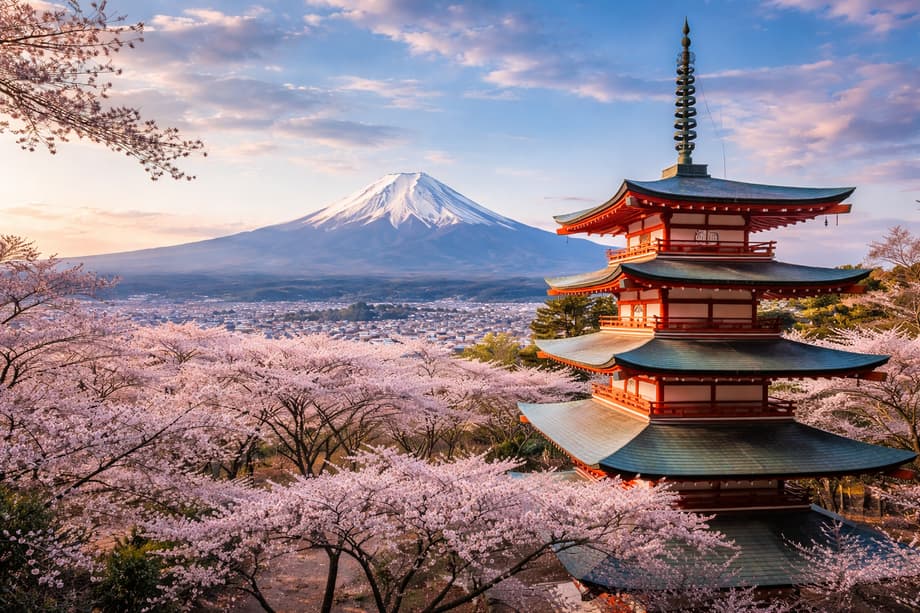
For a decade, the cherry blossom festival at Arakurayama Sengen Park offered what many considered Japan’s most perfect vista: the snow-capped symmetry of Mount Fuji framed by a five-story pagoda and clouds of pink sakura blossoms. This idyllic scene, captured in millions of social media posts, drew up to 10,000 visitors daily during peak season. Yet in February 2026, city officials in Fujiyoshida delivered heartbreaking news. Citing a “strong sense of crisis,” Mayor Shigeru Horiuchi announced the immediate cancellation of the festival, ending a ten-year tradition that had become synonymous with spring in the shadow of Japan’s tallest peak.
- The Death of a Festival: When Tourism Devours Tradition
- Roots of Reverence: Why Sakura Defines Japan
- From Imperial Courts to Public Parks
- Living Monuments: Japan’s Most Sacred Trees
- Shadows and Light: The Warrior’s Flower
- The Global Bloom: Diplomacy in Pink
- The Overtourism Crisis: A Global Pattern
- What Comes Next: Managing the Unmanageable
- Key Points
The decision followed months of escalating tensions between visitors and local residents. Tourism records reveal the scope of the pressure: 42.7 million tourists visited Japan in 2025, shattering the previous record of 37 million set in 2024. The weak yen transformed Japan into a budget traveler paradise, but the influx brought behavioral crises to Fujiyoshida that transcended mere inconvenience. City reports documented tourists trespassing into private homes without permission to use restrooms, defecating in residential yards, and becoming confrontational when confronted by property owners. Parents complained of children being shoved aside on narrow school sidewalks by visitors chasing the perfect photograph. Cigarette butts littered sacred grounds, and chronic traffic jams paralyzed the small city west of Tokyo.
To protect the dignity and living environment of our citizens, we have decided to bring the curtain down on the 10-year-old festival.
The cancellation marks a pivotal moment in global tourism, representing a rare instance where cultural preservation and resident welfare have outweighed economic benefits. While the park remains open, the organized festival with its infrastructure and support will not proceed. Officials plan alternative crowd management measures, including increased security, temporary parking facilities, and portable toilets, but the symbolic message resonates far beyond this single town. Japan has essentially declared that some aspects of its cultural soul are not for sale at any price.
Roots of Reverence: Why Sakura Defines Japan
To understand why cancelling a cherry blossom festival feels like a national wound requires understanding that sakura are not merely flowers in Japan. They are the country’s spiritual heartbeat, cultural DNA rendered in pink and white. The word “sakura” itself derives from ancient agricultural theology. “Sa” refers to the rice paddy god, while “kura” means a seat or vessel. Thus, sakura literally translates to “the seat of the rice god,” reflecting the belief that these trees serve as dwelling places for mountain deities who transform into agricultural gods during planting season.
This spiritual dimension transformed cherry blossoms into sacred entities long before they became tourist attractions. Farmers once traveled to mountain groves each spring to worship beneath the branches, offering prayers for abundant harvests. Many ancient trees remain wrapped in shimenawa, large twisted ropes that designate them as kodama, trees inhabited by kami or spirits. Folklore warns that misfortune befalls anyone who harms these sacred sakura. The Uba-zakura, or Milk Nurse Cherry Tree, allegedly blooms annually on the death anniversary of a wet nurse who sacrificed her life to save a child she cared for, her soul said to live within the bark. Another legendary tree in Wakegori blooms each January 16th, marking the day an elderly samurai committed ritual suicide after his beloved companion tree died, his spirit entering the wood to ensure perpetual blooming.
The Japan National Tourism Organization officially recognizes cherry blossoms as “perhaps the most recognizable symbol of the country and its culture.” This status evolved over twelve centuries of literary, artistic, and philosophical immersion. The flowers embody mono no aware, the Buddhist-informed aesthetic of impermanence, beauty tinged with the sadness of inevitable loss. Unlike other flowers that wilt before falling, sakura petals drop at peak bloom, creating the poetic spectacle of pink snow that has inspired generations of poets from the Manyoshu anthology to Matsuo Basho.
From Imperial Courts to Public Parks
The tradition of hanami, or flower viewing, began not with cherry blossoms but with plum blossoms during the Nara period (710-794 CE). Chinese cultural influence dominated early Japanese aesthetics, making plum blossoms the prestige flower of the aristocracy. However, by the Heian period (794-1185), as indigenous Japanese culture flourished, the focus shifted decisively to sakura. The imperial court developed elaborate rituals for viewing the blossoms, which remained exclusive privileges of the nobility for centuries.
The Edo period (1603-1868) democratized hanami, transforming it from elite pastime to national custom. Tokugawa Yoshimune, the eighth shogun, ordered the planting of cherry trees in Asukayama Park in 1720 specifically for public enjoyment, establishing one of the first municipal hanami spaces. By the 17th century, commoners gathered beneath the blossoms for picnics featuring sake and seasonal foods, a tradition that continues today with companies sending junior employees to stake out prime tarpaulin spots at dawn. The period also saw the creation of the Somei Yoshino variety through the crossing of Edohigan and Oshima cherry species, a cultivar that now dominates Japanese landscapes with its abundant, eye-catching blooms.
Woodblock prints from the era, known as ukiyo-e or “pictures of the floating world,” captured these scenes with artists like Hiroshige and Kiyonaga depicting courtesans, samurai, and commoners alike celebrating beneath the branches. The Library of Congress exhibitions note that these images helped establish sakura as “a particularly Japanese cultural hallmark” recognized internationally by the 19th century. By the Meiji era, Somei Yoshino had spread nationwide, becoming the standard for modern hanami celebrations.
Living Monuments: Japan’s Most Sacred Trees
While Washington DC’s Tidal Basin holds 3,700 cherry trees and draws 1.5 million visitors annually, Japan shelters individual specimens that have witnessed millennia. The Jindai-Zakura in Hokuto City, Yamanashi Prefecture, stands as one of the Three Great Cherry Trees of Japan, estimated at 1,800 to 2,000 years old. Buddhist priest Nichiren allegedly prayed over this tree when it was dying, causing its miraculous recovery and earning it the name “myoho-zakura” or “Saddharma cherry blossom.” With a trunk circumference of 11.8 meters, it became the first tree designated as a national natural monument during the Taisho era.
In Fukushima, the Miharu Takizakura, literally “waterfall cherry tree,” spreads its branches 20 meters east-to-west and 18 meters north-to-south, standing over 12 meters tall. Estimated at over 1,000 years old, it creates the illusion of a pink cascade during late April blooms, drawing thousands who navigate strictly regulated traffic flows to glimpse its magnificence. The Usuzumi Zakura in Gifu Prefecture presents a unique tri-color spectacle: pale pink buds opening to pure white before aging to pale gray just before falling. At over 1,500 years old, it represents one of Japan’s oldest surviving specimens.
The Ishiwari-zakura in Morioka demonstrates nature’s resilience, having taken root in a crack within a boulder four centuries ago and grown so powerful that it split the stone in half. These trees function as living shrines, their physical presence connecting modern Japan to its ancient past in ways that transcend the transient tourism of the Instagram era.
Shadows and Light: The Warrior’s Flower
The symbolism of cherry blossoms carries darker undertones that reveal the complexity of Japanese cultural psychology. The samurai class adopted the flower as their emblem during the feudal era, seeing in the brief, brilliant bloom a mirror of their own existence. The bushido code demanded warriors live with honor and die without fear, viewing their lives as beautiful but temporary. Fallen sakura petals became potent metaphors for samurai dying young in battle, their glory preserved at the moment of death rather than fading through old age.
This symbolism reached its most tragic expression during World War II, when kamikaze pilots painted cherry blossoms on their aircraft and called themselves “cherry blossoms” before suicidal missions. The planes themselves were named Ohka, another word for cherry blossom, and young cadets wore the flower on their uniforms. The imagery represented dying “like beautiful falling cherry petals for the emperor,” transforming the aesthetic of impermanence into a tool of militaristic sacrifice. Understanding this history adds layers of poignancy to modern hanami celebrations, reminding observers that beauty and violence have long intertwined in the Japanese conception of sakura.
Yet the flower transcends these dark associations in contemporary culture. Each April marks new beginnings, the start of the school year and fiscal calendar, when families gather to celebrate renewal and hope beneath the branches. The Japanese Meteorological Agency issues annual sakura forecasts tracked with the intensity of hurricane warnings, as citizens plan pilgrimages to specific trees and parks with military precision.
The Global Bloom: Diplomacy in Pink
The cultural magnetism of cherry blossoms has spread far beyond Japanese shores, creating diplomatic bonds and occasional controversies. The most famous export occurred in 1912, when Tokyo Mayor Yukio Ozaki gifted 3,020 cherry trees to Washington DC as a gesture of friendship. First Lady Helen Taft planted the first two trees on March 27, 1912, fulfilling the decades-long dream of Eliza Scidmore, the first woman on the National Geographic Society board, who had campaigned since 1885 to beautify the reclaimed Potomac River banks. Today, the National Cherry Blossom Festival draws over 1.5 million visitors annually to the Tidal Basin, where the Jefferson Memorial provides a neoclassical backdrop to the pink explosion.
However, the international spread has sparked nationalist debates, particularly in South Korea. During Japan’s colonial rule (1910-1945), Yoshino cherry trees were introduced to the Korean peninsula. Following liberation and the Korean War, anti-Japanese sentiment led to mass cutting of these trees. Modern South Korean ecologists like Shin Joon Hwan have campaigned to replace Yoshino varieties with the “king cherry,” claiming Korean origin for the species. In 2018, South Korea’s National Arboretum genetically analyzed Somei Yoshino trees and removed them from the native plant list, confirming Japanese origin. Yet author Che Sukyoung notes that despite cherry trees existing in Korea for centuries, they appear in no classical Korean literature or poetry, suggesting the culture of appreciation simply never developed indigenously as it did in Japan.
Commercial exports now extend the season globally. Agricultural cooperatives like JA Shonai Midori in Yamagata Prefecture ship cherry blossom branches to Hong Kong, Vietnam, Singapore, and the Netherlands, where they appear during Lunar New Year celebrations and spring festivals. Aucnet, handling these exports, coordinates with growers to adjust bud stages for different climates, sending 170,000 stems in 2025 alone. The varieties bred for maximum beauty and transportability now circulate as global ambassadors of Japanese aesthetics.
The Overtourism Crisis: A Global Pattern
Fujiyoshida’s festival cancellation fits into a worldwide “backlash phase” against unchecked tourism growth. Venice, receiving 25-30 million annual visitors, now charges day-trippers 5 euros for entry during peak periods and limits tour groups to 25 people while banning large cruise ships. Machu Picchu caps visitors at 5,600 daily with timed entry slots and mandatory circuits. Barcelona has restricted short-term rentals, while Rome charges 2 euros to access the Trevi Fountain viewing area.
The economic mathematics of overtourism often fail local populations. While Japan’s hanami season generated approximately $9 billion in 2025 compared to $7.7 billion in 2024, these gains concentrate in airlines and major hotel chains while residents shoulder infrastructural costs. The 2013 Uttarakhand disaster report highlighted how tourism-related construction on fragile hillsides increased vulnerability to catastrophe. In India’s Goa, 10 million domestic tourists overwhelm a state of 1.6 million residents, creating sewage crises and traffic paralysis despite contributing 16.43% to state GDP.
Japan’s crisis intensified specifically because of social media amplification. The Arakurayama Sengen Park view became a viral “bucket list” destination, with influencers and travel bloggers posting the Mount Fuji-pagoda-cherry blossom composition endlessly. This digital word-of-mouth created exponential growth that outpaced infrastructure planning. The phenomenon repeats across Asia, where 315,100 Indian tourists visited Japan in 2025, marking an 80% increase over 2019 levels driven by direct flights and favorable exchange rates.
What Comes Next: Managing the Unmanageable
Japanese authorities have begun implementing aggressive crowd management strategies short of outright cancellation. In 2024, Fujikawaguchiko erected large black barriers at popular Mount Fuji photography spots to discourage unruly behavior, following complaints of tourists blocking pavements and parking illegally. The Japan Tourism Agency promotes dispersal strategies, encouraging visitors to explore lesser-known sakura spots in Tohoku or Hokkaido rather than concentrating in Kyoto and Tokyo.
Technical solutions include real-time digital ticketing systems, mobile apps showing crowd density at major sites, and strict enforcement of behavioral guidelines. The Swadesh Darshan 2.0 initiative in India offers a model Japan may emulate, focusing on sustainable destination development rather than scattered infrastructure projects. Some experts advocate for entry fees at previously free natural sites, creating economic disincentives for mass tourism while funding conservation.
The fundamental challenge remains philosophical: how to share cultural treasures without destroying them. Cherry blossoms represent the paradox of beauty that must be witnessed to be appreciated, yet cannot withstand the weight of millions of footsteps and selfie sticks. The cancellation at Mount Fuji signals that Japan has reached its limit, choosing the dignity of residents and the integrity of sacred spaces over tourism revenue.
As the 2026 sakura season approaches, with forecasts predicting early blooms in Tokyo around March 19-20, travelers will still find ample opportunities for hanami across the archipelago. From Shinjuku Gyoen in Tokyo to the Philosopher’s Path in Kyoto, from Hirosaki Castle to Matsumae Park in Hokkaido, the blossoms will bloom as they have for centuries. Yet visitors must now recognize that these flowers are not merely backdrops for social media posts but living components of a cultural ecosystem requiring respect, distance, and reverence. The fallen petals at Arakurayama Sengen Park may yet prove the most important sakura lesson of all: that some beauty must be protected by limiting access rather than maximizing it.
Key Points
- Japan cancelled the Arakurayama Sengen Park cherry blossom festival near Mount Fuji after 10 years due to overtourism and disruptive tourist behavior including trespassing and sanitation violations
- Record tourism of 42.7 million visitors in 2025, driven by the weak yen and social media popularity, overwhelmed small towns like Fujiyoshida with 10,000 daily visitors during peak season
- Cherry blossoms (sakura) hold deep spiritual significance in Japan, with the name literally meaning “seat of the rice god,” and represent the aesthetic concept of mono no aware (the poignancy of impermanence)
- The tradition of hanami (flower viewing) evolved from 8th-century imperial rituals to public celebrations during the Edo period, centering on the Somei Yoshino variety created through selective breeding
- Individual sacred trees like the 2,000-year-old Jindai-Zakura and the Miharu Takizakura are protected as national natural monuments and believed to harbor kami spirits
- The flowers carry complex symbolism including samurai ethics of brief but honorable life and WWII kamikaze pilot imagery, alongside modern associations with renewal and new beginnings
- Japan joins global destinations like Venice and Machu Picchu in implementing restrictions, with officials erecting barriers at photo spots and considering entry fees to protect cultural sites
- The cancellation reflects a broader shift in global tourism from growth-at-all-costs models to sustainable management prioritizing resident welfare and cultural preservation over pure revenue