The Storage Challenge in a Solar Superpower
When President Xi Jinping announced in December 2020 that China would install 1,200 gigawatts of wind and solar capacity by 2030, the target seemed ambitious. Instead, China reached that milestone in July 2024, six years ahead of schedule. By the end of 2025, combined wind and solar capacity had surged past 1,840 gigawatts, representing 47.3% of the nation’s electrical capacity. The expansion shows no signs of slowing. Between January and May 2025 alone, China added 198 gigawatts of solar and 46 gigawatts of wind. In May specifically, the country installed 93 gigawatts of solar capacity and 26 gigawatts of wind, additions that energy analyst Lauri Myllyvirta noted could generate as much electricity as Poland, Sweden, or the United Arab Emirates, depending on conditions.
This explosive growth has created an unexpected problem. Renewable energy arrives when the sun shines and the wind blows, not necessarily when people need electricity. In 2025, countries worldwide reported record levels of curtailment, or energy-dumping, when grids cannot absorb excess power. Brazil discarded 20% of its solar generation, while Germany, France, and the Netherlands collectively cut 3.9 terawatt hours of renewable production. China now faces the central challenge of storing energy for when it is needed, not just generating more of it.
The battery storage sector grew by 75% in 2025 compared with 2024, yet even this rapid expansion cannot match the scale required. Chemical batteries excel at short-term frequency regulation but face degradation and supply chain constraints when scaled for multi-hour storage. The solution lies in an old technology deployed at new scale: pumped storage hydropower. These facilities act as giant batteries, offering operational lifespans of 70 to 100 years with lower maintenance costs than chemical alternatives and requiring no rare earth minerals.
How Pumped Storage Works: Gravity as a Battery
The mechanics of pumped storage hydropower rely on basic physics. Water weighing thousands of tons sits at elevation in an upper reservoir, storing energy as gravitational potential. When released, the water rushes through turbines connected to generators, converting that potential energy back into electricity. Unlike conventional hydropower dams that rely on river flow, pumped storage systems reuse the same water repeatedly, creating a closed loop that can operate regardless of seasonal rainfall.
During periods of low demand or high renewable output, these plants use excess electricity to pump water from a lower reservoir to an upper one. When demand peaks, the water flows back down through turbines, generating power on demand. This simple gravity-based storage system currently provides more than 90% of all long-duration energy storage worldwide.
Modern plants increasingly employ variable-speed motor generators, allowing operators to adjust power consumption during pumping mode rather than running at fixed rates. This flexibility enables better grid stabilization services. The technology excels at absorbing vast quantities of surplus power and releasing it over hours or even days, making it ideal for balancing intermittent wind and solar generation. While lithium-ion batteries dominate short-term storage markets, they remain expensive to scale for multi-hour discharge durations and degrade with heavy cycling.
China’s geography provides natural advantages. Research indicates that 79% of the country’s pumped storage potential lies in the northwest and southwest regions, where mountainous terrain creates natural elevation differences ideal for reservoir construction. However, engineers have also begun deploying innovative solutions for flatter regions, demonstrating that with sufficient engineering creativity, the technology can adapt to diverse landscapes.
Record-Breaking Projects Reshape the Landscape
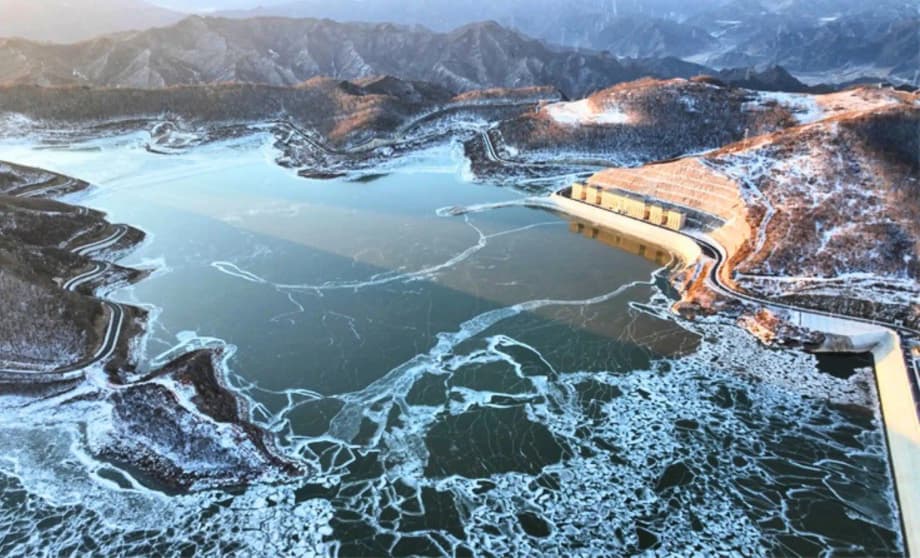
China is not merely building pumped storage plants; it is constructing the largest and most ambitious facilities ever conceived. The Fengning Pumped Storage Power Station in Hebei province, completed in August 2024, stands as the world’s largest such facility. Operated by the State Grid Corporation of China, Fengning features 12 reversible pump-turbine units each rated at 300 megawatts, delivering a total installed capacity of 3.6 gigawatts. The project, which began construction in June 2013, surpassed the previous record-holder, the Bath County station in the United States, and now serves as the cornerstone of northern China’s grid stability. The facility utilizes advanced variable-speed generators in its second phase, rated at 330 MVA in generator mode and 345 MVA in pump mode, allowing precise matching of grid frequency fluctuations.
While Fengning claims the capacity crown, the Zhenjiang (Jurong) Pumped Storage Power Station in Jiangsu province holds the record for the tallest dam of its kind. Commissioned in October 2025, the facility features an upper reservoir dam standing 182.3 meters high, roughly equivalent to a 60-story building and taller than the Statue of Liberty. This engineering feat proved particularly challenging because Jiangsu province is predominantly flat terrain. Engineers used excavated material from the site itself to construct the dam body, creating an artificial elevation difference in the Lunshan valley where nature provided none.
The Jurong plant houses its machinery in an underground cavern 800 meters deep, containing six reversible units of 225 megawatts each for a total capacity of 1.35 gigawatts. The upper reservoir holds 17.07 million cubic meters of water, and the system consumes approximately 1.8 billion kilowatt-hours annually during pumping while generating 1.35 billion kilowatt-hours during discharge. According to Wang Chenhui, director of the Development Department of State Grid Zhenjiang Power Supply Company, the plant provides approximately 2.7 million kilowatts of bidirectional energy regulation capacity, relieving pressure on the electric grid during peak demand periods in the industrial Yangtze River Delta region. Official projections indicate the facility will avoid consumption of approximately 140,000 tons of coal annually while reducing carbon dioxide emissions by roughly 349,000 tons per year, providing power for approximately 360,000 households.
In full operation, it will provide approximately 2.7 million kilowatts of bidirectional energy regulation capacity, relieving pressure on the electric grid during peak demand periods.
Beyond standalone storage facilities, China is pioneering hybrid installations that combine conventional hydropower with pumped storage. The Lianghekou project in Western Sichuan, built at an elevation of 9,842 feet on the Tibetan plateau, represents the world’s largest hybrid system. The facility pairs a conventional 3,000 megawatt hydropower plant with a 1,200 megawatt pumped storage addition, creating a combined 4.2 gigawatt complex. The project integrates with the Yagen Level-1 Hydropower Station serving as the lower reservoir, creating a massive water battery. Excavation for the underground powerhouse, located 1,640 feet beneath the mountain surface, has been completed, with concrete pouring for the lower reservoir now underway.
In Anhui province, the Jixi pumped storage facility has operated since 2021 as a “super power bank” for eastern China. With 1.8 million kilowatts of capacity, the plant has responded to 106 emergency grid demands with a 100% startup success rate. As of 2024, it had generated 2.479 billion kilowatt-hours while reducing annual coal consumption by approximately 216,000 tonnes and cutting carbon dioxide emissions by 475,000 tonnes. The facility achieved an output value of 1.684 billion yuan in 2024, contributing significantly to local economic development while maintaining recognition as a national model project for water and soil conservation.
Geographic Innovation: From Mountains to Coastlines
Traditional pumped storage development focuses on mountainous regions where natural valleys provide ready-made upper and lower reservoirs. In China, the northwest and southwest regions account for 79% of the nation’s total energy storage potential, with Qinghai Province alone contributing 32% of the total. These areas offer the steep elevation changes necessary for efficient power generation. Research utilizing Geographic Information Systems and Digital Elevation Models has identified 532 large existing reservoirs that could support upper reservoir additions, representing a theoretical potential of 9,671 gigawatt-hours. The realizable potential of 8,717 gigawatt-hours is roughly 1.74 times the country’s current planned and reserved pumped storage capacity.
However, China’s energy demand centers on the eastern coastal provinces, where flat terrain historically complicated storage development. The success of the Jurong project in Jiangsu demonstrates that large-scale pumped storage can function even in topographically challenging areas. By creating artificial elevation differences and using underground powerhouses, engineers can now deploy storage infrastructure close to major load centers rather than transmitting power long distances from remote mountains.
Looking toward the future, researchers are exploring seawater pumped energy storage for China’s extensive coastline. This approach uses the ocean as the lower reservoir, eliminating freshwater requirements and competition with agricultural or municipal water needs. A recent study identified approximately 20,000 potential coastal sites with a combined storage capacity of 4,379 gigawatt-hours. Among these, 87 sites exhibit construction costs approaching those of conventional freshwater systems at approximately 949 euros per kilowatt, particularly when utilizing natural coastal depressions that minimize excavation requirements. This technology could prove crucial for integrating offshore wind farms in coastal provinces, offering a scalable framework for coordinated storage and renewable energy development.
Construction Pace and Quality Controls
China’s development speed dwarfs global competitors. As of May 2023, the country operated 50 gigawatts of pumped storage capacity, representing 30% of the global total. By August 2025, installed capacity reached 62.365 gigawatts, surpassing the 14th Five-Year Plan target ahead of schedule. The country currently has 89 gigawatts under construction, with developers seeking approvals for an additional 276 gigawatts. China aims to reach 400 gigawatts by 2035, a figure that would establish pumped hydro as the foundation of the national long-duration storage system.
This acceleration relies on advanced engineering techniques and industrialized construction methods. At the Pingjiang project in Hunan province, engineers employed a variable-diameter tunnel boring machine named Tianyue to excavate a 1,338-meter inclined shaft at a 50-degree angle. This first-of-its-kind machine adjusted its excavation diameter from 6.5 meters to 8 meters while climbing, using a triple-gripping hydraulic interlock system to prevent slippage. The machine measures 87 meters long and weighs 900 tonnes. Its triple-gripping system creates what manufacturer CRCHI describes as an “anti-slip triangular matrix,” allowing the machine to anchor into shaft walls and advance uphill safely by alternating mid and rear grippers every 1.5 meters to maintain continuous counter-thrust. Such innovations allow projects to proceed on accelerated schedules, with some units entering service just 18 months after installation began.
However, the rapid pace has also exposed quality control challenges. In late 2025, the Yongan pumped storage project in Fujian province, a 7.5 billion yuan ($1.06 billion) flagship facility, became embroiled in scandal after reports surfaced of “serious quality defects” in the lower reservoir construction. The National Energy Administration launched an investigation into allegations of substandard materials and sloppy practices at the site, which is a priority project under the national five-year plan covering 2021 to 2025. Power Construction Corporation of China, the parent company of the contractors, established a special investigation group and pledged to address the issues according to laws and regulations. The incident highlights the tension between construction speed and engineering rigor as China races to build out its storage infrastructure.
Global Race for Long-Duration Storage
China’s buildout forms part of a worldwide resurgence in pumped storage development. The International Hydropower Association reports that developers globally are pursuing 570 gigawatts of new pumped storage capacity, with China accounting for roughly 40% of that pipeline. Eddie Rich, chief executive of the IHA, stresses that record levels of renewable curtailment represent a warning sign that generation capacity must be matched by storage infrastructure.
The record levels of curtailment we saw in 2025 are a clear warning sign. The world is building clean generation at a rapid rate, but now that rate must be matched by building the infrastructure needed to use it or to store it.
Rich added, “If we are serious about energy security, energy sovereignty and resilience, pumped storage must be treated as the backbone, not an afterthought.”
Other nations are moving slower due to regulatory and permitting hurdles. In Europe, Germany’s 300-megawatt Riedl project received approval after more than a decade of planning, while Austria’s Limberg III facility entered service in September 2025 following four years of intensive underground construction. The United States has over 90 projects in development, including the 1,200-megawatt Goldendale facility in Washington State, but permitting processes governed by laws from the 1980s mean most will not operate for at least a decade.
The United Kingdom plans to build 10 gigawatts of pumped storage by the mid-2030s, including the 1,800-megawatt Earba project in the Scottish Highlands. These developments aim to absorb surplus wind power and displace expensive gas-fired peaking plants. In the Middle East, Dubai Electricity and Water Authority has begun trial operations at the 250-megawatt Hatta facility, the first such plant in the Gulf region. Featuring an upper dam holding 5.3 million cubic meters and a powerhouse 60 meters underground, the plant supports Dubai’s Net-Zero Carbon Emissions Strategy 2050.
India is pursuing large-scale projects to complement its rapidly expanding solar and wind fleet. The 1,800-megawatt Gandikota project in Andhra Pradesh will use reversible pump turbines supplied by Andritz, while Greenko’s Pinnapuram complex integrates 1,000 megawatts of solar, 550 megawatts of wind, and 1,200 megawatts of closed-loop pumped storage, representing India’s first co-located renewable-plus-storage facility. Australia’s pipeline includes Snowy 2.0, which will add 2,000 megawatts of capacity through tunneling between reservoirs, and the Kidston project in Queensland, which repurposes a former gold mine into a 250-megawatt storage facility.
Pablo Valverde, Deputy CEO of the International Hydropower Association, expressed admiration for China’s progress.
It’s inspiring to see how the first of the renewable energies continues to break new records, support new technologies and come up with new solutions. The hydropower industry is constantly innovating, and we look forward to bringing an international delegation to China to learn more about the latest developments there.
Key Points
- China surpassed its 2030 wind and solar targets six years early, reaching 1,840 gigawatts by the end of 2025, creating urgent demand for energy storage to manage intermittency and curtailment.
- Pumped storage hydropower uses excess electricity to pump water uphill for later release through turbines, providing over 90% of global long-duration energy storage with operational lifespans of 70 to 100 years.
- The 3.6-gigawatt Fengning station in Hebei province is the world’s largest pumped storage facility, while the Jurong station in Jiangsu features the tallest dam at 182.3 meters, proving the technology works even in flat terrain.
- China operates 62 gigawatts of pumped storage capacity with 89 gigawatts under construction, targeting 400 gigawatts by 2035 to support renewable integration.
- Engineers are adapting the technology for diverse geographies, including experimental seawater systems using coastal depressions and hybrid plants combining conventional hydro with storage.
- Quality control concerns have emerged at some projects, including the Yongan facility in Fujian, where investigations found alleged construction defects, highlighting risks of rapid buildout.
- Global developers are pursuing 570 gigawatts of new pumped storage capacity, though China builds faster than Western nations due to streamlined permitting, while other countries face decade-long approval processes.