Broken Promises on the Java Coast
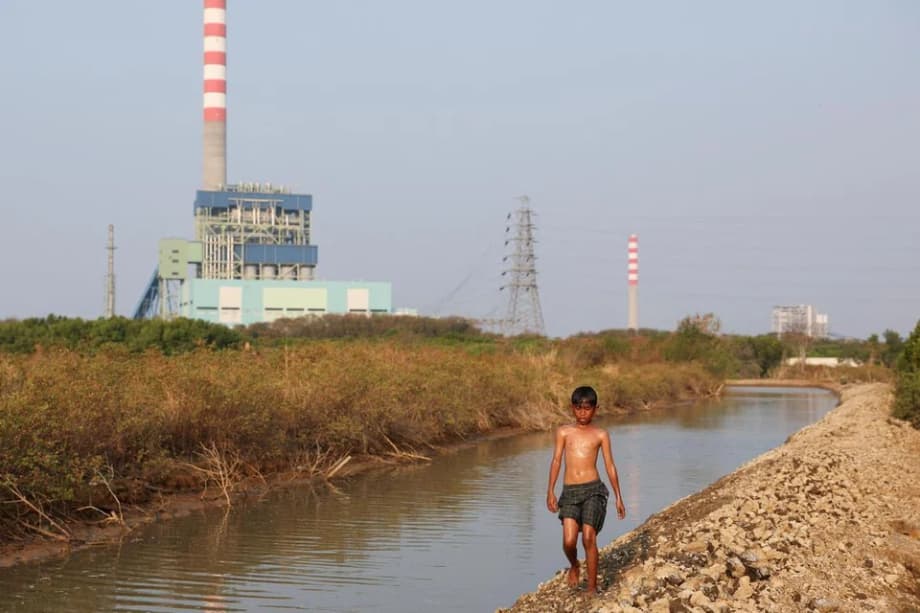
Supriyanto stands on the shore of his fishing village in Cirebon, West Java, staring at the white plumes rising from the 660-megawatt Cirebon-1 coal power plant that dominates the coastline. The facility, operated by Cirebon Electric Power, began generating electricity in 2012 under a 30-year contract that once seemed to guarantee decades of industrial activity. A second 1,000-megawatt facility began operation next to the original plant in 2023, compounding the environmental pressure on the region. The 32-year-old green mussel trader once relied on local fishermen to harvest shellfish from these waters, but those days have vanished along with the marine life. Like many Indonesians, he goes by one name. He questions why the facility must remain in his community.
“There should be goods from our own village, now there are not. Why does it have to be here?”
The Cirebon-1 facility was supposed to enter its final years with a planned closure set for early 2035. This early retirement formed a central pillar of Indonesia’s strategy to reduce dependence on coal power, supported by a $20 billion international financing package announced with great fanfare during the 2022 G20 Summit. The reversal of that decision in late 2024 has sent shockwaves through the community and cast serious doubts on Jakarta’s commitment to its energy transition promises.
For Sarjum, a 46-year-old father of three living in another nearby village, the plant has destroyed his seafood trading business. Hot water discharged from the facility has altered marine conditions, driving fish away from traditional fishing grounds. The father of three explains that he has been forced to seek alternative work to support his family.
“The power plant discharged hot water. So the fish do not come.”
The consortium operating Cirebon Power maintains that all wastewater is expelled in a clear condition at temperatures matching seawater, yet local fishermen tell a different story of declining yields and vanishing livelihoods. Women in the fishing villages who once shucked clam meat for sale now struggle with declining marine yields, representing a silent economic crisis unfolding alongside the more visible smokestack emissions.
The Flagship Deal Unraveling
The Cirebon-1 plant holds historic significance as Indonesia’s first coal-fired power plant owned by an independent power producer. Its selection for early retirement represented more than an environmental milestone; it served as a test case for the Just Energy Transition Partnership, an international framework designed to channel funding from wealthy nations to help emerging economies green their electricity grids. Indonesia became the second country to sign such an agreement, following South Africa, with Vietnam and Senegal later joining the initiative.
The partnership involves a complex refinancing model where the Asian Development Bank pre-pays existing creditors to become the new lender at lower interest rates, conditional on the debtor agreeing to shut down operations after debt repayment. This innovative structure was meant to demonstrate that early coal retirement could be financially viable while protecting investor interests, creating a template for similar transactions across Southeast Asia.
Under the original plan announced at COP28, the Asian Development Bank, Cirebon Electric Power, the Indonesian Investment Authority, and state owned electricity company PLN committed to shortening the power purchase agreement, terminating electricity supply by December 2035, six and a half years ahead of the original July 2042 schedule. The refinancing package was estimated at $230 to $300 million, including compensation for shareholders’ lost future dividends.
However, the partnership has struggled to translate commitments into action. While total funding has grown to $21.8 billion, only approximately $3.4 billion has actually been made available, according to Indonesian government statements. The situation deteriorated further when Washington withdrew from the initiative entirely, leaving Germany and Japan to assume joint leadership roles. Bhima Yudhistira Adhinegara, executive director of the Center of Economic and Law Studies, describes the framework as being in deadlock, partly because partner nations maintain separate energy transition schemes such as Japan’s Asia Zero Emission Community.
“It means that each country is not placing their priority on the JETP itself.”
He suggests the deal requires reformulation with greater emphasis on local community impacts.
Technical and Economic Constraints
Behind the policy reversal lie complex technical challenges and economic anxieties. The Indonesian government announced in December that Cirebon-1 would remain operational, citing its long potential lifespan and supercritical technology, which burns coal more efficiently than older facilities. Officials indicated they would seek to close less efficient plants instead, a decision that reflects deep concerns about electricity prices and grid stability.
Supercritical plants operate at higher temperatures and pressures than conventional coal facilities, achieving greater thermal efficiency and lower carbon dioxide emissions per megawatt hour. However, they still emit significant pollutants and greenhouse gases compared to renewable alternatives. The government’s argument that newer technology justifies extended operation clashes with climate science that demands rapid retirement of fossil fuels to meet global temperature targets.
PLN, the state power utility, faces a regulatory requirement to maintain a 30 percent reserve margin on the transmission grid, a safety buffer that helps absorb demand fluctuations. Retiring Cirebon-1 would necessitate adding various renewable energy sources and investing in energy storage and smart grid technology to ensure smooth integration without blackouts. The Lowy Institute estimates that PLN requires $1.3 billion in infrastructure investment for system upgrades to accommodate renewable integration and ensure long term stability.
Fabby Tumiwa, executive director of the Institute for Essential Services Reform, believes the government feared rising electricity prices because funding for replacement capacity remains uncertain.
“The funds to build infrastructure to replace the coal plant are not all available now.”
This fear of state losses and consumer price hikes appears to have overridden environmental commitments, despite the fact that grid optimization represents an overdue investment in Indonesia’s economic competitiveness rather than a pure cost of closure.
Health and Environmental Costs
While policymakers weigh economic calculations, communities surrounding Cirebon-1 bear the direct costs of continued operations. Many residents report increased respiratory problems since the plant began operating in 2012. Research from the Centre for Research on Energy and Clean Air linked air pollutant emissions from the facility to over 400 deaths annually, though the plant’s owner insists it follows all required emission thresholds.
The CREA study identified particulate matter, sulfur dioxide, and nitrogen oxides as primary contributors to the estimated 400 annual deaths, with vulnerable populations including children and the elderly facing heightened risks of respiratory and cardiovascular diseases. These health burdens fall disproportionately on low income fishing communities that lack access to medical resources or alternative employment opportunities.
The environmental damage extends beyond air quality. In addition to the hot water discharge affecting fish populations, the plant’s presence has disrupted the entire marine ecosystem that once supported local clam and mussel harvesting operations. The combined facilities now discharge thermal effluent and atmospheric pollutants that local residents blame for the disappearance of green mussels and the reduction in fish stocks that once supported dozens of families.
The policy reversal has eroded trust between local communities and the government. Mohammad Aan Anwaruddin, a local activist who has campaigned for the plant’s closure, expressed the prevailing sentiment of betrayal.
“We no longer believe what the government says.”
Yet the situation creates painful divisions within the community. Sopian Suputra, a security guard at the plant, represents the other side of this dilemma.
“I am not a hypocrite. I am the breadwinner, earning my living there for my wife and children.”
His testimony highlights how employment at the facility provides economic stability for some families while destroying the livelihoods of others.
Investor Confidence and Alternative Pathways
The cancellation of Cirebon-1’s early retirement carries significant consequences for Indonesia’s ability to attract private investment in its energy transition. Tiza Mafira, director of Climate Policy Initiative’s Indonesia chapter, warns that because the Cirebon deal was structured around private financing, its cancellation could erode private sector confidence in similar arrangements involving PLN owned plants or independent power producers selling to the state utility.
Dinita Setyawati, Asia energy analyst at Ember, describes the government’s reversal as sending a mixed signal on its commitment to phase out fossil fuels. The move highlights the urgent need for funding to build cleaner alternative power plants that can satisfy Indonesia’s growing energy needs. She suggests that a market led energy transition, including deregulation of electricity distribution and strategic subsidies, might prove more effective than the current partnership model.
Market led transition models would require breaking PLN’s monopoly on electricity distribution, allowing private renewable generators to sell directly to consumers and industrial users. Such deregulation could accelerate solar and wind deployment without requiring massive state investments in grid infrastructure, though it would challenge the existing state owned utility model that has dominated Indonesian electricity since independence.
Despite President Prabowo Subianto’s 2024 commitment to phasing out fossil fuel power plants over 15 years, current trends suggest a different trajectory. State power firm PLN projects 16.6 gigawatts of new coal and gas capacity by 2034, while captive coal plants supplying industrial sites will add another 31 gigawatts, according to CREA studies. This expansion contradicts the rhetoric about phasing out and suggests that without structural reforms to financing and grid management, international climate partnerships may struggle to compete with the immediate demands of energy security and economic growth.
Reforming the Transition
Salvaging Indonesia’s energy transition requires addressing the legal and financial barriers that stalled the Cirebon-1 deal. One critical regulatory issue involves whether the $1.3 billion in grid system costs can be classified as allowable costs under Presidential Regulation 112/2022. Recognizing these infrastructure investments as strategic national priorities rather than state losses would alleviate pressure on PLN and clarify the financial pathway forward.
The Ministry of Finance, Ministry of Energy, and Ministry of State owned Enterprises must issue clear written instructions for PLN to proceed with necessary grid investments. Additionally, the Ministry of Energy should establish a formal Early Retirement Roadmap while PLN integrates closure plans into its Electricity Supply Business Plan, ensuring these measures reflect broader national strategy rather than isolated pilot projects.
International partners must also streamline their competing initiatives. With Japan pursuing its Asia Zero Emission Community, the United States withdrawing from leadership roles, and European nations offering bilateral deals, the fragmentation of climate finance complicates Indonesia’s decision making. A unified approach that prioritizes grid investment alongside plant retirement, while respecting the economic needs of both fishing communities and plant workers, offers the only viable path forward.
For the fishing communities of Cirebon, time is running out. Sarjum vows to continue campaigning for closure, driven by fears for his children and grandchildren’s health.
“I think it is killing Cirebon people slowly.”
As Indonesia weighs its options, the smoke continues to rise over West Java, a visible reminder that energy transitions are not merely technical exercises in grid management and financing, but decisions that determine the survival of communities and the credibility of international climate commitments.
Key Points
- Indonesia reversed plans to close the Cirebon-1 coal plant by 2035, citing technical efficiency and cost concerns
- The plant was a flagship project of the $21.8 billion Just Energy Transition Partnership, which has disbursed only $3.4 billion
- Local fishing communities report destroyed livelihoods from hot water discharge and declining marine populations
- Health studies link the plant to over 400 premature deaths annually from air pollution
- The decision threatens private investor confidence in Indonesia’s energy transition projects
- Indonesia continues planning 16.6 gigawatts of new fossil fuel capacity despite commitments to phase out coal