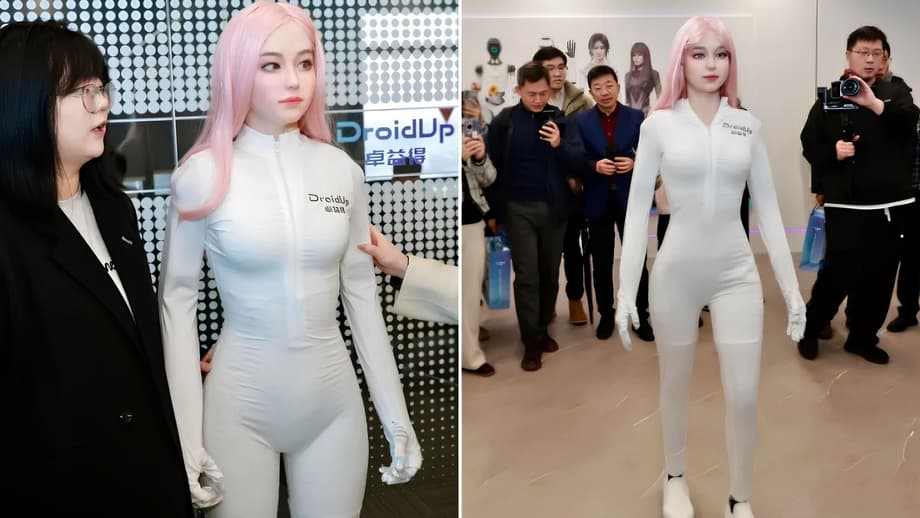
A New Contender in the Humanoid Robotics Race
In the bustling technology corridor of Shanghai’s Zhangjiang Robotics Valley, a striking figure took its first steps into public consciousness on January 30, 2026. Moya, a humanoid robot developed by the startup DroidUp (also known as Zhuoyide), immediately captured global attention through viral videos showcasing movements that blurred the boundary between machine and human. Standing 1.65 meters tall with silicone-based synthetic skin that maintains a body temperature of 32 to 36 degrees Celsius, this 32-kilogram android represents a deliberate departure from the cold, mechanical aesthetic that has dominated robotics for decades.
The unveiling marked a significant milestone in embodied artificial intelligence, a field dedicated to creating machines that perceive, reason, and act within physical environments rather than operating purely as digital entities. DroidUp claims Moya is the world’s first fully biomimetic embodied intelligent robot, a designation that emphasizes its focus on biological mimicry rather than industrial utility. While other manufacturers prioritize strength, speed, or cartoonish designs that avoid human comparison, DroidUp has engineered Moya to cross the uncanny valley, that psychological chasm where near-human appearances trigger discomfort rather than connection.
Engineering Warmth and Movement
Moya’s specifications reveal an engineering philosophy centered on social interaction rather than physical labor. The robot’s proportions mirror those of an average adult human, weighing approximately 70 pounds while incorporating a skeletal structure covered in soft materials that replicate the feel of underlying fat and muscle tissue. Perhaps most distinctively, Moya maintains a thermal profile between 89.6 and 96.8 degrees Fahrenheit, a feature inspired by research indicating that humans subconsciously use temperature to gauge kinship and emotional connection during physical contact.
Li Qingdu, founder of DroidUp, articulated this design philosophy in an interview with Shanghai Eye.
A robot that truly serves human life should be warm, almost like a living being that people can connect with.
This thermal regulation serves both psychological and practical purposes, positioning Moya as a potential caregiver or companion in settings where emotional comfort proves as valuable as functional capability.
The robot’s locomotion system achieves what DroidUp describes as 92 percent accuracy in replicating human walking posture. This metric, while difficult to verify independently, suggests that Moya has overcome much of the jerky, mechanical gait associated with earlier humanoid prototypes. The movement capabilities stem from the robot’s “Walker 3” chassis, an evolution of the Walker 2 platform that secured third place in Beijing’s first humanoid robot half-marathon in April 2025. This foundation incorporates tendon-driven systems and lightweight lattice muscle materials that enable fluid motion while improving heat dissipation and operational endurance.
Facial expression capabilities further distinguish Moya from industrial humanoids. The robot’s head features 25 degrees of freedom, allowing for subtle micro-expressions including smiles, nods, winks, and eye contact that tracks human faces through camera systems positioned behind the eyes. These movements are not pre-programmed animations but dynamic responses generated by artificial intelligence processing real-time sensory inputs, creating the impression of genuine emotional engagement during conversation.
Understanding Embodied Intelligence
The concept of embodied artificial intelligence represents a paradigm shift from traditional robotics. While conventional AI systems process information within server farms or respond through screens, embodied AI integrates intelligence directly into physical forms that learn from and adapt to real-world environments. Moya exemplifies this approach through sensor arrays that capture visual, auditory, and tactile information, feeding data into machine learning algorithms trained on extensive datasets of human behavior.
This technological architecture allows Moya to generate responses that feel intuitive rather than scripted. When a person approaches, the robot can turn its head, establish eye contact, and offer a subtle smile that mimics natural human greeting behaviors. The system processes these interactions through neural networks potentially inspired by biological nervous systems, though DroidUp has remained guarded about specific technical specifications.
The modular design of Moya’s bionic platform allows for customization of external appearance without altering the underlying mechanical structure. DroidUp has indicated that the robot can be configured with different gender characteristics and aesthetic presentations, suggesting applications ranging from educational settings where approachability matters to healthcare environments where trust and comfort are paramount. This flexibility addresses a growing recognition in robotics research: the physical appearance of service robots significantly impacts user acceptance and emotional response.
Target Markets and Commercial Strategy
DroidUp has positioned Moya for sectors where prolonged human-robot interaction forms the core value proposition rather than heavy lifting or precision manufacturing. The company identifies healthcare facilities, educational institutions, elder care centers, and commercial service environments as primary deployment opportunities. This targeting reflects a calculated bet that emotional labor, companionship, and social engagement represent more sustainable markets for humanoid robots than warehouse automation or industrial assembly.
In healthcare applications, Moya’s warm skin and expressive face could address isolation and loneliness among elderly patients, providing medication reminders, physical therapy assistance, and conversational engagement without the fatigue or emotional strain experienced by human caregivers. Educational settings might deploy customized Moyas as tireless tutors capable of adapting lesson presentations based on student emotional cues detected through facial recognition and eye tracking.
Commercial environments such as train stations, banks, museums, and shopping malls represent intermediate deployment scenarios where Moya could serve as an information concierge, offering route guidance and consultation services with a level of interpersonal warmth impossible to achieve through touchscreen kiosks or conventional automated systems. This positioning aligns with broader industry trends recognizing that service economy automation requires social intelligence alongside mechanical capability.
Navigating the Uncanny Valley
Public reaction to Moya’s debut has split between fascination and unease, highlighting the persistent challenge of the uncanny valley effect first identified by roboticist Masahiro Mori in 1970. This phenomenon describes the emotional response wherein entities that appear almost human trigger feelings of eeriness or revulsion rather than empathy. Social media users commenting on demonstration videos have described Moya as “walking like a ghost” or suggested that her movements resemble those of a person walking in uncomfortable heels, noting the slight mechanical stiffness that betrays her artificial nature despite the 92 percent accuracy claims.
These mixed responses illustrate the gamble DroidUp has made in pursuing hyper-realism rather than stylization. Many robotics companies deliberately employ cartoonish features, exaggerated proportions, or clearly mechanical aesthetics to avoid triggering uncanny valley responses. DroidUp, however, appears to be betting that pushing through to the other side of the valley, achieving sufficiently convincing human mimicry, will ultimately yield greater acceptance and emotional connection than avoidance strategies.
The debate extends beyond aesthetics into ethical territory. As robots achieve greater realism in appearance and behavior, questions emerge regarding emotional dependency, privacy concerns related to the data collected during intimate interactions, and the potential displacement of human workers in care professions. DroidUp’s emphasis on healthcare and elder care applications raises particular ethical considerations given the vulnerability of populations in these settings.
Pricing and Timeline for Market Entry
Commercial availability for Moya remains scheduled for late 2026, with pricing estimates varying across reports. The South China Morning Post cites a starting price of approximately 1.2 million yuan, equivalent to roughly $173,000 or £127,000. This premium positioning reflects the sophisticated biomimetic technology and targeted professional applications rather than consumer household markets. Some sources suggest alternative pricing tiers or leasing models might emerge, with one report indicating figures closer to $9,000, though this appears inconsistent with the hardware specifications and likely represents currency conversion errors or distinct commercial arrangements for bulk institutional purchases.
At the reported $173,000 price point, Moya enters the market as a specialized tool for institutions with substantial budgets for patient care or customer service enhancement, rather than a mass-market consumer product. This positioning places DroidUp in competition with other high-end service robots while distinguishing Moya through her emphasis on emotional realism over purely functional capabilities.
The company’s background provides context for these ambitions. Founded in 2023 and based in Shanghai, DroidUp emerged within China’s rapidly expanding robotics ecosystem, benefiting from significant investments in artificial intelligence and automation technologies amid global competition for dominance in embodied intelligence. The startup’s progression from earlier Walker prototypes to the current Moya platform demonstrates iterative engineering focused on improving human likeness rather than pursuing headline-grabbing athletic feats or industrial strength metrics.
What to Know
- Moya is a 1.65-meter tall, 32-kilogram humanoid robot unveiled by Shanghai-based startup DroidUp on January 30, 2026, at Zhangjiang Robotics Valley.
- The robot maintains a body temperature of 32-36 degrees Celsius through synthetic skin designed to feel warm and lifelike during human interaction.
- DroidUp claims Moya achieves 92 percent accuracy in replicating human walking posture through an upgraded “Walker 3” chassis with tendon-driven systems.
- Facial capabilities include 25 degrees of freedom enabling micro-expressions, eye contact maintenance, and dynamic emotional responses powered by embodied AI.
- Target applications include healthcare, elder care, education, and commercial service environments rather than industrial or domestic labor.
- Expected market launch is set for late 2026 with reported pricing around $173,000, positioning Moya as a premium solution for institutional care and service roles.
- Public reaction has been divided between admiration for the technical achievement and unease related to the uncanny valley effect, with some viewers describing the robot as unsettlingly realistic.