An Unwelcome Guest Takes Root
Japan’s pristine waterways and productive farmlands face a growing ecological threat from an invasive species known as alligator weed (Alternanthera philoxeroides). This tenacious plant, native to South America, has been steadily spreading across the country since its first documented appearance in 1989. Today, it has been confirmed in Tokyo and 30 prefectures, causing significant damage to agriculture, increasing flood risks, and threatening native ecosystems. The Japanese government has recently strengthened countermeasures against what experts describe as one of the fiercest and most damaging invasive species.
- An Unwelcome Guest Takes Root
- The Invasion History of a Fierce Competitor
- Agricultural Damage and Economic Consequences
- Ecological Threats and Disaster Risks
- Efforts to Combat the Invader
- Government Response and Future Directions
- The Importance of Public Awareness and Cooperation
- Looking Ahead: Challenges and Opportunities
- Key Points
On December 1, officials discovered alligator weed growing along a path beside a rice paddy in Tatebayashi, Gunma Prefecture, marking the first confirmed instance of the plant in the wild in that prefecture. The plant had already spread across several square meters, highlighting its rapid expansion capabilities. The Gunma Agricultural Technology Center quickly removed the plant using herbicides and established monitoring protocols to ensure complete eradication.
“As we have feared, the invasive alien species has made an incursion into the prefecture,” said Tomoji Arai, section chief at the Gunma Agricultural Technology Center.
The Invasion History of a Fierce Competitor
Alligator weed first entered Japan through ornamental trade routes, brought from overseas as decorative aquatic plants before being released or escaping into natural environments. The Environment Ministry reports that the weed was first found growing wild in Japan in Amagasaki, Hyogo Prefecture, in 1989. Since then, it has gradually spread across western Japan and has now reached eastern Japan as far as southern Fukushima Prefecture.
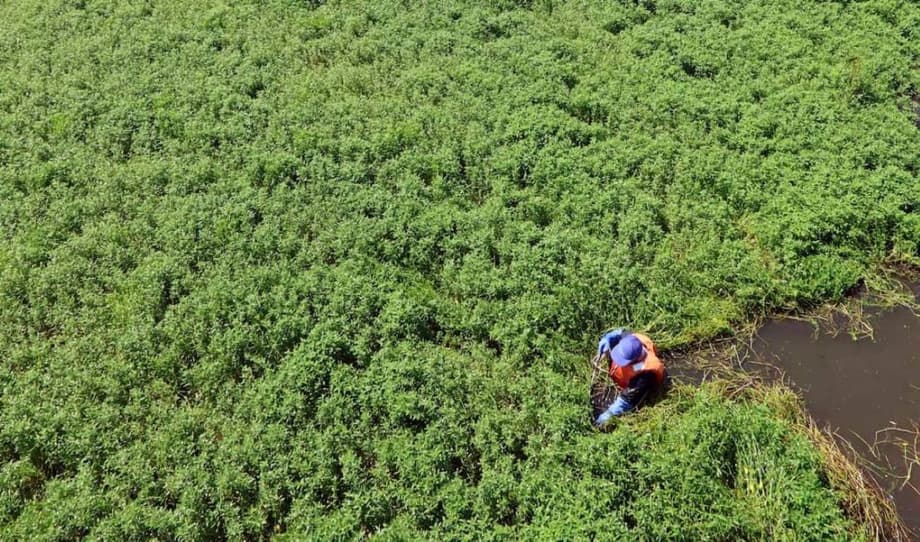
The plant’s successful colonization of new territories stems from its remarkable biological adaptations. Alligator weed is a perennial, drought-resistant species that extends its stems both on land and in water while branching extensively. As it grows, the plant intertwines to form dense mat-like clusters on water surfaces. Its stems typically grow to 0.5 to 1 meter in length and possess a distinctive straw-like vascular system that contributes to both its structure and resilience.
What makes alligator weed particularly formidable is its reproductive strategy. The stems break easily, and even small fragments just a few centimeters long can take root and establish new plants. This vegetative reproduction allows the species to spread rapidly, especially when stem fragments are carried to new locations by sticking to farm machinery, shoes, or other objects. The plant can also overwinter in warm regions or water, with below-ground stems and roots serving as the primary overwintering structures in frost-prone areas.
In recognition of its threat potential, alligator weed was designated as an invasive alien species when Japan’s Invasive Alien Species Law went into effect in 2005. This legal classification reflected growing concerns over the plant’s detrimental effects on both ecosystems and agriculture.
Expansion Patterns and Current Distribution
The geographic spread of alligator weed has followed a concerning pattern over the past three decades. After its initial detection in Hyogo Prefecture, the species steadily expanded throughout western Japan before making inroads into eastern regions. As of December 2024, it had been detected in 26 prefectures south of the Tohoku region, according to Japan’s National Agriculture and Food Research Organization (NARO).
The expansion has accelerated in recent years, with first-time discoveries in previously unaffected prefectures raising alarm among agricultural officials. In Iwaki, Fukushima Prefecture, a resident spotted the suspicious weed in a waterway of a rice paddy and reported it to authorities in June. After analysis by NARO confirmed it as alligator weed in early August, the prefecture swiftly issued an alert calling for comprehensive extermination efforts.
The Fukushima prefectural government has chosen not to disclose the exact location of the discovery to prevent curious visitors from potentially spreading the species to other regions through tiny plant pieces attached to their clothes. This precaution underscores the extreme ease with which alligator weed can disperse to new territories.
“We need to rein in the spread. Otherwise, the weed could do tremendous harm,” said an official with the Fukushima prefectural pest control center.
Agricultural Damage and Economic Consequences
Alligator weed poses a direct and severe threat to Japan’s agricultural sector, particularly rice cultivation. In southern Ibaraki Prefecture along the Shin-Tonegawa river, the plant has spread widely across watershed areas, establishing itself not only around rivers but also in agricultural irrigation canals that transport water to fields. These irrigation networks, essential for rice farming, have become unwitting vectors for the spread of alligator weed into agricultural lands.
The impact on individual farmers can be devastating. In autumn of last year, alligator weed completely covered a rice field owned by Masahiro Kayanuma, a 65-year-old farmer in Kawachi, Ibaraki Prefecture. The infestation prevented him from harvesting approximately 700 square meters of rice, as his farm equipment could not operate in the weed-choked field. Kayanuma had attempted to prevent the invasion by spraying commercially available herbicide before planting rice seedlings and even placing a net over the water inlet from an irrigation canal, but these measures proved insufficient.
“Tiny parts of the stems may have slipped through the mesh of the net into the fields. The herbicide wasn’t effective, either,” Kayanuma explained. “The plant has such high reproductivity that farmers can’t cope with them on their own.”
Similar stories have emerged from other affected regions. A rice farmer in Chiba Prefecture described an “endless battle” against the unfamiliar weed that started growing in his fields several years ago. No matter how much he removes them, they continue to grow back, threatening his livelihood. In rice paddies, alligator weed competes directly with rice plants for nutrients, water, and sunlight, reducing yields. The plant can also twine around rice stalks, causing them to fall over and making harvesting operations nearly impossible.
Chiba Prefectural Governor Toshihito Kumagai emphasized the scale of the challenge during a meeting with other governors, noting that it would cost more than ¥20 million to eliminate the plant just around the Akita River. With limited local budgets, securing funding from the central government and establishing effective elimination methods have become priorities for affected prefectures.
Broader Economic Impact on Local Communities
The economic burden of alligator weed extends beyond individual farms to affect entire local economies. As part of a broader invasive species crisis, the damage inflicted by this plant and other non-native species represents a significant challenge to Japan’s agricultural sector and food security. Over the past two decades, citizen groups and local governments have undertaken extermination activities to the best of their ability, yet no fundamental solution has been found.
Aquatic plants like alligator weed are shaking up Japanese society more than most other invasive species. When they invade rice paddies, they sink their roots deep underground, reducing rice yields and causing rice plants to topple over. They even interfere with the operation of combine harvesters during the autumn harvest, creating economic losses that compound across the agricultural season.
Ecological Threats and Disaster Risks
Beyond agricultural damage, alligator weed poses serious ecological threats and increases disaster risks in Japan’s waterways. The plant grows in dense clusters in rivers and canals, clogging drainage systems and creating potential flood hazards. During Typhoon in September 2015, drainage systems at Inbanuma lake in northern Chiba Prefecture designed to divert water to a nearby river to prevent flooding became clogged with alligator weed, forcing an emergency shutdown. While this incident did not result in flooding, it required emergency removal operations and highlighted the dangerous potential for increased flood risks during extreme weather events.
Alligator weed also proliferates extensively in Teganuma lake, part of the Tonegawa river system in Chiba Prefecture. The prefectural government has been leading efforts to remove the plant from this important water body, but faces significant challenges in achieving lasting results.
“No matter how many times we remove them, they just grow again. It’s a game of cat and mouse,” said a local official involved in managing agricultural water in the region.
From an ecological perspective, alligator weed forms dense mats that can drive out native species by outcompeting them for resources and space. These mats alter the physical and chemical characteristics of aquatic ecosystems, reducing biodiversity and changing habitat conditions for fish, insects, and other aquatic organisms. In Shiga Prefecture, a colony of alligator weed took root and clogged drainage pipes on Lake Biwako, demonstrating its ability to disrupt even large, important water bodies.
The plant’s ability to thrive both on land and in water makes it particularly dangerous to Japan’s varied landscape. Unlike many invasive species that are limited to specific habitats, alligator weed can establish populations in wetlands, rivers, lakes, irrigation canals, rice paddies, and even terrestrial environments with sufficient moisture. This ecological versatility greatly expands the range of ecosystems at risk and makes containment strategies more complex.
Efforts to Combat the Invader
Japanese authorities have implemented various strategies to combat alligator weed, though challenges remain at every turn. Traditional control methods have included manual removal, mechanical harvesting, and herbicide applications. In Saga Prefecture, local workers remove the weeds using heavy machinery, dry the plants, and then incinerate them to ensure complete destruction and prevent regrowth from plant fragments.
However, these approaches have proven largely ineffective at achieving long-term eradication. The plant’s ability to regenerate from tiny stem fragments makes manual removal particularly difficult, as any pieces left behind can establish new infestations. Similarly, mechanical cutting often results in spreading the plant rather than controlling it, as chopped fragments are carried by water currents to new locations where they can take root.
Chemical control through herbicides presents its own challenges. Many commercially available herbicides have limited effectiveness against alligator weed, as discovered by farmers like Masahiro Kayanuma who tried standard products without success. The plant’s waxy leaves and robust vascular system can reduce herbicide absorption, while its ability to regenerate from underground parts allows it to survive treatments that kill only above-ground vegetation.
Scientific Breakthroughs in Control Methods
Amid these challenges, researchers have made important advances in developing more effective control strategies. NARO, in collaboration with the Chiba Prefectural Agriculture and Forestry Research Center and the Kanagawa Prefectural Agriculture Technology Center, has developed a novel approach to controlling alligator weed in rice paddies. This breakthrough utilizes a sequential application of specific herbicides at critical growth stages.
The new method involves applying a pyraclonil-based herbicide immediately after rice transplanting. Approximately 20 days later, when the alligator weed begins to regenerate and reaches a height of 5 centimeters, a florpyrauxifen-benzyl-based herbicide is applied. Alternatively, about 40 days after transplanting, when the alligator weed is 35 centimeters or shorter, the florpyrauxifen-benzyl-based herbicide can be applied as a second option.
This systematic approach effectively reduces alligator weed growth to less than 10% of conventional levels without requiring manual weeding during the rice growing season. Perhaps most importantly, two consecutive years of sequential application can eliminate below-ground stems and roots, preventing regrowth in previously infested fields. By preventing the formation of propagules, this technology not only mitigates the impact of alligator weed in rice fields but also helps prevent its further spread through irrigation systems.
The scientific community has also contributed to understanding and prioritizing the management of alligator weed through research on invasive species risk assessment. Studies using weed risk scoring systems have helped characterize higher-priority invasive species based on scores correlated with lifeform, growth rates, reproductive traits, and impacts on social, environmental, and agricultural assets. These assessments consistently identify aquatic species causing damage to water flow and quality, like alligator weed, as top priorities for management.
Government Response and Future Directions
Recognizing the severity of the alligator weed threat, the Japanese government has been increasing funding and developing new strategies for management and eradication. The Environment Ministry allocated ¥500 million in subsidies to municipalities working to eradicate the plant and other invasive species under the fiscal 2025 budget. For fiscal 2026, it has requested ¥1.4 billion in the preliminary budget, representing a substantial increase in resources dedicated to this problem.
These funds support various control and prevention initiatives across affected prefectures. Beyond direct eradication efforts, the government is investing in innovative approaches to combat the spread of alligator weed. The Environment Ministry, in collaboration with the Agriculture, Forestry and Fisheries Ministry and other agencies, is advancing surveillance of the plant using artificial intelligence with image recognition capabilities. This technology promises to improve early detection and rapid response to new infestations before they become established.
Research into more effective pesticides continues, with scientists seeking compounds that can target alligator weed’s unique biological vulnerabilities while minimizing impacts on rice crops and non-target species. The government is also exploring integrated management approaches that combine chemical, mechanical, and biological control methods tailored to specific environmental conditions and infestation levels.
At the local level, prefectural governments have implemented their own control measures and awareness campaigns. In Fukushima Prefecture, officials have asked farmers to place fine-meshed nets on water inlets of rice fields and to thoroughly clean their agricultural equipment to prevent the spread of plant fragments. They have also urged farmers to use herbicides rather than weed cutters, as mechanical removal can disperse stems and roots, allowing the plant to spread further.
The Chiba prefectural government offers subsidies to remove weeds, but acknowledges that much more funding is needed to address the problem comprehensively. The disparity between the scale of the problem and available resources represents a significant challenge for effective alligator weed management.
“Alligator weed poses a significant threat in various areas, including ecosystems and agriculture. We must prevent it from spreading,” said an Environment Ministry official, emphasizing the urgency of the situation.
The Importance of Public Awareness and Cooperation
Effective management of alligator weed requires cooperation beyond government agencies and scientific institutions. Public awareness and citizen engagement play crucial roles in preventing the spread of this invasive species. Agriculture remains the main industry in many affected prefectures, making early detection and reporting by farmers essential for protecting crops and livelihoods.
Experts emphasize three cardinal principles for preventing damage by invasive species: “don’t introduce,” “don’t discard,” and “don’t spread.” Unfortunately, these rules have not been fully adhered to in the past. With the expansion of international logistics, various invasive species have entered Japan by hitching rides on imported cargo. In the case of alligator weed and other aquatic plants, they were likely introduced intentionally as ornamental species before being released or escaping into natural environments.
Fukushima prefectural officials are calling on the public to immediately report sightings of suspicious weeds. This rapid reporting system allows for quick identification and response before infestations become unmanageable. The prefecture’s pest control station has issued alerts for all-out efforts to exterminate the invasive plant, recognizing that early intervention is critical for effective control.
Citizen groups have also formed to combat alligator weed in affected areas. Members of a citizens’ group working to remove alligator weeds from Teganuma Lake in Chiba Prefecture note that cooperation with administrative bodies is essential, as eliminating the weeds by hand does not help much due to their ability to regenerate from tiny fragments. These grassroots efforts demonstrate the important role that concerned citizens can play in invasive species management.
Looking Ahead: Challenges and Opportunities
While significant progress has been made in understanding alligator weed and developing control methods, substantial challenges remain. The plant’s biological characteristics make it exceptionally resilient and adaptable, allowing it to withstand various eradication efforts. Its capacity for vegetative reproduction through small stem fragments means that incomplete control can actually spread the infestation rather than reduce it.
Climate change may further complicate management efforts, potentially expanding the suitable habitat for alligator weed and lengthening its growing season. Warmer winters could allow the plant to overwinter more successfully in regions where it was previously limited by cold temperatures, while increased frequency of extreme rainfall events could enhance dispersal through waterways.
Despite these challenges, there are reasons for cautious optimism. New herbicide technologies developed by NARO offer promising tools for controlling the plant in agricultural settings. Advances in artificial intelligence and remote sensing may improve detection and monitoring capabilities. Increased government funding reflects growing recognition of the problem’s severity. Public awareness campaigns are educating citizens about how they can help prevent the spread of invasive species.
The experience with alligator weed in Japan also contributes valuable lessons for global invasive species management. As one of the “worst invasive plants on earth,” the strategies developed to combat it in Japan may inform efforts in other countries facing similar invasions. International cooperation and knowledge sharing will be essential for addressing the global challenge of invasive species in an interconnected world.
While complete eradication of alligator weed from Japan may be unrealistic given its widespread distribution and biological resilience, focused management efforts can reduce its impact on agriculture, ecosystems, and infrastructure. Through scientific innovation, strategic resource allocation, and public cooperation, Japan can work toward containing this formidable invader and protecting its natural resources and agricultural heritage.
Key Points
- Alligator weed is an invasive plant species from South America first detected in Japan in 1989
- The plant has been confirmed in Tokyo and 30 prefectures, with recent expansions into Fukushima and Gunma Prefectures
- It threatens rice production by competing with crops and making harvest operations impossible
- The plant increases flood risks by clogging drainage systems in rivers, lakes, and irrigation canals
- It forms dense mats that displace native species and reduce biodiversity in aquatic ecosystems
- NARO has developed a new sequential herbicide treatment that can eliminate below-ground stems and roots
- The Japanese government increased funding for eradication from ¥500 million in fiscal 2025 to ¥1.4 billion in fiscal 2026
- Public cooperation is essential for early detection, reporting, and prevention of spread
- Climate change may potentially expand the suitable habitat for alligator weed in Japan