A Diplomatic Clash Beneath the Waves
Tensions between China and Taiwan have escalated following a public accusation by Beijing that two Taiwanese nationals orchestrated a smuggling operation involving a vessel that damaged a critical undersea communications cable in February. The incident, which severed a link connecting Taiwan’s main island to the Penghu Islands, has become the focal point of a fierce disinformation battle. Chinese authorities claim the damage was an accident caused by smugglers evading capture, while Taiwan maintains it was a deliberate act of “grey zone” warfare designed to pressure the democratic island.
The public security bureau in Weihai, located in China’s eastern Shandong province, announced that an investigation into the incident revealed the involvement of two Taiwanese men identified only by their surnames, Chien and Chen. According to Chinese state media, these individuals were operating the Togo-registered vessel, the Hong Tai 58, as part of a long-running syndicate smuggling frozen goods into China. Beijing has used this finding to counter Taiwan’s allegations that the Chinese government was responsible for severing the cable as a form of hybrid warfare.
China’s Taiwan Affairs Office accused Taiwan’s governing Democratic Progressive Party of falsely claiming that Beijing had used the Hong Tai 58 to deliberately sabotage an undersea cable off the island in a bid to stir cross-Strait confrontation.
This narrative clash highlights the increasing volatility in the Taiwan Strait, where infrastructure incidents are rapidly becoming proxy battlegrounds for broader geopolitical disputes.
The February Incident and Legal Fallout
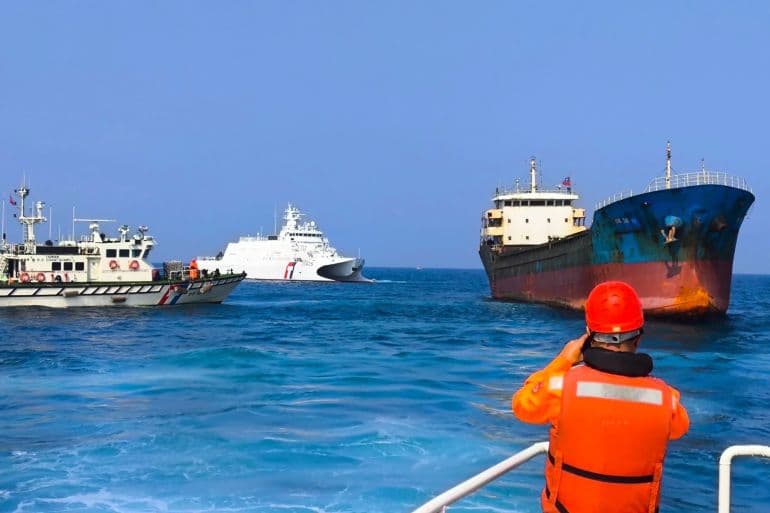
The controversy centers on events that unfolded in the early hours of February 25, 2025. Taiwan’s Coast Guard detected the Hong Tai 58 lingering near the TPKM-3 undersea cable, which connects the Penghu Islands with Taiwan proper. The vessel, reportedly dilapidated and sailing under multiple names, was crewed entirely by Chinese nationals. Despite Coast Guard warnings to leave the area, the ship dropped anchor. Shortly after the vessel began to move, operators detected a break in the cable.
Taiwanese authorities intercepted the ship and escorted it to port for investigation. While the seven other crew members were eventually returned to China without charge, the captain, identified by his surname Wang, stood trial. In June, a Taiwanese court sentenced Wang to three years in prison after finding him guilty of intentionally damaging the cables. The court noted that the damage seriously interfered with government and societal operations, warranting severe condemnation.
During the trial, the captain initially denied the charges but eventually admitted he “might have broken the cable.” He claimed rough waters forced him to drop the anchor without realizing the location of the infrastructure. Prosecutors, however, presented evidence suggesting intent. They pointed to electronic charts on the ship that clearly marked the cable’s location and noted the vessel’s suspicious movement patterns. The Coast Guard testified that rather than circling the anchor as is typical, the ship had dragged its anchor straight across the seabed in a zigzag pattern.
The Smuggling Accusation
Months after the sentencing, Chinese authorities released their own findings. The Weihai public security bureau stated that interviews with the returned crew members confirmed the ship was engaged in smuggling. According to this account, the vessel severed the cable accidentally while trying to evade Taiwanese law enforcement. Beijing has gone as far as to offer a reward of 250,000 yuan, roughly $35,500, for information leading to the capture of the Taiwanese ringleaders, Chien and Chen, who they claim have been wanted since 2014.
Taiwan’s Mainland Affairs Council swiftly rejected these claims. They argued that the Chinese Communist Party does not have jurisdiction over Taiwan and dismissed the announcement as a tactic of “cross-border repression and political manipulation.” The Council urged Beijing to provide concrete evidence rather than engaging in public relations campaigns.
The Strategic Threat of Undersea Cables
To understand the gravity of this dispute, one must look at the infrastructure involved. Undersea cables are the physical backbone of the modern internet. These fiber-optic lines laid on the ocean floor carry nearly 99 percent of the world’s international data traffic. From financial transactions to military communications, global society relies heavily on these fragile links.
Taiwan is particularly vulnerable due to its geography and political isolation. An island nation of 23 million people, Taiwan depends on just 24 subsea cables, 14 international and 10 domestic, to maintain connectivity with the outside world. Damage to these cables can have immediate and severe consequences.
In early 2023, Chinese-registered vessels severed two cables supplying Taiwan’s Matsu Islands, knocking residents offline for weeks. This incident served as a wake-up call for Taipei, demonstrating how easily physical isolation could be achieved. While backup systems like satellite links exist, they provide only a fraction of the capacity needed for a modern economy. During the Matsu outage, backup microwave systems restored only about 5 percent of the lost bandwidth.
Vulnerabilities and Repair Challenges
Global statistics show that cable damage is not uncommon, with 100 to 200 faults occurring annually. Most are accidental, caused by fishing nets, ship anchors, or natural disasters. However, proving intent is notoriously difficult. This ambiguity creates a perfect environment for “grey zone” tactics, a term referring to coercive acts that fall below the threshold of armed war but still apply significant pressure.
Adding to the danger is the limited global capacity for repair. There are only about 80 vessels globally dedicated to maintaining and expanding this infrastructure. When a cable is damaged, repairs can take weeks or even months, especially if specialized ships are occupied elsewhere or if weather conditions are poor. In regions with geopolitical tensions, access for repair ships can be further delayed by regulatory hurdles or direct interference.
A Pattern of Suspicious Incidents
Taiwanese officials and international security experts argue that the February incident is not an isolated event but part of a disturbing pattern. Since 2023, there have been at least 11 cases of subsea cable breakdowns around Taiwan. While some were attributed to equipment aging or accidents, the frequency and timing have raised alarms.
In January 2025, shortly before the Hong Tai 58 incident, another vessel named the Shunxin 39, allegedly damaged the TPE cable north of Taipei. Taiwanese authorities noted that many of the ships involved in these incidents fly “flags of convenience,” registered in countries like Mongolia, Cameroon, or Sierra Leone to avoid scrutiny, despite being owned or funded by Chinese interests.
This pattern mirrors events in Europe. Since the Russian invasion of Ukraine, the Baltic Sea region has seen a sharp increase in undersea cable damage. In November 2024, a Chinese vessel, the Yi Peng 3, was suspected of severing cables connecting Finland, Germany, Lithuania, and Sweden. These incidents suggest a coordinated strategy where infrastructure is targeted in a deniable manner to signal resolve without triggering a full-scale military response.
Technological Capabilities
Concerns are further fueled by reports of China developing specialized equipment for such operations. Researchers at China’s Lishui University have designed an anchor-like device explicitly intended to sever submarine cables. Maritime security experts note that this device is optimized for depths beyond typical fishing activity and features that indicate a sabotage purpose rather than commercial use.
Taiwan’s Coast Guard has also intercepted Chinese research vessels allegedly gathering seabed data near cable routes. This activity suggests an effort to map the precise location of critical infrastructure for future targeting.
Taiwan’s Defensive Measures
Recognizing the severity of the threat, Taiwan has shifted its defense posture. What was once treated as a bureaucratic issue is now a national security priority. The government has stepped up patrols in the Taiwan Strait, particularly around known cable routes.
Reports indicate that Taiwan’s Coast Guard is now conducting 24-hour surveillance near critical infrastructure. An automated alert system detects vessels moving slowly within a one-kilometer range of sensitive cables. Dozens of radar operators monitor the waters, ready to dispatch patrol boats to intercept suspicious vessels. Taiwan has blacklisted 96 China-linked boats for close monitoring and is tracking nearly 400 others that could potentially pose a threat.
Jenson Chien, a commander of a coast guard flotilla near the damaged TP3 cable, described the suspicious vessels as “cannon fodder, piles of scrap metal.” He noted that these ships employ minimal resources to disrupt connections, causing maximum unrest.
International Cooperation
Taiwan is also seeking to bolster its resilience through international partnerships and domestic investment. The government is exploring the acquisition of its own dedicated cable repair ship to reduce reliance on foreign vessels, primarily based in Japan and Singapore, which can take months to arrive. Taipei is also investing in satellite-based internet alternatives, such as low-Earth orbit (LEO) constellations, to provide emergency backup for essential services.
Furthermore, Taiwan is sharing intelligence with “like-minded” capitals regarding the real-time locations of suspicious vessels. This cooperative approach aims to expose the opaque ownership structures often used to hide the origins of the ships involved in these incidents.
Global Implications
The situation in the Taiwan Strait serves as a warning for the rest of the world. As geopolitical tensions rise, critical infrastructure becomes a legitimate target. The undersea cable network is the circulatory system of the global economy, and it is largely undefended.
Security analysts warn that similar tactics could be deployed in other contested regions, from the South China Sea to the Arctic. The difficulty of attribution makes it an attractive weapon for state actors seeking to coerce adversaries without starting a war. A coordinated attack on multiple cables could cripple a nation’s economy and military command structure before a single shot is fired.
The disconnect between China’s public stance and its actions adds to the uncertainty. While Beijing dismisses these incidents as “common maritime occurrences,” the simultaneous development of cable-cutting technologies and the aggressive maritime posture suggest a more calculated strategy. For Taiwan, the message is clear: its digital lifeline is precarious, and its physical security is inextricably linked to the health of cables lying miles beneath the ocean surface.
The Bottom Line
- China has accused two Taiwanese men of running a smuggling operation involving the vessel Hong Tai 58, which damaged an undersea cable in February.
- Taiwan sentenced the Chinese captain of the vessel to three years in prison, ruling the damage was intentional.
- Undersea cables carry 99 percent of international data, making them critical yet vulnerable infrastructure.
- Taiwan reports at least 11 cable incidents since 2023, viewing them as “grey zone” warfare tactics by China.
- Global repair capacity is limited, with roughly 80 dedicated vessels available worldwide.
- Taiwan has increased patrols and blacklisted 96 China-linked vessels in response to the threats.
- Similar cable sabotage tactics have been observed in the Baltic Sea following Russia’s invasion of Ukraine.