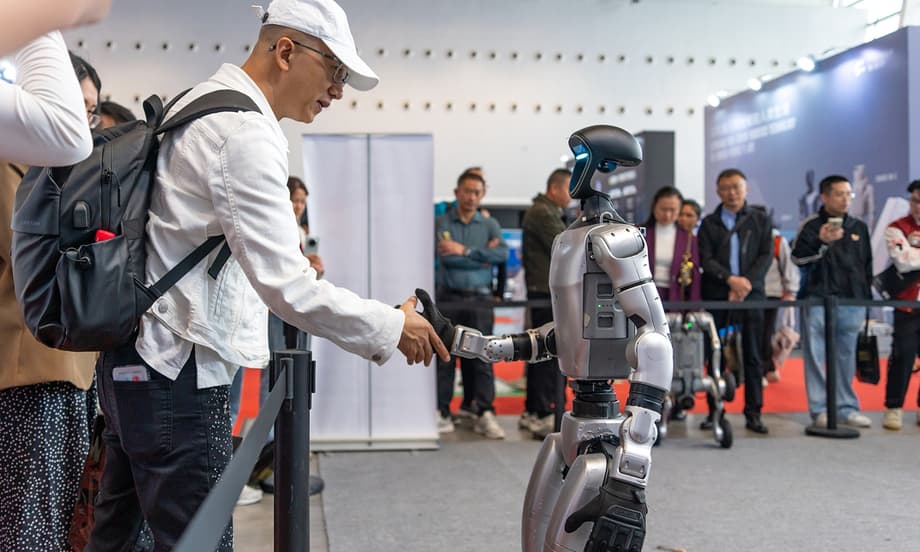
A Viral Performance That Stunned the World
On a December evening in Chengdu, six humanoid robots took the stage alongside pop superstar Wang Leehom, executing synchronized backflips that left more than 100,000 concertgoers in awe. The performance quickly transcended the stadium walls, capturing global attention when Tesla CEO Elon Musk reposted the footage on social media with a single word: “Impressive.” This moment marked another milestone in China’s rapidly advancing robotics industry, showcasing capabilities that seemed like science fiction just months earlier. The robots, developed by Hangzhou-based Unitree Robotics, demonstrated unprecedented precision and coordination, signaling a new era in humanoid technology.
The concert video spread rapidly across social media platforms, igniting discussions about the state of robotics development worldwide. Just days later, another video from Unitree went viral, showing a robot mirroring a human engineer’s fighting movements with remarkable precision before delivering what viewers jokingly described as a “vicious” kick toward its human counterpart. Musk responded to this clip with a laughing-crying emoji, marking the second time in a month he had commented on Chinese-made humanoid robots.
These performances are not merely entertainment spectacles. They represent tangible progress in the field of embodied intelligence, where machines gain physical capabilities that increasingly mirror human dexterity and agility. For the first time, the public witnessed humanoid robots performing movements that many humans cannot execute, highlighting how quickly the gap between biological and artificial motion is closing.
The Rapid Evolution of Chinese Robotics
The contrast between recent performances and earlier demonstrations is stark. At the first World’s Humanoid Robot Games in Beijing earlier this year, some robots struggled to complete a 400-meter run without veering off course or falling. Just eleven months before the Chengdu concert, during China’s Spring Festival Gala, humanoid robots stood stiffly while tossing handkerchiefs, appearing more like toddlers learning to walk than capable machines.
Li Qingdu, executive dean of the Institute of Machine Intelligence at the University of Shanghai for Science and Technology, explained the significance of this progression. “These shows allow the public, perhaps for the first time, to intuitively grasp how far humanoid robots have come in dynamic control, and how those capabilities can be packaged in controlled environments into highly shareable outcomes.”
The pace of development has accelerated dramatically. Unitree Robotics has continuously upgraded its motion-control system, reaching version 6.0 by October 2025—the same system used in the December concert performance. A Unitree representative explained that the eye-catching somersaults were the direct result of these latest improvements, demonstrating how incremental engineering advances can produce spectacular results.
This evolution extends beyond Unitree. Several Chinese robotics firms, including EngineAI and DroidUp, have achieved synchronized multi-robot stage performances using multi-agent control technologies. DroidUp Robotics collaborated with human performers earlier this year at a Peking Opera performance, where robots replicated traditional opera footwork and physical bearing with human-like facial expressions, sparking widespread discussion about cultural preservation through technology.
Technical Specifications of the G1 Robot
The Unitree G1 robot that took the stage stands approximately 1.32 meters tall and weighs 35 kilograms, yet it packs formidable capabilities. Equipped with between 23 and 43 joint motors, it delivers a maximum joint torque of up to 120 newton-meters, enough power to support complex, high-difficulty movements like flips and kicks. This compact design positions the G1 as an affordable alternative to more expensive international competitors, with Unitree listing the base model at roughly $12,000 to $16,000.
Critical to its performance is enhanced group coordination capability. The millisecond-level synchronization of six robots was made possible by a distributed control system supported by 5G and edge computing. Amid intense lighting, smoke, and close interaction with human dancers, the robots relied on multimodal perception systems, integrating vision, inertial sensing, and force feedback to maintain stable performance.
Technical specifications reveal the sophistication of these machines. Launched in May 2024, the G1 combines agile mechanical design with AI-driven control, featuring a large range of motion across its numerous joint motors. Onboard perception is enabled by 3D LiDAR and depth cameras, supporting real-time spatial awareness and navigation. The robot uses imitation learning and reinforcement learning frameworks to adapt and improve its motion repertoire over time, while force-controlled dexterous hands give it potential for fine manipulation capabilities.
Engineering the Robot “Cerebellum”
Behind the rapid maturation of motion control lies a fundamental engineering challenge: computational division of labor. The “brain” handles perception and planning, while the “cerebellum” translates high-level intent into high-frequency, real-time joint control signals, managing dynamics, balance, and disturbances. Engineers call this “the last centimeter” between algorithms and the physical world—the gap where virtual commands must become precise physical actions.
Li Qingdu described what companies like EngineAI and Unitree are achieving as “engineering of the cerebellum,” extracting motion-control capabilities from bespoke projects, manual tuning, and tightly coupled code, and turning them into reusable, deliverable, and measurable system assets. This transformation represents a crucial step from laboratory curiosities to practical applications.
The challenge now is ensuring the brain can keep pace with the rapidly advancing cerebellum. Li noted that when robots can complete 80 percent of tasks in 80 percent of unfamiliar environments using only voice commands, that’s when the brain will have caught up, and embodied intelligence will reach a true inflection point. Wang Xingxing, Unitree’s CEO, predicted in June that the “ChatGPT moment” for embodied intelligence could arrive within the next one to two years.
Advanced Demonstrations of Capability
In December, a teaser for a unique “boxing” competition captured global attention, showcasing EngineAI’s T80 humanoid robot unleashing fluid punch combinations and kicking through a wooden door with explosive force. The robot also demonstrated basic environmental perception, enabling it to avoid collision risks under complex lighting conditions and in densely populated settings.
EngineAI CEO Zhao Tongyang personally participated in a test, being kicked by the robot on stage. A 75-kilogram adult was knocked to the ground by a single strike, demonstrating not just precision but considerable force. That kick bore more than a passing resemblance to the one seen in Unitree’s viral video, suggesting that Chinese robotics companies are reaching similar technical milestones through different approaches.
An EngineAI representative explained that while these tests appeared playful, they were designed as direct or extreme ways to evaluate the robot’s strength and control. Such demonstrations serve dual purposes: they provide entertainment value that generates public interest while simultaneously proving the robustness of underlying systems. Li Qingdu observed that at this point, robots’ large-scale motion capabilities are highly mature and can be widely applied in performance settings, indicating that the systems governing movement control are growing increasingly sophisticated.
China’s Strategic Robotics Initiative
These technological achievements do not emerge from a vacuum. They result from sustained national investment and strategic planning. China’s Ministry of Industry and Information Technology released a document in October 2023 outlining ambitious plans to mass-produce “advanced level” humanoid robots by 2025, predicting that these new robots would “reshape the world.” This declaration represents part of a broader initiative that has seen China invest 1 trillion yuan ($138 billion) in robotics and high tech over the next two decades.
The strategic rationale stems from demographic and economic pressures. China faces a looming labor crunch, with its working-age population expected to shrink by about 22% through 2050. The manufacturing sector alone projects a shortfall of 30 million workers in 10 sectors by the end of this year. This gap is aggravated by younger generations’ reluctance to take the kind of blue-collar factory jobs their parents embraced. Humanoid robots represent one potential solution to these structural challenges.
Market projections reflect the scale of this ambition. The China Electronics Society predicted that by 2030, China’s humanoid robot market could reach approximately 870 billion yuan. Meanwhile, a report from China’s Development Research Centre of the State Council estimated that the embodied intelligence market may top 400 billion yuan by 2030 and surpass 1 trillion yuan by 2035. Globally, Citigroup projects the market for humanoid robots and related services could surge to $7 trillion by 2050.
Henrik I Christensen, director of the Contextual Robotics Institute at the University of California San Diego, offered a stark assessment of the competitive landscape: “China is winning the humanoids war. I have no doubt.” This statement reflects not just current capabilities but momentum, as Chinese companies leverage manufacturing expertise, robust government support, and a growing domestic market to scale production rapidly.
Competitive Landscape and Tesla’s Challenge
Elon Musk has expressed both admiration and concern regarding China’s robotics advancements. During an April conference call, the billionaire said he thinks Tesla’s Optimus robots lead the industry in performance but acknowledged China may end up dominating the field. “I’m a little concerned that on the leaderboard, ranks 2 through 10 will be Chinese companies,” he stated, though he remained confident that Tesla would hold the top position.
This competition extends beyond national pride. Leadership in humanoid robotics carries profound economic and strategic implications. Whoever develops these machines first could potentially command an army of indefatigable workers, caregivers, and soldiers, redefining economic and political strength. Musk has argued that the addition of robot labor could unlock immense economic potential, potentially growing the global economy to ten times its current size.
Tesla’s foray into humanoid robotics began with the unveiling of its Optimus robot in 2022. Musk has ambitious plans, expecting to have thousands of Optimus robots working in Tesla factories by the end of 2025 and projecting production of a million units annually within five years. The robots are expected to cost $20,000 to $30,000 when they hit the market in 2027. Meanwhile, Chinese companies like Unitree are already selling thousands of units at significantly lower price points, creating a competitive dynamic that could accelerate development across the industry.
Public Reception and Ethical Considerations
While industry observers marvel at technical achievements, public reactions to humanoid robot performances reveal mixed sentiments. Beyond Elon Musk’s enthusiastic endorsement, many social media users expressed skepticism about the necessity of robot performers in concerts. Comments across platforms criticized the use of robot technology to replace or enhance human dancers, with worries about job displacement and reduced entertainment quality.
Reddit users reacting to clips of Wang Leehom’s robot-performed concert described the performance as marking the start of a new dystopian era. Comments such as “Who is this for?” and “We don’t need this” reflected concern that technological resources might be better deployed in fields like engineering or medicine rather than entertainment. One particularly striking observation noted the irony of the situation: “WE’VE COME FULL CIRCLE—Humans doing the Robot to Robots doing the Human.”
Rodney Brooks, the MIT roboticist who co-founded iRobot, recently delivered a blunt critique of today’s humanoid boom, calling Musk’s vision of humanoid robot assistants “pure fantasy thinking.” He argued that, despite billions poured into research and development, modern humanoids still are not particularly useful anywhere. Brooks points to the cautionary tale of Rethink Robotics, which introduced the Baxter collaborative robot in 2012 with promises of revolutionizing factory work but shut down in 2018 due to limited practical adoption.
The gap between ambitious vision and real-world utility hangs over the humanoid sector. Critics see the same pattern repeating itself: impressive demos, heavy investment, and uncertain paths to sustained, practical value. This contrast between the superhuman acrobatic capabilities of contemporary humanoids while they struggle with basic tasks exemplifies what roboticists call Moravec’s Paradox—the observation that tasks humans find effortless often prove hardest for machines because they require sophisticated perception and manipulation.
Practical Applications Beyond Performance
Despite these critiques, Chinese companies are actively deploying humanoid robots in real-world settings. UBTech Robotics has deployed its Walker S1 to help assemble iPhones for Apple partner Foxconn Technology Group. More than 500 of its machines work in auto factories for companies including BYD, Geely Automobile Holdings, and FAW-Volkswagen, performing tasks like lifting boxes, sorting components, and testing instruments. At the FAW-Volkswagen plant, robots detect refrigerant leaks in air-conditioning systems, protecting human workers from potential harm.
Leju Robotics, another Shenzhen-based startup, is pushing the use of humanoids to sort and deliver medicines at elder-care facilities. At least a hundred of its machines have been delivered to carmakers including BAIC Motor Corp and Nio Inc, exhibition halls in China, and nursing homes in Suzhou. Colleges have also purchased Leju robots for research purposes, expanding the ecosystem of developers and researchers working on humanoid applications.
These early deployments represent the tip of the iceberg. Humanoid robots are being tested for everything from sorting garbage and delivering medicines in nursing homes to patrolling streets alongside police officers and guiding tours through museums. Local media reports indicate that bots are quietly being tested for military combat applications as well, raising additional questions about the dual-use nature of these technologies.
Susanne Bieller, general secretary of the Frankfurt-based International Federation of Robotics, sees China emerging as a leading player in humanoids as the country’s startups work with manufacturers to bring down costs and make machines more affordable. “Within the next 5 to 10 years we can expect it to be more widely adopted in industry,” she predicted, noting that falling prices and improving capabilities could accelerate adoption significantly.
The Future of Humanoid Robotics
Humanoid robots are moving beyond demonstrations of basic walking and jumping toward more demanding goals: stable locomotion in unstructured environments, dexterous manipulation, and effective human-robot collaboration. The industry is rapidly approaching what insiders call the “ChatGPT moment” for embodied intelligence—a breakthrough where machines suddenly demonstrate capabilities far beyond previous expectations.
Unitree expects its next-generation compact robot, the R1, to be the top-selling humanoid of 2026 with an entry price of $5,900. However, competing firms are challenging that assumption. Beijing-based NOETIX Robotics has reported more than 1,000 preorders for its pint-sized Bumi humanoid priced around $1,400. This price competition suggests that humanoid robots could become increasingly accessible to researchers, small businesses, and eventually consumers.
Walt Disney Imagineering is developing free-roaming bipedal robots modeled after characters like Olaf from Frozen for theme park deployment starting in 2026. Engineers use reinforcement learning in simulation to train these robots, translating animated reference movements into real-world behaviors without hand-coding every step. This approach demonstrates how entertainment and practical applications are converging as the technology matures.
LimX Dynamics, a Shenzhen startup, recently outfitted its bipedal robot named TRON in a hyper-realistic dinosaur outfit for immersive learning. The company is generating buzz with its surreal acrobatic movements while simultaneously sending robots into real-world environments to learn human abilities and gather data for the incoming wave of robotic workers. This dual focus on spectacle and practical application characterizes the broader Chinese approach to robotics development.
From the Spring Festival Gala stage to stadium concerts, from laboratories to production lines, China’s robotics industry is completing a dazzling somersault, landing steadily at the center of the global AI push. The performances that captured Elon Musk’s attention represent not just technological milestones but harbingers of a future where humanoid machines become increasingly integrated into daily life.
Key Points
- Six Unitree G1 humanoid robots performed synchronized backflips at Wang Leehom’s December 18 concert in Chengdu, drawing praise from Elon Musk
- The G1 robot stands 1.32 meters tall, weighs 35 kilograms, and features 23-43 joint motors with 120 newton-meters of torque
- China projects its humanoid robot market could reach 870 billion yuan by 2030, with global estimates reaching $7 trillion by 2050
- Musk expressed concern that Chinese companies could dominate ranks 2-10 in humanoid robotics while Tesla maintains the lead
- Chinese companies have already deployed humanoids in factories, healthcare facilities, and other practical settings
- Unitree plans to sell its R1 robot for $5,900 in 2026, while competitors offer models as low as $1,400
- Public reactions to robot performances reveal mixed sentiments about automation replacing human roles
- Engineers focus on “engineering the cerebellum”—translating high-level commands into precise physical movements
- China has invested 1 trillion yuan in robotics and high tech over two decades as part of a strategic national initiative
- The “ChatGPT moment” for embodied intelligence could arrive within one to two years according to industry predictions