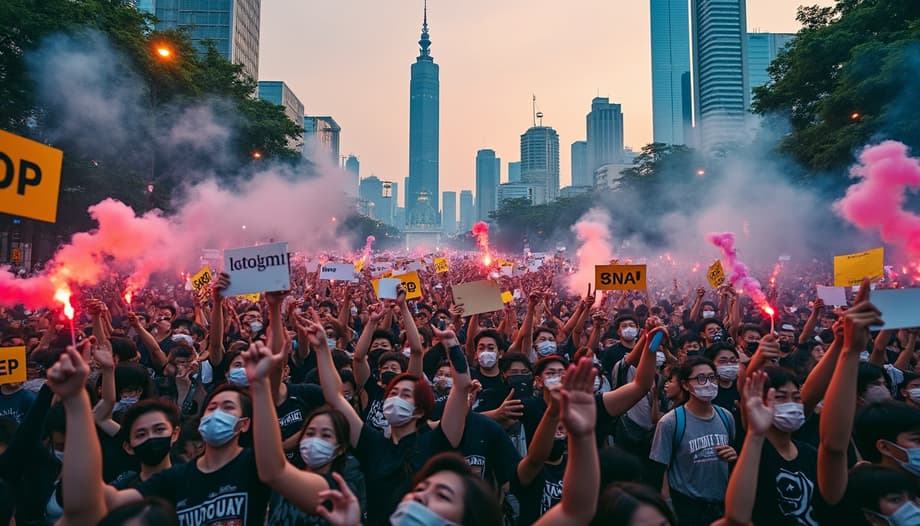
A rally driven by a ticking clock
Hundreds of migrant workers and supporters marched through central Taipei, calling for the end of Taiwan’s work year limits for blue collar jobs. Under current rules, most factory and construction workers can stay for up to 12 years, while caregivers who meet specific criteria can extend to 14 years. Protesters say the cap pushes experienced workers out just as they build stable lives, friendships, and financial plans in Taiwan.
- A rally driven by a ticking clock
- What Taiwan law allows and where the cap comes from
- The retention program how it works and who gets in
- Workers argue the cap hurts families and feeds an underground economy
- Inside the dorms and on the factory floor
- Labor shortage and the politics of retention
- What advocates want and what reforms could look like
- What employers and officials argue
- What to Know
The march set off near the Ministry of Labor and moved toward the legislature. Participants carried props that symbolized the pressure they feel as years add up, including mock bombs and costumes that likened the rule to a shelf life stamped on a person’s future. The demonstration was organized by migrant worker alliances and advocacy groups that have long sought stronger protections, the end of restrictive term limits, and a path to permanence for workers who keep Taiwan’s factories humming and its long term care system running.
Two voices stood out in the crowd. One was Ignas, a 46 year old Indonesian manufacturing worker who has spent 11 years on the production line. Another was Fajar, an Indonesian caregiver at the cusp of the limit after 12 years of managing around the clock care and household duties. Their stories capture what is at stake in the debate over how Taiwan treats the people who fill labor shortages in vital sectors.
Faces behind the march
Ignas has one more year before he reaches the ceiling and must leave. He described the rule as a rejection of the skills he has gained on the job and of the roots he has put down in Taiwan. He asked why a system that needs experienced hands would force them out once they are fully trained.
Ignas said: “Why are experienced workers not allowed to continue working in Taiwan?”
Fajar, who cares for an elderly Taiwanese and manages household tasks, says returning to Indonesia after 12 years would mean starting over, losing hard won social ties, and disrupting the income that supports her family back home. She worries that the cap pushes some workers into irregular status rather than solving labor problems.
Fajar said: “Being forced to return home feels like being thrown away.”
What Taiwan law allows and where the cap comes from
Taiwan admits foreign labor into designated sectors to fill shortages, especially in manufacturing, construction, agriculture, fisheries, and home based care. The cap on years of work was designed as a rotation mechanism. It limits most blue collar workers in factories and construction to 12 years. Caregivers can extend to 14 years if their employers meet conditions introduced in 2015. The idea behind rotation is to prevent permanent settlement through temporary visas, manage population flows, and ensure that employers refresh their workforce.
That framework sits uneasily with today’s demographic and economic realities. Taiwan has about 800,000 to 850,000 migrant workers, the largest share from Indonesia, Vietnam, the Philippines, and Thailand. Factories count on experienced operators to keep production lines steady. Families, hospitals, and care institutions rely on seasoned caregivers as the population ages. Migrant workers and labor groups argue that sending trained staff home interrupts care, reduces productivity, and drains skill from sectors that are already short of manpower.
The retention program how it works and who gets in
The Ministry of Labor launched the Long term Retention of Skilled Foreign Workers Program in April 2022 to keep proven workers in Taiwan. Under this program, eligible workers can be reclassified as intermediate skilled, which lifts the 12 or 14 year limit and allows them to stay on long term. The program covers sectors that already hire foreign labor, including manufacturing, construction, agriculture, slaughterhouses, and long term care.
Eligibility centers on experience, skills, and pay. In general, a worker needs substantial time in Taiwan jobs, such as six years of service, or a long accumulation across contracts, then must meet a salary threshold or a technical certification standard suited to the sector. In industry, a typical benchmark is a regular monthly salary of at least NT$33,000 or total annual pay of NT$500,000. For many caregiving roles the thresholds are lower. When a worker meets the standard and is reclassified, the limit on years disappears. After five more years in intermediate skilled status, the worker can apply for permanent residency, provided they reach set income or certification thresholds.
Protection improves under the program. Intermediate skilled workers receive higher pay, the same labor and health insurance as before, and they stop paying the employment security fee. The system also ties applications to employers, which means the company or household files the paperwork on the worker’s behalf. As of late November, around 60,000 workers had been admitted since the program began, with roughly 16,000 added each year since launch.
Workers and advocates describe practical hurdles. Only a small share of the migrant workforce has been classified as intermediate skilled so far, roughly 5 percent by early autumn. Many who qualify on experience cannot apply without their employer’s support, and some employers prefer to replace them with lower paid newcomers recruited through brokers. Salary thresholds can be out of reach in lower wage roles, even when the worker’s skills clearly exceed entry level tasks. Caregivers and factory operators report pressure to accept tougher assignments in exchange for a small raise that clears the threshold.
Workers argue the cap hurts families and feeds an underground economy
Protesters say the cap adds a layer of instability that ripples through families and communities. Long term workers who reach the limit face a stark choice, return to a country they barely recognize after years abroad or slip into irregular status and work under the radar. Some workers carry debts from recruitment fees and cannot afford a sudden loss of income. Advocacy groups and social workers describe cases in which workers become undocumented after disputes with brokers or employers, then cycle through informal jobs with few protections. By some estimates the number of undocumented foreign nationals in Taiwan has roughly doubled since 2021 to around 90,000. Marchers argue that a clear path to stable status would reduce that number.
Life after 12 years can also be emotionally costly. Many long term workers have formed communities, joined church groups, learned Mandarin or Taiwanese, and even brought parents or siblings for visits. Some hope to reunite with spouses and children if they secure permanent residency. The cap can cut off those plans and create sudden separation that affects families in two countries. Caregivers describe the guilt of leaving frail elders behind, and factory workers point to unfinished projects and relationships at work and in their neighborhoods.
Why the broker system draws criticism
Most migrant workers in Taiwan are recruited and managed through private employment brokers. The broker system has deep roots, but it is also a steady source of complaints. Workers report heavy placement fees, pressure to sign one sided contracts, and in some cases the withholding of passports or personal documents. When disputes occur, the same broker may be involved in mediation, creating a conflict of interest. Government statistics show that broker related issues represent a substantial share of labor complaints filed by migrant workers.
Officials have tried to expand direct hiring, which shortens the chain between worker and employer and reduces costs. A national online platform now helps workers and companies connect without an intermediary. Advocacy groups support more direct hiring and stricter oversight of agencies, arguing that lower costs and clearer contracts would reduce conflict and help workers advance into intermediate skilled roles without extra debt.
Inside the dorms and on the factory floor
Working life for many migrants goes beyond the shift. Company managed dormitories set rules on movement and daily routines, which can slide from safety policies into tight control. During the Taipei march, a Filipino factory worker from a medical device company described strict dormitory schedules that limited when employees could sleep or leave their rooms. She said conditions improved after a union formed at the site, with more freedom in the dorms and a stronger channel to raise concerns about pay and hours.
The company responded that the dormitory rules were intended to maintain cleanliness, order, and safety. It said it gathered feedback, then relaxed measures that affected daily life. The episode illustrates how collective action and negotiation can reset expectations in shared housing and at work, while also showing why many workers want more autonomy over their living arrangements.
Labor shortage and the politics of retention
Taiwan is moving toward super aged status, which will increase the demand for caregivers and health aides. Manufacturing faces its own gap as local birthrates fall and fewer domestic workers take factory jobs. Policymakers have widened the list of roles open to foreign workers and promoted direct hiring, and the 2022 retention program is now the main channel to stay beyond 12 or 14 years. The cabinet has also floated incentives to lift wages for local workers while granting employers additional migrant quotas. One plan allows an employer to hire an extra migrant worker for every NT$2,000 monthly raise given to a local employee.
Critics say that approach frames the problem as a contest between local and foreign workers, when both groups need fair pay and safer conditions. They argue that retention should focus on skill and experience, not on trading one group’s wage increase for another group’s visa slot. Separately, in October the premier said the government is conducting a broad review of recruitment standards and conditions for foreign labor, with new measures expected after the review.
What advocates want and what reforms could look like
Migrant worker organizations and unions have coalesced around a set of proposals. First, end the work year cap for blue collar roles, and base the right to stay on employment and good standing instead of a blanket time limit. Second, let workers apply for intermediate skilled status on their own, so that a new job or a conflict with an employer does not derail their stability. Third, adjust salary thresholds by sector and recognize the skill in care work as more than basic labor, including formal credit for certification courses many caregivers already complete. Fourth, phase out excessive broker fees and enforce transparent costs when recruitment agencies are used.
Groups also want direct hiring methods expanded and simplified, including multilingual support and clear timelines for approvals. They favor faster paths to permanent residency for those who have already lived and worked in Taiwan for a decade, along with family reunification policies that let spouses and children join once income and housing meet realistic standards. Advocates argue that experienced workers are already part of the economic and social fabric, and that retaining them stabilizes factories, improves continuity in care, and helps households plan for the long run.
What employers and officials argue
Employers stress the need for flexibility. Some prefer regular rotation to prevent wage compression and to bring in new workers who accept entry level pay. Others support retention, saying that skilled veterans keep error rates low and reduce training costs. The Ministry of Labor points to the 2022 program as the balanced route, since it raises pay, adds protections, and finishes with a path to permanent residency after five years in intermediate skilled status. Officials have said that removing the cap entirely could weaken the incentive to upgrade, although worker groups counter that ending the cap would not prevent workers from pursuing higher status and better pay.
The program’s design gives employers a role in national workforce planning. When a company upgrades a set number of foreign workers into intermediate skilled status, it can also recruit an equivalent number of new hires. That approach aims to keep experienced workers while ensuring a pipeline of entry level labor. Government data indicates that around 60,000 people have used the program so far, a fraction of the total migrant workforce but a rising share each year.
What to Know
- Blue collar migrant workers in manufacturing and construction face a 12 year cap, while caregivers can extend to 14 years if certain conditions are met.
- A Taipei rally drew hundreds of workers and allies who want the cap abolished and a clearer path to long term status.
- The 2022 retention program lets eligible workers become intermediate skilled, lifting the cap and allowing later application for permanent residency.
- As of late November, about 60,000 workers had been admitted to the retention program since launch, with roughly 16,000 added each year.
- Workers say employer control over applications and salary thresholds make the program hard to access, and only a small share qualify today.
- Advocates argue that the cap feeds irregular work, adds debt pressure tied to broker fees, and disrupts care and production.
- Officials highlight expanded direct hiring and say new measures are under review to improve conditions for foreign labor.
- Reform proposals include ending the cap, worker initiated applications for retention, fair recognition of caregiving skills, and lower recruitment costs.