A Rail Revolution Reaches New Heights
The China-Laos Railway has shattered another barrier in regional connectivity, surpassing 70 million passenger trips since commencing operations on December 3, 2021. According to data released by China Railway Kunming Group Co. on March 31, the 1,035-kilometer high-speed line has evolved from an ambitious infrastructure project into a vital artery for Southeast Asian travel and trade, operating over 3,100 international train services during this period. The achievement represents a significant milestone for the Belt and Road Initiative’s flagship project, demonstrating sustained demand for modern rail connectivity across challenging mountainous terrain.
This milestone arrives just over three years after the railway first linked Kunming in southwest China’s Yunnan Province with Vientiane, the Lao capital. The railway threads through diverse landscapes, connecting major urban centers with over 560 scenic spots ranging from tropical rainforests to ancient temple complexes, creating an integrated tourism corridor that spans two distinct cultural and ecological zones. The achievement underscores the transformative impact of what officials from both nations describe as the crown jewel of bilateral cooperation.
The railway’s success extends well beyond raw passenger numbers. More than 780,000 tourists from over 120 countries and regions have utilized cross-border services, representing tangible evidence of deepening people-to-people exchanges between Southeast Asia and the broader world. These travelers navigate a route that traverses some of Asia’s most challenging construction environments, including 167 bridges and 88 tunnels, making the journey in approximately 10 hours rather than the two days previously required by road through winding mountain passes. Passenger demographics reveal a mix of business travelers, students, tourists, and daily commuters utilizing the service for purposes ranging from university attendance to cross-border commerce. The single-month peak of 22.5 million trips recorded earlier this year illustrates the system’s capacity to handle massive traffic flows during traditional festivals and vacation periods, while maintaining safety and punctuality standards that rival established rail networks in more developed economies.
The technical specifications of the line reflect its ambitious scope. Trains operate at speeds up to 160 kilometers per hour on the standard-gauge track, cutting through karst mountains and spanning deep valleys. The project required extensive tunneling and bridge construction to maintain consistent gradients suitable for high-speed rail, overcoming geographic barriers that had historically isolated northern Laos from its neighbors and limited economic development in the region.
From Landlocked to Land-Linked
For decades, Laos existed as one of Southeast Asia’s few landlocked nations, constrained by mountainous terrain that isolated communities and limited economic opportunities. The China-Laos Railway has fundamentally altered this geographic destiny, converting isolation into connectivity and transforming the nation into what officials term a “land-linked” hub within the regional economy. This shift represents more than semantic change; it signals a fundamental reorientation of the national development strategy away from reliance on overland trucking and river transport toward modern logistics and rail-based commerce.
The World Bank recognized this potential even before the railway’s completion, projecting in 2020 that with appropriate policy reforms including trade facilitation and logistics improvements, the rail network could increase Laos’ aggregate income by up to 21 percent over the long term. The analysis emphasized that the $5.9 billion project could provide the nation with its first reliable land link to global supply chains, potentially shifting 1.5 million tonnes of trade from maritime routes to rail by 2030. Such a shift would reduce transport costs by 40-50 percent between Vientiane and Kunming, and by 32 percent between Kunming and the Port of Laem Chabang in Thailand.
The construction financing reflected a complex partnership structure that has drawn international attention. Forty percent of costs came through equity, split 30 percent Lao and 70 percent Chinese, while the remaining 60 percent was funded through loans taken by the Lao-China Railway Company. This arrangement meant Laos contributed approximately $1.4-1.6 billion, partially funded through loans from the Export-Import Bank of China, while China provided the majority investment. The high costs presented significant risks for the small economy, equivalent to roughly one-third of Laos’ 2017 GDP, requiring careful management to ensure returns justified the substantial capital outlay.
Vilaysay, a 20-year-old student from Oudomxay province in northwest Laos, embodies this transformation. Where his uncle once spent nearly three days traveling by bus to reach China for studies, Vilaysay now boards a train that covers the distance to Pu’er in Yunnan in just over five hours for approximately 173 yuan ($25). His story illustrates the personal impact of reduced travel times on educational access and social mobility for rural populations previously isolated by geography.
The railway has changed everything. Now it is easy to study, travel and explore new opportunities in China.
Parents across northern Laos now encourage children to learn Chinese, recognizing that language skills open doors to employment in the railway sector, logistics companies, and special economic zones springing up near stations. Even septuagenarians have enrolled in night schools to acquire basic Mandarin, hoping to participate in the economic opportunities flowing through their communities. This cultural shift reflects the railway’s deeper impact on social mobility and educational aspirations, creating demand for language instruction and cross-cultural competencies that will shape the workforce for generations.
Scaling Operations to Meet Surging Demand
The explosive growth in passenger numbers required rapid operational expansion and unprecedented cross-border coordination between railway authorities. Railway administrators from both countries have maintained close collaboration to optimize services, resulting in dramatic increases in daily service frequency to accommodate holiday rushes, business commuters, and international tourists alike.
On the Chinese section, daily passenger trains rose from eight during the early days of operation to a peak of 86. The Lao section similarly expanded from four daily trains to 18 at maximum capacity. This tenfold increase in Chinese operations and fourfold expansion in Laos reflects the intense demand for affordable, reliable transportation between the two nations, as well as the operational flexibility built into the system’s design.
International passenger services commenced on April 13, 2023, connecting Kunming directly with Vientiane and reducing cross-border travel time to approximately 10.5 hours. During peak periods, the railway manages over 60,000 passenger trips daily, including four cross-border services facilitating travel for more than 1,000 international passengers each day. These services have proven particularly crucial during traditional festivals and holiday periods when demand spikes exponentially.
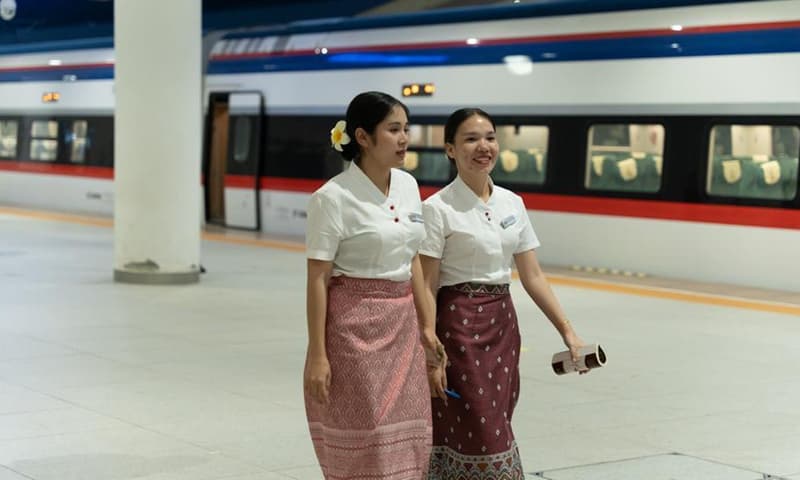
Service quality has adapted to diverse passenger needs through multilingual support systems. Train attendants provide assistance in Putonghua, the Dai language, Lao, and English, ensuring accessibility for international travelers and ethnic minority communities along the route. The railway now operates more than 70 passenger trains daily during peak winter-spring tourism seasons, with plans for further expansion as regional integration deepens and neighboring countries complete connecting infrastructure projects.
Tourism and Cross-Border Cultural Exchange
The railway has created an integrated tourism corridor connecting major destinations across two nations, fundamentally altering travel patterns in mainland Southeast Asia. Visitors can now seamlessly access Kunming’s Spring City charms, Xishuangbanna’s tropical biodiversity, Luang Prabang’s UNESCO World Heritage temples, and Vientiane’s French colonial architecture without enduring arduous bus journeys through mountainous terrain that previously deterred casual visitors and limited cultural exchange.
Xishuangbanna Station has emerged as one of the busiest terminals along the entire route, processing 3.45 million passenger trips during its first year of operations alone. The station recorded 27,000 passengers on a single day during the Dai Water-Splashing Festival in April 2023, illustrating how cultural events drive rail traffic and demonstrating the system’s capacity to handle seasonal surges while maintaining service quality.
The cross-border services have proven particularly popular among international tourists seeking multi-country itineraries. The ability to board in Bangkok, transfer through Vientiane, and continue to Kunming creates unprecedented travel flexibility. French travelers Lise Dubos and Guillaume Pattier recently described the experience as comfortable, affordable, and low-carbon, continuing their Asian rail journey from Beijing through to Hanoi and beyond.
Laos’ tourism industry has experienced robust growth since the railway’s inauguration. In the first four months of 2024, the nation welcomed over 1.5 million foreign tourists, representing a 35 percent increase compared to the same period in the previous year. Chinese visitors numbered at least 351,000, establishing China as the third-largest source of foreign tourists after Thailand and Vietnam. Vietnamese tour groups arriving at border stations increased by 40.7 percent in 2024, reflecting broader ASEAN interest in rail-based tourism and cultural exploration.
Freight Traffic and Economic Corridors
While passenger statistics capture public attention, the railway’s freight operations have proven equally transformative for regional trade and agricultural supply chains. As of early 2026, the line has transported 76.8 million tonnes of cargo, including 17 million tonnes of cross-border freight spanning 3,800 product categories ranging from electronics and machinery to agricultural commodities and consumer goods.
The Lancang-Mekong Express, launched in early 2022, has become a critical conduit for temperature-sensitive agricultural products. Thai durian farmers now ship premium fruit to Kunming in just three days, compared to weeks via maritime routes. This efficiency has reshaped consumer markets; premium Thai durian prices have dropped from 1,500-1,600 yuan per box to approximately 800 yuan, a reduction locals describe as achieving “durian freedom” through improved supply chain efficiency.
Lao bananas reach Beijing in seven days using the railway’s refrigerated container services. Logistics operators report that these cold-chain containers remain fully booked during harvest seasons, with facilities handling over 100 containers daily at peak times. Zhang Dehuan, deputy general manager of a Kunming-based international logistics operator, notes that refrigerated containers are so popular they remain fully booked throughout the season, requiring advance scheduling by agricultural exporters.
Customs efficiency improvements have facilitated this growth. Under a new “express rail clearance” model offering 24/7 pre-scheduled services, containers pass through the Mohan checkpoint in as little as 2-5 hours, down from as much as 40 hours previously. Cross-border freight trains through Mohan have risen from two per day at launch to 18, peaking at 23, reinforcing its role as China’s busiest rail port to ASEAN. The service network now extends beyond the bilateral route, covering 31 Chinese provinces and reaching 19 countries and regions including Thailand, Malaysia, Singapore, and Vietnam.
Regional Integration and Future Expansion
The China-Laos Railway functions as the southern anchor of a broader pan-Asian rail network under development, with connections extending beyond the bilateral route into Thailand and potentially onward to Malaysia and Singapore. Thailand’s connection to the line, inaugurated in July 2024 with passenger services between Bangkok and Vientiane, represents the next phase of integration and demonstrates the project’s expanding geographic influence across mainland Southeast Asia.
This Bangkok-Vientiane link reduces journey times between the Thai capital and the Lao border to approximately 10 hours, creating a continuous rail corridor from the Gulf of Thailand to the Chinese border. Future plans envision continuous standard-gauge track extending through Malaysia to Singapore, creating a seamless rail corridor from Kunming to the Malay Peninsula. Such connectivity would eventually enable passengers to travel from Singapore to Beijing by rail, traversing the entire Southeast Asian peninsula through multiple countries on a single continuous network.
Current constraints require freight transfer at border points between Thailand’s meter-gauge system and the standard-gauge China-Laos Railway, but infrastructure investments aim to resolve these discontinuities through dual-gauge track or transloading facilities. The ASEAN Express freight system has already demonstrated the potential benefits, completing a nine-day journey from Malaysia to Chongqing via Thailand and Laos, compared to 14-21 days by sea, resulting in approximately 20 percent cost savings for shippers.
Twelve special economic zones have emerged along the railway corridor, attracting $2.3 billion in investment from companies representing China, Thailand, Japan, Malaysia, Singapore, the United States, and Switzerland. The Vientiane Saysettha Development Zone alone hosts 150 companies and has created at least 7,000 jobs for local workers, offering tax incentives and privileged access to markets in 42 countries that extend tariff exemptions to Laotian products under various trade agreements.
Addressing Economic Concerns and Debt Sustainability
The railway’s financial structure has attracted scrutiny from international observers, given the $5.9 billion construction cost representing approximately one-third of Laos’ 2017 GDP. Critics initially questioned whether the project would generate sufficient returns to justify the debt burden, particularly given the country’s existing external debt obligations. However, operational data suggests the venture is approaching financial sustainability faster than projected, challenging narratives of inevitable fiscal distress or so-called debt trap diplomacy.
Liu Hong, General Manager of the Laos-China Railway Co., Ltd., noted that both passenger and freight traffic have exceeded targets with very high growth rates. In 2023 alone, the Lao section carried 2.594 million passengers, an 85.8 percent year-on-year increase, while freight reached 4.089 million tonnes, up 83.1 percent. These figures approach the annual targets originally set for 2031, indicating performance roughly a decade ahead of initial projections.
Dr. Piti Srisangnam, a lecturer at Thailand’s Chulalongkorn University and Executive Director of the ASEAN Foundation, argues that the project contradicts “debt trap” characterizations. He explains that such traps require a creditor knowingly funding unprofitable projects to damage the borrower’s economy. Since China holds 70 percent ownership and shares operational risk through the joint venture structure, the project represents genuine investment rather than predatory lending.
This project is the opposite of the debt trap status. It is an important source of foreign currency flowing into Laos.
Anongdeth Phetkaysone, Deputy General Manager of the railway company, confirmed that freight volumes in 2023 doubled the break-even point of two million tonnes annually, enabling debt repayment capacity while generating operational profits. Lao President Thongloun Sisoulith has repeatedly emphasized that the railway bolsters efforts to transform the country from land-locked to land-linked, driving socioeconomic development through tourism revenues and logistics services that generate foreign currency inflows to offset debt servicing requirements.
Key Points
- The China-Laos Railway has handled over 70 million passenger trips since December 2021, with more than 780,000 tourists from 120 countries crossing borders on 3,100 international trains
- Daily train services increased from 8 to 86 on the Chinese section and 4 to 18 on the Lao section to meet surging demand for cross-border travel and commerce
- The 1,035-kilometer line has transported 76.8 million tonnes of cargo, including 17 million tonnes of cross-border freight spanning 3,800 product categories
- Thai durian and Lao bananas now reach Chinese markets in 3-7 days via refrigerated rail services, cutting logistics costs by 20-30 percent and reducing retail prices significantly for consumers
- Thailand’s rail link to Vientiane, opened in July 2024, extends the corridor toward a future pan-Asian network connecting to Malaysia and Singapore
- World Bank projections suggest the railway could increase Laos’ aggregate income by up to 21 percent with complementary trade facilitation reforms and logistics improvements
- Operational freight volumes exceeded 4 million tonnes in 2023, double the two million tonne annual break-even threshold, supporting debt sustainability and operational profitability