April 1 Brings Fuel Restrictions, Not a Cash Only Switch
Singaporean motorists using petrol stations in Johor Bahru on April 1, 2026, found that foreign credit and debit cards could still work at self service pumps when they bought RON97. Malaysia's new restrictions focus on RON95, the subsidised petrol sold to eligible Malaysians at RM1.99 per litre under the BUDI95 programme.
Contents
- April 1 Brings Fuel Restrictions, Not a Cash Only Switch
- How the Automatic Checks Work
- Johor Stations Balance Checks With Queues
- Hundreds of Stations Face Inspections
- Oil Prices Put Pressure on the Subsidy
- Why Johor Fuel Still Attracts Singapore Drivers
- Motorists Describe Different Payment Choices
- Liability Extends Beyond Station Operators
- Malaysian Purchasers Also Face Action
- Dealers Support Automation, Consumers Seek Reform
- Key Points
RON97, priced at RM5.15 per litre, remained available to international visitors using foreign cards at both dispensers and station counters. Checks at Petronas, Shell, Caltex and Petron outlets across Johor Bahru found that cards issued in Singapore successfully processed RON97 purchases. Drivers whose transactions were declined could still pay at the counter with the same card or with cash.
Thousands of motorists regularly cross from Singapore into Malaysia for cheaper fuel. Before the restrictions took effect, many expected a switch to cash, longer queues and more trips to station counters. The first day instead showed a system that separates payment access by fuel grade, allowing visitors to keep using their usual payment methods for RON97 while tightening access to subsidised RON95.
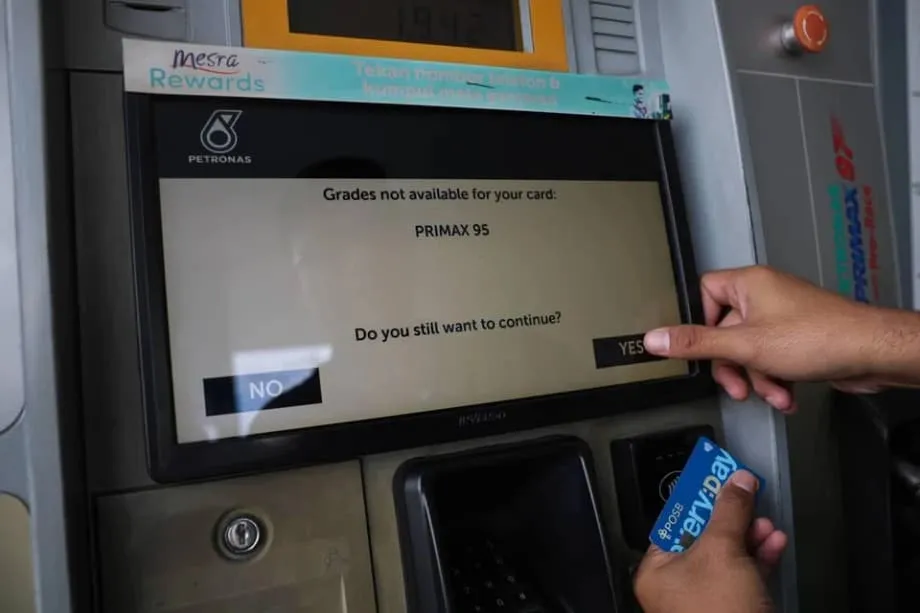
The Domestic Trade and Cost of Living Ministry (KPDN) began phased enforcement nationwide on April 1. At automated pumps, the mechanism rejects foreign cards when RON95 is selected, while allowing those cards for RON97. Foreign cards may still be used for RON95 transactions at counters, where staff can check the purchase. Foreign registered vehicles remain barred from RON95 regardless of whether a driver pays by card or cash.
The practical difference for motorists is therefore both the fuel they choose and where they pay. Counter payment remains an option when a terminal rejects a card, but drivers of foreign registered vehicles must continue to buy RON97.
How the Automatic Checks Work
KPDN's system uses payment terminal filters to identify the origin of a card and the fuel grade selected. A foreign card presented for RON95 at a self service dispenser is automatically rejected. The same card can be accepted for RON97, allowing stations to control access to subsidised fuel without stopping every foreign card transaction.
Datuk Azman Adam, KPDN's enforcement director general, explained that the automatic checks were intended to support station operators and enforcement officers in applying existing rules.
After April 1, the system will automatically filter transactions. This measure is intended to facilitate monitoring by petrol station operators and enforcement authorities, while ensuring compliance with existing regulations.
The restrictions address a weakness at self service terminals, where purchases could previously proceed without staff checking whether a vehicle was entitled to receive RON95. Automated filtering provides checks around the clock and reduces the amount of manual monitoring required from station workers.
Several oil companies said they were fully prepared for the mechanism and had updated their payment systems to recognise combinations of card origin and fuel grade. Implementation is nevertheless being phased in nationwide, making the counter an alternative for motorists who encounter a rejected payment.
RON95 transactions using foreign cards at counters require staff involvement. The payment option and the right to buy the fuel remain separate matters: staff must still apply the restriction on foreign registered vehicles. A Malaysian driving a vehicle registered abroad is also barred from buying RON95 for that vehicle.
Johor Stations Balance Checks With Queues
Petrol station supervisors near the Sultan Iskandar Customs, Immigration and Quarantine Complex said ministry officials conducted inspections on the morning of April 1. Staff explained how payment arrangements worked and warned that sending every foreign card user to a counter would increase congestion.
One station supervisor described the concern to inspectors, saying that keeping dispenser payments available helped avoid queues inside the station.
We told them if we stopped people from paying using their foreign cards at the pump, this station would be congested because people would need to queue at the counter and wait for their turn to pay. So foreigners can still pay for fuel at the dispenser using their foreign cards. It's the system we've had for years already.
For stations serving traffic from Singapore, retaining card payments for RON97 helps preserve the convenience of regular refuelling trips. The arrangement also leaves staff free to focus on purchases requiring checks, rather than handling every payment from an international visitor.
Hundreds of Stations Face Inspections
Johor deployed 180 enforcement officers to intensify inspections across all 639 petrol stations in the state. Officers were paying particular attention to 31 locations near the Singapore border identified as presenting a high risk of subsidised fuel reaching ineligible users.
Johor KPDN director Lilis Saslinda Pornomo said daily patrols also included explaining the updated regulations to owners of foreign vehicles. The checks combine monitoring with outreach so that drivers understand the restrictions before attempting a purchase.
Sarawak's monitoring covers 283 petrol stations statewide. Datuk Azman Adam visited a station in Tasik Biru, Bau, approximately 25 kilometres from Kuching, to observe implementation. Kedah deployed 180 officers working with the Border Control and Protection Agency and police through Ops Tiris 4.0.
Perlis intensified daily inspections at its 40 petrol stations, concentrating on 10 border locations. Its approach placed education and outreach ahead of immediate penalties. Those 10 locations represent a quarter of the state's stations, showing how much of the inspection effort is directed towards the border.
State directors said operators had received advance notification through major oil companies. Engagement sessions were held to ensure dealers understood their responsibilities, and follow up inspections check whether stations display clear notices about the restrictions. In Kelantan, station managers said they had briefed all staff and welcomed the initiative as a way to keep RON95 available to local residents.
Oil Prices Put Pressure on the Subsidy
The conflict in the Middle East, the closure of the Strait of Hormuz and the resulting disruption to supplies have pushed crude oil above US$100 per barrel, representing a 40 percent increase. Those pressures have added urgency to Malaysia's efforts to protect subsidised fuel from purchases by people who are not entitled to it.
The subsidy keeps the price paid by eligible motorists below the cost they would otherwise face. When international oil prices rise while the subsidised retail price stays fixed, protecting that benefit becomes more demanding for the government. The foreign card filters are part of the effort to keep that support directed towards eligible users.
Prime Minister Datuk Seri Anwar Ibrahim announced temporary changes to the Budi MADANI RON95 programme, reducing the monthly allocation from 300 litres to 200 litres from April 1. The subsidised price remains RM1.99 per litre.
The reduction removes 100 litres from the monthly quota, cutting the previous allowance by one third. Eligible motorists retain the same subsidised price for each litre within their allocation, but have fewer litres available at that rate.
The government has assured motorists that petroleum supplies are sufficient through at least May 2026. The quota adjustment reflects the financial pressure created by sustained increases in global oil prices, alongside the effort to stop subsidised fuel from reaching ineligible vehicles.
Why Johor Fuel Still Attracts Singapore Drivers
RON97 in Johor costs RM5.15 per litre, equivalent to about S$1.64. Singapore's RON95 costs approximately S$3.40 per litre, while its lowest grade, RON92, costs S$3.38. Malaysia's unsubsidised RON97 therefore remains cheaper than either of those Singapore grades.
Using the stated Singapore dollar prices, a litre of RON97 in Johor costs S$1.76 less than a litre of RON95 in Singapore. Singapore's RON95 price is slightly more than twice the S$1.64 equivalent for Johor's RON97. That gap helps explain why motorists continue to cross the border even when they cannot buy Malaysia's subsidised grade.
The comparison also explains why continued access to foreign card payments matters. Drivers can still obtain the cheaper RON97 available to them without necessarily changing to cash or joining a queue at the counter.
Some Singaporean motorists nevertheless expressed concern about losing cashback benefits connected to their Singapore credit cards. Those cards can provide rebates on overseas spending, competitive exchange rates and no foreign transaction fees. Paying at a counter instead of a terminal may complicate reward arrangements and add costs to a refuelling trip.
Singapore also applies its own rule to vehicles leaving the country: their fuel tanks must be at least three quarters full. Drivers who breach that requirement face fines of S$500 and must return to refuel before departure. Regular visitors to Johor therefore have to comply with Singapore's departure requirement as well as Malaysia's restrictions on the fuel they may buy.
Motorists Describe Different Payment Choices
A Volkswagen Touran driver identified only as Mr Chen had no difficulty using a debit card issued in Singapore to buy RON97 at a Johor dispenser. He said he did not visit Johor for petrol often and had been unaware of the new restriction.
I don't pump in Johor often, and I didn't know there is a ban.
Singapore nurse Syafiq Mohamed chose to pay for RON97 at the counter because that was his usual practice. He said staff offered both payment options and helped him pay for the exact quantity purchased.
When I reached the petrol station, the staff gave me the option of paying directly at the dispenser or at the counter. Because I'm used to paying at the counter, the staff helped to activate the pump so I can pay exactly for the fuel amount I bought at the counter.
Their experiences show the two payment routes available for RON97 on the first day of enforcement. Mr Chen used a foreign card directly at the pump, while Syafiq used staff assistance and paid at the counter. Neither needed to switch to subsidised RON95 to benefit from Johor's lower fuel prices.
Liability Extends Beyond Station Operators
Malaysia's legal approach to RON95 restrictions has also changed. Historically, enforcement under the 2010 Control of Supplies Act penalised petrol station operators for selling subsidised RON95 to foreign registered vehicles. Regulations drafted in early 2026 extended liability directly to drivers and vehicle owners, making them personally accountable for misuse.
A Singapore permanent resident was fined RM9,000 at Kulai's magistrate court on January 14 after being filmed pumping subsidised RON95 into a vehicle registered in Singapore. The vehicle's registration plate was partially obscured, illustrating the kind of conduct authorities are targeting.
The restriction applies to the vehicle's registration, including when a Malaysian is driving a foreign registered car. Foreign nationals are also barred from obtaining RON95 for foreign registered vehicles, whatever payment method they choose.
Several developments preceded the April 1 payment changes:
- Early 2026: Regulations were drafted to extend liability for misuse to drivers and vehicle owners, beyond station operators.
- January 14: A Singapore permanent resident received a RM9,000 fine in Kulai after buying RON95 for a vehicle registered in Singapore with a partially obscured plate.
- March 21: A viral video showed a woman filling a large container in a car boot with more than 71 litres of RON95 at a Skudai station.
- April 1: Nationwide phased enforcement of foreign card restrictions began, and the monthly BUDI95 quota fell from 300 litres to 200 litres.
Malaysian Purchasers Also Face Action
The March 21 video from Skudai led authorities to identify the people involved as Malaysian citizens. Both the purchaser and the vehicle owner received immediate bans from subsidised fuel purchases after the footage showed more than 71 litres being pumped into a large container in the boot.
Their MyKad cards were blocked from future RON95 transactions under BUDI95. The Finance Ministry said such misuse undermines transparency in the management of subsidies. The action shows that enforcement includes Malaysian recipients who misuse the programme, alongside checks on foreign registered vehicles.
The two measures operate at different points in a purchase. Foreign card filtering controls transactions at unattended pumps, while blocking MyKad access removes an individual's ability to make future subsidised purchases through BUDI95.
Station staff and enforcement officers still have a role in checking what motorists are doing at the dispenser. Payment controls can reject certain transactions automatically, while inspections address conduct such as filling containers or attempting to buy RON95 for a vehicle that is ineligible.
Dealers Support Automation, Consumers Seek Reform
The Petrol Dealers Association of Malaysia (PDAM) broadly supports the automated restrictions. Its president, Datuk Khairul Annuar Abdul Aziz, described the measure as a practical way to ease the monitoring burden and improve productivity through automatic controls.
Khairul Annuar said physical monitoring must continue because some owners of foreign vehicles might try to obtain RON95 using bank cards issued locally. A terminal can identify where a card was issued, while staff must still check whether the vehicle is entitled to receive the fuel.
Pertubuhan Mesra Pengguna Malaysia deputy president Azlin Othman said the payment restriction system was harder to manipulate than conventional methods, but warned that the use of local representatives to carry out transactions could remain a loophole. She argued that the move pointed to a need for broader changes to the subsidy system.
This is not just about plugging leakages, but a clear indication that the current subsidy system is no longer relevant and must be restructured towards a more targeted approach.
Federation of Malaysian Consumers Associations president Datuk Dr N. Marimuthu suggested the restrictions could be an early step towards wider subsidy rationalisation. In this context, rationalisation means changing how fuel support is allocated so that it is directed more closely towards intended recipients. He stressed the need for transparency in implementing the policy.
The consumer organisations' comments reflect support for tighter controls as global oil prices increase pressure on Malaysia's subsidy spending, despite political preferences for universal subsidies. Their proposals concern the broader design of support, while the measures taking effect on April 1 focus on payment checks and a smaller monthly allowance. No timetable was given for a wider restructuring.
Key Points
- Malaysia began phased restrictions on foreign credit and debit cards for RON95 at self service pumps on April 1, 2026.
- Foreign cards remain usable for RON97 at dispensers and counters. RON95 counter payments still require compliance with eligibility rules.
- Foreign registered vehicles cannot buy RON95, including when driven by Malaysians or paid for with locally issued cards.
- Johor deployed 180 officers to inspect 639 stations, with particular attention to 31 locations near the Singapore border.
- The BUDI95 monthly allowance fell from 300 litres to 200 litres, while the subsidised price remained RM1.99 per litre.
- Johor's RON97 costs RM5.15, about S$1.64, per litre, compared with approximately S$3.40 for Singapore's RON95.
- A Singapore permanent resident was fined RM9,000 in January, and two Malaysians lost subsidised fuel access after the March incident involving more than 71 litres in Skudai.
- The government says petroleum supplies are sufficient through at least May 2026, as crude prices exceed US$100 per barrel.