France Eyes South Korean Rocket Artillery to Bridge Critical Firepower Gap
The French Army confronts an uncomfortable reality as European security tensions intensify. Its long range strike capability, once anchored by American made M270 Multiple Launch Rocket Systems, has withered to just nine outdated launchers requiring extensive maintenance. With high intensity warfare demonstrating the decisive value of precision rocket artillery in Ukraine, France finds itself in a race against time. The solution may come from an unexpected source: South Korea.
- France Eyes South Korean Rocket Artillery to Bridge Critical Firepower Gap
- The Artillery Crisis Driving Urgent Procurement
- Why American HIMARS Faces Rejection
- Technical Capabilities of the Chunmoo System
- European Adoption Creates Momentum
- Domestic Alternatives Face Development Hurdles
- Strategic Implications for Alliance Logistics
- The Narrowing Window for Decision
- Key Points
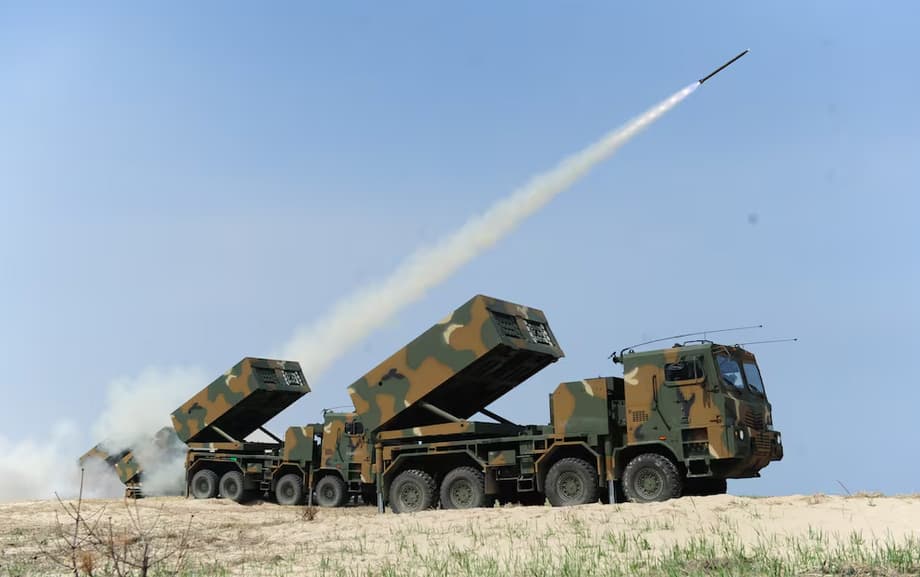
A recent study by the French Institute of International Relations (IFRI) has recommended the K239 Chunmoo system, manufactured by Hanwha Aerospace, as the preferred interim solution to replace France’s aging Lance Roquettes Unitaire (LRU) platforms. This recommendation comes as French defense planners confront a stark timeline gap. Their sovereign replacement system, the Feux Longue Portee Terre (FLP-T), will not enter service until 2030 at the earliest, leaving a dangerous capability vacuum during an era of renewed great power competition.
The K239 Chunmoo represents a growing trend across European defense procurement. While France has traditionally pursued sovereign military industrial solutions, the urgency of modern battlefield requirements is forcing a pragmatic reassessment. The Chunmoo system offers a modern, flexible capability with a wide range of available munitions and relatively short delivery timelines compared to alternatives. It is already in service or on order in several European countries, including Norway, Estonia, and Poland, creating a nascent user community that France could join. This shift toward South Korean military technology signals a broader realignment in European defense acquisition strategies as nations seek to balance sovereign industrial priorities against immediate security needs.
The Artillery Crisis Driving Urgent Procurement
France’s current artillery predicament stems from decades of capability erosion and deferred modernization. The French Army operates only nine M270 derivative LRU launchers, systems originally fielded during the Cold War era. These platforms no longer receive maintenance support from original manufacturer Lockheed Martin, forcing French defense firms to perform increasingly complex overhaul work to keep the launchers operational past their intended service life.
The limitations extend beyond maintenance headaches. The LRU systems cannot meet the demands of modern high intensity warfare, where precision deep strike capabilities determine operational success. France’s current maximum range strike capacity extends only to brigade level targets, approximately 60 kilometers, with no systems capable of reaching division level (150 km) or corps level (300 km) depths effectively. This range deficiency leaves French forces vulnerable in scenarios requiring suppression of enemy air defenses, destruction of logistics nodes, or counter battery fires against sophisticated adversaries.
Under the 2024-2030 Military Programming Law (LPM), France committed to developing the FLP-T as a sovereign solution. Two competing teams, Safran paired with MBDA and Thales paired with ArianeGroup, are working in parallel on the project, with winner selection expected in 2026. The target specifications call for initial range capabilities exceeding 150 kilometers by 2030, with gradual expansion to 500 kilometers and eventually 1000 kilometers in subsequent phases. However, these timelines offer little comfort to military planners confronting immediate security challenges and the possibility of near term contingencies.
Why American HIMARS Faces Rejection
France’s search for foreign alternatives initially examined the obvious candidates. The United States offered its M142 HIMARS system, battle proven in Ukraine and standardized across NATO. Israel proposed its PULS (Precise and Universal Launching System), already adopted by Germany, the Netherlands, Denmark, and Spain. Yet both options face significant obstacles in the French political context, leading legislators to seek solutions beyond traditional transatlantic suppliers.
French parliamentarians have explicitly labeled the HIMARS option “geopolitically risky and politically incomprehensible,” citing concerns over American inconsistency as a strategic partner. In a detailed report presented to the National Defence and Armed Forces Committee, the report emphasized that Lockheed Martin’s production backlog extends until 2029-2030, creating unacceptable delays for French operational requirements. The analysis questioned whether Paris should depend on Washington for critical firepower given recent fluctuations in alliance politics.
“In the face of the increasingly obvious inconsistency of the American partner, the choice of HIMARS would be geopolitically risky and politically incomprehensible.”
The Israeli PULS system faces similar political headwinds. French officials cite “growing geopolitical tensions with Israeli partners” as a disqualifying factor, effectively removing EuroPULS from serious contention despite its adoption by several European NATO members. This double rejection of American and Israeli systems, traditionally the default choices for European allies seeking off the shelf solutions, has opened the door for South Korean defense contractors to enter the European market with competitive offerings.
Technical Capabilities of the Chunmoo System
The K239 Chunmoo offers technical characteristics that align closely with French operational requirements for flexible, long range fires. As a modular multiple launch rocket system, it accommodates various munition types through interchangeable launch pods, providing versatility that single purpose systems cannot match. This modularity allows commanders to configure loads for specific missions, from area suppression with unguided rockets to precision strikes with guided missiles.
Standard configurations include 239 millimeter GPS/INS guided rockets with ranges of 80 kilometers, extended range variants reaching 160 kilometers, and the CTM-290 tactical ballistic missile capable of striking targets at 290 kilometers. Norway’s recent procurement of an extended range variant demonstrates capabilities reaching 500 kilometers, far exceeding France’s initial FLP-T phase one requirements of 150 kilometers. This performance margin provides future growth potential without requiring immediate system replacement.
The system’s open architecture presents additional advantages for industrial cooperation. Countries can integrate their own chassis and command systems, as Poland has done with its locally produced Homar-K variant mounted on Jelcz trucks and integrated with Polish Topaz combat management systems. Hanwha claims 95% domestic South Korean manufacturing content for the Chunmoo, ensuring supply chain resilience that contrasts favorably with systems dependent on complex international logistics networks vulnerable to disruption.
European Adoption Creates Momentum
France is not alone in turning to South Korean military technology to satisfy urgent artillery needs. Norway recently finalized a $2 billion agreement for 16 K239 Chunmoo systems, becoming the first export customer for the 500 kilometer extended range variant. Norwegian Defence Minister Tore O. Sandvik emphasized that Hanwha was the only supplier meeting all requirements for performance, delivery time, and cost framework. Oslo specifically noted that competitors could not match the 500 kilometer range requirement, a critical factor for Arctic deterrence against Russian forces.
Estonia has pursued a complementary approach, ordering six Chunmoo systems to operate alongside its existing American HIMARS fleet. The 290 million euro contract includes CGR-080 rockets (80 km range), CTM-MR missiles (160 km), and CTM-290 tactical ballistic missiles (290 km), with deliveries beginning in late 2027. Estonian Defense Minister Hanno Pevkur explicitly framed the acquisition as strengthening deep strike capability to hold targets deep in adversary territory, stating that Tallinn requires the ability to influence enemy forces before they approach Estonian borders.
Poland represents the largest European adopter, with contracts for 290 Homar-K systems (the Polish designation for Chunmoo) running through 2029. Beyond hardware acquisition, Poland has established a joint venture between Hanwha Aerospace and WB Group for local missile production, creating a European manufacturing hub that could support additional NATO users. Hanwha plans to supply European customers, including Norway, with missiles produced in Poland, simplifying logistics and ensuring security of supply for the broader alliance.
Domestic Alternatives Face Development Hurdles
France continues pursuing indigenous solutions even as it evaluates foreign interim options, yet these programs face significant maturity and production challenges. The Foudre system, unveiled by Turgis Gaillard at the 2025 Le Bourget exhibition, offers a “100% French-made” alternative positioned to compete directly with HIMARS. However, the system remains at an early prototype stage and lacks dedicated munitions, potentially requiring reliance on Indian rockets at best, creating the same dependency risks French lawmakers seek to avoid.
Separately, MBDA and Safran have developed the Thundart multiple launch rocket system, a 227 millimeter guided rocket compatible with existing LRU launchers and achieving the 150 kilometer range required for FLP-T phase one. The system utilizes navigation and guidance technology derived from the AASM family of air launched precision munitions, adapted to withstand the shocks associated with carrier aircraft operations. Yet even these domestic options face a critical production volume challenge that may render them insufficient for high intensity operations.
French procurement agency DGA expects local industry to produce merely 50 to 100 missiles annually by 2030. These figures stand in stark contrast to consumption rates observed in Ukraine, where forces expend approximately 500 long range missiles each year in sustained combat. French lawmakers acknowledge that prioritizing a purely national solution may prove impractical given these constraints, suggesting that licensed production of foreign systems like the Chunmoo or Indian Pinaka might better serve operational needs while domestic capacity ramps up.
The Indian Pinaka system, mentioned multiple times in parliamentary reports, offers a range of 75 kilometers in its Mk2 variant, with the Mk3 version under development targeting 120 kilometers. Given France’s recent $7.41 billion export deal for Rafale-M fighters to India, defense ties between Paris and Delhi could facilitate licensed production agreements similar to those Hanwha established with Poland, potentially offering France another avenue for interim capability.
Strategic Implications for Alliance Logistics
The proliferation of K239 Chunmoo systems across Europe carries significant alliance implications for NATO standardization and wartime logistics. As European nations diversify their rocket artillery inventories beyond American HIMARS and M270 platforms, questions of interoperability and ammunition standardization become increasingly urgent. Germany has explicitly stated its intention to integrate American GMLRS rockets with its Israeli-made PULS launchers, though technical and industrial barriers persist, with Lockheed Martin expressing skepticism about compatibility.
France’s potential adoption of Chunmoo would add another munition type to NATO’s logistical landscape, yet it would also create valuable redundancy that could prove decisive in high intensity conflict. The war in Ukraine has demonstrated that magazine depth, the ability to sustain high volume fires over extended periods, often determines operational success more than individual platform sophistication. A distributed battery of Chunmoo systems can saturate assembly areas or air defense nodes with twelve guided rockets per launcher, then displace before counter battery fire, while operating alongside HIMARS sections prosecuting high value point targets.
General Christopher T. Donahue, commander of US Army Europe, has advocated for common autonomous missile launchers capable of firing various national munitions types with unified command systems. Such interoperability would allow French Chunmoo batteries to fire Polish-manufactured rockets or coordinate fires with German EuroPULS units, maximizing the alliance’s collective deep strike potential while respecting national industrial requirements. This approach aligns with France’s insistence that any interim solution must include provisions for local ammunition production.
The Narrowing Window for Decision
French defense planners face a narrowing window for procurement decisions as Hanwha’s production schedule fills with firm orders. With Norway receiving deliveries in 2028-2029 and Estonia beginning acceptance in 2027, slots for new customers become increasingly scarce. Yet the alternative, waiting for domestic FLP-T development, leaves France with nine aging LRUs as its sole deep strike capability for the remainder of the decade, a risk few military planners are willing to accept given the current European security environment.
The IFRI recommendation carries substantial weight as France considers its options. By selecting the Chunmoo as an interim solution, Paris could achieve operational capability within four years while continuing FLP-T development for long term sovereign independence. This dual-track approach mirrors Estonia’s strategy of operating both HIMARS and Chunmoo systems simultaneously, ensuring capability availability while hedging against single-supplier risks and production bottlenecks that could cripple sustained operations.
Ultimately, France’s choice reflects broader European realignments in defense procurement priorities. As nations from the Baltic to the Arctic seek long range precision fires to deter Russian aggression, South Korea’s defense industry has emerged as a critical partner offering capabilities that match or exceed American alternatives without the associated geopolitical complications. For France, the Chunmoo represents not merely a weapons system, but a pragmatic admission that sovereign capability cannot always accommodate the speed of strategic necessity in an era of heightened continental tensions.
Key Points
- France is considering South Korea’s K239 Chunmoo MLRS as an interim replacement for its aging M270 LRU launchers, which have dwindled to just nine operational systems no longer supported by the manufacturer.
- French parliamentarians rejected the American HIMARS system as “geopolitically risky” due to delivery delays extending to 2029-2030 and concerns over the consistency of American partnership.
- The sovereign French replacement system, FLP-T, will not enter service until 2030, creating a dangerous capability gap given current European security conditions and high intensity warfare requirements.
- Norway recently selected the Chunmoo in a $2 billion deal for 16 systems, including a new 500 kilometer extended range variant, with deliveries starting in 2028.
- Estonia and Poland have also adopted the Chunmoo, with Poland establishing a joint venture for local missile production that could supply other European users including Norway.
- Domestic French alternatives like the Foudre and Thundart systems remain in early development stages and face production capacity limitations of only 50-100 missiles annually by 2030.
- The Chunmoo offers modular munitions capabilities ranging from 80 kilometer guided rockets to 290 kilometer tactical ballistic missiles, with potential for 500 kilometer ranges exceeding French requirements.
- France is also evaluating India’s Pinaka system as an alternative, leveraging strong recent defense trade relationships between Paris and New Delhi.