From Protectionism to Openness: India’s Economic Pivot
India has long been synonymous with trade barriers and bureaucratic complexity, a country where importing goods often meant navigating a labyrinth of tariffs and regulations. Yet in a remarkable reversal that is catching the attention of global markets, the world’s fifth-largest economy appears poised to shed its protectionist skin. A flurry of recent trade agreements, including landmark deals with the European Union and the United States, signals what officials and economists describe as a structural shift in India’s economic DNA. The question now dominating boardrooms from Mumbai to Brussels is whether this moment represents a genuine transformation or merely a tactical adjustment in a volatile geopolitical landscape.
- From Protectionism to Openness: India’s Economic Pivot
- The Mother of All Deals: Negotiating a New Global Position
- Manufacturing Realities: Why the Factory Engine Stalls
- The China Conundrum: Dependency and Diversification
- Sectoral Opportunities: From Textiles to Semiconductors
- Building the Foundations: Reforms Beyond Trade Deals
- Key Points
The evidence suggests something fundamental is changing. India’s Economic Survey 2025-26, tabled in Parliament earlier this year, delivered an unusually blunt message: services exports made India rich, but only manufacturing will make it resilient. For decades, India relied on its prowess in software and business process outsourcing to drive growth, creating a dual economy where world-class IT hubs coexisted with agricultural stagnation and industrial underperformance. The Survey argues that services “do not systematically compel broad upgrades in state capacity” because firms can bypass weak institutions and relocate easily. Manufacturing, by contrast, creates hard pressure on governments for infrastructure, logistics, skills, and regulation. This philosophical shift sits at the heart of New Delhi’s new trade strategy, which views export-oriented industrialization not merely as an economic goal but as a mechanism for state building and employment generation in a country that must create millions of jobs annually for its youthful population.
The numbers reveal both the opportunity and the challenge. Despite having the world’s fifth-largest economy, India’s share of global merchandise exports remains a modest 1.8%, compared to China’s 14%. Manufacturing contributes just 14% to India’s GDP, down from over 15% five years ago, and far below the 25% target set for 2025. Yet the momentum is shifting. Since 2020, total exports grew at 9.4% annually, reaching a record $825.3 billion in the fiscal year ending March 2025. The composition of these exports matters as much as the volume, with policymakers now fixated on moving beyond software services toward tangible goods that employ partially skilled workers in factories rather than engineering graduates in office parks.
The Mother of All Deals: Negotiating a New Global Position
The centerpiece of India’s trade offensive is the Comprehensive Free Trade Agreement with the European Union, nearly two decades in the making and finally concluded in early 2026. European Commission President Ursula von der Leyen labeled it the “mother of all deals,” a characterization that underscores its potential to merge two of the world’s largest economic blocs into a single trade zone covering nearly two billion people. For India, the agreement represents more than tariff reductions; it is a strategic hedge against an increasingly unpredictable global order dominated by tariff wars and geopolitical rivalry.
The EU pact eliminates tariffs on over 90% of Indian goods immediately, expanding to 93% within seven years. Sectors standing to gain include textiles, pharmaceuticals, leather, and engineering goods, with gems and jewelry exporters seeing particular benefits. Beyond market access, the agreement addresses critical input costs that have long hobbled Indian manufacturers. Currently, 35-40% of production costs in electronics stem from imported high-value components facing tariffs of 40% or higher. The FTA slashes these duties on European precision components, testing equipment, and lithography tools, potentially triggering what industry leaders call an input-side revolution.
Pankaj Rana, CEO of Hisense India, stresses that the most transformative impact may come from supply-side improvements rather than export markets alone.
“The underappreciated input-side shift is massive. Precision components, testing gear, lithography tools currently face 40 percent-plus import duties from European suppliers, now dropping significantly, enabling unprecedented cost reductions while elevating quality via mutual certifications and faster EU compliance.”
The strategic timing of these deals reflects a broader realignment in global commerce. As the United States under President Trump imposes disruptive tariffs and questions traditional alliances, both India and Europe are seeking to insulate themselves from Washington’s unpredictability. European Commission President von der Leyen explicitly framed the India deal as a response to an era where trade is increasingly weaponized.
“By combining our strengths, we reduce strategic dependencies at a time when trade is increasingly weaponised.”
For India, the agreements provide alternative markets as it faces pressure from Washington over its ties with Moscow and its trade surplus with the United States. The dual pacts position India as a bridge economy between competing blocs, enjoying preferential access to both Western markets while maintaining strategic autonomy.
Less than a week after the EU deal, India secured another breakthrough with the United States, agreeing to reduce tariffs on Indian exports to 18% from 25%. The pact, announced by President Donald Trump, also removed additional punitive levies imposed in retaliation for India’s purchases of Russian oil. In exchange, India committed to buying $500 billion in American goods including energy, coal, and agricultural products, while reportedly pledging to curb Russian oil imports. The speed of this agreement surprised many observers, coming on the heels of the EU deal and suggesting that New Delhi is successfully playing a multi-alignment strategy to its advantage.
Manufacturing Realities: Why the Factory Engine Stalls
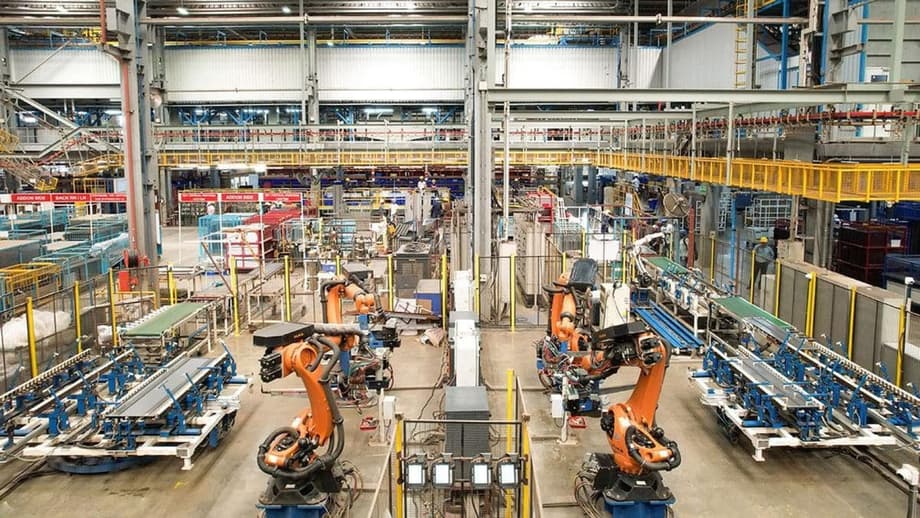
Despite the fanfare surrounding trade agreements, converting paper commitments into industrial output faces formidable headwinds. India’s flagship Production Linked Incentive (PLI) scheme, launched in 2020 with an outlay of 1.97 trillion rupees ($23 billion) covering 14 sectors, was supposed to catalyze a manufacturing renaissance. The results have been sobering. Rather than increasing, manufacturing’s share of GDP actually declined from over 15% when the scheme launched to 14% in fiscal year 2024-25. The program targeted production worth 15.52 trillion rupees but achieved only 14 trillion as of late 2024, leading to speculation that the government may allow the scheme to lapse.
The uneven performance reveals structural constraints that subsidies alone cannot overcome. Smartphone assembly has emerged as the standout success, with exports rising 42% in fiscal year 2024 and Apple now manufacturing 20-25% of its iPhones in India. Foxconn, Pegatron, and other major suppliers have established significant operations, helping India overtake China as the top smartphone exporter to the United States in 2025. Yet this success highlights a broader failure: India excels at final assembly but remains dependent on imported components, particularly from China. Nearly 40% of India’s electronic component imports still originate from Chinese suppliers, while 70% of active pharmaceutical ingredients come from the same source. This dependence undermines the strategic goal of building self-reliant supply chains and leaves Indian manufacturing vulnerable to geopolitical pressure.
Deeper bottlenecks persist in areas that trade deals cannot easily fix. India’s logistics costs consume approximately 14% of GDP, compared to 8-10% in China, while port clearance times average 6-8 days versus 1-2 days in Singapore. Labor productivity in India remains substantially lower than in China, though manufacturing wages at $2 per hour are less than half of China’s $5.58, according to data from JLL. Rigid labor laws have historically discouraged large-scale manufacturing employment, with firms facing significant hurdles in hiring and firing workers until recent reforms began addressing these constraints. Land acquisition delays, high industrial electricity tariffs, and a severe skills gap compound these challenges. Around 80% of Indian employers report difficulty finding skilled workers, with acute shortages in robotics, industrial IoT, and CNC operations. Only 11.7% of manufacturing workers hold regular employee status, with the vast majority trapped in informal arrangements that limit productivity and technology adoption.
The China Conundrum: Dependency and Diversification
No analysis of India’s manufacturing ambitions can ignore the elephant in the room: China. The economic relationship between Asia’s two giants is defined by acute asymmetry. Between 2014 and 2024, India’s trade deficit with China ballooned, with imports reaching $113.5 billion in fiscal year 2025 compared to exports of just $14.3 billion. Nearly 90% of what India buys from China falls in low and medium technology categories, goods that India could theoretically produce itself with the right policies. Yet Chinese dominance extends into critical inputs, with 57% of India’s telecom and electronics imports and 44% of machinery coming from the northern neighbor.
Beijing has demonstrated its willingness to weaponize these dependencies. In recent months, China has restricted exports of critical minerals including gallium, germanium, and graphite, essential for India’s electronics, defense, and electric vehicle manufacturing. Under the guise of national security, Chinese authorities have blocked exports of essential machinery to India, timed strategically to coincide with New Delhi’s final negotiations on the United States trade agreement. When Chinese battery giant CATL recently instructed Foxconn to pull all Chinese engineers from its Chennai plant, industry observers interpreted it as economic statecraft designed to deter India from including clauses in the US deal that might restrict Chinese-origin components.
Ajay Srivastava, founder of the Global Trade Research Initiative and a former trade official, warns that Beijing is demonstrating its willingness to exploit economic power.
“China is sending an unmistakable message. India’s industrial growth is heavily exposed to Chinese raw materials, technology, and engineers. These dependencies can be weaponised anytime.”
Yet the same vulnerabilities create opportunities. The “China Plus One” strategy, whereby global manufacturers diversify operations away from over-reliance on Chinese supply chains, has fueled a boom in foreign direct investment across Southeast Asia and India. Indonesia attracted $28.7 billion in manufacturing investment last year, while Vietnam’s manufacturing FDI climbed over 30% to hit $23.5 billion. India has captured some of this shift, particularly in electronics assembly, but remains behind smaller competitors in deeper supply chain integration. The challenge lies in converting final assembly operations into comprehensive manufacturing ecosystems that design, engineer, and source components locally rather than merely assembling imported parts.
Sectoral Opportunities: From Textiles to Semiconductors
The new trade agreements create distinct winners across specific industrial sectors. Textiles and apparel stand to benefit dramatically from duty-free access to the European Union, a market worth $750 billion. Currently, India holds only 5-6% of the EU textile market compared to Bangladesh’s 21-22% and China’s 28-30%, largely because tariffs made Indian products uncompetitive. With those barriers removed, analysts project Indian textile exports to the EU could double from $7 billion to $15 billion within five years, potentially employing over seven million additional workers. The timing proves particularly fortuitous given political instability in Bangladesh, where textile mills face shutdown threats and policy uncertainty following the change of government in 2026.
Pharmaceuticals represent another strategic opportunity. The India-EU FTA eliminates 11% tariffs on European drug imports including cancer therapies and biologics, while simultaneously streamlining regulatory compliance for Indian pharmaceutical exports to Europe. Industry projections suggest the domestic pharmaceutical market will grow from $31.2 billion in 2025 to $45.7 billion by 2035. More importantly, the agreement incentivizes domestic production of active pharmaceutical ingredients to replace the 70% currently imported from China. The budget allocates 100 billion rupees ($1 billion) specifically to establish India as a biopharma hub, alongside similar allocations for semiconductor manufacturing and container production.
Electronics and electric vehicles are receiving particular policy attention. India’s production of iPhones for Apple has scaled rapidly, but the country lacks domestic capacity for semiconductor fabrication and advanced component manufacturing. The new trade deals slash tariffs on precision testing equipment and lithography tools from Europe, potentially reducing production costs by double digits. In electric vehicles, Chinese manufacturer BYD has invested $500 million in a Thai facility capable of producing 150,000 vehicles annually, while India’s own EV sector struggles with battery supply constraints. The government’s recent budget emphasizes scaling up manufacturing in seven strategic sectors including biopharma, semiconductors, electronics components, and rare earth magnets, with three dedicated chemical production parks planned to reduce import dependency.
Building the Foundations: Reforms Beyond Trade Deals
Trade agreements open doors, but domestic capabilities determine whether India can walk through them. The Economic Survey explicitly warns that “realising the potential of trade agreements requires that we can produce competitively.” This recognition underscores a critical reality: FTAs reduce external barriers, but internal constraints regarding land, labor, logistics, and capital continue to impede manufacturing competitiveness. The Survey cautions that protectionist measures in upstream sectors like steel and aluminum can function as a tax on downstream manufacturing, suggesting that “decisions about what not to protect can be as important as decisions about what to support.”
Addressing these constraints requires action at the state level, where many economic powers reside. NITI Aayog, the government’s premier think tank, identifies three binding constraints: land availability and acquisition delays, high industrial electricity tariffs often exceeding production costs, and education and skilling gaps. Unlike trade policy, which the central government controls, these areas require coordination with state governments that have historically competed rather than cooperated on industrial policy. Proposed solutions include digitizing land records and streamlining acquisition timelines, rationalizing industrial power tariffs, and developing a manufacturing performance index to benchmark states against one another. Without these complementary reforms, India risks repeating the pattern of the past decade, where policy ambition at the center dissipated amid execution bottlenecks at the state level and weakening global demand.
Regional integration offers another pathway to manufacturing scale. Currently, intra-regional trade in South Asia accounts for only 5% of total trade, compared to 25% in ASEAN and 60% in the European Union. The cost of shipping a container from Mumbai to Dhaka ($538) is five times higher than from China to Vietnam ($108) due to trade barriers and inefficient border crossings. Strategic thinkers propose developing cross-border economic zones with Bangladesh for textiles and electronics, with Nepal for food processing, and with Sri Lanka for auto components and pharmaceuticals. Such integration could create a South Asian manufacturing ecosystem similar to how China developed regional supply chains in Vietnam and Thailand, potentially lifting regional trade toward the $2 trillion mark over the next decade and a half.
Key Points
- India has concluded major trade agreements with the European Union and the United States, reducing tariffs and expanding market access for manufactured goods in a shift from protectionism toward strategic openness.
- The Economic Survey 2026 emphasizes manufacturing over services as essential for economic resilience, job creation, and state capacity building, targeting $2 trillion in total exports by 2030.
- Structural challenges persist, including logistics costs at 14% of GDP, rigid labor laws, land acquisition delays, and a severe skills gap limiting manufacturing productivity and global value chain integration.
- Dependency on Chinese imports remains acute, with 70% of pharmaceutical ingredients and 40% of electronic components sourced from China, creating vulnerabilities that Beijing has demonstrated willingness to exploit through export curbs.
- Sector-specific opportunities exist in textiles (potential doubling of EU exports to $15 billion), pharmaceuticals, electronics assembly, and biopharma, supported by tariff reductions on critical inputs from Europe.
- Success depends on complementary domestic reforms in infrastructure, power tariffs, land availability, and regional integration with South Asian neighbors to create scalable manufacturing ecosystems beyond final assembly.