A Historic Shift in Global Climate Patterns
China’s carbon dioxide emissions have remained flat or declined for 21 consecutive months, marking the longest period of stabilization on record that has not been driven by an economic crisis. According to analysis from the Centre for Research on Energy and Clean Air for Carbon Brief, emissions fell by 1% in the final quarter of 2025 and likely declined by 0.3% across the entire year. This plateau positions the world’s largest greenhouse gas emitter to potentially reach its emissions peak years ahead of its official 2030 target, a development that could signal a turning point in global efforts to limit temperature rise.
The significance of this trend extends far beyond national boundaries. As the country responsible for over one-third of global CO2 output, China’s emissions trajectory largely determines whether worldwide pollution levels will stabilize in time to meet Paris Agreement goals. The current decline differs fundamentally from previous dips in 2009, 2012, 2015, and 2022, which were caused by financial crises, pandemic restrictions, or construction slumps. This time, clean energy expansion is driving the reduction even as economic activity continues to grow.
Power sector emissions fell by 1.5% in 2025 despite electricity demand growing by 520 terawatt hours. Solar power generation surged by 43% year-over-year, wind by 14%, and nuclear by 8%, collectively providing approximately 530 terawatt hours of new clean electricity that covered all demand growth. Energy storage capacity expanded by a record 75 gigawatts, outpacing the 55 gigawatt increase in peak demand and offering grid managers alternatives to fossil fuel backup during high consumption periods.
The Clean Energy Engine
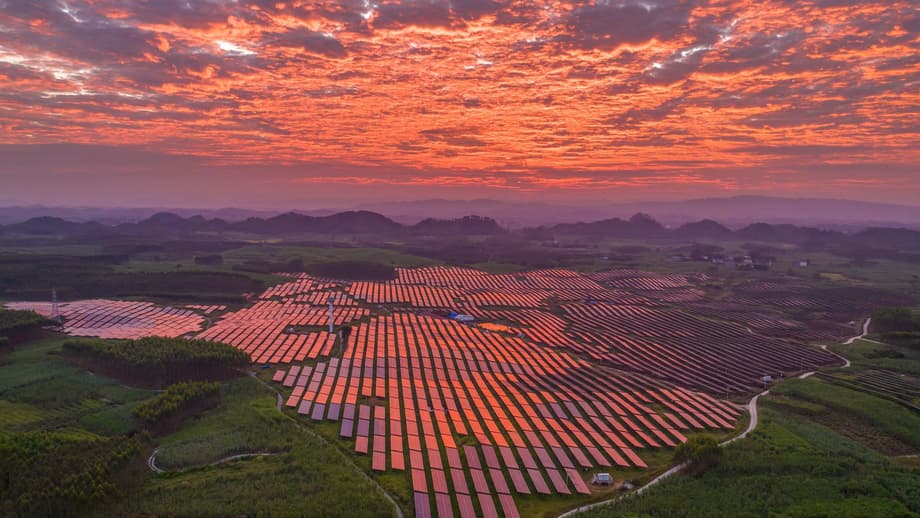
China’s renewable energy sector has achieved deployment rates that exceed even the most optimistic projections from earlier this decade. The country added 240 gigawatts of solar capacity in the first nine months of 2025 alone, building on a record 333 gigawatts installed in 2024, which surpassed the rest of the world combined. Wind power additions reached 61 gigawatts during the same period, with industry associations forecasting annual installations of 105 to 120 gigawatts through 2026.
This expansion has fundamentally altered the relationship between economic growth and emissions. Clean energy technologies contributed to more than one-third of China’s economic growth in 2025, with the so-called new three sectors, electric vehicles, batteries, and solar power, generating USD 1.1 trillion in added value. China now manufactures over 80% of global solar panels, 60% of wind turbines, and 75% of electric vehicles and their batteries, positioning the nation as the dominant supplier of climate solutions even as it decarbonizes its own economy.
The transportation sector illustrates this transformation clearly. Emissions from transport fell by 3% in 2025 as electric vehicles captured over 40% of new vehicle sales, with more than 12 million new energy vehicles produced and sold domestically. Battery electric vehicles and plug-in hybrids now constitute 8.9% of all vehicles on Chinese roads, displacing oil demand that previously drove emissions growth. The rapid adoption of these technologies demonstrates how infrastructure investment can accelerate sectoral decarbonization within a single market cycle.
Industrial Contradictions and Coal’s Persistent Shadow
Despite progress in power and transport, emissions trends across China’s industrial landscape reveal a more complex picture. While cement production emissions dropped by 7% and metal industry emissions fell by 3%, reflecting continued weakness in real estate construction, the chemicals sector emerged as a significant outlier. Emissions from chemical manufacturing surged by 12% in 2025, driven by a 15% increase in coal use and 10% rise in oil consumption as the industry expanded capacity for plastics and synthetic materials.
This growth in coal-to-chemicals represents a strategic response to energy security concerns and trade tensions. As China seeks to reduce dependence on imported oil and gas, particularly amid tariff disputes with the United States, the sector is rapidly building plants that convert coal directly into chemical feedstocks and synthetic fuels. Current expansion plans, if fully implemented, could lock in years of additional emissions growth in a sector that already accounts for roughly 13% of national CO2 output. Without the increase from chemicals, China’s total emissions would have fallen by an estimated 2% rather than 0.3%.
Perhaps more troubling for long-term decarbonization prospects, China commissioned 78 gigawatts of new coal-fired power capacity in 2025, the highest annual level in a decade, even as total coal generation declined. An additional 291 gigawatts remain in the development pipeline, already permitted or under construction. This expansion creates the risk of stranded assets and threatens to slow the clean energy transition if these plants operate for their full planned lifetimes. The China Coal Association expects coal use in steel and building materials to fall, but anticipates continued growth in power sector and chemical industry coal consumption until at least 2027.
Policy Crossroads: The 15th Five-Year Plan
The trajectory of Chinese emissions over the next five years will be determined largely by the 15th Five-Year Plan, scheduled for release in March 2026. This document will establish binding targets for energy intensity, renewable capacity, and industrial restructuring through 2030. Climate analysts note that China has already exceeded several of its 2030 Paris Agreement commitments ahead of schedule, including the installation of 1,200 gigawatts of wind and solar capacity, which was surpassed in 2024 when combined capacity reached 1,400 gigawatts.
However, the nation is falling short on carbon intensity targets. The 14th Five-Year Plan required an 18% reduction in CO2 emissions per unit of GDP between 2020 and 2025, but actual reductions reached only 12%. Meeting the 2030 goal of a 65% reduction from 2005 levels would now require cutting carbon intensity by approximately 23% over the next five years, a steep acceleration in decarbonization efforts. The government work plan for 2025 did not set a carbon intensity target, signaling that meeting this goal is not currently viewed as a priority.
In November 2025, China submitted its 2035 Nationally Determined Contribution, committing to reduce economy-wide net greenhouse gas emissions by 7 to 10% from their peak. While analysts consider this target conservative, noting that existing policies could achieve 10 to 16% reductions under optimistic scenarios, the commitment marks the first time Beijing has adopted an absolute emissions reduction target rather than intensity-based goals. The document also enhances targets for non-fossil fuel share to above 30% by 2035 and wind and solar capacity to 3,600 gigawatts.
Complementing these targets, Chinese authorities recently launched an initiative to develop zero-carbon factories across key industrial sectors. By 2027, pilot programs will operate in automobiles, lithium batteries, photovoltaics, and electronics, expanding to steel, petrochemicals, and textiles by 2030. The policy framework emphasizes renewable energy microgrids, carbon accounting systems, and intelligent management technologies to drive industrial decarbonization. As of the end of 2025, China had cultivated 6,430 national-level green factories, with their output value share in the manufacturing industry reaching 20 percent.
Global Consequences and Geopolitical Contrast
The timing of China’s emissions plateau carries profound implications for international climate efforts. With global energy-related CO2 emissions hitting record highs of 37.8 gigatons in 2024 according to the International Energy Agency, China’s potential early peak offers hope that worldwide emissions could begin declining this decade. Climate scientists note that seven in ten experts now expect Chinese emissions to peak by 2030, with 2028 identified as the most likely year in recent surveys conducted by CREA and the International Society for Energy Transition Studies.
Yet significant uncertainties remain. A rebound in emissions is possible if economic stimulus measures prioritize carbon-intensive construction over clean technology, or if the chemical industry’s expansion continues unabated. The physical climate itself poses risks, as extreme heat waves in 2024 forced China to ramp up coal generation to meet cooling demand, contributing approximately 100 megatons of additional CO2 emissions. Lauri Myllyvirta, lead analyst at CREA, highlighted the precarious nature of the current plateau.
While an emission increase or decrease of 1 per cent or less might not make a huge difference in an objective sense, it has heightened symbolic meaning, as China’s policymakers have left room for emissions to increase for several more years, leaving the timing of the peak open.
The contrast with United States climate policy has sharpened. While China advances its clean energy transition, the Trump administration has moved to revoke the 2009 endangerment finding that provides the legal basis for regulating greenhouse gas emissions, and has ordered the Department of Defense to increase purchases of coal-generated electricity. This divergence highlights the shifting landscape of global climate leadership, with China now positioned as both the largest emitter and the largest investor in clean energy transition technologies.
The Bottom Line
- China’s CO2 emissions have remained flat or falling for 21 months, the longest such period not caused by economic crisis, with a 0.3% decline likely for full-year 2025.
- Clean energy expansion, including 43% growth in solar generation and 14% in wind, met all new electricity demand in 2025 while storage capacity additions outpaced peak demand growth.
- The chemicals industry emerged as the primary source of emissions growth, rising 12%, while transport, power, and building materials all saw declines.
- China commissioned 78 gigawatts of new coal power capacity in 2025 despite the emissions plateau, with 291 gigawatts remaining in the development pipeline.
- The upcoming 15th Five-Year Plan in March 2026 will determine whether emissions have permanently peaked or will rebound before the official 2030 target date.
- China has committed to reducing net greenhouse gas emissions 7 to 10% from peak levels by 2035, the first absolute reduction target in its national climate strategy.