Power Projection in Fragile Waters
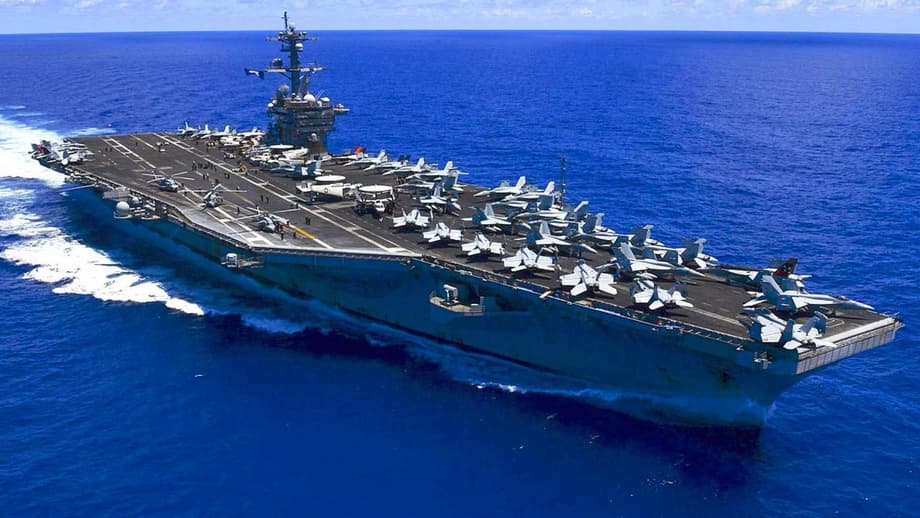
On January 8, 2026, the nuclear-powered aircraft carrier USS Abraham Lincoln fired its Phalanx Close-In Weapon System into the air above the South China Sea, sending a burst of radar guided rounds skyward from the flight deck while 3,200 sailors and nearly 90 aircraft maintained their watch below. The live fire drill, captured in photographs released by the Defense Visual Information Distribution Service, represented a routine training exercise for the Nimitz-class supercarrier. Yet the location chosen for this demonstration of naval firepower carries significance far beyond standard military readiness. The South China Sea hosts roughly thirty to forty percent of global shipping traffic by certain measures, serving as the maritime artery through which smartphones, automobile parts, and fuel tanks flow to markets worldwide.
This same patch of ocean shelters approximately 571 species of reef building corals, a biodiversity richness comparable to the famous Coral Triangle, alongside thousands of marine species ranging from reef fish to sea turtles. The Abraham Lincoln had been operating in these contested waters since December 26, 2025, having departed San Diego on November 24 with the guided missile destroyers USS Spruance, USS Michael Murphy, and USS Frank E. Petersen Jr. as escorts. The carrier strike group conducted flight operations, replenishments at sea, damage control training, and explosive ordnance disposal drills throughout its deployment. On January 8, sailors with Explosive Ordnance Disposal Mobile Unit 1 executed fast rope drills from an MH-60S Sea Hawk helicopter onto the carrier’s deck, sharpening precision and readiness across the Indo-Pacific theater.
Commander Matthew Comer, a spokesman for the U.S. 7th Fleet, described these activities as “routine operations” intended to deter aggression, strengthen alliances, and advance peace through strength. The embarked F/A-18E/F Super Hornet fighters took off from the flight deck as part of air wing exercises, demonstrating the carrier’s ability to project power across one of the world’s most heavily trafficked maritime areas. Captain Dan Keeler, commanding officer of the Abraham Lincoln, emphasized partnership and presence when the carrier arrived in Guam in mid-December.
“My crew is excited to be back in this area of the world, and we look forward to demonstrating what an aircraft carrier and carrier strike group bring to the fight. Our sailors are eager to learn from new cultures and strengthen partnerships across the region throughout our deployment.”
Regional Tensions and Strategic Timing
The arrival of the Abraham Lincoln in the South China Sea followed closely on the heels of Chinese military exercises that raised alarms across the region. Between December 29 and 30, 2025, Beijing conducted live fire war games dubbed “Justice Mission 2025” that encircled Taiwan, which sits strategically between the East and South China seas. China’s Eastern Theater Command characterized these drills as a “punitive and deterrent action” against Taiwan and nations supporting its independence. Beijing considers the self governing democracy a breakaway province that must be reunited with the mainland, by force if necessary.
The juxtaposition of American and Chinese military demonstrations in early January underscored the fragile equilibrium in the Western Pacific. President Donald Trump told The New York Times during this period that he considers Taiwan’s fate to be “up to” Chinese Premier Xi Jinping, though he added a qualifier that he would be “very unhappy” if China attempted to seize the island by force. The President articulated his view on the cross-strait relationship while warning against unilateral action.
“He considers it to be a part of China, and that’s up to him what he’s going to be doing,” Trump told the newspaper. “But I’ve expressed to him that I would be very unhappy if he did that, and I don’t think he’ll do that. I hope he doesn’t do that.” The Trump administration had announced $11.1 billion in arms sales to Taiwan the previous month, representing the largest ever weapons package for the island. The 1979 Taiwan Relations Act governs American interactions with the island, compelling the United States to ensure Taiwan receives resources needed to defend itself without strictly requiring military intervention if China invades. This policy framework, combined with regular carrier deployments, attempts to maintain strategic ambiguity while providing tangible support to Taipei.
The Ecosystem Under Pressure
Beneath the surface of these geopolitical maneuvers lies a marine environment already strained to its limits. Satellite and field analyses have documented at least eight thousand acres of damaged reef across the South China Sea, with approximately two thirds of that destruction linked to large scale dredging and artificial island construction, primarily by China. Scientists warn that such activities cause long term and sometimes irreparable changes to reef structure, altering habitats that support regional food security and natural storm protection for coastal communities.
Live fire drills like those conducted by the Abraham Lincoln introduce high energy impulses into both air and water columns. Even when rounds are aimed safely away from other vessels, fragments and acoustic disturbances penetrate the marine environment. Research on naval exercises in other ocean basins indicates that explosives and intense sound can injure fish, damage invertebrates, and disrupt feeding or spawning behaviors. Underwater noise pollution has emerged as a major environmental concern, driven by shipping traffic, seismic surveys, and military activities.
Studies have linked high intensity sonar and similar acoustic sources to mass strandings of beaked whales and other cetaceans, with effects ranging from behavioral disruption to physical injury. No published study has isolated the specific environmental footprint of this particular carrier deployment, a task that would prove unrealistic given the complexity of the ecosystem. Instead, marine experts caution that each new round of exercises adds to a cumulative load of noise, pollution, and physical risk in a semi enclosed sea where biological systems operate close to their tolerance thresholds. The South China Sea functions as a primary protein source for regional populations, with fisheries supporting millions of livelihoods and food security requirements.
Legal Frameworks and Environmental Responsibilities
The legal architecture governing these waters traces back to the 1982 United Nations Convention on the Law of the Sea, though the United States has not ratified the treaty while generally observing its provisions regarding innocent passage and exclusive economic zones. In 2016, an arbitral tribunal under the Permanent Court of Arbitration ruled that sweeping historic claims to the South China Sea had no legal basis under the Convention. Those same proceedings highlighted how large scale land reclamation had severely harmed coral reefs and violated obligations to protect fragile ecosystems and habitats of threatened species.
This legal logic applies to all states operating in the region, not solely to one claimant. The United States, along with coastal nations including the Philippines, Vietnam, and Malaysia, share responsibilities to prevent unnecessary environmental degradation while asserting navigation rights. The U.S. Navy has acknowledged these obligations through detailed environmental impact statements covering its training ranges, and NOAA Fisheries authorizations explicitly describe acoustic and explosive stressors as likely to affect whales, dolphins, and other marine mammals. Required mitigation measures include exclusion zones and shutdown rules when animals are spotted in operational areas.
The Abraham Lincoln’s presence near Scarborough Shoal, called Bajo De Masinloc by Manila and Huangyan Dao by Beijing, carried particular sensitivity. Located 120 nautical miles off Luzon, the shoal has become a focal point for renewed tensions after China declared plans in September 2025 to establish a national nature reserve there, fueling concerns about potential land reclamation similar to Beijing’s previous construction in the Spratly Islands. Philippine military leadership vowed to prevent China from establishing a permanent presence at the shoal, setting up a potential flashpoint where American naval power serves as both deterrent and, inadvertently, additional environmental stressor.
Sudden Redeployment to the Middle East
Just days after conducting its South China Sea drills, the Abraham Lincoln received new orders redirecting the strike group toward the Arabian Sea. By January 15, the carrier and its escorts were steaming westward away from the Indo-Pacific theater, transiting toward the Middle East amid escalating tensions with Iran. The redeployment came as President Trump signaled preparedness to strike Iran if necessary, stating that “we have a lot of very big, very powerful ships sailing to Iran right now, and it would be great if we didn’t have to use them.” The carrier arrived in the Arabian Sea on January 26, adding roughly 5,700 service members to the region’s force posture.
The shift left the South China Sea without an American carrier presence for the first time in three months, ending a continuous deployment that had included the USS Nimitz and USS George Washington strike groups prior to the Abraham Lincoln’s arrival. The Nimitz, which the Abraham Lincoln replaced, had returned home ahead of its expected decommissioning later in 2026, closing a chapter on more than fifty years of service. Some analysts suggested the rapid movement of the Lincoln 1,400 kilometers south from Iran’s waters indicated a recalibration of American priorities, though Pentagon officials maintained that the redeployment represented a necessary response to emerging threats rather than a retreat from Pacific commitments.
The Abraham Lincoln joined three other Navy destroyers already in the Middle East theater, two positioned near the Strait of Hormuz and one in the Red Sea, alongside three littoral combat ships in the Arabian Gulf. Air power reinforcements followed, with F-15E Strike Eagle fighter jets deploying to enhance combat readiness and promote regional security. The UK Ministry of Defence also contributed Typhoon fighter jets to the defensive posture. This buildup mirrored previous air defense hardware deployments, including Patriot missile systems, that preceded potential Iranian retaliation scenarios.
Sustaining Presence Through Partnership
Despite the Abraham Lincoln’s departure, American naval operations in the South China Sea continued through other means. On January 28, the guided missile destroyer USS John Finn joined Philippine Navy frigate BRP Antonio Luna and Philippine Coast Guard cutter BRP Gabriela Silang for joint patrols near Scarborough Shoal. Fighters, surveillance aircraft, and helicopters participated alongside the surface vessels in warfare exercises and night operations. This drill represented the first joint operation between Washington and Manila in the South China Sea for 2026, underscoring the enduring alliance even without carrier level support.
The Armed Forces of the Philippines stated that the iteration highlighted the shared commitment to strengthening maritime security, enhancing operational interoperability, and upholding a rules-based international order in the Indo-Pacific. Philippine state media reported the presence of a Chinese Type 054A-class frigate sailing near the formation during the exercises. The People’s Liberation Army Southern Theater Command announced its own naval patrols in response, claiming that Manila had co-opted foreign powers for “disrupting peace and stability in the South China Sea.”
Beyond surface ship patrols, the United States maintains contracted intelligence support, a forward based Marine Corps Reaper drone unit, and persistent P-8 Poseidon surveillance flights throughout the South China Sea. These assets provide continuous monitoring and rapid response capabilities even when supercarriers are diverted to other theaters. The three-month carrier presence off Western Luzon, now concluded, had provided reassurance to Philippine concerns regarding Chinese activities at Scarborough Shoal, but the transition to distributed maritime operations demonstrates how American military planners attempt to maintain influence across vast distances with finite resources.
The Bottom Line
- The USS Abraham Lincoln conducted live fire drills in the South China Sea on January 8, 2026, testing its Phalanx Close-In Weapon System and air wing capabilities while operating in contested waters claimed by China.
- The carrier strike group, comprising approximately 3,200 sailors, 90 aircraft, and three guided missile destroyers, had been deployed to the region since December 26, 2025, following Chinese “Justice Mission 2025” exercises encircling Taiwan.
- Environmental scientists warn that military activities add cumulative stress to a marine ecosystem already damaged by dredging and island construction, threatening coral reefs and marine mammal populations in waters that support regional food security.
- By mid-January, the Pentagon redirected the Abraham Lincoln to the Arabian Sea amid rising tensions with Iran, ending a three-month continuous U.S. carrier presence in the South China Sea but maintaining regional engagement through destroyer patrols and partnerships with allies like the Philippines.
- The drills occurred within a complex legal framework governed by the Law of the Sea, requiring all naval powers operating in the region to balance freedom of navigation rights with obligations to protect fragile marine environments.