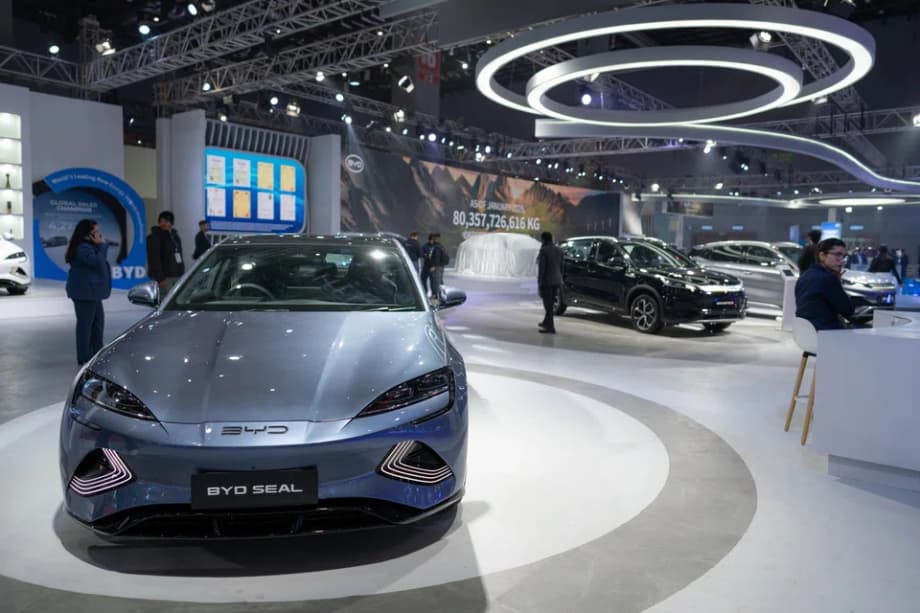
A $60 Billion Evaporation
BYD, the world’s largest electric vehicle manufacturer, has witnessed a staggering evaporation of investor wealth as its Hong Kong-listed shares collapsed approximately 7 percent this week. This decline extended a devastating sell-off that has obliterated more than $60 billion in market capitalization since May, sending shockwaves through China’s electric vehicle sector. The Shenzhen-based automaker’s plunge dragged down peers across the board, with Geely Auto falling 9.5 percent, Nio dropping between 3 and 8 percent, and XPeng declining nearly 6 percent as traders confronted an uncomfortable reality.
The market turmoil reflects deep-seated anxiety about profit sustainability in the world’s most competitive electric vehicle market. Short sellers have capitalized on the chaos, with bearish positioning in EV stocks on the Hang Seng Tech Index climbing sharply since November, diverging significantly from the broader benchmark according to S3 Partners data.
“Investor sentiment is extremely negative,” observed Xiao Feng, co-head of China industrial research at CLSA in Hong Kong. “The deeper worry is that we will see large-scale earnings downgrades this year, raising doubts about the EV makers’ long-term ability to generate profits in China’s domestic market.”
Even analysts who maintain long-term optimism have retreated to the sidelines. Gareth Pan, senior investment manager at Pictet Asset Management, described the current environment as “too early to step in” given the cautious full-year outlook.
The valuation reset has been brutal. BYD shares now trade at approximately 15 times forward earnings estimates, below their three-year average of 18, yet investors remain wary. Bloomberg data indicates that sell ratings on the stock have reached their most pessimistic levels since 2022. The collapse comes despite BYD’s fundamental position as the world’s top EV vendor by volume, a status it achieved by unseating Tesla in 2024 through a 150.7 percent surge in overseas sales. That international success has proven insufficient to offset mounting concerns about the company’s domestic market strategy, where aggressive discounting has triggered a margin crisis that threatens to engulf the entire sector.
Domestic Demand Evaporates
The depth of China’s EV slowdown became unmistakable in January when BYD reported its fifth consecutive month of declining sales. The company delivered just 210,051 vehicles globally, representing a precipitous 30.1 percent drop from the previous year. Domestic deliveries proved particularly dismal, halving to 109,569 units compared to January 2024 figures. This collapse came immediately after Beijing allowed a decade-long tax exemption on electric vehicles to expire, reinstating a 5 percent purchase tax on January 1 that effectively raised prices for consumers already reluctant to spend amid economic uncertainty.
The policy shift represents a fundamental change in government support. For years, Chinese authorities nurtured the EV industry through generous subsidies and tax breaks, helping domestic manufacturers achieve global dominance. Now, with the market maturing and budget deficits mounting, officials have withdrawn these props. Morgan Stanley analysts note that most local automakers expect first-quarter volumes to decline 30 to 40 percent from the December quarter, suggesting the January slump is not an isolated incident but rather the beginning of a prolonged contraction in domestic demand. The timing compounds the data complexity, as the Lunar New Year holiday always creates seasonal fluctuations, but the year-over-year comparisons reveal unmistakable weakness.
XPeng, another prominent Chinese EV maker, reported total deliveries declined more than 30 percent, while combined sales for Nio, Li Auto, and XPeng reached just 74,861 units in January. Though this represented a 1 percent year-over-year increase, it marked the slowest growth for the trio since January 2023. Li Auto delivered 27,668 vehicles, down about 8 percent, while XPeng managed just 20,011 units, well below its 2025 monthly average of 35,000 vehicles. Even Geely, which has gained ground on BYD recently with over 270,000 January sales, saw its shares tumble as investors recognized that no manufacturer remains immune to the sector’s spreading malaise. The battery electric segment specifically hit a two-year low of 83,249 units for BYD, while plug-in hybrids, which comprise more than half of BYD’s sales, fell 28.5 percent.
The Price War Reaches Fever Pitch
BYD’s latest market turbulence stems directly from aggressive pricing strategies designed to clear mounting inventory and maintain market share against resurgent competitors. In late May, the automaker announced sweeping discounts of up to 34 percent across 22 electric and plug-in hybrid models, including its Ocean and Dynasty series. The cuts reduced the starting price of the Seagull hatchback to just 55,800 yuan (approximately $7,765), a 20 percent reduction on what was already the company’s cheapest model. The Seal 07 DM-i model saw the steepest discount at 53,000 yuan, representing a 34 percent price slash.
These incentives require customers to trade in existing vehicles, a tactic that has strained dealership networks already struggling with record inventory levels. Data from the China Passenger Car Association revealed that stock levels at dealerships reached 3.5 million cars in April, equivalent to 57 inventory days, the highest since December 2023. Citi analysts estimated that BYD’s weekend discount announcements triggered a 30 to 40 percent surge in dealership traffic, suggesting the pricing strategy may successfully move metal even as it devastates profit margins. The automotive industry has entered what analysts describe as a race to the bottom, with manufacturers cutting prices and offering premium features such as smart assisted driving systems for free to attract skittish consumers.
The financial toll became apparent when BYD reported that its June-quarter profit fell 30 percent, marking the first year-over-year decline in more than three years. With the company burning cash on promotions while simultaneously investing heavily in overseas expansion, investors have grown wary of the sustainability of its market-share-at-all-costs approach. The firm’s gross profit margin, while still robust at approximately 20 percent in the first quarter, faces mounting pressure from both discounting and input cost inflation. BYD has slashed its 2025 delivery target from 5.5 million vehicles to 4.6 million, implying the need to move 1.7 million units in the final four months of the year to meet even this reduced goal.
Financial Stability Fears
The crisis has prompted stark warnings from industry veterans who see parallels between China’s current EV sector and the collapsed property market. Wei Jianjun, chairman of Great Wall Motor, issued a provocative statement comparing the automotive industry to debt-laden developer Evergrande, which became the poster child for China’s property sector liquidity crisis.
“An Evergrande of the auto industry already exists, though it has yet to explode,” Wei declared in a May interview with Sina Finance.
He accused unnamed manufacturers of over-relying on capital market financing to boost production scale while ignoring profitability, warning that capital chains would break if market environments change.
Wei’s warning highlighted uncomfortable financial realities. While BYD maintains that its debt-to-asset ratio of approximately 70 to 74 percent remains manageable, comparing favorably to Ford’s 84 percent and General Motors’ 76 percent, accounting firm GMT Research suggested in January that BYD’s net debt might actually stand at 323 billion yuan rather than the officially reported 27.7 billion yuan. The consultancy pointed to the company’s Dilink supply chain financing platform as a potential source of off-balance sheet obligations, essentially delayed payments to suppliers that artificially inflate apparent liquidity. For 2024, BYD’s total debt rose 10.3 percent to 584 billion yuan, while total assets increased 15.3 percent to 783 billion yuan.
The supplier squeeze has become acute enough to trigger regulatory intervention. On June 1, new State Council regulations took effect requiring large enterprises to settle payments with small and medium suppliers within 60 days. BYD announced on June 11 that it would standardize its payment period to comply, though industry observers note that automakers may consequently report higher debt ratios in coming quarters as these obligations move onto balance sheets. Wei accused unnamed manufacturers of cutting corners on safety and reliability to maintain unsustainable price cuts, asking what industrial product could possibly maintain quality after seeing prices slashed from 220,000 yuan to 120,000 yuan. Li Yunfei, BYD’s general manager of brand and public relations, defended the company on Weibo, noting that BYD’s interest-bearing debts and accounts payable are lower than many competitors and calling comparisons to Evergrande “laughable.”
Input Cost Inflation
Compounding the pricing pressure, EV manufacturers face a severe cost inflation environment that threatens to add approximately $1,000 or more to the production cost of premium models. Lithium prices for EV batteries have more than doubled over the past three months, while copper and aluminum have experienced significant surges. The supply crunch in memory chips has made intelligent auto components substantially more expensive, directly impacting the advanced driver-assistance systems that Chinese manufacturers have begun offering as standard features to differentiate their products. Market estimates suggest these additional costs per vehicle could reach about $1,000 or more for some premium models.
Bernstein research indicates that mass-market brands with weaker margins, including XPeng, Li Auto, and Nio, face particular vulnerability to these input cost increases. Nio carries a debt ratio of 87.45 percent, while these newer EV specialists continue burning cash to establish market presence. BYD maintains a defensive advantage through its vertically integrated supply chain, manufacturing its own batteries and many semiconductors in-house, which provides insulation from some supply shocks. Nevertheless, the combination of rising input costs and falling output prices creates a margin squeeze that no manufacturer can entirely avoid.
“Cost inflation is the main risk,” stated Joanne Cheng, investment manager for China equities at Aberdeen Investments. “Whether auto OEMs can pass through to retail customers while competition remains fierce is a question.”
Overseas Expansion Accelerates
Amid the domestic carnage, BYD’s overseas expansion offers a rare bright spot. In April, the company achieved a historic milestone by outselling Tesla in Europe for the first time, registering 7,231 battery-electric vehicles compared to the American rival’s declining regional performance. European sales jumped 169 percent year-over-year, contributing to a fifth consecutive monthly record for overseas shipments. In January, BYD exported 100,482 new energy vehicles, a figure that, while down from December’s 133,172, still represents a strategic lifeline as domestic volumes crater. The company has targeted 1.3 million overseas shipments for 2026, suggesting 24 percent growth though lower than an earlier goal of 1.6 million vehicles.
The company has committed up to $20 billion to expand European operations over the coming years, with executive vice president Stella Li identifying Germany, the United Kingdom, and Italy as priority markets.
“If we decide to do something, we put all our resources behind it,” Li told Bloomberg regarding the company’s commitment to after-sales service in Europe.
Manufacturing facilities in Hungary are expected to come online this year, complementing existing plants in Brazil and Thailand and planned assembly operations in Indonesia and Turkey. This localization strategy helps circumvent the 17 to 35.3 percent tariffs imposed by the European Union in October 2024, though negotiations between Beijing and Brussels continue regarding potential minimum price agreements as alternatives to trade barriers.
BYD is also investing in advanced technologies to maintain its competitive edge. The company’s adoption of DeepSeek’s R1 AI model is expected to rival Tesla’s Full Self-Driving technology, potentially at significantly lower cost. However, the company has delayed several domestic product launches until early 2026, hoping that updated designs, battery improvements, and longer ranges on plug-in hybrids will reignite consumer interest. Analysts note that BYD’s product lineup has not evolved significantly since its 2018-2024 dominance, allowing competitors like Geely and Leapmotor to capture sales with fresher designs.
Regulatory Intervention
Beijing has begun signaling discomfort with the sector’s trajectory. The People’s Daily, the official Communist Party newspaper, published a scathing editorial titled “The ‘Price War’ In The Automotive Industry Leads Nowhere And Has No Future,” warning that disorderly competition squeezes profits across the entire supply chain and risks income declines for workers. “Long-term, this ‘race to the bottom’ competition is unsustainable,” the paper cautioned, explicitly linking excessive discounting to potential quality compromises and reduced after-sales service. The commentary noted that industry average net margins fell to 4.3 percent in 2024, down from 5 percent in 2023.
The Ministry of Industry and Information Technology has urged automakers to avoid disorderly price wars and maintain fair competition, while the state planner has warned against excessive competition in key industries, noting that some firms are selling below production cost. The China Association of Automobile Manufacturers issued a veiled criticism of BYD’s leadership in initiating price cuts, stating that “a certain automaker has taken the lead in launching significant price cuts and many companies have followed suit, triggering a new round of ‘price war’ panic.” BYD dismissed these concerns as alarmist, defending its actions as fair competition while noting that its interest-bearing debts remain lower than many competitors. The government employs approximately 30 million people in the auto sector, representing over one-tenth of urban employment, giving officials strong incentive to prevent industry-wide collapse.
The Essentials
- BYD has lost over $60 billion in market value since May as Hong Kong shares plummeted, extending losses across the Chinese EV sector including Geely, Nio, and XPeng.
- January marked the fifth consecutive month of sales declines for BYD, with domestic deliveries halving year-over-year to 109,569 units following the expiration of decade-long EV tax exemptions and reinstated 5 percent purchase tax.
- The company initiated aggressive price cuts of up to 34 percent across 22 models, reducing the Seagull hatchback to approximately $7,765 and triggering concerns about unsustainable margin compression as quarterly profits fell 30 percent.
- Great Wall Motor Chairman Wei Jianjun warned of an “Evergrande-like” financial crisis in the auto sector, citing high debt ratios, potential off-balance sheet obligations, and quality compromises from extreme discounting.
- Raw material costs have surged dramatically, with lithium prices doubling and memory chip shortages adding an estimated $1,000 or more to production costs for some premium models.
- Despite domestic struggles, BYD achieved record export growth and outsold Tesla in Europe for the first time in April with 7,231 registrations, a 169 percent year-over-year jump.
- Chinese regulators have intensified scrutiny of the sector, implementing 60-day supplier payment requirements and warning against below-cost selling that disrupts fair competition and threatens supply chain stability.