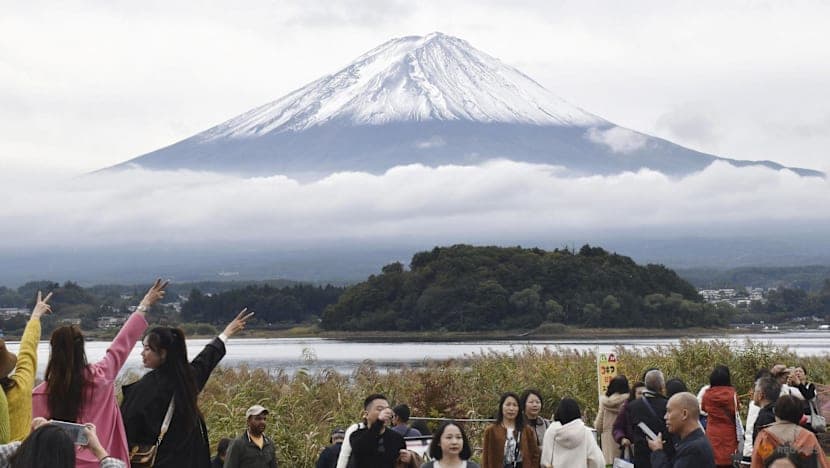
The Price of a Perfect Photo
For a decade, the city of Fujiyoshida in central Japan’s Yamanashi Prefecture hosted a spring celebration that seemed to distill the entire nation into a single photographic frame. The Arakurayama Sengen Park Cherry Blossom Festival offered visitors an almost surreal vista: delicate pink cherry blossoms cascading around the vermilion five-story Chureito Pagoda, with the snow-capped peak of Mount Fuji rising majestically in the background. This carefully composed view became a social media phenomenon, propelling a relatively quiet community of 45,000 residents into the global spotlight and drawing approximately 200,000 visitors annually to streets never designed for such crowds.
- The Price of a Perfect Photo
- When the Cherry Blossoms Stop Blooming for Tourists
- The Breaking Point: When Visitors Crossed Every Line
- Numbers That Overwhelmed a Small City
- Beyond Fujiyoshida: A Nation Grappling with Its Own Popularity
- The Sacred Mountain Under Siege
- The Economic Paradox of Popularity
- What Spring Will Bring Without the Festival
- A Global Pattern of Destination Resistance
- The Essentials
That era ended abruptly on February 3, when Mayor Shigeru Horiuchi announced the cancellation of the 2026 festival, declaring that overtourism had transformed the community’s pride into a source of deep crisis. The decision marks one of Japan’s most significant concessions to the mounting pressures of mass tourism, highlighting a growing tension between the economic benefits of foreign visitors and the preservation of daily life for local citizens who found their neighborhood increasingly unrecognizable.
When the Cherry Blossoms Stop Blooming for Tourists
The cancellation stems from what officials describe as an existential threat to community dignity. First established in April 2016, the festival was initially conceived as a modest municipal effort to boost local appeal and create a lively atmosphere during sakura season. What began as a gentle promotional push evolved into a weeks-long invasion that brought roughly 10,000 people daily into narrow residential streets during peak bloom periods, fundamentally altering the character of the neighborhood.
In a candid statement explaining the decision, the city government acknowledged that the festival had succeeded too well, generating harmful overtourism that exceeded the community’s capacity to absorb visitors while maintaining residents’ safety and privacy. The municipality emphasized that for locals, Mount Fuji represents not merely a backdrop for photographs but an integral part of their identity and daily existence.
Behind this beautiful landscape is the reality that the quiet lives of citizens are threatened. We have a strong sense of crisis. To protect the dignity and living environment of our citizens, we have decided to bring the curtain down on the 10-year-old festival.
Mayor Horiuchi personally signed the proclamation, signaling that the festival’s cancellation represents a calculated choice to prioritize civic wellbeing over tourism revenue, a reversal of the municipal strategy that had prevailed for the previous decade.
The Breaking Point: When Visitors Crossed Every Line
While crowd size provided the statistical justification for cancellation, it was the specific behavior of tourists that transformed inconvenience into intolerable intrusion. City officials compiled a disturbing catalogue of complaints that ranges from the inconsiderate to the truly shocking, detailing violations that invaded the most private spaces of residential life.
Residents reported chronic traffic congestion that gridlocked streets designed for local traffic rather than tour buses. Pedestrians described being jostled off sidewalks by camera-wielding visitors, with parents particularly distressed about children being forced to walk in streets during school commutes. One specific complaint noted that large crowds gathered along narrow pavements to reach popular photo spots, pushing children aside on their school routes.
The violations escalated from public nuisance to private invasion. Multiple residents reported tourists opening private home doors without permission to request bathroom access, effectively invading domestic space. In especially egregious cases, visitors were caught defecating and urinating in residential gardens, then creating confrontations when challenged by property owners. Additional complaints included littered cigarette butts, trespassing on private property, and general disregard for residential boundaries. Such incidents transformed the festival from a temporary inconvenience into what residents experienced as a sustained assault on their domestic privacy and property rights.
Numbers That Overwhelmed a Small City
The crisis in Fujiyoshida cannot be separated from Japan’s broader tourism explosion. The nation welcomed approximately 42.7 million foreign tourists in 2025, shattering the previous record of 37 million set in 2024. This surge has been fueled by a historically weak yen that makes Japanese destinations extraordinarily affordable for visitors holding dollars, euros, or other major currencies, effectively turning the archipelago into a bucket list bargain for international travelers.
The Arakurayama Sengen Park experienced a 50% increase in visitors during the 2024 festival season compared to previous years, drawing an estimated 270,000 people, up from 180,000 in earlier editions. Social media algorithms amplified the location’s popularity, with the specific framing of pagoda-plus-Fuji becoming a mandatory shot for travel influencers and casual tourists alike. The result was a human traffic jam that transformed a contemplative cultural experience into a competitive scramble for camera position, with waiting times to enter the park’s observation deck sometimes stretching up to three hours.
The demographic shift proved significant. While the festival initially attracted primarily domestic visitors, recent years saw an explosive increase in foreign tourists who often lacked familiarity with local customs and behavioral expectations. The weak yen effectively discounted Japan’s cultural treasures, encouraging a volume of travel that local infrastructure could not sustainably accommodate.
Beyond Fujiyoshida: A Nation Grappling with Its Own Popularity
The problems in Yamanashi Prefecture mirror challenges emerging across Japan’s most iconic destinations. In Kyoto’s historic Gion district, home to traditional geisha and their teenage apprentices known as maiko, residents have resorted to fining tourists 10,000 yen (approximately $68) for entering private streets. This measure follows reports of visitors harassing performers by grabbing kimonos, blocking pathways for unauthorized photographs, and refusing to respect the performers’ privacy.
Nearby Fujikawaguchiko Town gained international attention in May 2024 when officials erected an unprecedented screen that obscures the view, measuring 2.5 meters high and 20 meters wide behind a Lawson convenience store. The black barrier was specifically designed to block the iconic shot of Mount Fuji appearing to float above the store’s roof, a composition that had become wildly popular on Instagram. Tourists had been trespassing on private dental clinic property and crossing busy single-lane roads without using designated crossings to capture the perfect angle, prompting the town to describe the barrier as a last resort after security guards and English signage failed to deter bad behavior.
Lawson’s corporate headquarters issued a formal apology to local residents for the inconvenience and concern caused by the store’s unintended popularity, though the company had done nothing to encourage the photography trend. The convenience store chain also committed to installing multilingual warning signs and considering private security to manage crowds.
The Sacred Mountain Under Siege
The overtourism threat extends beyond inconvenience into the realm of environmental and cultural preservation. Mount Fuji, a UNESCO World Heritage Site since 2013, faces potential delisting if authorities fail to address crowding and environmental degradation. The International Council on Monuments and Sites (ICOMOS), which advises UNESCO, explicitly warned Japanese officials that to preserve sacredness of the mountain, overtourism must be addressed.
The statistics justify international concern. The fifth station, the largest base camp for climbers, received 4 million visitors during the summer of 2023, representing a 50% increase since the UNESCO designation in 2013. During official climbing season, more than 400,000 people summited the 12,388-foot peak, creating human traffic jams on narrow trails and generating approximately 61 rescue calls in 2023 from ill-prepared hikers.
Environmental damage includes erosion, litter accumulation, and increased carbon emissions from the sheer volume of visitors. Additionally, many hikers adopted the dangerous practice of bullet climbing, starting late at night and hiking without rest until reaching the summit at dawn. This strategy has resulted in more injuries and altitude-related illnesses, particularly among inexperienced climbers attempting the trek without proper acclimatization.
In response, authorities implemented a daily cap of 4,000 climbers starting July 2024, along with a 2,000 yen ($13.50) entry fee intended to fund conservation efforts, trail maintenance, and safety enforcement. These measures represent attempts to manage access without completely severing the economic lifeline that tourism provides to mountain communities.
The Economic Paradox of Popularity
The cancellation highlights a painful economic paradox facing Japanese municipalities. Tourism generated record revenues for Japan in 2024 and 2025, with regional areas particularly dependent on visitor spending for economic survival. Yet the very success of these destinations threatens to destroy the authentic cultural and natural environments that attracted visitors initially.
Kyoto has responded with Japan’s highest-ever hotel tax, approved in October 2025 and effective in 2026. The tiered system charges luxury hotel guests up to 10,000 yen (approximately $58) per night, with mid-range stays incurring 4,000 yen and budget accommodations facing lower rates. Officials emphasize the tax is not intended to discourage tourism but to ensure visitors contribute to the infrastructure and maintenance required by their presence. Funds will be reinvested in public transport, waste management, and heritage preservation.
Fujiyoshida’s more drastic measure, festival cancellation entirely, suggests that for some communities, the point of no return has already been reached. The economic loss of 200,000 potential visitors was deemed preferable to the continued degradation of residential life. Mayor Horiuchi has articulated a vision of transforming the city into a sustainable tourism city where residents can coexist with visitors without sacrificing their dignity or domestic tranquility.
What Spring Will Bring Without the Festival
Officials acknowledge a grim reality: canceling the festival may prove largely symbolic. The cherry trees will still bloom in April and May. The park will remain open. The Instagram-famous view will still exist, and social media momentum may continue driving visitors regardless of official programming. The municipality admitted that even without the festival, the venue may still see a spike in visitors as spring nears.
The city is preparing for this inevitability by deploying security guards and traffic direction staff during the first half of April, establishing temporary parking areas, and installing portable restroom facilities to reduce the burden on residential neighborhoods. Warning signs will remind visitors to use public transportation, refrain from entering residential areas, and avoid taking unauthorized photos of private property. Wait times to enter the park’s observation deck are still expected to stretch up to three hours during peak season.
Notably, the city government included the iconic promotional photograph in its cancellation announcement, an inadvertent reminder that the beauty which drew crowds remains potent and accessible. The festival name and official promotion will disappear from tourism websites, but the view itself cannot be retracted. The quasi-festival structure, which previously included vendor stalls and official programming, will cease, but the natural attraction remains.
A Global Pattern of Destination Resistance
Japan’s struggles reflect a worldwide reassessment of unrestricted tourism growth. In Italy, Rome introduced a 2 euro fee to access the Trevi Fountain viewing area in 2025, while Venice implemented day-tripper permits costing 5 to 10 euros for peak season visits. These measures represent a global shift from quantity to quality in tourism management, prioritizing resident quality of life and monument preservation over sheer visitor numbers.
For Fujiyoshida, the cancellation represents a line in the sand. Whether the city can achieve sustainable tourism depends not on municipal policy alone, but on whether tourists can learn to visit without acting with disrespect, as local publications characterized the behavioral failures that precipitated the crisis. The city has stated it will take in feedback from locals and stakeholder organizations before determining any future for the festival, suggesting an extended hiatus rather than a permanent termination.
The Essentials
- The Arakurayama Sengen Park Cherry Blossom Festival in Fujiyoshida has been cancelled after 10 years due to overtourism and visitor misbehavior including trespassing and sanitation violations
- The festival attracted approximately 200,000 visitors annually, with 2024 seeing 270,000 attendees and peak days bringing 10,000 people to the city of 45,000 residents
- Resident complaints included tourists entering private homes without permission to use bathrooms, defecating in residential gardens, littering cigarette butts, and forcing children to walk in streets due to overcrowded sidewalks
- Japan recorded 42.7 million foreign tourists in 2025, a record high fueled by a weak yen currency exchange rate that made the country a bargain destination
- Other anti-overtourism measures in the region include a 2.5 meter by 20 meter view-blocking barrier at a Lawson convenience store in Fujikawaguchiko, a 4,000-person daily cap on Mount Fuji climbers, and Kyoto’s 10,000 yen fines for entering private streets in the Gion district
- Mount Fuji’s UNESCO World Heritage Site status faces potential threat from ICOMOS if overtourism and environmental degradation are not adequately managed
- The park remains open for spring 2026 despite the festival cancellation, with security and temporary facilities deployed to manage expected crowds, though the event name has been removed from official tourism promotion