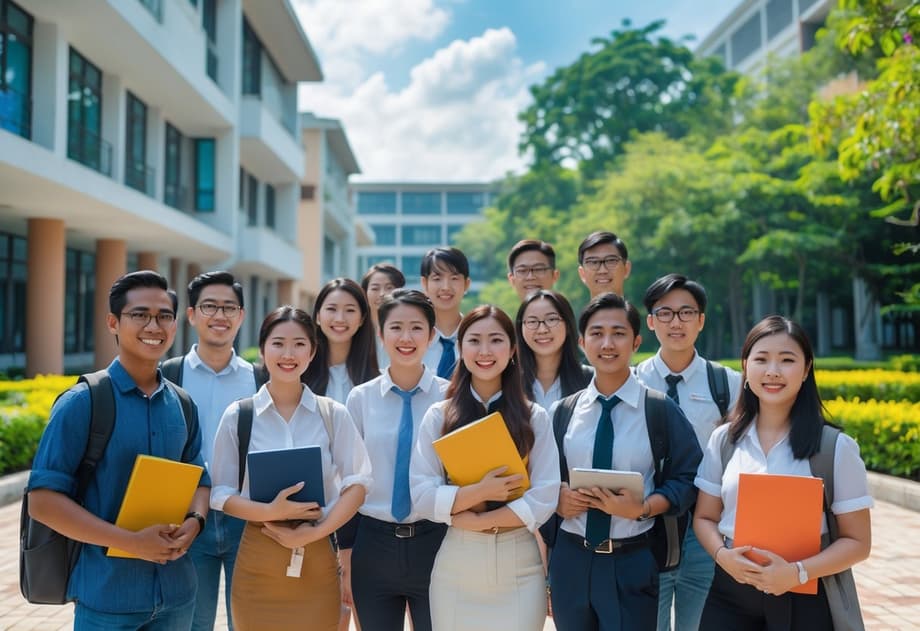
A New Era in Global Education
Global student mobility is undergoing a profound transformation as rising costs and policy uncertainties in traditional destinations push learners toward emerging alternatives. Vietnam has secured its position among the world’s top eight emerging study abroad destinations according to EduOpinions, a respected international education review platform that attracts nearly 1.3 million annual visits. The Southeast Asian nation now stands alongside established European alternatives such as Italy, Spain, Portugal, Poland, and Lithuania as a viable option for international students seeking quality education without the financial burden of traditional Western hubs.
According to rankings released in December and based on verified student reviews collected during 2024-2025, Vietnam achieved an overall satisfaction rating exceeding 4.5 out of five stars. This figure surpasses the average score of 4.38 recorded for institutions in the United Kingdom during the same period, marking a significant milestone in the country’s educational development. All countries featured in EduOpinions’ emerging destinations list maintained average scores above four stars, indicating a consistent level of quality across these alternative markets.
This recognition reflects a broader turning point in the global education landscape. In 2022, nearly half of all international students worldwide were concentrated in just ten traditional destinations including the United States, the United Kingdom, Canada, Australia, France, and Germany. Today, that concentration is gradually giving way to emerging education hubs where value for money and quality of experience are becoming decisive factors in student decision-making.
The Affordability Advantage
Rising tuition fees and living costs in established study destinations are prompting students and families to reassess return on investment. Vietnam stands out by offering what EduOpinions describes as a dual advantage: access to internationally recognized learning environments combined with living costs estimated to be three to four times lower than those in major cities such as London or New York. This cost differential is becoming increasingly decisive as global economic pressures affect household budgets.
British University Vietnam (BUV), cited by EduOpinions as a leading example of the country’s international education sector, offers undergraduate tuition fees averaging approximately €7,000 ($8,212) per year. Annual living costs in Hanoi range from roughly €5,600 to €7,300, placing the total cost of study significantly below equivalent programs in the UK or US. For many students, this represents an opportunity to obtain a quality degree without accumulating substantial debt.
Karunaratne Chaanakya Rahel, a second-year student from Sri Lanka enrolled in BUV’s Data Science and Artificial Intelligence programme, illustrates this shifting calculus. He initially planned to study in Germany, with Vietnam not featuring in his original considerations.
“At first, I was thinking about studying in Germany, and Vietnam was not my first choice. However, after learning more about the country, I found that studying and living here is far more affordable, while the quality of education and student experience has met, and in some cases exceeded, my expectations.”
Rahel’s experience aligns with broader trends showing that approximately 22,000 international students currently study in Vietnam, with numbers growing as word spreads about the programs available there.
Quality Assurance and Academic Standards
Vietnam’s growing reputation is closely linked to institutional efforts to deliver genuine international learning experiences validated by global standards. BUV has established itself as a pioneer in this regard, becoming the first university in Vietnam to achieve QS 5-Star status for six consecutive years (2022-2028). Additionally, it stands as the first institution in Vietnam and the ASEAN region to receive institutional accreditation from the UK’s Quality Assurance Agency for Higher Education (QAA).
This Triple Quality Assurance model ensures that academic programs meet rigorous international benchmarks while maintaining local relevance. The university provides a range of study options including full-time degree programmes, short-term exchanges, and work-integrated learning opportunities. Student services are designed to assist with both academic and daily life needs, creating a supportive environment for international learners.
A Chinese student enrolled in BUV’s Digital and Social Media Marketing programme highlighted the community atmosphere, noting that the experience encompassed both academic rigor and social engagement.
“I’ve had a very positive experience. The university provides both strong academics and a supportive, engaged community.”
Strategic Position and Long-term Viability
Beyond cost considerations, Vietnam offers strategic advantages that contribute to its appeal as a long-term study destination. EduOpinions highlights the country’s political and economic stability, alongside its strategic location in Southeast Asia, as key factors in its rising profile. International students benefit not only from academic opportunities but also from a distinctive living experience that ranges from world natural heritage sites to vibrant, culturally rich urban centers.
Professor Rick Bennett, Deputy Vice-Chancellor of BUV, stressed these foundational strengths.
“These are precisely the foundations that allow Vietnam to offer international students an ideal balance between academic excellence and long-term career potential.”
The country’s economic momentum creates additional opportunities for graduates. Vietnam continues to attract major multinational investments, particularly in technology and manufacturing sectors. In February 2025, foreign direct investment rose 5.4% year-on-year to $2.95 billion. The information technology market, valued at $8 billion in 2023, is projected to reach $13 billion by 2026, generating demand for graduates in software engineering, computer science, and artificial intelligence.
The Global Context: Shifting Away from Traditional Hubs
Vietnam’s rise occurs against a backdrop of significant challenges facing traditional destination countries. Policy volatility in the United States has created uncertainty for international students, with institutions reporting declining enrolments amid visa restrictions and anti-immigrant rhetoric. The University of Washington recently recorded a 5-7% decline in new international enrolments, while the overall drop across US institutions reached 17% in some analyses.
Similarly, the United Kingdom has seen rising tuition fees and living costs that place financial strain on international students. Canada’s immigration policy shifts and Australia’s visa rejection rates, which reached 24.3% for Indian students in 2023, have further complicated the landscape for prospective learners.
This environment has created opportunities for alternative destinations across multiple continents. Germany currently hosts around 420,000 international students, with tuition-free universities and English-taught programs driving growth. Hungary has seen applications for its Stipendium Hungaricum scholarship surge to over 113,800 this year, competing for just 5,000 places. France hosted nearly 445,000 international students in 2024-25 and aims to reach 500,000 by 2027.
In Asia, South Korea surpassed its target of 300,000 international students two years ahead of schedule, with Vietnam itself being a major source market for Korean institutions. Malaysia is targeting 250,000 international students by 2030, while Japan aims for 400,000 by 2033.
Expanding Infrastructure and Future Ambitions
Vietnam’s education sector is witnessing significant infrastructure investments that support its international ambitions. In late 2025, Khoi Nguyen Investment Group (KNI) and Ardingly College International announced plans to establish Ardingly College Vietnam in Lao Cai province, the first British-style boarding school in the country. Scheduled to open in the 2026-2027 academic year, the institution will cater to students aged 11 to 18, offering both international and bilingual pathways.
This development reflects the elevation of UK-Vietnam relations to a comprehensive strategic partnership, which has created favorable conditions for educational collaboration. Ben Figgis, head of Ardingly College UK, noted that this partnership paves the way for the export of high-quality British education to Vietnam while enabling local students to access international-standard curricula.
The boarding school aims to become a regional hub attracting students from China, Laos, Cambodia, ASEAN nations, South Korea, India, and Japan. This expansion beyond higher education into K-12 international schooling demonstrates the depth of Vietnam’s growing education ecosystem.
For India specifically, Vietnam has emerged as a strategic destination for students seeking British-accredited degrees at accessible price points. With UK visa restrictions tightening and costs rising, Indian students are increasingly turning to transnational education hubs like Vietnam. British University Vietnam offers scholarships of up to 100% tuition for Indian students, with degrees awarded from five top UK universities and academic direction from the London School of Economics.
Key Points
- Vietnam ranks among the top eight emerging study abroad destinations globally according to EduOpinions, alongside Italy, Spain, Portugal, Poland, and Lithuania
- The country achieved a student satisfaction rating exceeding 4.5 out of 5, surpassing the UK average of 4.38 for 2024-2025
- Living costs in Vietnam are estimated to be three to four times lower than in major cities like London or New York
- Approximately 22,000 international students currently study in Vietnam, with the number growing steadily
- British University Vietnam (BUV) is the first university in Vietnam to achieve QS 5-Star status for six consecutive years (2022-2028) and the first in ASEAN to receive UK QAA institutional accreditation
- Undergraduate tuition at BUV averages approximately €7,000 ($8,212) per year, significantly below comparable UK or US programs
- Vietnam benefits from political stability, economic growth, and strategic location in Southeast Asia
- New infrastructure investments include Ardingly College Vietnam, a British-style boarding school opening in 2026
- The country is increasingly viewed as a stable, long-term education option amid policy volatility in traditional Western destinations