A Sea of Mourners Floods Dhaka Streets
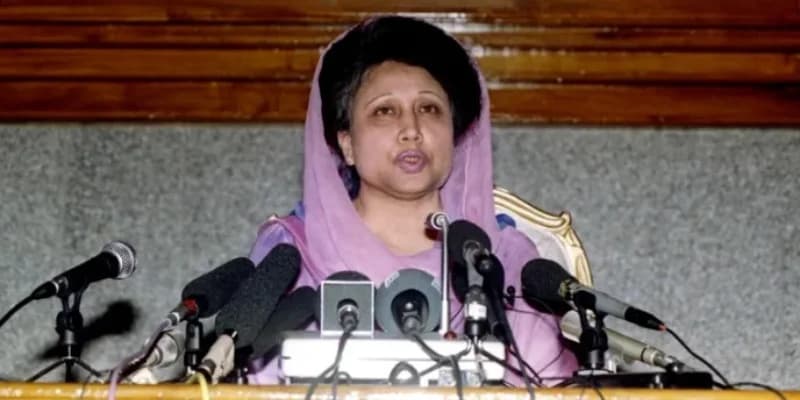
Dhaka stood still yesterday as millions gathered to pay their final respects to Khaleda Zia, Bangladesh’s first female prime minister and a towering figure in South Asian politics. From Agargaon in the north to Shahbagh in the south, mourners filled every thoroughfare and alleyway, transforming the capital into an ocean of grief. The unprecedented outpouring demonstrated the profound impact Zia had on a nation she led for decades.
People arrived by every conceivable means. Some travelled by bus, truck, train, private car, or motorcycle. Others walked on foot for hours just to catch a glimpse of the proceedings. By the time the funeral prayers began, the crowd had spilled onto alleyways connected to Manik Mia Avenue, spread to Sobhanbagh and Farmgate, with lines of the bereaved stretching kilometers away to Shahbagh. Even the elevated expressway and rooftops of nearby buildings were packed with people seeking a final view of the leader they called their own.
Elderly citizens stood alongside women and young people, many visibly emotional as they waited for hours under the sun. The gathering was not limited to political supporters. People from all walks of life, including those who had never voted for her, came to honor a woman who had devoted her lifetime to democracy. State authorities brought gun salutes, floral wreaths, and a guard of honor, but the truest farewell came from people standing kilometers away, their palms outstretched to the heavens in prayer.
“She was not only the leader of a party, but a leader of the people irrespective of political backgrounds,” said one mourner standing near the Asad Gate.
The government deployed approximately 10,000 security personnel, including soldiers, to manage the massive crowds and ensure smooth movement. Traffic on surrounding roads came to a complete standstill. Authorities urged people to remain calm and follow instructions to avoid chaos as the nation said goodbye to its former leader.
State Honors for a Democratic Icon
The funeral proceedings began at 7:00am at the South Plaza of the Jatiya Sangsad Bhaban, Bangladesh’s parliament building. BNP leaders and activists arrived from across Dhaka and other districts starting in the early morning hours. They were joined by ordinary citizens who had heard about the funeral and wanted to participate in this historic moment of national mourning.
Microphones had been installed across the venue and surrounding areas, with recitations from the Holy Quran ongoing throughout the morning. The atmosphere was solemn yet charged with emotion as people waited patiently for the arrival of the body. When the flag-draped hearse finally brought Khaleda Zia to the South Plaza around 11:46am, a hush fell over the crowd before prayers and tributes began.
Chief Adviser Professor Muhammad Yunus, who heads Bangladesh’s interim government, attended the funeral prayers. Chief Justice Zubayer Rahman Chowdhury was also present, along with BNP Secretary General Mirza Fakhrul Islam Alamgir, Bangladesh Jamaat-e-Islami Ameer Dr Shafiqur Rahman, the chiefs of the three military services, and National Citizen Party Convener Nahid Islam. The presence of officials from across the political spectrum underscored the unity this moment had brought to the divided nation.
Mufti Abdul Malek, khatib of the Baitul Mukarram National Mosque, led the namaz-e-janaza, the Islamic funeral prayer. The service drew thousands who bowed in prayer alongside the political elite, bridging the gap between the corridors of power and the streets of Dhaka. After the prayers ended at 3:05pm, the procession moved toward the final resting place.
Flags flew at half-mast across the country throughout the day. The interim government had announced three days of mourning and declared Wednesday a public holiday to honor the three-time prime minister’s legacy. Banks, factories, and government offices remained closed, while universities suspended academic activities. The Dhaka Metropolitan Police even banned fireworks, lanterns, and cultural programs in the capital as a mark of respect.
International Dignitaries Pay Their Respects
The funeral attracted significant international attention, with foreign envoys and representatives from 32 countries joining the ceremony. India’s External Affairs Minister S Jaishankar attended to represent his country, as did Pakistan’s National Assembly Speaker Sardar Ayaz Sadiq and Bhutan’s Foreign Minister Lyonpo DN Dhungyel. Nepal’s interim Prime Minister Sushila Karki and representatives from Sri Lanka, the Maldives, China, and Russia also sent delegations.
Jaishankar handed over a condolence letter from Prime Minister Narendra Modi to Tarique Rahman, Zia’s son. In his message, Modi expressed hope that Zia’s vision and legacy would continue to guide the partnership between India and Bangladesh. This diplomatic presence highlighted the regional significance of Zia’s passing and her role in South Asian geopolitics.
A Son’s Farewell to His Mother
The most poignant moment of the funeral came when BNP acting chairman Tarique Rahman addressed the crowds just before the prayers began. He spoke not as a politician or party leader, but as a grieving son saying goodbye to his mother. There were no words of politics, no talk about Khaleda’s authorship in the story of Bangladesh, nor any reference to the injustices she faced during her years in prison and under house arrest.
“I am Tarique Rahman, the eldest son of the late Khaleda Zia,” he said, dropping all political hats before a crowd that already recognized him as the chief of the largest political party contesting the upcoming national election.
He simply asked for forgiveness on her behalf as a mother, touching the hearts of millions who watched. The raw humanity of the moment transcended political divisions, revealing the personal loss behind the public mourning. Earlier in the day, Zia’s body had been taken to Tarique’s residence, House 196 on Gulshan Avenue. It was a home she visited at last, only in death. His return to Bangladesh on December 25 came when she lay critically ill in hospital, never to rise again. There, a grief-stricken Tarique sat alone on a chair inside, reciting verses from the Holy Quran for his mother.
Tarique had been in self-imposed exile in London for 17 years before returning to Bangladesh just last week. His homecoming was bittersweet, arriving only when his mother was too ill to recognize him properly. The emotional scenes at the family residence before the public funeral captured the private tragedy behind the national mourning.
After the namaz-e-janaza, Tarique descended into his mother’s grave to receive her body. With his gaze lowered, he scooped handfuls of soil and gently poured them over his mother. Family and party members stretched a grave-sized flag over her burial ground. A guard of honor fired three volleys into the air, and the bugle sounded the Last Post, signalling that Khaleda’s duty was done and she could finally rest in peace.
From Homemaker to Prime Minister
Khaleda Zia’s political journey reads like a dramatic novel. Born in 1945 in what was then British India, she lived through the partition and the birth of Bangladesh in 1971. Her entry into politics came through tragedy rather than ambition. Her husband, Ziaur Rahman, was a military officer who became president of Bangladesh after the turbulent years following independence. He was assassinated in a military coup in 1981 when Khaleda was just 36 years old.
Suddenly widowed with two young sons, Khaleda was thrust into a role she had never sought. She became the chairperson of the Bangladesh Nationalist Party (BNP), which her husband had founded. Her political rise was meteoric. In 1990, she joined forces with her archrival Sheikh Hasina, daughter of Bangladesh’s founding father, to lead a popular uprising that toppled military ruler General Hussain Muhammad Ershad. The mass movement restored democracy to Bangladesh after years of authoritarian rule.
Khaleda Zia first became prime minister in 1991 after a landslide victory when parliamentary democracy was introduced. She served until 1996, then returned to power from 2001 to 2006. As the first woman to serve as prime minister in the South Asian nation of 170 million people, she broke barriers and inspired generations of women to enter politics. Her calm demeanor and unwavering resolve earned her respect even from opponents.
“Khaleda Zia has been an inspiration,” said mourner Sharmina Siraj, a mother of two. “Stipends introduced by the former leader to improve women’s education made a huge impact on the lives of our girls.”
During her time in power, Khaleda moved Bangladesh from a presidential system to a parliamentary one, placing authority in the hands of the prime minister. She eased restrictions on foreign investment and introduced free and compulsory primary education. Her government maintained the confidence of the business community by following pro-investment, open market policies. These economic reforms laid groundwork for Bangladesh’s remarkable growth in subsequent decades.
The Battling Begums
Bangladeshi politics for the past three decades has been defined by the intense rivalry between Khaleda Zia and Sheikh Hasina. The two women, dubbed the “battling Begums,” traded power back and forth as their parties alternated in government. “Begum” is an Urdu honorific for married women of status, and their personal enmity became the stuff of political legend.
Both had suffered profound loss. Hasina’s father, Sheikh Mujibur Rahman, Bangladesh’s founding father, was assassinated in a 1975 coup along with most of her family. Khaleda’s husband was assassinated in 1981. These shared tragedies initially brought them together in the fight against military dictatorship, but their alliance fractured once democracy was restored.
What followed was decades of bitter political struggle. They boycotted elections when out of power, accusing each other of rigging votes when in government. Their rivalry paralyzed Bangladesh’s institutions at times, as civil servants, police, and judiciary were pressured to take sides. International observers frequently expressed concern about the deterioration of democracy under both leaders.
Yet there was grudging respect between them. Despite years of personal attacks and political maneuvering, both women remained committed to Bangladesh’s democratic process, however imperfectly implemented. Their domination of national politics meant that for three decades, no other political figure could emerge as a viable national alternative. The recent popular uprising that ousted Hasina in August 2024 opened new possibilities, but the shadow of the battling Begums still loomed over Bangladesh’s political landscape.
Years of Resistance and Imprisonment
Khaleda Zia’s final years were marked by struggle against what she termed politically motivated persecution. After losing power in 2006, she spent most of the next 18 years either in prison or under house arrest. In 2018, she was sentenced to 17 years in jail in two separate corruption cases involving misuse of power and embezzlement of funds meant for a charity named after her late husband.
Her party insisted the charges were fabricated to weaken the opposition and remove her from politics before elections. The Hasina government maintained that the cases were matters for the courts and that it did not interfere. International human rights organizations expressed concern about the politicization of Bangladesh’s judiciary during this period.
Even while imprisoned, Khaleda refused to compromise on her principles or leave the country. Her family sought permission at least 18 times for her to travel abroad for medical treatment, but the requests were rejected. Critics accused Hasina of being vindictive, while supporters argued that no one should be above the law. The standoff continued until the August 2024 uprising that unseated Hasina.
After the popular revolution that brought Nobel Peace Prize laureate Muhammad Yunus to power as interim leader, Khaleda was finally allowed to travel abroad. She went to London in January 2025 and returned to Bangladesh in May. In a dramatic legal development, the Supreme Court acquitted her in the final corruption case in January 2025, clearing the way for her to contest the general election scheduled for February 2026.
Despite her failing health and advanced age, Zia intended to run for parliament in three constituencies according to the BNP’s candidate list released earlier this month. Her determination to participate in the electoral process, even from a hospital bed, demonstrated her unwavering commitment to democratic politics.
A Nation’s Loss and Future Questions
The massive crowds at Khaleda Zia’s funeral surprised even seasoned political observers. Hundreds of thousands attended, including people who had never voted for her BNP party. Retired government official Minhaz Uddin, 70, came despite never having supported her politically.
“I came here with my grandson, just to say goodbye to a veteran politician whose contributions will always be remembered,” Uddin said, watching from behind a barbed wire barricade.
This cross-party respect for Khaleda Zia suggests that her legacy extends beyond her electoral achievements. She is remembered as a symbol of resistance against authoritarianism, a woman who endured repeated arrests, denial of medical care, and what her supporters called relentless persecution. Her resilience in the face of personal and political setbacks drew admiration even from critics.
Those who worked with her recall a leader who asked probing questions while making key decisions. Economist Dr Debapriya Bhattacharya noted that she left a lasting impression as “a political leader who appreciated ideas and valued informed decision-making.” This intellectual curiosity contrasted with the populist style of many South Asian politicians.
With Khaleda’s passing, questions arise about the future of Bangladeshi politics. Her son Tarique Rahman, 60, is now the acting chairman of the BNP and expected to lead the party into the February elections. His return from exile and presence at his mother’s funeral suggests he intends to claim the political mantle she leaves behind. The BNP is widely seen as a frontrunner in the upcoming polls, and if they win a majority, Tarique is expected to become the country’s new leader.
However, Tarique carries his own political baggage. He was accused of corruption and running a parallel government during his mother’s tenure. His years in exile kept him removed from grassroots politics. Whether he can command the same respect and emotional connection that his mother enjoyed remains to be seen. The massive turnout at her funeral was as much a personal tribute as a political statement, and translating that emotion into electoral support for her son will be challenging.
A Final Reunion
The burial ceremony at Zia Udyan in Sher-e-Bangla Nagar brought the day’s proceedings full circle. Khaleda Zia was laid to rest beside her husband Ziaur Rahman, martyred president and founder of the BNP. The burial took place at around 4:30pm, completing a journey that began 44 years ago when assassination claimed her husband and transformed her life forever.
Khaleda was widowed at the age of 36, thrust unexpectedly into the center of Bangladeshi politics. Yesterday, the two were finally reunited in death, bringing closure to a story of love, loss, and extraordinary political transformation. The grave, situated in a park outside the parliament building where she had served as prime minister, will become a site of pilgrimage for her supporters and a monument to her place in the nation’s history.
A guard of honor fired three volleys into the air as the burial concluded. The bugle sounded the Last Post, signalling that Khaleda’s duty was done. With his gaze lowered, Tarique scooped handfuls of soil and gently poured them over his mother. Family and party members stretched a grave-sized flag over her burial ground. It was a moment of profound finality, marking the end of an era in Bangladeshi politics.
As the crowds began to disperse and the sun set over Dhaka, Bangladesh was left to reflect on the legacy of its first female prime minister. Her life spanned the entirety of Bangladesh’s independent existence, from the bloody war of liberation in 1971 to the democratic struggles of the 21st century. She was both a product of her nation’s turbulent history and a shaper of its political development.
Interim leader Muhammad Yunus captured the national mood when he said that Bangladesh had “lost a great guardian.” The three days of mourning declared by the government gave the country time to process this significant loss. Flags remained at half-staff, and people continued to visit the grave to pay their respects.
The February 2026 elections will now take place without the presence of the woman who had dominated Bangladeshi politics for three decades. New leaders will emerge, new coalitions will form, and new directions will be chosen. But the influence of Khaleda Zia on Bangladesh’s democratic journey will endure. Her funeral was not just a farewell to a person, but a recognition of the pivotal role she played in shaping her nation’s destiny.
The Essentials
- Khaleda Zia, Bangladesh’s first female prime minister, died at age 80 after a prolonged illness
- Millions attended her state funeral in Dhaka, filling streets from Agargaon to Shahbagh
- She served as prime minister three times, first taking office in 1991
- Her body was laid to rest beside her husband Ziaur Rahman, assassinated in 1981
- She was imprisoned for years on corruption charges she called politically motivated
- Her son Tarique Rahman is now acting chairman of the BNP party
- Dignitaries from 32 countries attended the funeral ceremony
- Bangladesh declared three days of national mourning and a public holiday
- The BNP is considered a frontrunner in upcoming February 2026 elections