The Countdown to Naval Parity
Beijing is accelerating toward a 435-ship People’s Liberation Army Navy by 2030 while the United States risks falling below 300 battle force vessels. This divergence creates a strategic imbalance with direct consequences for Taiwan, the South China Sea and Indo-Pacific deterrence. The projected expansion represents the most consequential maritime power shift since the United States emerged as the world’s dominant naval power after 1945.
If current construction rates remain unchanged, China could field approximately 141 more battle force vessels than the U.S. Navy by the end of this decade. This numerical advantage fundamentally reshapes military calculations surrounding Taiwan, the South China Sea and the wider Western Pacific. American assessments increasingly warn that China’s accelerating naval construction is no longer merely narrowing a traditional capability gap. Instead, it is beginning to create a structural numerical imbalance Washington may struggle to reverse.
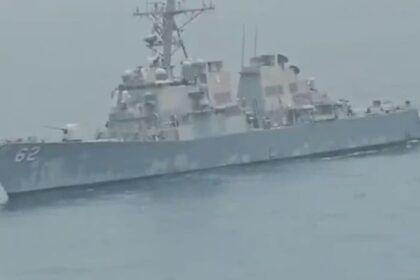
Pentagon projections indicate that the PLAN already exceeds 370 battle force ships today. The fleet could expand toward 395 vessels before 2025 concludes, ultimately reaching 435 ships by 2030. By comparison, the U.S. Navy operated 296 battle force ships during late 2024. Under current funding plans, American forces are projected to decline toward approximately 294 ships by 2030.
Senior American analysts increasingly argue that the most important question is no longer whether China possesses the world’s largest navy. The critical concern is whether Washington can still deter Beijing regionally. One senior congressional assessment delivered a stark warning to lawmakers.
The PLAN is the largest navy in the world, with an expanding fleet that already includes aircraft carriers, submarines, amphibious vessels, destroyers, frigates and fleet auxiliaries.
This assessment reflects the numerical disparity that has intensified because China simultaneously commands approximately 50 percent of global shipbuilding capacity. The United States retains barely 0.13 percent of worldwide shipbuilding output. This industrial asymmetry suggests that Washington cannot simply out-build Beijing to regain numerical superiority.
Industrial Foundations of Maritime Power
China’s projected 435-ship navy is not emerging from isolated defence spending increases. It comes from a national industrial system capable of sustaining naval construction on a scale unmatched anywhere globally. Chinese shipyards are simultaneously producing destroyers, frigates, corvettes, submarines, aircraft carriers, amphibious assault ships, replenishment vessels and coast guard cutters at a tempo no Western country currently approaches.
The PLAN already operates more than 370 battle force vessels. This count excludes approximately 60 missile-armed HOU BEI-class patrol craft that remain outside formal battle force calculations despite their operational significance. Those excluded patrol combatants nevertheless carry anti-ship cruise missiles. They would likely play a major role during any Taiwan contingency, blockade operation or South China Sea confrontation.
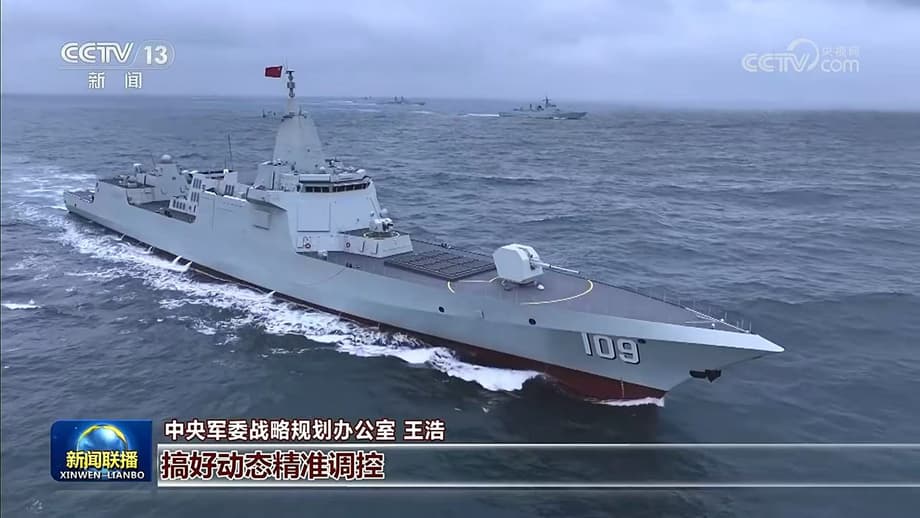
Chinese naval growth remains especially concentrated in major surface combatants. Beijing continues rapid construction of Type 055 destroyers, Type 052D destroyers and modern multi-role frigates. The Type 055 cruiser-sized destroyer is particularly important because its large missile capacity and advanced radar systems increasingly provide the PLAN with blue-water command capabilities.
China is also expanding its carrier fleet, with the aircraft carrier Fujian completing sea trials. Beijing reportedly aims toward approximately nine carriers by 2035. Unlike China’s earlier ski-jump carriers, Fujian incorporates a catapult launch system. This innovation significantly improves the range, payload and sortie rate of embarked aircraft.
Chinese naval planners also appear increasingly focused upon logistics. Replenishment ships, repair vessels and fleet support platforms remain essential for sustained operations beyond coastal waters. Unlike previous decades, Beijing no longer appears focused exclusively upon defending coastal waters. Its new fleet architecture increasingly supports extended maritime operations across the wider Indo-Pacific.
That transformation suggests Chinese leaders increasingly view naval power not merely as a defensive instrument. They see it as the principal mechanism for reshaping regional strategic geography. China is simultaneously building additional Type 075 amphibious assault ships and Type 071 landing platform docks. These vessels create the sealift capacity necessary for larger expeditionary operations.
Taiwan and the Anti-Access Strategy
China’s accelerating naval expansion is closely tied to a military strategy designed primarily for Taiwan, the East China Sea and the wider South China Sea. Beijing’s growing fleet provides the physical capacity necessary to sustain a prolonged blockade around Taiwan. It also creates capabilities for deterring, delaying or fragmenting potential American intervention.
A larger Chinese navy enables Beijing to maintain continuous pressure across multiple maritime flashpoints simultaneously. This includes disputed islands, contested shipping routes and critical maritime chokepoints. The PLAN’s expanding inventory of destroyers, missile frigates, submarines and amphibious vessels increasingly supports an anti-access and area-denial strategy centered upon overwhelming nearby adversaries.
That strategy relies upon creating dense layers of missiles, aircraft, submarines and surface combatants. These layers are capable of raising the military cost of intervention beyond politically acceptable thresholds. Chinese warships would not necessarily need to defeat the U.S. Navy globally in order to achieve Beijing’s objectives surrounding Taiwan or the South China Sea. Instead, China would only need to create temporary local superiority near its own coastline. This advantage would need to last long enough to isolate Taiwan or intimidate neighboring states.
A 435-ship PLAN could potentially maintain simultaneous patrols near Taiwan, in the South China Sea and around the East China Sea without exhausting operational reserves. That would allow Beijing to sustain continuous maritime pressure even if one regional crisis overlaps with another elsewhere in the Indo-Pacific.
The numerical growth of the Chinese navy therefore matters because it directly affects Beijing’s ability to generate force rapidly and repeatedly during prolonged crises. China’s near-seas focus means its ships require less endurance than American vessels because they can operate closer to mainland bases, logistics hubs and missile coverage.
The United States, by contrast, must sustain forces across vast Indo-Pacific distances stretching from Guam and Japan toward the Philippine Sea and Indian Ocean. Because Beijing fights close to home while Washington projects power across oceans, China’s larger fleet can generate stronger local concentration despite America’s broader global commitments.
That asymmetry explains why numerical comparisons increasingly matter strategically. Beijing may eventually possess enough vessels to dominate regional waters without matching total American capability.
Capability Gaps and Air Power Advantages
Although China is building more ships, the U.S. Navy still retains clear advantages in tonnage, blue-water endurance, combat experience, logistics integration and carrier aviation. American battle force ships collectively displace approximately 4.5 million tons. China’s current fleet displaces roughly 3.2 million tons despite containing more vessels overall.
The U.S. Navy continues operating approximately 11 aircraft carriers, compared with China’s current inventory of three carriers entering progressively more sophisticated service. American warships generally carry deeper missile magazines, longer operational endurance and more advanced sensors than many Chinese platforms currently entering service.
The United States also benefits from decades of operational experience conducting complex carrier strike group operations, submarine patrols and global maritime logistics under combat conditions. American commanders have accumulated extensive experience operating across multiple theatres simultaneously, including the Persian Gulf, Mediterranean, Arctic and Indo-Pacific.
Yet the qualitative gap continues narrowing because China is commissioning newer vessels faster than the United States can replace aging platforms. Several American shipbuilding programs, including Virginia-class submarines, Ford-class aircraft carriers and new destroyers, continue suffering delays, cost overruns and industrial bottlenecks.
According to assessments from defense analysts including congressional representatives, China does not only possess quantity in terms of naval capability. Beijing also increasingly commands quality. The PLA-Navy builds its fourth aircraft carrier, adds new quasi-stealthy Type 055 destroyers and accelerates the arrival of its new Type 076 amphibious assault ships.
These warships are increasingly armed with advanced surface to air, surface-to-surface and surface-to-land weapons capable of precisely targeting U.S. assets from long ranges. For instance, the PLA-Navy Type 055 Destroyer has test fired the YJ-21 hypersonic missile. This weapon is capable of traveling several thousand miles faster than Mach 5.
Despite these advances, the PLA-Navy operates at a substantial deficit when it comes to sea-launched air power. The service is just now introducing the J-35 5th-generation stealth carrier-launched fighter in very small numbers. The United States operates hundreds of F-35Cs and F-35Bs.
A US Navy America-class amphibious assault ship can deploy with as many as 20 F-35Bs. A single U.S. carrier can launch up to 90 F-35Cs if fully equipped with 5th-generation aircraft. This means China would be unable to launch a 5th-generation stealth air attack from the ocean comparable to American capabilities. The PLA-Navy has no F-35B equivalent capable of vertical takeoff and landing from amphibious warships.
An ability to control the skies and keep Chinese warships at risk from the air would offset any surface warfare advantage the PLA-Navy may have against the U.S. Navy.
America’s Eroding Shipbuilding Base
The United States now confronts a naval challenge driven less by insufficient strategy than by inadequate industrial capacity supporting long-term force generation. Current American plans aim eventually toward 381 manned battle force ships and 134 large unmanned vessels. Those targets remain decades away.
Under existing projections, the U.S. Navy may actually shrink toward approximately 283 battle force ships during 2027 before modest growth resumes afterward. That temporary decline would occur precisely when China continues expanding rapidly. This timing potentially widens the numerical imbalance during the most dangerous years surrounding Taiwan.
American shipyards presently lack the workforce, infrastructure and production scale necessary to compete directly against China’s enormous commercial and military shipbuilding ecosystem. Because Chinese yards build commercial vessels and warships simultaneously, Beijing can exploit economies of scale unavailable to fragmented American industrial networks.
American naval construction also suffers from a shrinking industrial workforce, higher labour costs and long delays in expanding production facilities. The United States has therefore increasingly struggled to replace retired warships quickly enough to maintain existing fleet numbers, let alone expand them.
Congress has repeatedly debated increasing shipbuilding budgets. Additional funding alone cannot immediately solve industrial limitations accumulated across decades. The Virginia-class submarine program is especially important because attack submarines remain one of Washington’s most decisive advantages in a potential Taiwan conflict.
However, repeated production delays have reduced the number of submarines entering service precisely as older Los Angeles-class boats continue retiring. The Ford-class aircraft carrier program has similarly encountered years of delays and higher costs, slowing the replacement of aging Nimitz-class carriers.
American naval planners increasingly warn that even a technologically superior fleet can become strategically inadequate if insufficient numbers are available simultaneously. If those trends persist, Washington could eventually retain a more capable fleet individually while losing the regional force concentration required for effective deterrence.
Strategic Responses and Regional Alliances
Washington is increasingly exploring allied shipbuilding partnerships with Japan and South Korea to supplement domestic naval construction capacity. Such partnerships could eventually reduce pressure upon American yards. South Korean and Japanese shipbuilders possess advanced expertise producing sophisticated maritime platforms rapidly.
South Korea in particular has become increasingly attractive because its shipyards already build some of the world’s most advanced commercial vessels and naval platforms. American officials are also examining whether Japanese and South Korean facilities could support maintenance and repair work for U.S. Navy ships deployed in the Pacific.
However, those measures would still require years before delivering meaningful results. This leaves the United States vulnerable during the remainder of this decisive decade.
Washington has responded by shifting additional naval assets toward the Pacific, accelerating unmanned systems, expanding hypersonic weapons and strengthening alliances including AUKUS and the QUAD. The United States is also increasingly emphasizing distributed maritime operations. Dispersing smaller forces may complicate Chinese targeting and partially offset Beijing’s numerical superiority.
American planners further hope that large unmanned surface vessels and autonomous underwater systems could eventually compensate for the declining number of traditional warships. Yet those systems remain years from full operational maturity. They cannot currently replace the presence, endurance and missile capacity of major surface combatants.
China’s naval growth is therefore occurring faster than America’s technological response can realistically mature during the same period.
Regional governments from Japan and Australia to the Philippines and Vietnam are watching Chinese naval growth with increasing strategic anxiety. Those states increasingly fear that a larger Chinese fleet could eventually weaken confidence in American security guarantees and encourage political accommodation with Beijing.
The financial dimension further intensifies the challenge because replacing American fleet losses or expanding naval production would require tens of billions of dollars annually. A single Ford-class aircraft carrier costs approximately USD13 billion before including escorts, aircraft and lifetime operating expenses. A Virginia-class attack submarine costs approximately USD4.5 billion, illustrating the enormous cost of rebuilding American undersea superiority.
By contrast, China’s lower industrial costs allow Beijing to construct new warships substantially faster and more cheaply than comparable American programs.
The Essentials
- China projects a 435-ship navy by 2030, compared to approximately 294 ships for the United States
- Beijing currently commands roughly 50 percent of global shipbuilding capacity versus 0.13 percent for Washington
- The numerical gap creates strategic pressure around Taiwan and the South China Sea
- America retains advantages in carrier aviation, stealth fighters, and blue-water experience
- Industrial partnerships with Japan and South Korea may help offset U.S. shipbuilding shortfalls
- The balance of power in the Indo-Pacific may depend on whether Washington can reverse fleet decline before 2030