Decades to Months: The New Timeline for Desert Restoration
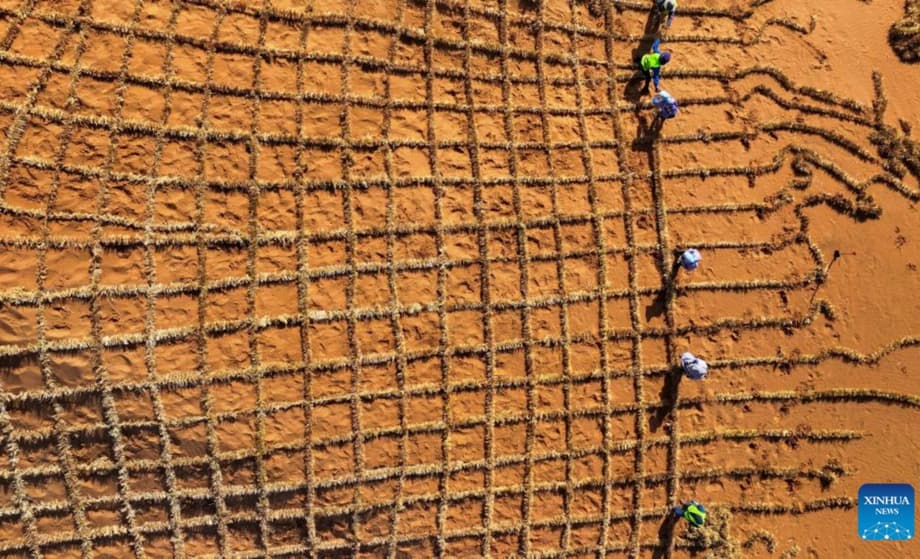
Scientists in China have developed a method to transform shifting desert sand into stable, fertile soil within 10 to 16 months using laboratory cultivated microbes, a process that previously required several decades. The breakthrough, documented by the Chinese Academy of Sciences (CAS) near the Taklamakan Desert in Xinjiang, harnesses cyanobacteria to create biological soil crusts that bind sand grains together, preventing wind erosion while building organic matter. The technique represents a significant acceleration of natural desert restoration processes. Historical records tracking crust growth across 59 years of desert recovery showed that adding laboratory grown cyanobacteria shortened this timeline from decades to mere months. The rapid stabilization provides restoration teams with a critical window to establish vegetation before harsh winds and extreme temperatures destroy young plants. Straw checkerboard barriers laid across northwest China serve as the foundation for this process, with treated plots showing dark films that persist after seasonal dust storms and temperature extremes. This biological approach offers a potential solution to the limitations of traditional afforestation methods that require extensive irrigation and decades to mature. Under the microscope, these cyanobacteria form a mesh of bacterial threads wrapped around sand grains, exuding sticky sugars that harden into a cohesive layer. This living glue reduces wind driven soil loss by more than 90 percent according to laboratory tests, creating a stable surface where seedlings can establish roots. The method has been tested in the harsh conditions of the Taklamakan, where summer temperatures soar and winter brings freezing conditions, demonstrating resilience across seasonal extremes.
- Decades to Months: The New Timeline for Desert Restoration
- How Ancient Bacteria Build Soil from Sunlight and Air
- Ecological Succession: From Microbes to Moss
- Carbon Capture in the Sands: Complementing the Great Green Wall
- Scaling Up: From Taklamakan Trials to National Policy
- What Limits Can Microbial Restoration Overcome?
- Global Lessons for Arid Land Recovery
- Key Points
How Ancient Bacteria Build Soil from Sunlight and Air
Cyanobacteria, which likely appeared approximately 3.5 billion years ago, function as microscopic ecosystem engineers. These sunlight powered bacteria perform photosynthesis, pulling carbon dioxide from the air and releasing simple organic compounds. In nutrient poor desert environments, certain strains also perform nitrogen fixation, converting atmospheric nitrogen gas into plant ready nutrients, effectively creating fertilizer from thin air. The bacteria colonize straw checkerboard barriers laid across the sand, forming thin living layers that withstand seasonal dust storms and temperature extremes. Once established, these organisms initiate a transformation that turns barren mineral surfaces into budding soil ecosystems capable of supporting higher plant life.
The Sticky Foundation of New Soil
Under microscopic examination, the biological soil crusts reveal a complex mesh of bacterial threads wrapped around individual sand grains. The cells exude sticky sugars that harden into a thin, cohesive layer, essentially gluing the sand together. This crust reduces wind driven soil loss by more than 90 percent in laboratory tests, according to research published in Soil Biology and Biochemistry. Within the first year, the treated surface begins retaining nutrients in the top inch of soil rather than allowing them to blow away. Dead microbial cells and leaked sugars mix with drifting mineral dust to form organic matter that traps nitrogen and phosphorus, creating the initial building blocks of fertile soil in an environment previously devoid of such resources.
Ecological Succession: From Microbes to Moss
As the crust matures, the community evolves from predominantly microbes to a mixed cover including lichens and small moss patches. Research from the Tengger Desert spanning 53 years of restoration shows that lichens add toughness to the surface, while moss provides height and shade that shelters new microbes and retains moisture in tiny pockets. However, this succession requires protection, as footsteps, vehicle traffic, and grazing can fracture the delicate surface, potentially setting back recovery by years. The progression from simple bacterial mats to complex lichen and moss communities marks the transition from initial stabilization to genuine soil formation, though this advanced stage typically requires two to three years to achieve full disturbance resistance.
Studies of soil bacteria in restored deserts reveal distinct roles for different microbial populations. Abundant bacterial taxa, which can utilize wide resource ranges, drive rapid restoration of multiple ecosystem functions through coordinated nutrient cycling. Rare taxa, possessing narrow ecological niches, contribute to long term stability through functional redundancy. Research published in Communications Biology indicates that while abundant microbes follow stochastic assembly patterns, rare taxa are governed by deterministic processes, together creating resilient soil ecosystems that can withstand environmental fluctuations.
Carbon Capture in the Sands: Complementing the Great Green Wall
The microbial restoration technique aligns with broader efforts to convert desert peripheries into carbon sinks. The Taklamakan Desert, known as the Death Sea for its extreme aridity, has recently been fully encircled by a 3,046 kilometer green belt of drought resistant trees and shrubs under the Three North Shelterbelt Forest Program. This living barrier functions as a net carbon sink, pulling carbon dioxide from the atmosphere while stabilizing shifting dunes. Remote sensing data confirms the carbon capture potential. University of California atmospheric physicist King Fai Li studies the region using Solar Induced Fluorescence (SIF) technology, which detects the faint near infrared glow emitted during photosynthesis. Li emphasizes that while the carbon drawdown is modest compared to rainforests, consistency matters.
“This is not a rainforest. It’s a shrubland like Southern California’s chaparral. But the fact that it’s drawing down CO2 at all, and doing it consistently, is something positive we can measure and verify from space.”
However, traditional afforestation faces significant challenges. Analysis of water resources shows that extensive tree planting can reduce river runoff and deplete aquifers, as thirsty forests increase evapotranspiration. Research from China Agricultural University indicates that while planting trees increased overall rainfall in some regions, it also pulled more moisture from soils and groundwater, creating water stress in dry basins. This tension highlights the potential value of microbial crust technology, which requires less water than mature forests while still sequestering carbon through soil organic matter accumulation.
Scaling Up: From Taklamakan Trials to National Policy
The cyanobacteria technique has shown promise beyond the Taklamakan. In the Mu Us Desert, aerial seeding combined with microbial restoration has facilitated soil formation from quicksand while improving fertility. High throughput sequencing analysis of 30 years of aerial seeding sites reveals significant increases in soil microbial diversity, with total carbon, nitrogen, and nitrate levels rising alongside bacterial and fungal populations. Local strains of cyanobacteria typically outperform imported varieties in handling heat, salt, and drought, necessitating culture collection from nearby deserts rather than relying on universal commercial inoculants. This localization requirement presents challenges for rapid scaling but ensures ecological compatibility and long term survival of the introduced microbial communities.
What Limits Can Microbial Restoration Overcome?
Despite the promising results, the microbial restoration method faces significant limitations. Desertification stems from multiple causes including overgrazing, water misuse, and climate change, meaning crusts alone cannot address these underlying drivers. Without long term protection from vehicles and heavy foot traffic, restored surfaces can crumble. Water remains the ultimate constraint. During extended drought periods, the living crust enters dormancy, meaning results depend heavily on climate conditions and careful timing of restoration activities. The method works best as part of an integrated approach combining physical barriers, microbial inoculation, and strategic vegetation planting. Monitoring these restored ecosystems requires sophisticated approaches. Scientists utilize high throughput sequencing to track microbial succession patterns and assess ecological security. In the Hulun Buir Sandy Land, research shows that bacterial communities respond more strongly to environmental changes than fungal communities, with pH, soil moisture, and vegetation factors driving community structure. These indicators help managers determine when restored lands have achieved functional stability.
Global Lessons for Arid Land Recovery
Experience from Chinese deserts offers lessons for other arid regions, from Africa’s Sahel to the Middle East. The African Great Green Wall initiative, launched in 2007, now employs mosaic restoration approaches rather than continuous tree belts, incorporating assisted natural regeneration and agroforestry. In Niger and Burkina Faso, farmers have revived soils through assisted natural regeneration, catching rain in shallow pits and protecting young trees without heavy irrigation. These methods have restored millions of acres while creating sustainable livelihoods through agroforestry products like fodder and honey. The integration of microbial soil crusts could accelerate the stabilization of mobile dunes in these regions, providing a foundation for natural regeneration techniques to take hold more quickly.
The technology demonstrates that even severely degraded lands can recover functionality with targeted intervention. Scientists suggest that combining cyanobacteria inoculation with local water harvesting techniques could overcome the primary limitation of arid zone restoration, which is the initial establishment phase when young plants are most vulnerable to wind and drought. International collaborations are already exploring how to adapt the Chinese methodology to African soils, with preliminary trials focusing on identifying locally adapted strains of cyanobacteria that can survive the specific heat and salt conditions of the Sahel. As climate change intensifies desertification pressures worldwide, methods that accelerate soil formation while minimizing water use could prove essential for maintaining agricultural productivity and preventing sandstorm expansion across continents.
Key Points
- Chinese scientists have reduced desert soil formation from decades to 10 to 16 months using laboratory grown cyanobacteria that bind sand particles into stable biological crusts.
- The technique reduces wind erosion by over 90 percent and creates nutrient rich topsoil through nitrogen fixation and organic matter accumulation.
- Research across multiple deserts shows microbial communities drive ecosystem multifunctionality, with abundant taxa handling nutrient cycling and rare taxa ensuring long term stability.
- Traditional afforestation in arid regions faces water consumption challenges, making microbial restoration a potentially more sustainable complement to tree planting.
- The method requires protection from physical disturbance and sufficient rainfall timing, functioning best as part of integrated desertification control strategies.