A Mobile Laboratory for the Deep
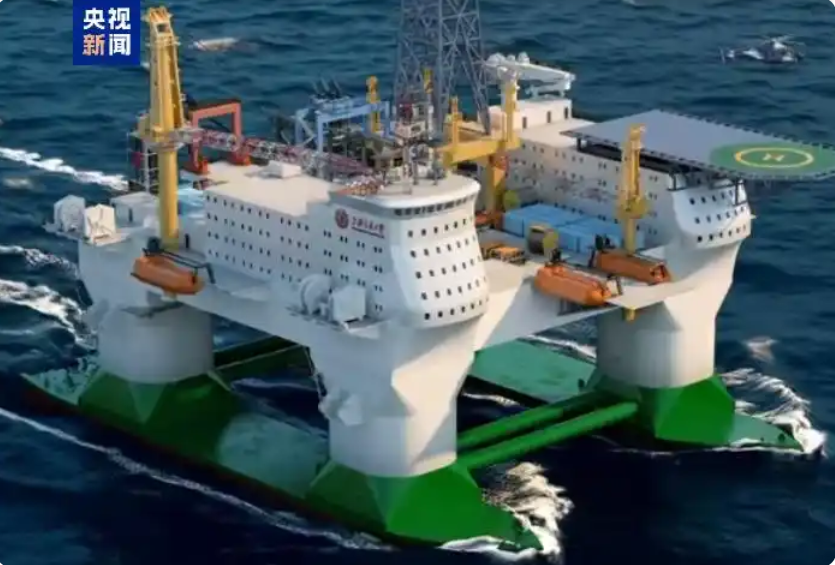
China has initiated construction of an unprecedented maritime research facility that redefines the boundaries of ocean exploration. The Deep-Sea All-Weather Resident Floating Research Facility, launched ceremoniously in Shanghai, represents the world’s first ultra-large floating platform designed to sustain continuous scientific operations in the open ocean regardless of weather conditions. This 78,000-tonne structure, scheduled for completion by 2030, combines the mobility of research vessels with the stability of fixed installations, creating a new category of marine infrastructure that can support 238 researchers for up to four months without resupply.
The project, led by Shanghai Jiao Tong University, emerges as a cornerstone of China’s national scientific infrastructure program. Its scale rivals that of the People’s Liberation Army Navy’s Fujian aircraft carrier, stretching 138 meters in length and 85 meters in width, with a main deck towering 45 meters above the waterline. The platform can cruise at approximately 15 knots, matching conventional research vessel speeds, before ballasting down to transform into a stable laboratory capable of conducting experiments at depths reaching 10,000 meters, or roughly 32,800 feet.
This floating artificial island addresses a critical gap in existing marine research capabilities. While China possesses advanced deep-sea laboratories, oceanographic research vessels, and deep-sea submersibles, none of these assets offer the combination of rapid transit and extended on-site residency that modern ocean science demands. The new facility merges characteristics of semi-submersible oil platforms with research vessel mobility, creating a self-propelled scientific platform capable of operating in distant waters for extended durations.
The initiative received official designation as a major national science and technology infrastructure project, reflecting Beijing’s commitment to expanding its presence in the global oceans. Construction began following the establishment of a dedicated Institute of Science and Engineering in Deep and Distant Waters at Shanghai Jiao Tong University, which will coordinate research activities and connect the physical infrastructure with scientific production. The university describes the platform as a paradigm shift in ocean science, offering real-scale testing capabilities that no laboratory or existing ship can match.
Engineering a Nuclear-Proof Platform
While officials stress the facility’s scientific mission, engineering specifications reveal a structure built to withstand extraordinary physical stresses. The platform incorporates advanced metamaterial sandwich panels, microscopic lattices of folded metal tubes arranged in precise geometric patterns. These materials function as high-resilience energy-dissipating structures that compress inward under extreme pressure, becoming denser and stronger when squeezed, effectively transforming catastrophic shocks into gentle compressions.
This nuclear-blast-resistant design protects critical compartments housing emergency power systems, secure communications arrays, and navigation control centers. Professor Yang Deqing, leading the project team at Shanghai Jiao Tong University, explained the rationale in a peer-reviewed paper published in the Chinese Journal of Ship Research. The deep-sea facility requires all-weather, long-term residency capabilities, making protection for essential systems absolutely vital. The structure’s semi-submersible twin-hull configuration provides exceptional stability in severe oceanic conditions, including tropical cyclones that would incapacitate conventional surface vessels.
The twin-hull design enables the platform to test deep-sea equipment weighing hundreds of tons while maintaining position in rough seas. This capability allows engineers to validate marine technologies under actual oceanic conditions rather than relying on nearshore simulations or laboratory models. The platform’s ability to submerge partially through ballasting creates a stable working environment even when surface waves would disrupt conventional vessels, effectively decoupling the research space from surface weather patterns.
Beyond Science: Strategic Consequences
The facility’s dual-use capabilities have attracted attention from defense analysts worldwide. While China officially classifies the platform as a civilian scientific installation, its military-grade survivability and strategic mobility suggest applications extending far beyond marine biology and resource extraction. The vessel’s 120-day endurance exceeds that of many nuclear-powered aircraft carriers, enabling persistent presence in contested maritime zones while operating under a civilian research banner.
Defense experts note that the platform could function as a flexible asset in the South China Sea, serving as a resilient command node, logistics hub, or surveillance station. Its ability to deploy rapidly to disputed waters and remain on station for extended periods offers presence without permanence, avoiding the diplomatic complications associated with constructing permanent artificial islands. This approach aligns with Beijing’s documented strategy of using gray-zone tactics, deploying civilian assets that blur the line between scientific research and military projection.
This dual identity, peaceful in appearance, powerful in capability, is exactly what makes China’s floating island so strategically unsettling. It is a vessel designed for discovery, yes, but also for deterrence, presence, and persistence in waters where Beijing’s ambitions run deepest.
The timing of this project coincides with intensified regional maritime competition. Vietnam has recently accelerated its own island-building activities in the Spratly Islands, conducting dredging and landfill work at multiple reefs including Alison Reef, Collins Reef, and East Reef. China’s mobile platform offers a counterbalance to these developments, providing comparable strategic benefits without the environmental and legal complications of permanent land reclamation. Satellite photographs reveal that Hanoi has expanded outposts previously consisting of only small concrete pillbox structures into larger artificial features.
The Architecture of Ocean Exploration
The floating research island operates as an integrated system combining three distinct components. The central semi-submersible twin-hull platform serves as the primary operational hub, capable of testing deep-sea equipment weighing hundreds of tons in real ocean conditions. This is supplemented by ship-based laboratories that provide mobile research capabilities and shore-based support infrastructure that handles logistics, data processing, and personnel rotation. Together, these elements form a comprehensive network connecting engineering tests, scientific observation, and analytical processing within a single operational framework.
Professor Yang Jianmin, an academic researcher at Shanghai Jiao Tong University, described the platform’s operational versatility. The vessel can sail at speeds comparable to research vessels, then transition to stable research mode through ballasting once reaching designated areas. Its super-heavy load capacity, extended stay capability, and robust typhoon resistance enable operations in harsher sea conditions, for longer periods, and in deeper waters than existing alternatives. Once ballasted, the platform remains stable regardless of surface wave action, providing a steady base for delicate scientific measurements and heavy equipment deployment.
The facility’s ability to operate at full-ocean depths of 10,000 meters opens access to the hadal zone, the deepest regions of the ocean found primarily in deep-sea trenches. These extreme environments, marked by crushing pressures and complete darkness, host unique biological communities that may offer insights into the origins of life and potential applications in biotechnology. The platform supports not only biological sampling but also geological surveys and equipment testing for future commercial mining operations in these remote areas.
A Blueprint for the Blue Economy
Scientific applications for the platform span multiple disciplines, from commercial resource extraction to fundamental questions about life’s origins. The facility will serve as an open-sea testing ground for deep-sea mining systems, critical marine equipment, and offshore oil and gas infrastructure. By allowing full-scale equipment trials in actual ocean conditions rather than controlled laboratory environments, researchers can accelerate the commercial development of marine resources while identifying engineering failures before deployment in remote operational areas.
The platform’s capacity to support exploration at extreme depths opens possibilities for studying environments that remain largely unexplored. Scientists anticipate the facility will help reveal seasonal evolution patterns in marine ecosystems and contribute to understanding how life adapts to high-pressure, low-light conditions. Additionally, the platform’s meteorological capabilities promise to improve typhoon forecasting accuracy, enhancing disaster prevention and mitigation efforts for coastal communities across the Pacific Rim.
Xiao Longfei, a professor at Shanghai Jiao Tong University, stressed the facility’s unique positioning within China’s research ecosystem. The nation possesses various marine research facilities, but lacked a platform combining swift navigation with extended mission duration. This new structure fills that void by integrating semi-submersible platform characteristics with research vessel capabilities. The university also highlights the platform’s role in training specialists and stimulating applications in underwater engineering equipment and deep-sea exploration methods.
Global Maritime Competition Intensifies
The floating island project forms part of a broader Chinese strategy to dominate oceanic spaces through what Beijing terms the blue economy. This initiative includes extensive seabed mapping operations across the Pacific, Indian, and Arctic oceans, utilizing dozens of research vessels to collect hydrographic data crucial for submarine navigation and anti-submarine warfare. According to naval warfare experts, the data gathered by vessels conducting systematic surveys would be potentially invaluable in preparation of the battlespace for Chinese submarines.
Rear Admiral Mike Brookes, commander of the U.S. Office of Naval Intelligence, testified before a congressional commission that China has dramatically expanded surveying efforts, providing data that enables submarine navigation, concealment, and positioning of seabed sensors or weapons. The integration of civilian scientific research with military technology development, known as civil-military fusion, has become a central focus under President Xi Jinping’s administration. Chinese researchers have pledged to transform the most advanced scientific and technological achievements into new types of combat capabilities for military operations at sea.
The scale of China’s ocean mapping has raised concerns among Western military officials. For decades, the U.S. Navy maintained an asymmetric advantage in knowledge of the ocean battlespace. China’s comprehensive surveying efforts, combined with platforms like the floating research island, threaten to erode that advantage. The construction of nuclear-resistant mobile platforms capable of sustained operations in contested waters represents a significant evolution in maritime infrastructure, one that challenges traditional distinctions between scientific research and strategic military assets.
What to Know
- China has begun construction of the world’s first nuclear-resistant floating research platform, scheduled for completion by 2030
- The 78,000-tonne semi-submersible twin-hull facility can house 238 researchers for four months without resupply and withstand nuclear blasts using advanced metamaterial panels
- Led by Shanghai Jiao Tong University, the platform supports research at depths up to 10,000 meters while serving as a testing ground for deep-sea mining and offshore oil equipment
- Defense analysts view the platform as a dual-use asset capable of serving as a mobile command node or surveillance station in contested waters, particularly the South China Sea
- The project complements China’s extensive ocean floor mapping operations, which naval experts say support submarine warfare capabilities and challenge U.S. undersea dominance