The Architecture of Control: How China Built a Nickel Empire
Over the past decade, Chinese companies have constructed a vertically integrated supply chain in Indonesia that serves as a blueprint for global mineral dominance. The strategy began in earnest after Indonesia banned nickel ore exports in 2014, a move that forced international firms to process minerals domestically. While Western companies hesitated, Chinese firms moved decisively. Tsingshan Group, a private steel conglomerate, entered through a 2009 joint venture with Indonesia’s Bintang Delapan Group, then rapidly scaled operations after the export ban took effect.
- The Architecture of Control: How China Built a Nickel Empire
- Indonesia’s Resource Nationalism and the Dependency Trap
- When Markets Turn: The Reckoning at Gunbuster
- Environmental Degradation and Community Displacement
- Washington’s Strategic Dilemma
- Exporting the Template: From Jakarta to Kinshasa
- Key Points
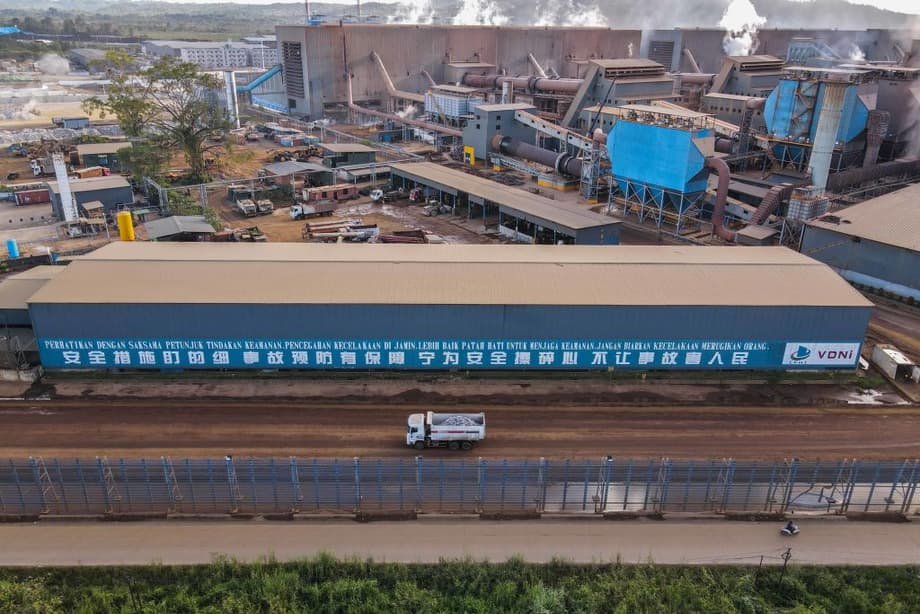
The Indonesia Morowali Industrial Park (IMIP) emerged as the flagship project under the Belt and Road Initiative, evolving from a simple smelter complex into a sprawling industrial city equipped with dedicated ports, coal burning power plants, and logistics systems. Chinese financing evolved alongside these physical investments. Between 2000 and 2013, policy banks such as the Export-Import Bank of China provided early stage infrastructure financing. After 2013, state owned commercial banks extended syndicated loans to distribute risk, enabling smaller projects within industrial parks.
This financing ecosystem, unavailable to Western competitors, enabled rapid capital deployment and high risk tolerance. Chinese firms commercialized high pressure acid leaching (HPAL) technology, which converts Indonesia’s abundant low grade laterite deposits into mixed hydroxide precipitate (MHP), a key precursor for electric vehicle batteries. Western attempts at similar processing in Australia and Papua New Guinea had failed due to cost overruns, but Chinese engineering succeeded. Today, Chinese companies control approximately 75 percent of Indonesia’s nickel refining capacity and own around 60 percent of global refined nickel production.
Indonesia’s Resource Nationalism and the Dependency Trap
Jakarta’s downstreaming policies aimed to capture greater value from the country’s vast nickel reserves, which represent over 42 percent of global supply. The 2020 export ban on raw nickel ore, building on earlier restrictions, successfully attracted foreign direct investment, which surged from $3.56 billion in 2019 to $10.96 billion by 2022. Nickel export revenues grew from roughly $6 billion in 2013 to nearly $30 billion in 2022, creating jobs and positioning Indonesia as the world’s largest producer.
However, this success masks a structural imbalance. While Indonesia controls the raw material, Chinese firms dominate processing technology, capital, and market access. Indonesian miners, mostly locally owned due to nationalistic ownership laws, must sell ore to Chinese processors at government regulated prices significantly below international rates. Meanwhile, Chinese companies receive substantial fiscal incentives, including income tax holidays lasting 15 to 20 years and access to subsidized coal through the Domestic Market Obligation (DMO), which caps prices at $75 per ton compared to global rates that reached $350 per ton in 2023.
The partial nickel ore ban before 2020 (where ore export permits were granted to companies making progress on smelter development) and securing permits within industrial parks was actually sufficient for nickel processing companies to invest in Indonesia.
The result is a near monopoly where Chinese firms capture most value added benefits. Indonesian officials have gained short term bargaining power through export bans, but Beijing retains long term structural power. As one Jakarta based banker noted, the partial export ban before 2020, combined with industrial park permits, would have been sufficient to attract investment without the current costly incentives that primarily benefit Chinese processors.
When Markets Turn: The Reckoning at Gunbuster
The fragility of this model became apparent in 2025 as commodity markets defied strategic planning. PT Gunbuster Nickel Industry (GNI), a massive smelting complex on Sulawesi backed by China’s Jiangsu Delong Nickel Industry, faces collapse. The facility, designed to produce 1.8 to 1.9 million metric tons of nickel pig iron annually, has seen many production lines go silent as creditors meet to discuss emergency financing. Jiangsu Delong has exited three of its four major Indonesian projects, absorbing losses of up to $300 million annually.
This crisis stems from a flood of new production that drove global nickel prices down by more than 40 percent, turning profitable projections into losses. GNI’s troubles were compounded by unfinished infrastructure, high electricity costs, and penalties for missed delivery deadlines. The facility represents about 10 to 12 percent of Indonesia’s total refined output, meaning its potential shutdown could disrupt 5 to 6 percent of global supply.
Compounding these pressures is a technological shift within China itself. While Indonesia bet heavily on nickel containing batteries for electric vehicles, Chinese manufacturers are rapidly adopting lithium iron phosphate (LFP) batteries, which contain no nickel. BYD’s $1 billion investment in an Indonesian EV assembly plant uses LFP technology, directly contradicting Jakarta’s nickel driven industrial strategy. As nickel based battery chemistries lose market share in China, Indonesian producers face weakening demand from their primary customer just as global oversupply peaks.
Environmental Degradation and Community Displacement
The nickel boom has exacted severe environmental and social costs, particularly in Sulawesi and Maluku. PT Vale Indonesia’s Sorowako Block, the longest operating nickel concession, has caused extensive deforestation. According to analysis by Mighty Earth, the Sorowako operation ranks first among Indonesian nickel mines for tree cover loss, with 14,559 hectares cleared between 2014 and 2022. The company has identified 14,137 hectares of key biodiversity areas within mineable zones, including critical habitat near Lake Towuti.
Local communities face displacement and pollution. In Loeha Raya, farmers cultivating white peppercorn on ancestral lands have encountered drilling operations without prior consultation. Spring water contamination from sedimentation has rendered some farmland unusable.
We are very worried about the company expanding mining here. When there is drilling exploration, people are afraid to farm.
Despite a 2013 Constitutional Court ruling recognizing Indigenous peoples’ customary forests, land tenure claims remain stalled in verification processes, leaving communities vulnerable to expansion.
The processing infrastructure itself creates severe emissions. Captive coal fired power plants built to supply nickel smelters now account for 23 percent of Indonesia’s total coal capacity, with more under construction than currently operational. Health studies project that air pollution from processing activities could cause annual deaths to rise from 215 in 2020 to nearly 5,000 by 2030, with associated healthcare costs reaching $3.4 billion annually.
Washington’s Strategic Dilemma
The United States faces difficult choices regarding Indonesian nickel. American mining companies have largely exited the country due to resource nationalism policies. Newmont Mining left entirely in 2016 after disputes over export restrictions, while Freeport McMoRan was forced to divest majority control of the Grasberg copper mine in 2018. Mandatory divestment laws and unpredictable regulations deter Western firms, whereas Chinese state supported enterprises can absorb volatility and accept lower margins.
Recent US engagement has been limited and awkward. Ford Motor Company announced a $4.5 billion partnership in 2023 with Vale Indonesia and China’s Huayou Cobalt to build an HPAL facility, reflecting the reality that Western automakers cannot secure Indonesian nickel without collaborating with Chinese firms. The lack of a free trade agreement between the United States and Indonesia prevents Indonesian nickel from qualifying for clean vehicle tax credits under the Inflation Reduction Act, while strict restrictions on foreign influenced entities further complicate access.
Some policymakers argue for building alternative supply chains outside Indonesia, but this would require enormous investment and long term industrial policy. Others suggest engaging directly with Indonesia through offtake agreements and minority equity stakes. Either approach requires sustained government coordination to provide regulatory clarity and financing for US firms, yet Washington currently lacks a coherent strategy for securing access to the world’s dominant nickel supplier.
Exporting the Template: From Jakarta to Kinshasa
Despite challenges in Indonesia, China appears poised to replicate this model elsewhere. Beijing’s 2023 outbound investment report identifies overseas economic cooperation zones as key platforms for international expansion, using infrastructure and industrial developments to support market access. The strategy is already appearing in investments for copper mining in Peru and cobalt processing in the Democratic Republic of the Congo (DRC).
In the DRC, Chinese firms have adapted to new export quotas on cobalt, capping exports at 96,600 metric tons annually for 2026 and 2027, roughly half of 2024 levels. This manipulation of supply mirrors the Indonesian approach of using policy tools to force domestic processing while Chinese companies control the resulting value chains. China has also doubled its high purity Class 1 nickel reserves since late 2024, creating strategic buffers to insulate domestic industry from price volatility while maintaining grip on global supply.
As more countries consider emulating Indonesia’s export bans to promote local economic growth, Chinese companies have demonstrated their ability to adapt and move up the value chain in target nations. They bring capital, technology, and willingness to operate under conditions that deter Western investors. The Indonesian experience shows that without strong governance, environmental safeguards, and diversified partnerships, resource rich nations risk trading one form of dependency, raw material exports, for another, controlled industrialization.
Key Points
- Chinese companies control approximately 75 percent of Indonesia’s nickel refining capacity and 60 percent of global refined nickel production, establishing a near monopoly through industrial parks like Morowali.
- Indonesia’s export bans successfully attracted investment and increased export values from $6 billion to $30 billion, but created structural dependency on Chinese technology, capital, and markets.
- Major Chinese backed projects face crisis as nickel prices collapsed 40 percent and demand shifts toward lithium iron phosphate (LFP) batteries that require no nickel.
- Environmental costs include extensive deforestation in Sulawesi, water contamination affecting local farmers, and health impacts projected to cause nearly 5,000 annual deaths by 2030.
- The United States lacks a coherent strategy to access Indonesian nickel, with American mining firms having exited due to resource nationalism while Chinese firms entrenched their position.
- China is replicating the Indonesia model in the Democratic Republic of the Congo for cobalt and Peru for copper, using industrial parks and state supported financing to control critical mineral supply chains.