Scaling New Heights in Wushan
Imagine beginning your daily commute by stepping onto a moving staircase that rises the equivalent of an 80-story building, winding through misty mountain air for nearly a kilometer until it delivers you to the clouds. This is now the reality for thousands of residents in Wushan County, a mountainous district within China’s sprawling Chongqing municipality, where an architectural wonder officially dubbed the Shennü Escalator, or “Goddess” escalator, began carrying passengers on February 17, 2026. Stretching 905 meters (2,969 feet) along the sheer face of the terrain and climbing 242.14 meters vertically, this massive transit system locally nicknamed the “Sky Ladder” has already transformed from a mere transportation utility into a viral sensation, drawing 450,000 visitors during the Spring Festival alone and fundamentally altering how locals navigate their vertical city.
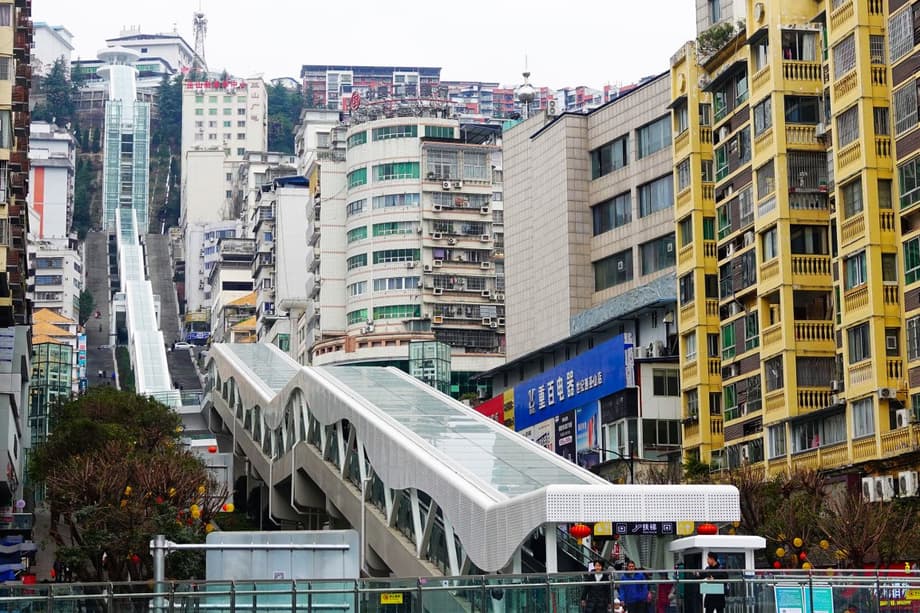
The structure comprises 21 individual escalators, eight elevators, four moving walkways, and two pedestrian bridges, all linked to form a continuous chain that hugs the mountain’s natural contours rather than blasting straight through them. Swiss engineering firm Schindler manufactured the actual stairway mechanisms in their Shanghai facility, while the overarching design came from China Railway Eryuan Engineering Group, a government-owned enterprise that first conceived of this vertical solution more than two decades ago. For a city already famous for its mind-bending infrastructure, including subway stations buried deeper than bomb shelters and light rail lines that thread through residential apartment blocks, the Goddess Escalator represents the latest evolution in Chongqing’s ongoing negotiation with gravity. End to end, the ascent takes approximately 20 minutes, a dramatic improvement from the hour-long climb previously required to scale the steep banks of the Yangtze River tributaries.
Engineering Against Gravity
Constructing a 0.5-mile escalator system on a mountainside presents challenges that would daunt even experienced urban planners. The route follows Goddess Avenue in Wushan’s Gaotang neighborhood, where the average slope hits 35 percent and reaches nearly 60 percent at its steepest points, creating a grade so severe that standard construction equipment often struggles to maintain traction. Engineers led by project chief designer Huang Wei faced additional complications from karst formations, the soluble bedrock common in southwestern China that creates unpredictable underground caverns and drainage patterns, alongside dense residential buildings and a labyrinth of underground utility pipelines that crisscross the hillside.
Rather than carving a brutal concrete scar across the landscape, the design team employed what they describe as “3D stitching,” elevating much of the structure on minimal corridors that float above the existing terrain, preserving ground space and minimizing environmental disruption. Transparent glass facades encase the transit line, reducing visual bulk while offering riders panoramic views of the Wu Gorge and the Yangtze River below. Three dedicated viewing platforms punctuate the ascent, including elevated “sky balconies” and a full-circle lookout point where the county town spreads out like a miniature map hundreds of meters below. This approach marks a departure from purely utilitarian infrastructure, instead treating the vertical commute as both a functional necessity and a scenic experience. The system was built to withstand severe weather conditions and accommodate heavy daily passenger loads, utilizing durable materials and redundant safety systems essential for outdoor operation in a humid subtropical climate.
From Blueprint to Mountainside
The concept of a vertical transit spine for Wushan first emerged in 2002, when the county completed its new urban area but found that the steep terrain continued to isolate residents from essential services. At that time, limited municipal funding and technological constraints forced officials to shelve the proposal, leaving locals to continue their arduous daily climbs on foot. The project remained dormant for two decades until 2022, when rising population density and traffic congestion prompted authorities to revisit the idea with modern engineering capabilities and expanded budgets. Huang Wei, head of the design team, confirmed the project’s unique status in an interview with the Financial Times.
“As far as I know, there are no similar projects nationwide, either exceeding or equal to ours, either under construction or already started. It’s the first of its kind.”
Huang and his team evaluated multiple alternatives before settling on the escalator network. Cable cars, while scenic, offered limited capacity and vulnerability to high winds that frequently buffet the mountain slopes. Sightseeing trains required too much horizontal space for switchbacks on the narrow mountain face. Rail transit proved prohibitively expensive for the relatively short distance involved. The modular escalator system won out because it could be assembled “like building blocks,” adapting to fragmented terrain while providing year-round reliability and large-volume passenger throughput. The ability to integrate with existing roads and buildings without requiring massive demolition made it the only practical choice for Wushan’s complex topography. Construction proceeded rapidly once approved, with the system opening for trial operations on February 17, 2026, coinciding with Lunar New Year celebrations that featured traditional lantern displays and dragon dances along the route.
Transforming Daily Life
For residents of the Gaotang area, the escalator’s arrival marks the end of an exhausting daily ritual. Previously, reaching the upper districts from the riverside required navigating narrow, winding roads and sharp inclines that could consume an hour of hard walking each way, particularly brutal during Chongqing’s humid summers when temperatures regularly exceed 35 degrees Celsius (95 degrees Fahrenheit). The journey presented particular difficulties for the elderly, families with young children, and the “bangbang men,” the iconic porters who carry goods on bamboo poles through Chongqing’s vertical landscape. These workers, who once numbered in the tens of thousands in the city’s central districts alone, found their livelihoods increasingly constrained by the physical toll of simply reaching their destinations.
Sixty-year-old Ran Guanghui, one of these porters who has spent decades hauling merchandise up mountainsides, described the change while transporting bags of goods to a mall near the escalator route. He recalled the 1990s era when elevators were virtually nonexistent in the area, making every delivery a test of endurance.
“In the 1990s, there were probably tens of thousands of porters in Yuzhong district alone. There weren’t elevators before, which was quite inconvenient.”
The new system now allows him and his colleagues to conserve energy for the actual carrying work rather than exhausting themselves on the approach. Xie Hongmin, a 44-year-old visitor from a nearby rural settlement, expressed hope that his own town might install similar infrastructure after experiencing the ride.
“Walking is quite tiring.”
The system has proven immediately popular, serving approximately 9,000 people daily during regular operations and seeing explosive demand during holiday periods. Trial operations offered free rides from February 12 to 16, 2026, before implementing a fare of three yuan (roughly $0.43) per direction, with authorities monitoring usage patterns to determine permanent pricing.
When Infrastructure Becomes Destination
Chinese urban planners have increasingly embraced the concept that transit systems need not merely move people efficiently but can themselves become attractions that drive economic activity. The Goddess Escalator embodies this philosophy through carefully integrated lighting installations that transform the structure after dark into a glowing ribbon winding through the hills, connecting to Wushan’s broader nightscape program aimed at activating evening leisure and consumption. Rather than treating the 20-minute journey as dead time, designers created an experiential pathway where tourists and locals alike pause at viewing platforms to photograph the mist-shrouded gorges. Huang Wei articulated this vision in interviews with local media, explaining the philosophy behind the design.
“Our goal was for infrastructure itself to become a destination. It’s not just a way to get from point A to point B, but part of the city’s experience.”
The project serves as a flagship initiative in Wushan’s campaign to position itself as a gateway destination along the Three Gorges, one of China’s most famous scenic regions. By making the infrastructure itself a destination, authorities hope to extend tourist stays and increase spending in the local economy. The escalator links directly to cultural institutions, medical facilities, and educational centers, creating a multi-level network that integrates previously isolated neighborhoods into the broader urban fabric. For a county seeking to improve its urban quality while preserving its natural advantages, the sky ladder offers a model of how difficult terrain can be converted from a liability into a distinctive asset. The transparent glass design ensures that riders maintain visual contact with the landscape throughout the ascent, reinforcing the connection between urban development and natural beauty.
A New Peak in Mountain City Design
Chongqing already held claim to one of the world’s most famous escalators, the Crown Escalator, built in the 1990s to connect railway stations in the city’s central Yuzhong district. At 112 meters long, that structure became an icon of the municipality’s verticality and a tourist attraction in its own right. The Goddess Escalator has now officially eclipsed its predecessor, exceeding it in both length and construction complexity while serving a more practical daily transportation function rather than primarily moving tourists between transit hubs. The new system surpasses the Crown Escalator by nearly 800 meters in total length, establishing a new benchmark for outdoor vertical transportation.
The achievement fits within Chongqing’s broader reputation for infrastructure that defies conventional urban planning. The municipality’s monorail system famously runs directly through the 19th floor of a residential building at Liziba Station, a compromise born from limited flat land. Subway stations here plunge deeper than almost anywhere else on Earth, with some platforms sitting nearly 100 meters below surface level. These projects reflect the reality of a “Mountain City” built across ridges and cliffs rather than flat plains, where engineers must constantly innovate to connect communities separated by hundreds of meters of elevation. The Goddess Escalator extends this tradition into the outdoor environment, creating a vertical main street where none existed before. As China continues to urbanize its western regions, projects like the Wushan Goddess Escalator demonstrate how modern engineering can tame even the most challenging topography without destroying the natural character that makes these locations unique.
The Bottom Line
- The Wushan Goddess Escalator stretches 905 meters (2,969 feet) and rises 242 meters (794 feet), equivalent to an 80-story building, making it the world’s longest outdoor escalator system.
- The network includes 21 escalators, eight elevators, four moving walkways, and pedestrian bridges, reducing commute times from one hour to 20 minutes for residents of Gaotang neighborhood.
- Located in Wushan County, Chongqing, the system opened February 17, 2026, and currently charges 3 yuan (approximately $0.40) per ride during its trial period.
- Designed by China Railway Eryuan Engineering Group with escalators manufactured by Schindler in Shanghai, the project overcame karst geology and slopes up to 60 percent using 3D stitching construction techniques.
- The structure features glass facades, three viewing platforms, and integrated lighting, serving both as essential transit for 9,000 daily users and a tourist attraction that drew 450,000 visitors during the Spring Festival.