Mimicking Nature to Fuel the Future
Chinese researchers have achieved a significant advance in clean energy technology by developing a system that converts carbon dioxide and water into valuable chemical building blocks using only sunlight. The breakthrough, detailed in the peer-reviewed journal Nature Communications, draws inspiration from photosynthesis, the natural process plants use to generate energy from sunlight, water, and atmospheric carbon.
The research team, comprising scientists from the Chinese Academy of Sciences and the Hong Kong University of Science and Technology, created a specialized material capable of storing small amounts of electrical energy. This energy storage capability proves essential for driving the chemical reactions needed to transform carbon dioxide into useful compounds without relying on fossil fuels.
When paired with catalysts that facilitate carbon dioxide conversion, the system enables solar-driven production of carbon monoxide. This intermediate chemical can then be processed further into liquid hydrocarbon fuels, offering a potential pathway to power sectors that remain difficult to electrify, including aviation and shipping.
How Artificial Photosynthesis Works
The process of converting carbon dioxide into fuel using sunlight, known as photocatalysis or artificial photosynthesis, has long been a goal of clean energy research. Natural photosynthesis allows plants to store solar energy in chemical bonds, creating sugars from carbon dioxide and water. Scientists have sought to replicate this efficiency in laboratory settings to create sustainable fuel alternatives that could replace petroleum products.
The Chinese team addressed a critical challenge in artificial photosynthesis: the need to connect multiple complex chemical reactions simultaneously. Natural systems use sophisticated biological mechanisms to store photogenerated electrons temporarily, facilitating efficient energy transfer between different reaction stages. The researchers replicated this strategy by engineering a silver-modified tungsten trioxide material that functions as a charge reservoir.
The research team described their breakthrough strategy in their published paper.
This work establishes a bioinspired charge reservoir strategy for efficient carbon dioxide photoreduction, providing a universal approach to solar fuel production.
This material stores electrons during light exposure and releases them on demand to drive chemical reactions. The system performs comparably to approaches using organic sacrificial agents, which are often unsustainable, while offering universal applicability when combined with various catalysts. Under natural sunlight conditions, the material successfully triggered the conversion reactions, demonstrating viability for practical solar fuel applications without requiring artificial lighting or external power sources.
Global Competition Intensifies
The Chinese breakthrough arrives amid intensifying international competition to develop viable solar fuel technologies. Researchers worldwide are pursuing parallel approaches to convert atmospheric carbon dioxide into usable energy carriers, each with distinct technical strategies and target applications. These simultaneous advances suggest the technology is approaching commercial viability after decades of laboratory research.
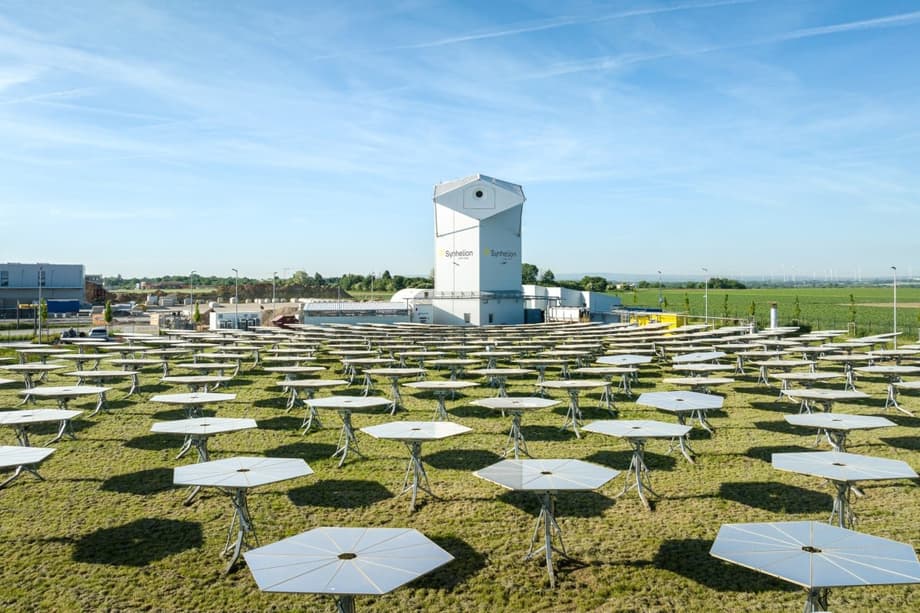
In Switzerland, scientists at ETH Zurich led by Professor Aldo Steinfeld have developed an industrial plant that extracts carbon dioxide and water directly from ambient air. Using concentrated solar energy, the facility splits these compounds to produce syngas, a mixture of hydrogen and carbon monoxide, which is subsequently processed into kerosene and methanol. This solar kerosene releases only as much carbon dioxide during combustion as it absorbed during production, achieving carbon neutrality. The technology has advanced sufficiently for commercial deployment, with funding secured for an industrial-scale production facility in Germany expected to demonstrate the economic feasibility of the process.
Japanese researchers have also shattered previous efficiency records using a different approach. Scientists from the Institute of Science Tokyo and Hiroshima University developed a novel lead-based oxyhalide photocatalyst that boosts hydrogen production activity by up to sixty times compared to conventional methods. Their material achieves a record quantum yield of approximately fifteen percent for hydrogen production and ten percent for converting carbon dioxide into formic acid, a liquid fuel. Professor Kazuhiko Maeda, who co-led the research, explained the significance of the structural improvements.
This study underscores the importance of controlling the morphology of oxyhalides to unlock their full potential as photocatalysts.
Meanwhile, researchers at Cambridge University have developed a solar-powered flow reactor that captures carbon dioxide directly from the atmosphere using specialized filters. The device absorbs carbon dioxide at night and converts it into syngas when exposed to sunlight, functioning without external power sources, cables, or batteries. A mirror concentrates sunlight to drive the chemical reaction, offering a decentralized approach that could enable fuel generation in remote locations without connection to electrical grids.
Indian scientists have contributed to this global effort as well. Professor Indrajit Shown at Hindustan Institute of Technology and Science in Chennai developed a zinc and sulfur-based material that captures sunlight to convert carbon dioxide into acetaldehyde, a fuel ingredient. The system operates approximately two hundred times more efficiently than previous methods using standard sunlight rather than specialized lighting equipment. Professor Shown emphasized the practical goals behind the research.
This research is about finding real ways to help the planet, not just scientific progress.
The international nature of these advances suggests that solar fuel technology is reaching maturity through multiple independent pathways, increasing the likelihood that at least one approach will achieve commercial success.
Targeting Aviation and Shipping
The potential applications for these technologies extend beyond conventional transportation into sectors that pose particular challenges for electrification. Aviation, shipping, and heavy industry rely heavily on liquid hydrocarbon fuels due to their high energy density and compatibility with existing infrastructure. These sectors collectively account for a substantial portion of global carbon dioxide emissions, yet they resist easy conversion to battery electric or hydrogen fuel cell technologies.
Aviation presents especially significant obstacles for decarbonization. Aircraft require fuels with extremely high energy density to maintain reasonable weight and range capabilities. Current battery technologies cannot provide sufficient energy storage for long-haul flights without adding prohibitive weight that would make commercial operations unfeasible. The aviation industry currently generates approximately three percent of global human-made carbon dioxide emissions, a figure projected to grow as passenger numbers increase toward 7.5 billion annually by 2035.
Solar-derived fuels offer a compelling solution because they function as drop-in replacements for conventional fossil fuels. Kerosene produced from carbon dioxide and sunlight can power existing aircraft engines without modification, while methanol can serve as a marine fuel or chemical feedstock for pharmaceutical production. Because these fuels release only the carbon dioxide captured during their production, they create a closed carbon cycle that avoids adding new greenhouse gases to the atmosphere while utilizing existing fuel distribution infrastructure.
The International Air Transport Association has identified sustainable aviation fuels as essential for achieving net-zero carbon dioxide emissions by 2050. The International Energy Agency projects that such fuels could satisfy ten percent of aviation fuel demand by 2030, rising to nearly twenty percent by 2040. However, current sustainable fuel usage remains below zero point one percent of total consumption, indicating the massive scaling required to meet these targets even as the technologies prove themselves in laboratory and pilot settings.
Barriers to Commercial Deployment
Despite the remarkable scientific progress, significant obstacles impede the widespread adoption of solar fuel technologies. Cost remains the primary barrier to commercial viability. Swiss researchers estimate that solar kerosene produced at scale would cost between one dollar thirty-five cents and two dollars twenty cents per liter. While this represents progress toward competitiveness with conventional jet fuel, high initial investment requirements for industrial-scale plants complicate deployment and present risks for early investors.
Geographic constraints also limit production potential. Solar fuel generation requires abundant sunlight, making desert regions optimal for facility placement. However, transporting produced fuels from remote desert locations to major transportation hubs necessitates substantial infrastructure investments and logistical coordination. Unlike biofuels, which often compete with food production for agricultural land, solar fuels can utilize non-arable desert areas, preserving valuable farmland for crops and livestock while taking advantage of regions with high solar irradiance.
Technical challenges persist in improving conversion efficiencies and system durability. While the recent breakthroughs represent substantial improvements over earlier technologies, current systems still convert only a fraction of available solar energy into chemical bonds. For context, natural photosynthesis operates at roughly one percent efficiency, while recent laboratory achievements have reached thirteen to fifteen percent in specific reaction steps according to research published in Science. Continued research must focus on developing more efficient catalysts, improving charge separation mechanisms, and creating systems that function reliably under real-world conditions rather than only in controlled laboratory environments with consistent temperatures and humidity levels.
Policy support appears crucial for bridging the gap between laboratory success and commercial deployment. Researchers suggest implementing quota systems requiring airlines to source specific proportions of fuel from sustainable sources, creating guaranteed demand that would justify infrastructure investments. Such regulatory frameworks could accelerate scaling and drive cost reductions through increased production volume, following the model that successfully reduced costs for solar photovoltaic panels and wind turbines over the past two decades.
The Essentials
- Chinese scientists have developed a plant-inspired system using silver-modified tungsten trioxide to convert carbon dioxide and water into fuel precursors using sunlight, published in Nature Communications.
- The technology employs a charge reservoir strategy that stores electrical energy to drive chemical reactions, eliminating the need for unsustainable sacrificial agents.
- Parallel research efforts in Switzerland, Japan, the United Kingdom, and India are pursuing similar solar fuel technologies with varying approaches and efficiency levels.
- Solar fuels offer particular promise for decarbonizing aviation and shipping, sectors that are difficult to electrify due to high energy density requirements.
- Current cost estimates for solar kerosene range from $1.35 to $2.20 per liter, with significant infrastructure investments required for large-scale production.
- The International Energy Agency projects sustainable aviation fuels could meet 10% of demand by 2030 and 20% by 2040 if scaling challenges are overcome.