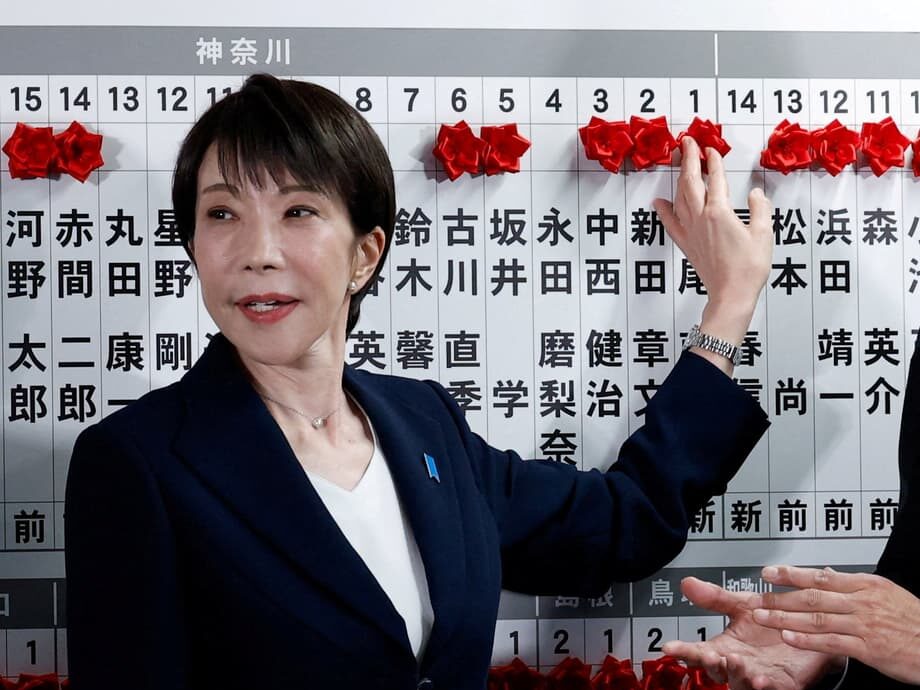
A High-Stakes Gamble Pays Off
Japanese Prime Minister Sanae Takaichi transformed a risky political wager into a historic mandate on Sunday, leading her conservative Liberal Democratic Party to its most decisive electoral victory since the party’s founding in 1955. Just 110 days after becoming Japan’s first female prime minister, Takaichi called a snap election during the depths of winter, betting her personal popularity could overcome both heavy snowfall and public fatigue with the political scandals that had plagued her predecessors. The gamble succeeded beyond expectations. Despite blizzard conditions that forced the closure of train lines and polling stations across the country, voters handed Takaichi’s LDP 316 seats in the 465-member lower house of parliament, according to public broadcaster NHK. Combined with 36 seats won by coalition partner the Japan Innovation Party, the government now commands a two-thirds supermajority of 352 seats.
The magnitude of this victory cannot be overstated. It marks the first time since World War II that a single Japanese party has captured more than two-thirds of the lower house, surpassing the previous record set during former Prime Minister Yasuhiro Nakasone’s administration in 1986. The result allows Takaichi to override the opposition-controlled upper house, a power no Japanese leader has wielded with such authority in decades. Voter turnout reached 55.6 percent, up from 53.8 percent in the 2024 election, with more than 27 million people casting early ballots to avoid the snow that reached depths of over two meters in some regions.
Kazushige Cho, a 54-year-old teacher in Niigata prefecture, braved the elements to support the LDP. Speaking outside a polling station surrounded by snowdrifts, he explained his reasoning.
She has shown strong leadership and pushes various policies forward. I think things could turn out quite well.
Takaichi had promised to resign if her coalition failed to secure a simple majority, making the election a make-or-break moment for her brief premiership. Instead, she emerged with a mandate stronger than any Japanese leader in the postwar era.
Economic Promises Meet Fiscal Reality
With her legislative constraints removed, Takaichi now faces the challenge of delivering on ambitious economic promises that have simultaneously energized voters and alarmed financial markets. During the campaign, she pledged a 21 trillion yen stimulus package and promised to suspend Japan’s 8 percent consumption tax on food for two years, a move she described as her long-cherished dream. The tax suspension alone would cost approximately 5 trillion yen annually, roughly equivalent to the nation’s entire education budget.
The fiscal math is daunting. Japan’s government debt already exceeds twice the size of its annual economic output, representing the heaviest debt burden of any advanced economy. Investors have expressed growing concern about how Takaichi intends to fund her expansionary agenda without issuing fresh debt, which she has ruled out. The uncertainty has triggered volatility in currency markets and a sell-off in government bonds, with yields on long-dated debt hitting record highs in recent weeks.
Speaking as exit polls indicated her landslide victory, Takaichi sought to reassure markets while reaffirming her commitment to stimulus.
We have consistently stressed the importance of responsible and proactive fiscal policy. We will prioritise the sustainability of fiscal policy. We will ensure necessary investments. Public and private sectors must invest. We will build a strong and resilient economy.
Despite these reassurances, analysts warn that Takaichi’s solidified grip on power may actually embolden her to push forward with controversial spending plans, sidelining fiscal hawks within her own party. Seiji Inada, managing director at consultancy FGS Global, predicted that markets could react swiftly and negatively if Takaichi follows through on her tax cut promises, potentially sending the yen to new lows against the dollar.
Navigating the China Challenge
Takaichi’s foreign policy approach, particularly her confrontational stance toward Beijing, has emerged as both a political asset and a diplomatic liability. In November, just weeks after taking office, she sparked the most serious dispute between Japan and China in over a decade by suggesting that Tokyo could intervene militarily if China attempted to invade Taiwan. The self-governing island, which lies just 60 miles from Japanese territory, is claimed by Beijing as part of its territory.
China responded with a coordinated pressure campaign that included urging tourists to avoid Japan, discouraging students from studying there, restricting imports of Japanese seafood, limiting exports of critical minerals, and even ending decades of panda diplomacy by returning Japan’s last two pandas. Chinese state media has characterized Takaichi’s victory as likely to accelerate Japan’s remilitarization and warned that Tokyo will become an increasingly significant source of regional security tensions.
Domestically, however, Takaichi’s refusal to back down from her Taiwan comments has played well with nationalist voters who view her as a strong leader willing to stand up to Beijing. The dispute has done little to dent her approval ratings, which have remained above 70 percent throughout her tenure. Margarita Estévez-Abe, an associate professor of political science at Syracuse University, noted that with no elections required until 2028, Takaichi now has breathing room to repair damaged ties with China if she chooses.
Now she doesn’t have to worry about any elections until 2028, when the next upper house elections will take place. So the best scenario for Japan is that Takaichi kind of takes a deep breath and focuses on amending the relationship with China.
David Boling, principal at the Asia Group, a geopolitical risk advisory firm, offered a different assessment, suggesting that Beijing now faces the reality that its efforts to isolate Takaichi have completely failed.
The Takaichi Phenomenon
Much of the LDP’s remarkable turnaround can be attributed to Takaichi’s personal appeal, which has transcended traditional political demographics in Japan’s male-dominated society. A former heavy metal drummer and motorbike enthusiast who cites Margaret Thatcher as her political hero, Takaichi has cultivated an image of relentless energy and straight-talking leadership. Her pledge to work, work, work on behalf of the country became the catchphrase of the year, while viral moments like an impromptu drum session with South Korean President Lee Jae Myung have endeared her to younger voters.
Her social media presence, featuring more than 2.6 million followers on X, nearly five times that of her predecessor, has created a direct connection with voters. Items associated with her have become cultural phenomena, from the pink ballpoint pens she uses in parliament to her 900-dollar black leather handbag, which sold out months in advance. This personal brand, combined with her conservative stance on social issues including opposition to same-sex marriage and support for the imperial family’s male-only succession, has consolidated support on the right while attracting disaffected young voters.
Akira Tamagawa, a 20-year-old college student voting in Tokyo, explained the attraction.
She’s clearly distinguished herself from the past image of the L.D.P. She states things very clearly.
However, her traditionalist views on gender roles, including opposition to allowing married couples to have separate surnames, have drawn criticism from women’s rights advocates. Jeff Kingston, a professor of Asian studies at Temple University’s Japan campus, observed that despite being Japan’s first female prime minister, Takaichi does not have a very positive track record on gender issues or women’s empowerment.
Constitutional Ambitions and Defense Policy
The supermajority victory opens the door to Takaichi’s long-held ambition of revising Japan’s postwar constitution, particularly Article 9, which renounces war and limits the military to self-defense capabilities. Amending the constitution requires two-thirds support in both houses of parliament plus a national referendum, meaning Takaichi would still need to secure upper house cooperation, but her lower house dominance provides unprecedented leverage.
During a speech earlier this month, Takaichi explicitly called for constitutional change.
Why can’t we write the Self-Defense Forces into the Constitution? I want you to let us revise the Constitution to position them as an effective organization.
The LDP has already increased defense spending significantly under Takaichi’s leadership, with further military expansion likely given her supermajority and close alignment with U.S. President Donald Trump, who has encouraged Japan to spend more on defense. Trump congratulated Takaichi on her victory via his Truth Social platform, writing that he wished her great success in passing her Conservative, Peace Through Strength Agenda. He had previously delivered a complete and total endorsement of her candidacy, an unusual intervention in a foreign election, and announced plans to welcome her to the White House on March 19.
Takaichi responded to Trump’s congratulations on X, stating that she looked forward to continuing their work together.
The potential of our Alliance is LIMITLESS. Let us work together to ensure that our Alliance continues to bring peace and prosperity to our two nations and beyond.
Stephen Nagy, a professor of international relations at International Christian University in Tokyo, cautioned that Takaichi might be misreading her mandate if she focuses primarily on constitutional revision, noting that many voters supported her based on economic concerns including inflation, cost of living, and stagnant wages.
Market Response and Global Reactions
Financial markets greeted Takaichi’s victory with enthusiasm, sending Japanese stocks to record highs while maintaining cautious pressure on government bonds and the yen. The benchmark Nikkei 225 index surged 5 percent in early trading on Monday, breaching the 57,000 level for the first time in history before closing nearly 4 percent higher. The broader Topix index also reached record territory. South Korea’s Kospi and Hong Kong’s Hang Seng gained more than 4 percent and 1.5 percent respectively, as investors bet that political stability in Asia’s second-largest economy would benefit the region.
The yen initially strengthened against the dollar, recovering from 18-month lows, but analysts warned that sustained weakness remains likely if Takaichi pursues her full fiscal agenda. Mansoor Mohi-uddin, chief economist at Bank of Singapore, noted that investors can see Japan now has a long-term administration in place, which takes away the near-term political risk and makes Japan stand out against other democracies. However, Fred Neumann, chief Asia economist at HSBC, stressed that markets will look very closely at any hints of fiscal slippage or foreign exchange weakness, setting an important constraint on Takaichi’s policy choices.
International leaders quickly offered congratulations. Indian Prime Minister Narendra Modi praised the landmark victory and expressed confidence that India-Japan friendship would reach greater heights. Malaysian Prime Minister Anwar Ibrahim said Takaichi’s resounding mandate reflected public confidence in her vision for economic renewal. Taiwanese President Lai Ching-te wrote that her victory demonstrated the trust Japanese voters have in her leadership and vision, looking forward to cooperation based on shared values.
With her historic mandate secured, Takaichi now faces the task of governing without the opposition constraints that have shaped Japanese politics for decades. Whether she can deliver economic relief to households while managing fiscal sustainability and regional tensions will determine whether this landslide victory translates into lasting transformation for Japan.
Key Points
- Sanae Takaichi’s Liberal Democratic Party secured 316 seats, giving the coalition a two-thirds supermajority of 352 seats in the lower house
- The snap election victory marks the first time since 1947 that a single Japanese party has won enough seats to override the upper house without opposition support
- Takaichi promised to suspend the 8 percent consumption tax on food for two years, a move that would cost approximately 5 trillion yen annually
- Her tough stance on Taiwan and China has strained diplomatic relations but resonated with nationalist voters, while earning her an endorsement from U.S. President Donald Trump
- Japanese stock markets reacted positively with the Nikkei 225 hitting record highs above 57,000 points, though investors remain concerned about fiscal sustainability
- The supermajority provides Takaichi with the legislative power to pursue constitutional revisions, including changes to Article 9’s pacifist provisions