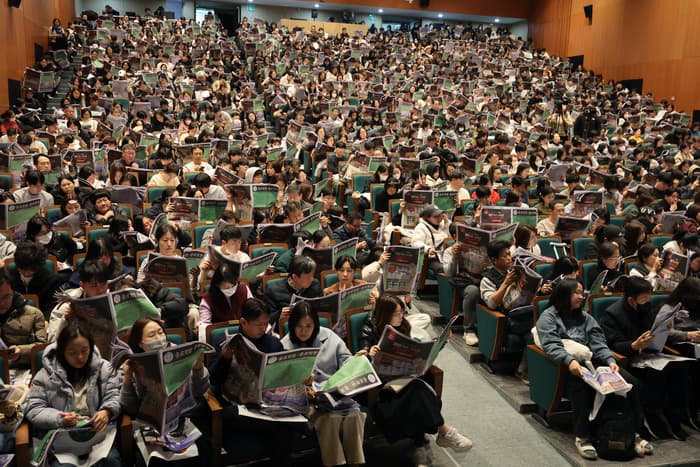
The Two Million Won Dilemma
Bae Hyun-jin, a 46-year-old education activist in South Korea, publicly condemns the nation’s private education culture as a societal sickness. Privately, she spends approximately 2 million won ($1,380) each month on tutoring for her high school son. This amount consumes more than half of South Korea’s average monthly salary of 3.73 million won. Her contradiction illustrates a national anxiety: parents recognize the academic rat race is destructive, yet feel powerless to exit.
- The Two Million Won Dilemma
- When the Guaranteed Path Crumbles
- The Global Race to Redefine Learning
- Digital Textbooks and the Promise of Equity
- The Unemployment Crisis Hitting Graduates
- Private Education Adapts Rather Than Retreats
- Searching for Alternatives in Play and Philosophy
- The Generational Divide
- The Essentials
Recently, a new fear has compounded her stress. Despite her substantial investment in traditional education, Bae cannot ignore headlines warning that artificial intelligence will soon replace workers in white-collar professions. The anxiety grows daily, but solutions remain elusive. Cutting back on tutoring is not an option she considers viable.
They say AI is reshaping hiring, but I honestly do not know anything. Even if AI replaces jobs in the future, I cannot tell my child to stop preparing for this and start preparing for something else instead.
Her confusion reflects a broader national paralysis. South Korea has long operated under a clear formula for success: intense study for the multiple-choice College Scholastic Ability Test, admission to a prestigious SKY university (Seoul National, Korea, or Yonsei), followed by employment at a major conglomerate or entry into a high-paying profession such as medicine, law, or accounting. Parents knew the path was expensive and grueling, but it offered a reliable target.
Now, as AI capabilities expand rapidly, that certainty has dissolved. Parents and students find themselves disoriented, clinging to a traditional model while knowing it may lead nowhere.
When the Guaranteed Path Crumbles
The Bank of Korea issued a stark warning in 2023 that high-income professions including medicine, law, and accountancy face high vulnerability to AI disruption. Technology pioneers Bill Gates and Elon Musk have similarly predicted that AI could soon perform tasks currently reserved for doctors and lawyers. A recent survey by Randstad, the world’s largest recruitment services firm, found that approximately 38 percent of employers plan to hire fewer workers this year than last year specifically because of AI capabilities.
For Korean families who have invested years and fortunes pursuing these professional credentials, such predictions create panic without providing alternatives. Ryu Eun-hye, a 47-year-old mother spending 1.5 million won monthly on her daughter’s private education, describes the shared anxiety.
I am anxious. My daughter is anxious. We are both anxious. For those who study well and have fixed goals, they seem fine. But for ordinary students like my daughter, I do not know what to tell her.
The irony cuts deeply. A few years ago, parents were told coding was the essential skill for the future. Now, AI has automated many entry-level programming tasks first. The question of what comes next remains unanswered.
Lee Byung-hoon, honorary professor of sociology at Chung-Ang University, explains that AI’s threat differs fundamentally from previous economic disruptions.
AI’s job threat is fundamentally different from past disruptions. The speed of change is frightening. When artificial general intelligence emerges, it will raise questions about whether human labor itself can be sustained.
He predicts that the obsession with university admission may slowly change if degrees no longer guarantee employment. Some may eventually conclude that skilled trades or service sectors impervious to AI replacement offer better prospects than professional careers.
The Global Race to Redefine Learning
While Korean parents hesitate, other nations are moving decisively to integrate AI literacy into education from the earliest ages. The United Arab Emirates has launched a nationwide initiative making AI a mandatory subject for all students from kindergarten through grade 12, beginning in the 2025-2026 academic year. The curriculum spans seven areas including foundational concepts, data and algorithms, ethical awareness, and real-world applications, with specially trained teachers delivering the content.
China has announced that by September 2025, all primary and secondary schools nationwide will include mandatory AI instruction, starting as early as first grade with at least eight class hours per year devoted to the subject. The Chinese government views AI literacy as essential to its ambition of becoming a global tech superpower.
In contrast, the United States lacks a national K-12 AI curriculum mandate, with standards varying by state. While the White House issued an executive order in April 2025 recognizing the importance of early AI exposure, implementation remains fragmented. Europe similarly shows growing interest but no region-wide mandate, with countries like Finland pioneering AI elements in high school while others move cautiously.
South Korea occupies a middle position. The government has accelerated plans to integrate AI Digital Textbooks (AIDT) into public schools by 2025, with 76 textbooks approved for use in elementary grades 3-4, middle school grade 1, and high school grade 1 for subjects including mathematics, English, and coding. The Ministry of Education has trained 10,000 leading teachers to spearhead this initiative.
Digital Textbooks and the Promise of Equity
Kang Eun-hee, superintendent of the Daegu Metropolitan Office of Education, emphasizes that AI technology represents an opportunity to realize truly customized education tailored to individual learning paces. Daegu has pushed for AIDT adoption at rates reaching 98 percent, compared to the national average of 32 percent.
The potential benefits extend beyond personalization. According to a McKinsey report, AI can automate 20 to 40 percent of tasks that traditionally consume teachers’ time, including grading, lesson planning, and administration. This would allow educators to focus on mentoring, fostering creativity, and supporting individual student needs.
The Korean initiative specifically aims to address educational inequality and reduce dependence on expensive private tutoring. AI-driven reporting systems automatically generate student progress summaries, eliminating manual data entry while providing real-time analytics for adaptive teaching strategies.
However, challenges remain. While AI proves highly capable in language learning, it sometimes struggles to explain mathematical or scientific reasoning in pedagogically sound ways. Students may become overly reliant on step-by-step AI solutions rather than developing independent problem-solving skills. This suggests AI tutoring works best as a supplement, not a replacement, for human instruction in technical subjects.
The Unemployment Crisis Hitting Graduates
Behind the debate over educational methods lies a harsh economic reality. The share of university graduates among South Korea’s unemployed reached 49.6 percent in September 2025, up from 47.8 percent in 2024 and 37.7 percent in 2010. The jobless rate among degree holders continues climbing despite a shrinking youth population.
In October 2025, there were only 0.42 job openings per job seeker, the lowest October figure since the 1998 Asian financial crisis. It now takes an average of 11.5 months for a young Korean to secure a first job, the longest delay on record. A recent Bank of Korea report found that nearly all 211,000 youth job losses over the past three years occurred in industries most exposed to AI.
Nobel laureate David Card of UC Berkeley identifies four global forces undermining Korea’s youth employment: disruption from US trade policy, AI automation heavily affecting entry-level software development, competition from China, and supply imbalances where educational output outpaced labor demand.
Professor Yoon Hong-sik of Inha University argues that Korea’s welfare and industrial model requires fundamental restructuring.
We once believed AI would only replace low- or mid-skill work, but it is now hollowing out high-skilled roles too. University education must shift from functional training to cultivating creativity and critical thinking, skills machines cannot replicate.
Private Education Adapts Rather Than Retreats
Despite fears of AI disruption, private education spending shows no signs of declining. Education professor Yang Jung-ho of Sungkyunkwan University predicts spending will continue as long as Korea’s admissions system remains unchanged.
Paradoxically, the private education sector is rapidly adopting AI technology rather than resisting it. Korean EdTech startup RiiiD has developed SANTA TOEIC, an AI-powered platform that provides personalized learning paths for English test preparation. The service analyzes user ability in real-time through deep learning algorithms, offering customized curricula that the company claims achieve score increases of approximately 130 points after just 20 hours of study.
RiiiD has secured millions in funding and expanded globally, partnering with US-based education provider Kaplan to deliver AI-driven tutoring solutions. The platform demonstrates how test preparation, the core of Korea’s private education industry, is itself being transformed by the very technology threatening to eliminate the jobs students are studying for.
This creates a complex dynamic. Parents continue investing in traditional credentials while the tools used to obtain those credentials become increasingly automated. A CPA exam candidate expressed this contradiction, noting that while AI usage will increase, complete replacement of experts remains impossible because human oversight is still required to manage AI systems.
Searching for Alternatives in Play and Philosophy
Amid the pressure, some families are experimenting with alternative approaches. Kim Jungu, a father in South Korea, uses generative AI to turn his five-year-old son’s drawings into video clips and stories during weekly 30-minute play sessions. Rather than drilling coding or test prep, he focuses on expanding creativity through space exploration and storytelling.
Kwon Jungmin, a professor specializing in AI education at Seoul National University of Education, emphasizes that the medium matters less than the relationship and critical thinking developed.
What is more important is how that child views ChatGPT. If the child does not have any educational experience on learning about how to view these technologies, then the child will just view it as someone with greater power and knowledge, and that will eventually lead to obeying the technology.
Kwon argues that education in the AI era should nurture critical thinking through humanities, literature, and philosophy rather than focusing solely on technical skills. She notes that European models, which emphasize critical analysis of AI ethics, offer valuable lessons even if they adopt technology more slowly.
Legislative efforts are also emerging to curb the excesses of early private education. A bill gaining bipartisan support would ban English cram school programs for children under 36 months and restrict instruction for older preschoolers to 40 minutes daily. The legislation targets English kindergartens where entrance exams create pressure on toddlers.
The Generational Divide
For current students, the confusion is palpable. A 21-year-old applicant preparing to retake the college entrance exam notes that despite warnings about AI replacement, top students still target medical and law schools because Korea continues to value academic pedigree.
Another applicant majoring in artificial intelligence expresses unsettling uncertainty about whether she is preparing for a field that will exist in its current form by the time she graduates.
The idea that AI could replace professional jobs feels anxiety-inducing. Technology is advancing so fast that the job structure could change dramatically. But the belief that academic pedigree and professional careers guarantee stability and social trust remains strong.
Marcus Alexander, professor at London Business School, offers a stark assessment for students navigating this transition.
Learning facts is irrelevant; learning how to think effectively is more important than ever. The critical issue is not about getting a degree but about what graduates actually learn from very different courses and institutions.
Parents like Ryu Eun-hye hope that the next generation will find clearer paths. Perhaps children growing up fully in the AI era will educate their own children differently. For now, those raised believing that SKY universities and elite professions define success find it nearly impossible to prepare their children for completely different trajectories.
The Essentials
- Nearly half (49.6%) of South Korea’s unemployed population now holds university degrees, with graduates facing 11.5 months average wait for first jobs
- Bank of Korea warns that high-income professions including medicine, law, and accounting face high vulnerability to AI disruption
- South Korea will introduce AI Digital Textbooks in public schools starting 2025, with 76 textbooks approved and 10,000 teachers trained
- Private education spending remains at record highs despite AI fears, with parents spending over 2 million won monthly on tutoring
- Global comparison shows UAE and China implementing mandatory AI education from kindergarten, while Korea focuses on digital textbooks and pilot programs
- EdTech sector is adapting rapidly, with AI tutoring platforms like RiiiD’s SANTA TOEIC replacing traditional cram school methods for test preparation
- Experts emphasize shift from rote learning to critical thinking, creativity, and humanities as essential skills for AI era
- Legislative efforts are underway to restrict early childhood English education and reduce pressure on preschoolers