A Strategic Shift in Naval Maintenance
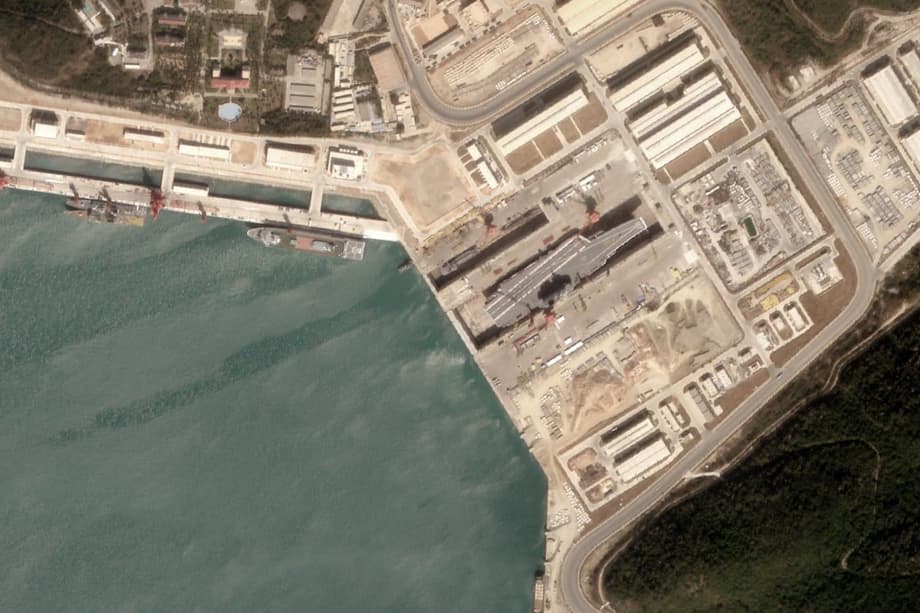
Satellite imagery captured on January 21, 2026, has revealed a significant development in China’s naval capabilities. The People’s Liberation Army Navy (PLAN) aircraft carrier Shandong (CV-17) entered a massive dry dock at the Yulin Naval Base in Sanya, located on Hainan Island in the southern Chinese province of Hainan. This marks the first time a Chinese aircraft carrier has utilized this particular facility, representing a critical evolution in the PLAN’s logistical infrastructure and operational sustainability.
- A Strategic Shift in Naval Maintenance
- The Yulin Facility: Engineering a Self-Sustaining Naval Hub
- Sustained Operations Create Maintenance Imperatives
- Avoiding the Carrier Gap in the South China Sea
- Extending Reach Toward the Indian Ocean and Beyond
- Maturing Infrastructure for a Blue-Water Navy
- The Bottom Line
According to analysis by AllSource Analysis, an American geospatial intelligence company, the Shandong entered the dry dock on either January 20 or January 21. The vessel’s presence in this facility signals that the dock, which became operational in 2022 after construction began in 2017, has now expanded its capabilities to handle the navy’s largest surface combatants. Previously, this dry dock had only serviced smaller surface combatants and coast guard vessels, despite its substantial dimensions of approximately 375 meters in length and 78 meters in width.
This development fundamentally alters how the Chinese military maintains its carrier fleet. Historically, major repairs and overhauls for Chinese aircraft carriers were confined to the Dalian shipyard in northern China, located in Liaoning province. The necessity to transit carriers thousands of kilometers from their operational areas in the South China Sea to the northern shipyards created significant logistical challenges and operational gaps. By establishing localized maintenance capabilities in the south, the PLAN effectively reduces transit time for mid-cycle repairs and increases the operational availability of its carrier strike groups in contested waters.
The Yulin Facility: Engineering a Self-Sustaining Naval Hub
The Yulin Naval Base dry dock represents years of strategic infrastructure investment designed to transform Sanya from a mere forward operating base into a comprehensive, self-sustaining naval hub. Construction commenced in 2017 and concluded in 2022, yet the facility waited until this January to receive its first aircraft carrier, suggesting extensive testing and certification processes for handling vessels of this magnitude.
The dry dock’s specifications are precisely calibrated for the PLAN’s current carrier fleet. At 375 meters long and 78 meters wide, the facility comfortably accommodates the Shandong, which measures 304.5 meters in length and 75 meters in width according to the Center for Strategic and International Studies’ ChinaPower project. The dock’s capacity also extends to the CNS Fujian (CV-18), China’s third and most advanced carrier, which entered active service on November 7, 2025, and is also homeported in the Southern Theatre Command.
Dry docks serve a fundamentally different purpose from standard berthing facilities. These specialized basins can be drained of water to lift entire vessels out of the sea, allowing maintenance crews to access submerged and normally inaccessible components including hulls, propellers, sea chests, and rudders. This capability is essential for cleaning and repainting to prevent corrosion, conducting complex overhauls of propulsion systems, and ensuring the operational readiness and longevity of capital ships. Without such facilities, carriers must transit to distant shipyards for even routine maintenance below the waterline, effectively removing them from operational status for extended periods.
Sustained Operations Create Maintenance Imperatives
The timing of the Shandong’s dry docking reflects the intense operational tempo the carrier has maintained throughout 2025. Prior to entering maintenance, the vessel participated in large-scale exercises including Joint Sword-2024B and Strait Thunder-2025A, conducting naval aviation training that reportedly included approximately 10,000 flight operations. These activities, combined with integration exercises involving destroyers and frigates and deployments to strategically sensitive areas, necessitated thorough technical inspections and maintenance work.
The Shandong, commissioned in December 2019, holds the distinction of being the first aircraft carrier built entirely in China. It represents the second operational carrier in the PLAN fleet, following the Liaoning (CV-16), which was originally constructed for the Soviet Navy and later purchased by China as an unfinished hull. After several years dedicated to testing and training, the Shandong completed its inaugural operational deployment to the western Pacific in 2023, validating its ability to operate beyond waters immediately adjacent to the Chinese mainland.
Song Zhongping, a prominent Chinese military commentator, has previously emphasized the significance of standardized carrier support infrastructure. He noted that the South China Sea presents complex sea conditions, and the ability to conduct multiple operational tasks and subsequent repairs within this theatre demonstrates that the Shandong task force now possesses complete and self-contained combat power. This localized maintenance capability eliminates the previous requirement for carriers to withdraw from the southern theatre for extensive periods, thereby maintaining continuous pressure and presence in contested waters.
Avoiding the Carrier Gap in the South China Sea
Analysts suggest that the activation of the Yulin dry dock for carrier-level work addresses a critical vulnerability in China’s naval strategy: the potential for a “carrier gap” in the South China Sea. When carriers required maintenance at Dalian, the transit time and repair duration could leave the southern theatre without carrier coverage for weeks or months. This gap created windows of opportunity for rival powers and complicated China’s ability to maintain consistent pressure in disputed waters.
Alex Luck, an Australia-based naval analyst, noted:
“Event illustrates a significant milestone for [People’s Liberation Army Navy, PLAN] both in terms of diversifying logistics and support infrastructure and reducing reliance on Dalian for carrier maintenance.”
This diversification creates redundancy in the PLAN’s support network, ensuring that maintenance bottlenecks in northern shipyards cannot simultaneously disable the entire carrier fleet.
The Yulin facility effectively enables China to maintain continuous carrier operations in the South China Sea even when one vessel requires maintenance. With the CNS Fujian now operational and also based in the southern theatre, the PLAN can rotate vessels through maintenance cycles without sacrificing operational tempo. This capability transforms the South China Sea from an area of periodic carrier presence into a region of sustained, year-round carrier strike group operations.
Extending Reach Toward the Indian Ocean and Beyond
While the immediate benefits focus on South China Sea operations, analysts indicate that the Yulin dry dock capability carries broader implications for China’s ambitions in the Indian Ocean and toward the Middle East. The ability to perform major maintenance in Hainan significantly extends the operational range of Chinese carrier strike groups, potentially supporting deployments far beyond the first island chain.
According to regional security experts, this infrastructure paves the way for military outreach along sea lanes stretching from the South China Sea through the Indian Ocean to the Middle East. This aligns with China’s broader strategic interests in protecting shipping routes and projecting power in regions traditionally dominated by the United States and its allies. The logistical footprint required to support carrier operations at such distances demands robust shore-based support systems; the Yulin facility represents a critical node in this expanding network.
The development comes at a time when the United States is adjusting its own carrier deployments in the region. As the Shandong entered dry dock, the American aircraft carrier USS Abraham Lincoln departed the Western Pacific for possible deployment to the Middle East amid tensions with Iran. This shift highlights the competitive nature of carrier presence in the Indo-Pacific, where the availability of maintenance facilities directly influences strategic flexibility and response times.
Maturing Infrastructure for a Blue-Water Navy
The activation of the Yulin dry dock for carrier maintenance underscores the PLAN’s transition from a regional “green-water” force to a true “blue-water” navy capable of sustained operations far from home ports. This transformation requires more than just additional hulls and aircraft; it demands sophisticated logistical support systems, specialized supply chains, and trained personnel capable of maintaining complex vessels.
A Chinese military observer, speaking on condition of anonymity because of the sensitive nature of the topic, previously told media outlets:
“A carrier doesn’t act alone, it also needs to provide support facilities for the entire [carrier strike] group.”
The Yulin expansion includes not just the dry dock itself but also expansive new berthing and maintenance infrastructure added over the past year to support multiple aircraft carriers and their escort fleets. This comprehensive approach indicates that China is building the industrial and logistical capacity to sustain prolonged naval campaigns rather than merely conducting periodic show-of-force deployments.
The Bottom Line
- The CNS Shandong entered the Yulin Naval Base dry dock on January 20-21, 2026, marking the first carrier use of this facility
- The dry dock, measuring 375 meters by 78 meters, was constructed between 2017 and 2022 but had previously only serviced smaller vessels
- This development decentralizes carrier maintenance from Dalian in northern China to Hainan in the south, reducing transit times and operational gaps
- The capability supports sustained carrier operations in the South China Sea and extends potential reach toward the Indian Ocean and Middle East
- The milestone coincides with the commissioning of the CNS Fujian, creating a dual-carrier presence in the Southern Theatre Command with local maintenance support
- Analysts view this as evidence of the PLAN’s maturing logistics infrastructure and its evolution toward blue-water naval capabilities