The Real Value Lies in the Habit, Not the Money
When Singapore’s Beverage Container Return Scheme (BCRS) launches on April 1, 2026, consumers will notice one immediate change: every bottled or canned drink will cost 10 cents more upfront. This refundable deposit, applicable to prepackaged beverages in plastic and metal containers ranging from 150 millilitres to 3 litres, represents the most visible element of a policy that extends far beyond simple waste management. While the financial mechanism appears straightforward, the true objective involves rewiring daily routines to make sustainable behavior automatic rather than optional.
Dr Janil Puthucheary, Senior Minister of State for Sustainability and the Environment, has stressed that the scheme represents a significant step toward Singapore’s circular economy goals. Behavioral scientists recognize something more subtle at work. By attaching a small monetary value to an empty container, the scheme transforms rubbish into an unfinished transaction, creating a psychological pause that prompts action. Over time, this interruption becomes habit, embedding environmental responsibility into the rhythm of daily life without requiring constant conscious motivation. This shift from active decision-making to passive habit formation represents the core strategy behind Singapore’s approach.
International evidence supports this method. Countries in Northern Europe have used deposit-return systems for decades, achieving return rates above 90 percent. The success in these regions stems not from enforcement, but from normalization. Returning bottles becomes simply what people do. Australia offers a regional comparison where return rates increased substantially after implementation, with participation remaining high despite modest refund amounts. These experiences suggest that once systems are convenient and embedded into daily life, people stop thinking about the incentive. The behavior becomes automatic.
Operational Framework: From Purchase to Refund
The mechanics of the scheme involve multiple stakeholders working within a carefully structured timeline. When consumers purchase eligible beverages from April 1, they pay the 10 cent deposit in addition to the retail price. The Inland Revenue Authority of Singapore has clarified that this deposit is not subject to GST, meaning consumers pay 9 percent tax only on the beverage itself, not the refundable amount. Suppliers must update accounting and point-of-sale systems to ensure proper separation of these amounts on invoices and receipts.
Recognizing the logistical complexity of transitioning existing inventory, authorities extended the original three month transition period to six months, running until September 30, 2026. During this window, retailers may sell both BCRS-labelled containers (with the 10 cent deposit) and older non-labelled stock (without deposit). Full implementation commences October 1, 2026, after which only labelled containers may be sold. This extension came after feedback from beverage producers who needed additional time to clear existing stocks and adjust supply chains.
The scheme covers all prepackaged drinks in plastic bottles and metal cans between 150ml and 3 litres, regardless of shape. Freshly prepared beverages and foods for special medical purposes remain exempt. The National Environment Agency (NEA) has licensed Beverage Container Return Scheme Ltd (BCRS Ltd), a not-for-profit company formed by beverage giants Coca-Cola Singapore Beverages, F&N Foods, and Pokka, to oversee operations for seven years until March 31, 2033. As the licensed operator, BCRS Ltd will collect containers for recycling on behalf of all beverage producers and maintain data protection systems to secure operational information.
Infrastructure and Accessibility: Technology Meets Daily Life
Accessibility determines success in deposit-return systems. Singapore plans to launch with approximately 1,000 return points strategically positioned across supermarkets, Housing and Development Board (HDB) void decks, and town centres. Within the first year, this network will expand to 2,000 locations, ensuring 90 percent of HDB residents live within a five minute walk of a return point. This proximity removes the friction that often prevents recycling participation.
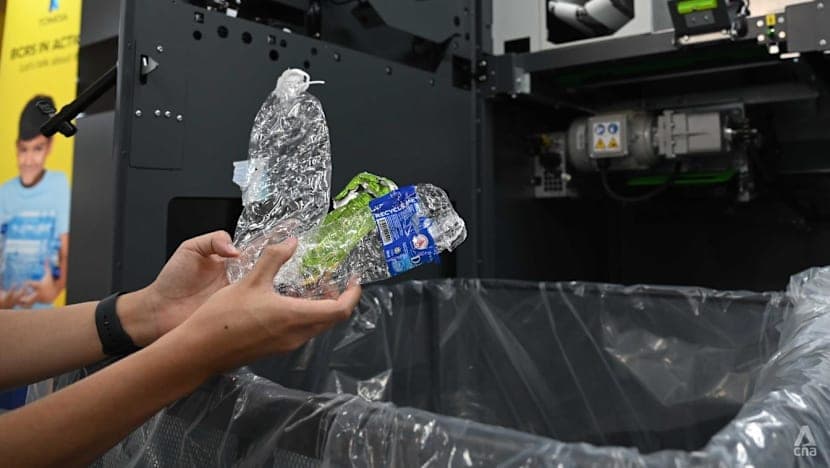
The technological backbone relies on reverse vending machines supplied by international specialists. Norwegian company TOMRA will deploy at least 350 units across central and north-eastern Singapore, having established a new office and warehouse facility in Kallang to support operations. Swedish firm RVM Systems will cover the eastern regions, while local operator SG Recycle handles the west and north. These automated machines crush and store containers, with smaller units holding up to 1,000 containers and larger models accommodating 2,000. TOMRA has indicated that container-sized machines capable of handling 8,000 units may be introduced if demand requires.
Refund mechanisms prioritize digital convenience. Consumers can tap EZ-Link cards, including student and senior concession cards, at machines to receive immediate credit. Additional digital payment methods will be announced closer to launch. Each machine provides instructions in Singapore’s four official languages, ensuring broad accessibility. TOMRA will partner with local cleaning company Chye Thiam Maintenance to handle site cleaning, maintenance, and transportation of collected containers to a central sorting facility jointly operated by BCRS Ltd and waste collector Cora Environment. This creates a closed loop that recovers an anticipated 16,000 tonnes of material annually from over one billion containers.
Business Adjustments: Costs, Concerns, and Compensation
While consumers focus on the deposit mechanism, producers face significant operational adjustments. All manufacturers and importers must register with BCRS Ltd, pay a one time registration fee of $500, and apply deposit marks and Singapore-specific barcodes to containers. For importers, this often involves manually pasting stickers on imported drinks, adding labor costs to logistical complexity.
These requirements sparked concerns among smaller producers, with some warning that compliance costs could force retail price increases between 25 cents and 70 cents per drink. Research from Nanyang Technological University highlighted these warnings, noting that the additional work and expenses might disproportionately affect smaller players in the market.
Dr Janil has clarified the actual cost structure, noting that beyond one time implementation expenses, ongoing producer fees amount to approximately 3 to 4 cents per container for logistics and recycling. Adding labeling costs, which vary from 3 cents per container when done at scale overseas to higher amounts for small local batches, brings the total to roughly 6 to 7 cents per unit. This remains comparable to fees in other jurisdictions with similar schemes. Dr Janil noted that producers representing 80 percent of beverage containers can change their container designs to meet requirements without stickers, reducing costs further.
To alleviate initial burdens, NEA introduced a producer transition grant of up to $2,500, automatically available to all registered beverage producers. This grant covers registration fees, producer fees, and scheme sticker costs, with eligible charges deducted automatically during billing. Authorities have pledged flexibility and support for producers who engage with BCRS Ltd to optimize operations and reduce costs over time.
Global Models and Local Context
Singapore joins a global movement that has proven effective across diverse contexts. Northern European nations have operated deposit-return systems for decades, achieving return rates exceeding 90 percent. The success in these regions stems not from stringent enforcement but from normalization, where returning bottles becomes embedded in social practice and daily routine.
Australia provides a closer regional comparison. Since implementing container deposit schemes across most states, return rates have increased substantially while litter has declined. Participation has remained robust despite modest refund amounts, demonstrating that convenience and visibility matter more than financial incentive. Once systems integrate into daily life, the behavior becomes automatic and self-sustaining.
Singapore’s adaptation emphasizes public space utilization. By placing return points in void decks and town centers rather than limiting them to supermarkets, the scheme transforms recycling from a private household task into a shared public practice. This visibility reinforces social norms. When residents see neighbors returning containers, the behavior gains legitimacy and becomes expected rather than exceptional. The presence of reverse vending machines in communal areas serves as a constant reminder of environmental responsibility.
The scheme also addresses equity concerns. If returning containers were easy only in certain neighborhoods, or if machines were difficult to use for some groups, participation would naturally be uneven. By ensuring 90 percent of public housing residents live within five minutes of a return point, policymakers aim to make environmental responsibility a collective expectation rather than an uneven burden based on time, familiarity, or access.
The Urgency of Circular Economy Transition
The scheme addresses an immediate environmental reality. Singapore’s only landfill, Semakau, is filling rapidly. Packaging waste constitutes one third of domestic waste generated annually, yet plastic recycling rates hover around only five percent. Without intervention, future generations will bear the environmental, economic, and social costs of current consumption patterns.
By creating clean, traceable streams of post consumer polyethylene terephthalate (PET) and aluminum, the BCRS provides quality feedstock for recycled polymer production. This supports Singapore’s net-zero commitments while reducing reliance on virgin materials. The extended producer responsibility framework ensures that companies placing containers on the market bear responsibility for their collection and recycling, incentivizing design changes that facilitate reuse.
Dr Janil has stressed the behavioral mission of the initiative.
At its core, this is not simply a scheme to collect beverage containers. It is a call for each of us to change our habits and behaviours.
While teething issues are expected, the government has committed to adaptive learning, monitoring return patterns and community feedback to optimize placement of additional return points during the initial months. Outreach efforts will target grassroots organizations, schools, youth groups, and corporate partners starting February 2026.
Ultimately, the beverage container return scheme should not be judged only by how much waste it diverts from incineration. Its deeper success lies in whether it normalizes sustainable behavior and strengthens a shared sense of responsibility for the city. Cities shape behavior through streets, systems, and infrastructure that guide what feels easy and expected. When policy is designed with behavioral insight, sustainability becomes less about persuading people to change, and more about enabling them to act on values they already hold.
Key Points
- The Beverage Container Return Scheme launches April 1, 2026, with a six month transition period ending September 30, 2026, during which both labelled and non-labelled containers may be sold
- Consumers pay a 10 cent refundable deposit on prepackaged drinks in plastic and metal containers (150ml-3L), redeemable at over 1,000 return points expanding to 2,000 within the first year
- Reverse vending machines supplied by Norwegian firm TOMRA, Swedish company RVM Systems, and local operator SG Recycle accept containers and issue refunds primarily via EZ-Link cards
- 90 percent of HDB residents will live within a five minute walk of a return point, with machines located at supermarkets, void decks, and town centres
- BCRS Ltd, a not-for-profit consortium of Coca-Cola, F&N Foods, and Pokka, operates the scheme under a seven year license from the National Environment Agency
- Producers face compliance costs estimated at 6-7 cents per container, with a one time government grant of up to $2,500 available to offset initial registration and labeling expenses
- The scheme targets an 80% return rate by its third year, aiming to recover over 16,000 tonnes of material annually from more than one billion containers
- The deposit is not subject to GST, and suppliers must update invoicing systems to separate the refundable amount from taxable beverage sales
- Beyond recycling, the policy aims to normalize sustainable behavior by embedding environmental responsibility into daily routines and public spaces