A Coordinated Judicial Strike
China has carried out a sweeping series of executions targeting the leadership of two powerful criminal dynasties operating from the lawless border regions of Myanmar, signaling an unprecedented escalation in Beijing’s campaign against transnational cyber fraud and human trafficking. In the span of less than a week, Chinese authorities executed 15 members of the notorious Ming and Bai families, crime syndicates accused of running industrial-scale scam compounds that generated billions of dollars through forced labor, torture, and sophisticated online fraud schemes targeting victims worldwide.
The executions, carried out by courts in Wenzhou and Shenzhen after approval from China’s Supreme People’s Court, represent the most severe judicial response to date against the operators of Myanmar’s scam centers. These facilities, part of a global criminal enterprise estimated by the United Nations to generate $40 billion annually, have trapped hundreds of thousands of trafficked workers in prison-like conditions where they are compelled to execute romance-based investment scams known as “pig butchering” operations.
Between January 29 and February 2, 2026, Chinese state media announced the executions in two separate waves, first targeting 11 members of the Ming family criminal group, followed by four additional leaders from the Bai family syndicate. The speed and finality of these sentences demonstrate Beijing’s determination to dismantle the criminal networks that have flourished in Myanmar’s civil war-torn borderlands, even as human rights organizations raise concerns about the transparency of China’s judicial process and the fate of remaining trafficking victims.
The Ming Family: Violence at the Border
On January 29, the Wenzhou Intermediate People’s Court in eastern Zhejiang province executed 11 core members of the Ming family criminal group, including Ming Guoping, a leader in the Kokang Border Guard Force aligned with Myanmar’s ruling junta, and his daughter Ming Zhenzhen. The family’s patriarch, Ming Xuechang, who had served as a member of Myanmar’s state parliament, killed himself while in custody following his arrest in late 2023.
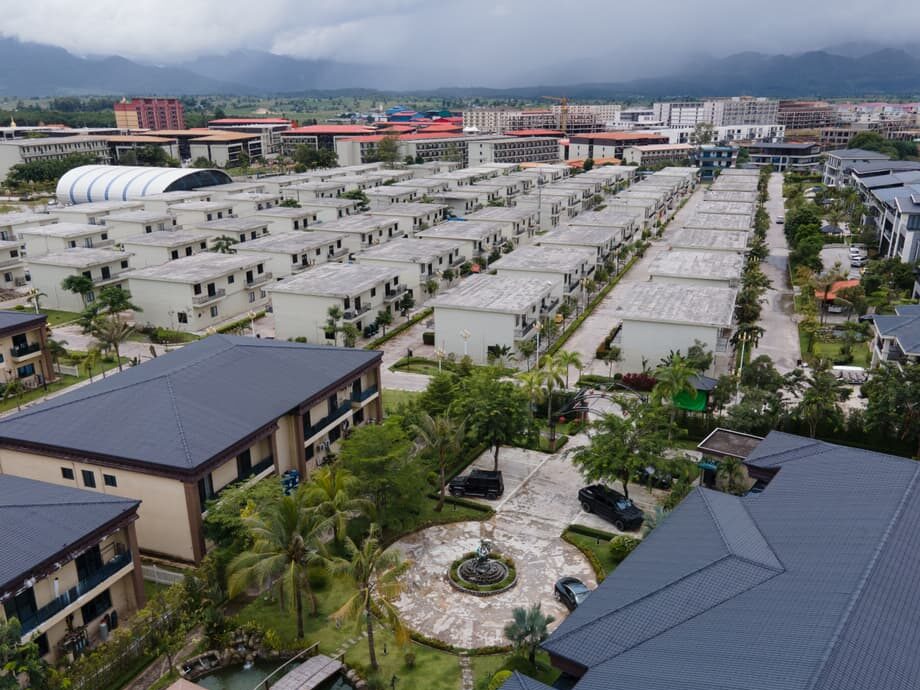
The court found that the Ming syndicate had established multiple operational bases in Myanmar’s Kokang autonomous region, specifically in the Laukkai, Shiyuanzi and Chinshwehaw areas, beginning in 2015. At its peak, the organization employed 10,000 people at the infamous Crouching Tiger Villa compound and other facilities, generating over 10 billion yuan ($1.4 billion) through telecom fraud and illegal gambling operations.
According to the Supreme People’s Court, which reviewed the case after two defendants appealed their September 2025 death sentences, the Ming family utilized their influence and weapons access to provide armed protection for criminal financiers while systematically employing lethal violence to maintain control. The court confirmed the group intentionally killed, injured, and illegally detained workers, resulting in the deaths of 14 Chinese citizens and injuries to numerous others.
In one particularly violent incident in October 2023, Ming family operatives allegedly opened fire on captive Chinese nationals during a transfer operation, killing four people to prevent their rescue by authorities who had been tipped off about an impending raid. Chinese state broadcaster CCTV reported that the group was moving workers from the cyberfraud park under armed guard when the shooting occurred. The court characterized these crimes as “exceptionally heinous” with “particularly serious circumstances.”
The Bai Clan: Drugs and Industrial Fraud
Four days later, on February 2, the Shenzhen Intermediate People’s Court in southern Guangdong province announced the execution of four additional gang leaders from the Bai family criminal group, marking the second wave of capital punishment against Myanmar-based scam operators in less than a week. The executed included Bai Yingcang, while the family’s alleged patriarch, Bai Suocheng, died of illness following his November 2025 conviction.
The Bai syndicate established industrial parks in the same Kokang region bordering China, operating a parallel criminal empire that the court said defrauded victims of more than 29 billion yuan ($4.2 billion). Beyond telecom fraud and illegal gambling, the Bai organization engaged in kidnapping, extortion, forced prostitution, and large-scale drug manufacturing, including the production of approximately 11 tonnes of methamphetamine.
Their criminal activities resulted in the deaths of six Chinese citizens and injuries to others, according to the Supreme People’s Court, which approved the death sentences after the Guangdong Provincial High People’s Court dismissed the defendants’ appeals in December 2025. The court emphasized that the group’s crimes posed “a tremendous threat to society” due to their scale and brutality.
The Bai family had established itself as one of the dominant forces in Laukkaing, the capital of Kokang, where they operated sprawling casino complexes and red light districts alongside their cyber-scam operations. Their industrial parks functioned as fortified compounds where trafficked workers were held under constant armed guard.
Inside the Scam Compounds
These executions target the apex of a criminal industry that has transformed parts of Southeast Asia into global hubs for cyber-enabled fraud. The scam compounds, often described as fortified industrial parks, function as hybrid facilities combining call center operations with detention centers. Traffickers recruit victims, primarily from China and other Asian nations, through fraudulent advertisements promising lucrative tech industry positions. Upon arrival in Myanmar’s border regions, workers find their passports confiscated and themselves confined to heavily guarded facilities.
Inside these compounds, trafficked individuals are forced to execute sophisticated fraud schemes, particularly “pig butchering” scams that combine romance fraud with cryptocurrency investment schemes. Workers establish fake online relationships with victims worldwide, gradually building trust before introducing fraudulent investment platforms designed to steal savings. Those who fail to meet financial quotas face physical abuse, torture, or sale to other criminal groups, while escape attempts often result in death.
The United States Institute of Peace estimates that these Southeast Asian scam operations steal more than $43 billion annually, while the UN Office on Drugs and Crime has warned that the industry is proliferating globally, expanding to South America, Africa, the Middle East, and Pacific Islands. Interpol has expressed particular concern over the expansion of human trafficking networks feeding these operations, with hundreds of thousands of people estimated to be working in scam centers worldwide, many having been stranded in the region following the COVID-19 pandemic.
Workers inside the compounds report prison-like conditions where armed guards routinely abuse and torture those who fail to meet financial targets. The Ming and Bai families specifically used lethal violence to control their operations, with the Supreme People’s Court confirming they intentionally murdered, assaulted, and illegally detained people involved in fraud operations.
The Kokang Criminal Ecosystem
The Ming and Bai families represent two of the “Four Families” that have dominated Kokang’s criminal economy for years, alongside the Liu and Wei syndicates. These organizations operated with impunity in the autonomous region, exploiting deep ties to local militias and Myanmar’s military junta to establish what amounted to a parallel state governed by organized crime.
Laukkaing, the capital of Kokang, became synonymous with unregulated casinos, red light districts, and cyber fraud parks, operating in a grey zone where Chinese law enforcement had limited reach and Myanmar central authority remained weak. Family members held official positions within local government and militia structures, providing both political protection and armed enforcement for their criminal enterprises.
The scam industry flourished amid the chaos of Myanmar’s civil war, which erupted following the military coup in February 2021. As central governance collapsed in border regions, criminal syndicates exploited the power vacuum to expand their operations, recruiting from pools of desperate migrants stranded by pandemic border closures and economic disruption. The autonomous status of Kokang and its proximity to the Chinese border created ideal conditions for these transnational criminal enterprises.
According to Chinese state media, the Ming family specifically used their position within the Kokang Border Guard Force, aligned with Myanmar’s ruling junta, to provide armed protection for scam compounds. This relationship between criminal syndicates and local militias allowed the industry to operate openly for years despite its reliance on forced labor and violence.
Beijing’s Cross-Border Crackdown
Beijing’s aggressive judicial response follows years of intensifying pressure on Myanmar and neighboring countries to dismantle the scam compounds. In November 2023, Chinese authorities issued arrest warrants for Ming family members, posting rewards between $14,000 and $70,000 for their capture. This coordinated crackdown has resulted in the repatriation of thousands of suspected fraud operators to China, including over 7,600 Chinese nationals from the Myanmar town of Myawaddy alone in 2025.
The executions align with broader regional cooperation efforts, including joint operations between China, Myanmar, and Thailand launched in February to repatriate fraud suspects. When asked about the executions, Chinese Foreign Ministry spokesperson Guo Jiakun stated that Beijing would continue intensifying efforts to combat cross-border crime.
“For some time, China has been actively working with Myanmar and other countries in combating crimes of cross-border telecom and online fraud, eliminating the scourge of online gambling and telecom fraud. These efforts have achieved remarkable results. China will continue deepening international law enforcement cooperation, step up efforts of combating telecom fraud and online gambling and other related cross-border crimes and eradicate the problems of gambling and scams.”
The severity of the sentences reflects both the scale of the crimes and China’s determination to deter similar operations. Legal observers note that while China conducts more executions annually than any other country, according to Amnesty International, the public nature of these announcements and the specific targeting of transnational criminal leadership represents a strategic messaging effort aimed at dissuading other syndicates.
Global Implications and Human Trafficking
Beyond the immediate impact on the Ming and Bai criminal networks, these executions highlight the growing international urgency to address cyber scam centers as a form of organized crime and human rights abuse. The industry has evolved from localized operations into a globalized threat, with criminal groups now expanding beyond Chinese-speaking targets to conduct multi-language scams affecting victims across North America, Europe, and Australia.
The case also underscores the complex geopolitical challenges posed by Myanmar’s ongoing instability. As the civil war continues, criminal syndicates have found fertile ground in ungoverned border spaces, creating enforcement gaps that require unprecedented cross-border judicial cooperation. The extradition of Chen Zhi, an alleged scam kingpin and head of the sanctioned Prince group, from Cambodia to China earlier this year demonstrates the expanding scope of Beijing’s campaign against these networks.
For the thousands of trafficking victims still believed to be held in compounds across Myanmar, Cambodia, and Laos, the dismantling of these two families offers hope but no immediate guarantee of freedom. Human rights organizations continue to pressure regional governments to prioritize victim rescue alongside criminal prosecution, ensuring that those forced into fraudulent labor receive protection rather than punishment.
The UN Office on Drugs and Crime warned in April 2025 that Chinese and Southeast Asian gangs are raking in tens of billions of dollars annually through these operations, with the industry showing signs of global expansion. The executions in China represent one government’s attempt to stem the tide through severe criminal penalties, though the ultimate effectiveness of such measures against a multi-billion dollar global industry remains uncertain.
The Bottom Line
- China executed 15 members of two Myanmar-based criminal families in separate announcements on January 29 and February 2, 2026
- The Ming family executions involved 11 people including Ming Guoping and Ming Zhenzhen; patriarch Ming Xuechang died in custody
- The Bai family executions involved 4 people; patriarch Bai Suocheng died of illness after sentencing
- Combined criminal proceeds exceeded $5.6 billion through telecom fraud, gambling, and drug trafficking
- Operations resulted in the deaths of at least 20 Chinese citizens and injuries to numerous others
- Scam compounds in Myanmar’s Kokang region used trafficked workers to conduct global cyber fraud worth an estimated $40-43 billion annually
- Executions approved by China’s Supreme People’s Court after appeals were dismissed by provincial high courts
- Beijing has intensified cross-border cooperation with Myanmar and Thailand to dismantle scam centers and repatriate thousands of suspects