Security companies face scrutiny over Cambodia's scam compounds
Cambodian authorities have announced investigations into private security companies and serving military personnel after Amnesty International linked five firms to at least 23 scam compounds where survivors described confinement, beatings, electric shocks and sexual violence.
Contents
- Security companies face scrutiny over Cambodia's scam compounds
- How Amnesty traced the guards and their employers
- What survivors described inside the compounds
- The five companies and their responses
- Why Long Bay remains central to the inquiry
- From the crackdown to the expanded investigation
- What the enforcement figures show
- Scam networks are moving beyond Cambodia
- The test is whether investigations reach those providing protection
- Key Points
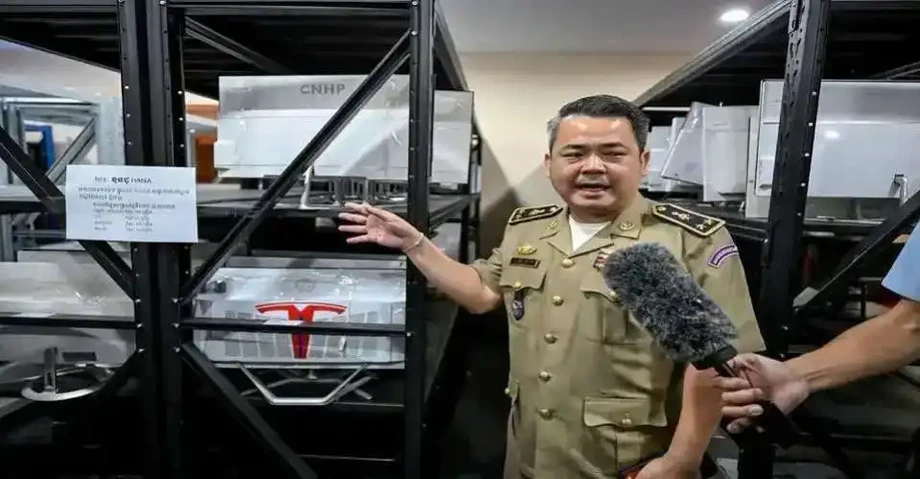
Chhay Sinarith, the senior minister who heads the secretariat of the Ad Hoc Commission for Combating Technology-Based Scams, said on November 1 that investigators would examine companies, officials and others connected to major scam operations. He acknowledged that earlier efforts had concentrated on ringleaders, leaving people who provided security and other support under less scrutiny.
The announcement followed Amnesty International's October 29, 2026 report, Official Business. The organisation connected more than 20 military and police personnel to security companies and at least 22 of the 86 compounds it documented across Cambodia.
Sinarith said investigators would examine whether private security companies participated in illegal activities or helped confine and torture people. He described the government's intended response in direct terms:
We must take legal action,
The expanded inquiry puts attention on the people who controlled compound gates, deployed guards and supplied protection, alongside those accused of directing online fraud. For people trafficked into these sites, the guards often determined whether they could leave, contact help or escape punishment.
Authorities said 529 cases involving scams and 5,778 people were before Cambodian courts. Suspects included nationals of China, Japan, India and Vietnam. Sinarith also said investigators had identified 97 criminal networks inside Cambodia and about 100 more operating overseas.
How Amnesty traced the guards and their employers
Amnesty's investigation combined survivor testimony with corporate records, visits to compounds and material posted online by guards themselves. Between January 2023 and September 2026, researchers interviewed 151 survivors and reviewed records concerning more than 400 additional victims.
Researchers identified 86 compounds and visited 82. They found security guards at every compound. Their investigation also examined more than 25,000 videos and photographs posted by guards, alongside satellite imagery and business records.
Amnesty located videos from more than 200 guards' TikTok accounts at 23 compounds. This process, called geolocation, involves matching details visible in an image, such as buildings, roads or landmarks, to a real place. Researchers also analysed uniforms, insignia, identification numbers and social media timelines to establish when apparent military and police personnel were present.
At three compounds, Amnesty identified apparent serving military personnel training, leading or supervising guards. At other locations, apparent state personnel carried firearms or occupied guard positions.
Agnès Callamard, Amnesty International's secretary general, said the research provided evidence for accounts survivors had given for years:
For years, survivors of these nightmarish compounds described encountering members of the Cambodian military or police inside. These accounts could not be independently verified – until now,
The findings connect the daily enforcement of captivity to registered businesses and people with official positions. Amnesty is calling for investigators to trace responsibility through the companies that recruited, deployed and controlled guards.
What survivors described inside the compounds
Survivors consistently told Amnesty that guards prevented them from leaving. Some described beatings after attempted escapes, electric shocks and prolonged detention in rooms used for punishment. Most of the 151 survivors interviewed said guards carried electric shock batons or could obtain them immediately.
At Park 8, also known as PV01, a woman from Cameroon identified by the pseudonym Maia said guards restrained her when she arrived. She said they later took her to a dark room where managers raped her while guards stood outside.
Gabe, a survivor from Uganda at the same compound, described being chained above basins of water, beaten for hours and shocked with an electric baton. Several survivors also reported seeing firearms carried by guards or other people.
Forced labour in these compounds involved making people carry out online fraud under threat of violence. A person sending deceptive messages could therefore be both participating in a scam and being held captive by its organisers. Investigators must establish each person's conduct and circumstances.
Earlier cases involving South Korean scam suspects illustrated that complexity. In January 2026, 73 suspects returned from Cambodia for questioning over alleged scams involving 48.6 billion won and 869 South Korean victims. Other South Koreans described confiscated passports, guarded compounds and coercion.
The five companies and their responses
Leap Somnang had the largest presence among the companies Amnesty identified, with links to at least 15 compounds across eight provinces. Twelve survivors recognised its guards, uniforms or logo. All 12 said its guards prevented them from leaving under threat of violence; several described guards taking part in beatings, electric shocks or prolonged isolation.
Amnesty said Leap Somnang was controlled by Ban Sophat, a colonel in the Royal Cambodian Armed Forces who publicly presented himself as its chairman. Sophat denied holding an ownership, director or management role, saying he had served as an adviser to the company's owner. He also denied involvement in abuse.
Security Response was linked to five compounds, including Park 8. Amnesty traced business connections to Panda Commercial Bank and the Huione corporate network. Security Response denied the allegations and said it operated lawfully as a registered security provider.
ZD Security, formerly BIC Security, was linked to two compounds in Botum Sakor, including Long Bay. Amnesty connected the company to ZhengHeng Group and its chairman, Deng Pibing. ZhengHeng has denied involvement in the alleged abuses. ZD Security did not respond to Amnesty.
Dara Security was linked to two compounds in Sihanoukville. Best Security was linked to a compound in Bavet where Amnesty documented trafficking, forced labour and child labour.
Amnesty found Deputy Police Chief Lay Channy's telephone numbers on a Best Security advertisement. The company denied that he controlled its operations, saying he owned a building it rented and that his number helped local customers contact the branch. Best Security also denied providing services at the compound identified by Amnesty and suggested its uniforms might have been copied.
Brigadier General Tek Bunthoeun was linked by Amnesty to a property development containing another compound, identified as BM02, where survivors described torture, confinement and forced labour. Amnesty sought responses from the people and businesses it identified and included the replies it received in its report.
Why Long Bay remains central to the inquiry
Long Bay, a development in Koh Kong province, brings together allegations involving property ownership, security services and official protection. Sinarith said authorities were pursuing Deng Pibing, also known as Dung Ping, while investigating officials named in a video investigation about the site.
Deng chaired the board of the company now known as ZD Security until October 2023, according to Amnesty. Britain sanctioned ZhengHeng Group in 2023 over forced labour at Long Bay, where Amnesty said ZD Security supplied guards.
Authorities previously confirmed Deng's departure from Cambodia in late May 2026, citing immigration information. Suspected scam buildings had been discovered at Long Bay in February, after suspected criminal groups had left evidence behind. Cambodian authorities said they detained suspects, secured evidence and sealed premises.
Sinarith said the new investigation would also examine whether casino and resort owners, including Kok An and Ly Yong Phat, directly participated in criminal activities or leased properties to criminal groups. Investigators will need to establish what each person did and knew.
No deadline was announced for completing the investigations into the security companies or Long Bay, and no arrest date was given for Deng.
From the crackdown to the expanded investigation
Cambodia's enforcement campaign began more than a year before the latest announcement. The sequence shows how raids and departures from compounds have been followed by closer scrutiny of the businesses and officials connected to them.
- July 2025: The government launched its nationwide crackdown on scam compounds.
- January 2026: Thousands of people escaped or were released from compounds, creating urgent demands for shelter, documents and consular help.
- February 2026: Authorities discovered buildings suspected of involvement in online scams at Long Bay.
- Late May 2026: Deng Pibing left Cambodia, according to immigration information cited by Sinarith.
- October 15, 2026: Cambodian authorities told Amnesty that 77 police officers had been disciplined in connection with scam compounds.
- October 29, 2026: Amnesty published Official Business, identifying five security companies and connections to military and police personnel.
- November 1, 2026: Sinarith announced broader investigations into security companies, military personnel and others connected to major scam operations.
The January compound departures showed the immediate needs of people leaving captivity. By January 22, the Indonesian embassy in Phnom Penh had received contact from 1,440 released Indonesian nationals. People also sought shelter and assistance while waiting to return home.
Amnesty's latest demands include effective remedies and reparations for survivors, alongside investigations. That would mean addressing the harm people suffered as well as pursuing those responsible.
What the enforcement figures show
Cambodia's Interior Ministry said authorities raided 832 scam sites and sent 3,477 suspects to court between July 2025 and August 2026. Its response to Amnesty also recorded disciplinary action against 77 police officers.
Sinarith's November statement gave a later court caseload of 529 cases involving 5,778 people. He said 86 major compounds had closed, while smaller operations were still being uncovered almost daily, particularly in Preah Sihanouk province, Phnom Penh and Poipet.
Amnesty said large operations appeared dormant after the crackdown. At publication, however, it was unaware of investigations into the five security companies, their owners and managers, or the wider commercial and state connections it documented. The November announcement promises inquiries into those areas.
Amnesty connected military and police personnel to at least 22 of its 86 documented compounds, roughly one quarter. Separately, the five companies were linked to at least 23 compounds. Those categories overlap, so adding them together would count some locations twice.
The organisation called for prompt, independent investigations with sufficient resources, suspension of company licences while credible allegations of serious abuse are examined, and inquiries into serving military and police personnel involved in compound security.
Scam networks are moving beyond Cambodia
Investigators outside Cambodia are pursuing operations with connections to Southeast Asia, including in Madagascar. United States prosecutors in the District of Columbia announced charges against six people based in Africa accused of targeting Americans through fraudulent investments involving non-fungible tokens.
A non-fungible token, or NFT, is a digital token with its own identifying record, often marketed as representing an artwork or collectible. In an investment scam, victims may be persuaded to send money to a supposed trading platform or project controlled by criminals.
United States prosecutors said evidence indicated that a criminal group with connections to Malaysia and China opened compounds in Madagascar in early 2025, likely moving operations from Cambodia after enforcement action there.
Madagascar's Justice Ministry said it shut down 13 compounds run by Chinese operators in August and September. Eleven Chinese nationals arrested in separate raids walked out of a local jail in August, an episode that implicated the head of the local prison service.
Authorities in Laos, Sri Lanka and Timor-Leste have also launched crackdowns. In Myanmar, criminal groups have been relocating compounds farther inland from the Thai border despite the administration's stated policy of zero tolerance for online fraud.
Financial investigations are crossing borders too. A Thai court issued arrest warrants for Yim Leak, a former director of the security company now known as ZD Security, and six others accused of laundering scam proceeds. Thai authorities said they would seize more than $1 billion in assets. Leak denies the charges, and his lawyers have denied his involvement in abuses at compounds.
The test is whether investigations reach those providing protection
Cambodia's expanded inquiry addresses a central finding in Amnesty's investigation: scam compounds depended on people and businesses that kept workers confined. Arresting fraud operators leaves investigators with further work tracing who supplied guards, managed properties and provided protection.
Callamard, Amnesty's secretary general, said responsibility should be investigated through the companies that employed and controlled guards:
Investigations must assess and follow responsibility from the lowest ranks all the way upwards to the companies, including the managers and owners who recruited, deployed and controlled security guards at scamming compounds.
For survivors, the concrete issues are access to safety, assistance and compensation, and whether those accused of abuse face proceedings. For authorities, the announced investigations require examining allegations involving people within the police and military as well as private businesses.
Sinarith has promised legal action against companies or officials found to be involved. The next substantive developments will be the results of those inquiries, including any charges, licence decisions or measures to compensate victims.
Key Points
- Cambodia announced broader investigations on November 1 after Amnesty linked five security companies to at least 23 scam compounds.
- Amnesty connected more than 20 military and police personnel to companies and at least 22 documented compounds.
- Survivors described guards preventing escape and participating in beatings, electric shocks and other abuses.
- Several companies and individuals denied ownership, operational control or involvement in the alleged abuses.
- Authorities said 529 cases involving 5,778 people were before Cambodian courts, while smaller scam operations continued to be discovered.
- Investigators are pursuing Deng Pibing and examining allegations connected to Long Bay.
- Operations linked to Southeast Asian scam networks have also emerged in Madagascar, extending the need for cooperation across borders.