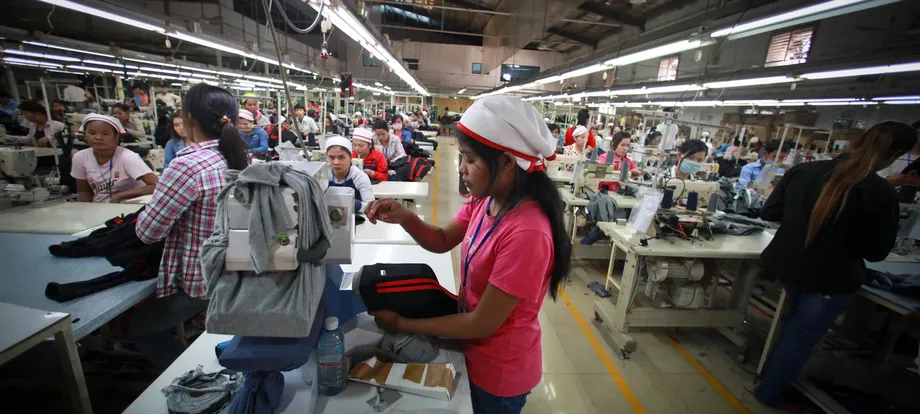
517 factory assessments reveal risks behind export growth
Sixty percent of garment factories and 74% of factories making travel goods and bags failed temperature and ventilation requirements in Better Factories Cambodia assessments covering 2025. Indoor temperatures reached 41°C, workers reportedly bought their own fans, and more than half of garment factories had obstructed emergency escape routes.
Contents
- 517 factory assessments reveal risks behind export growth
- What the factory checks covered
- Heat and long hours compound daily strain
- A former Nike supplier shows the human cost
- Inspection visits and workers' experiences
- Blocked exits create another immediate danger
- Union leaders describe pressure and retaliation
- Earlier cases explain the barriers to organising
- How the current findings fit a longer timeline
- Key Points
The findings cover 421 garment factory assessments and 96 assessments of travel goods and bags factories. They describe overlapping problems for a workforce made up predominantly of women: excessive heat, inadequate fire protection, long working hours and alleged interference with independent unions.
Cambodia's Ministry of Labour and Vocational Training says nearly 80% of the issues identified have been resolved. Its spokesperson, Sun Mesa, said the ministry would verify data, inspect factories presenting high risks and take legal action where necessary. He also stressed that the findings did not represent every factory in Cambodia.
The stakes extend beyond individual workplaces. Garment production is a major source of employment and export income. The broader garment, footwear and travel goods sector generated $3.75 billion in exports in the first quarter of 2026, nearly 8% more than in the same period of 2025, according to customs figures cited by Better Factories Cambodia.
Export growth and persistent workplace violations now sit side by side. The central issue for workers is whether inspections lead to functioning alarms, clear exits, tolerable temperatures, accurate pay records and the freedom to raise complaints without losing their jobs.
What the factory checks covered
Better Factories Cambodia's 2025 annual report combines compliance assessments with progress reports from 247 factories that completed an advisory service cycle during the year. Those services help factories address problems identified through monitoring.
BFC conducts unannounced assessments covering more than 200 questions across eight areas of compliance. Inspectors examine workplace safety, pay, contracts and working hours, alongside rights involving discrimination, forced labour, child labour, freedom of association and collective bargaining.
Collective bargaining means workers negotiating together with an employer over matters such as wages and working conditions. Freedom of association means workers can form or join organisations of their choosing, including independent unions.
BFC introduced shorter assessments lasting one day for selected factories in 2025. It reached 103 new factories and increased assessment coverage by 14% compared with 2024. Its advisory and training services remain optional.
The figures describe conditions in assessed exporting factories. Yang Sophorn, president of the Cambodian Alliance of Trade Unions, warned that more than 2,000 factories outside the programme could face even worse conditions. Her warning points to a large area beyond the programme's reach, while the assessment results provide a detailed picture of the workplaces it examined.
Heat and long hours compound daily strain
Travel goods and bags factories recorded a higher rate of failure on temperature and ventilation than garment factories: 74% against 60%, a gap of 14 percentage points. Workers reportedly buying their own fans illustrates how basic cooling costs can fall on the people exposed to the heat.
At 41°C, workers performing repetitive tasks face serious physical strain. Heat makes it harder for the body to cool itself, especially when ventilation is poor. Long working hours can extend that exposure and leave less time for rest.
Nearly two thirds of garment factories and half of travel goods and bags factories exceeded the legal limit of two hours of overtime a day. Around one fifth of factories in both groups also failed to maintain accurate records of working time.
For a worker, an inaccurate attendance record can turn a wage complaint into a difficult argument about how many hours were actually worked. For inspectors, it makes checking overtime limits and pay calculations harder. Reliable records therefore connect two parts of the report that might otherwise look separate: physical exhaustion and the ability to recover wages owed.
A former Nike supplier shows the human cost
Accounts from former employees at Y&W Garment in Phnom Penh describe what repeated weakness and fainting looked like inside one factory. The plant once employed about 4,500 people and made Nike children's clothing under arrangements workers said involved Haddad Brands.
A former medical worker at Y&W described eight to 10 workers visiting the clinic each month because they felt weak, including one or two who lost consciousness and needed hospital care. During May and June, as many as 15 workers a month became too weak to work. Other former employees recalled carrying workers to the clinic or seeing them taken there with pale faces and closed eyes.
Phan Oem, a former Y&W worker who joined shortly after the factory opened in 2012, described the conditions:
It's so hot. I'm sweaty. It's too hot.
Workers said fans sometimes broke and went unrepaired. The medical worker attributed illness to overtime, insufficient sleep and inadequate food. Those who remained conscious were given calcium pills and allowed to rest before typically returning to work.
Workers said Y&W stopped making Nike apparel in late 2023, shortly before bankruptcy. Nike said it was committed to ethical and responsible manufacturing and set supplier expectations through its code of conduct. It did not answer questions about what it knew of conditions at Y&W or why production there ended. Y&W, its parent company and Haddad Brands did not provide responses to the questions put to them.
Inspection visits and workers' experiences
Better Factories Cambodia conducted four inspections at Y&W between March 2020 and July 2023, yet said it had not known about the reported fainting incidents. The gap between those visits and workers' accounts matters for how complaints reach factory monitors.
BFC began operating in 2001 as part of an effort to connect Cambodia's expanding garment trade with better labour conditions. It can assess factories and support improvements, but it has no power to fine a factory or order it to close. Enforcement depends on Cambodian authorities.
Jill Tucker, who led BFC from 2011 to 2014, described persistent fainting as a consequence of low wages and poor working conditions. She also criticised the programme's historical focus on measures offering short term relief. BFC spokesperson Daramongkol Keo described continuing improvements and monitoring.
Government figures recorded more than 4,500 factory faintings between 2017 and 2019. In Cambodia, the term has been used for both loss of consciousness and episodes in which workers become too weak or dizzy to continue working. Authorities have cited several contributing factors, including heat, poor nutrition, chemicals and inadequate ventilation.
A 2024 report by the Center for Alliance of Labor and Human Rights also described factories receiving perfect BFC union compliance marks while workers alleged widespread interference with unions. Together, these experiences make confidential worker testimony and follow through on complaints central to detecting problems between inspection visits.
Blocked exits create another immediate danger
More than half of assessed garment factories had obstructed emergency escape routes. Nearly half of factories in both subsectors lacked adequate fire detection and alarm systems.
Clear routes and working alarms serve different parts of the same emergency response. An alarm gives workers time to react; an unobstructed exit lets them leave. Where both are deficient, workers may receive a warning late and then encounter obstacles while trying to escape.
The ministry's statement that nearly 80% of identified issues had been resolved is therefore consequential. The response gave no breakdown showing how many heat, fire safety, overtime or union issues had been corrected, and no deadline for completing the remaining work. Workers need those improvements to hold during ordinary production and during emergencies.
Union leaders describe pressure and retaliation
Employers in 18 garment factories and two travel goods and bags factories were alleged to have tried to control or manipulate unions. The practices described included promoting rival organisations and offering incentives to union leaders.
Yang Sophorn said newly elected union leaders increasingly faced threats and coercion, and that workers encountered greater difficulties forming unions than in the previous year. An employer's influence over who represents workers can affect which complaints reach management and whether workers feel safe raising them.
CENTRAL, a Cambodian labour rights organisation, said more than 2,000 workers across 36 workplaces had been dismissed since 2019 in what it described as retaliation for union activity. Its programme manager, Khun Tharo, called on governments, employers and global brands to strengthen protections.
Khun Tharo argued that workers need safeguards against discrimination for union activity, accessible routes to union recognition and effective ways to resolve disputes. Without those protections, a legal right to organise can be difficult to exercise at the workplace.
Heat, overtime and union rights are connected in practical terms. Workers seeking a repaired fan, payment for extra hours or a cleared exit need a safe way to make that request together. Fear of dismissal can discourage complaints before an inspector arrives.
Earlier cases explain the barriers to organising
Human Rights Watch's 2022 union rights report drew on interviews with 32 independent union leaders and activists conducted between March and June that year. It documented five cases involving allegedly unfair dismissals or mass layoffs targeting union leaders and active members, and four involving threats or use of criminal proceedings.
The organisation described barriers under the 2016 Trade Union Law, including mandatory registration and rejected applications over small errors or misspellings. It also documented complaints that independent unions struggled to get disputes heard through official channels.
Contracts were another pressure point. Human Rights Watch said Cambodian labour law generally required a move to contracts without a fixed end date after two years of successive contracts with fixed durations. It criticised the ministry's 2019 Instruction 050 for allowing successive contracts over four years. Workers dependent on repeated renewals can fear that union activity will cost them their next contract.
The NagaWorld casino dispute showed similar tensions outside garment production. The company announced 1,329 layoffs in April 2021; 365 dismissed workers sought reinstatement and fair compensation. Union president Chhim Sithar spent 74 days in pretrial detention between January and March 2022.
Sithar, president of the Labor Rights Supported Union of Khmer Employees, described the pressure on her role in April 2022:
Even when I am not in prison, I cannot freely exercise my right to be a union leader. I cannot give up because of the threat of prison. I have to stand up for workers' rights.
Cambodian authorities have rejected allegations that union leaders are prosecuted for legitimate organising, saying cases concern criminal offences. Human Rights Watch called for changes to registration, bargaining and dispute procedures so independent unions could operate without retaliation.
How the current findings fit a longer timeline
Cambodia's monitoring programme has expanded while complaints about heat and retaliation have persisted across several years. The sequence connects today's inspection figures with earlier efforts to make export manufacturing safer:
- 2001: Better Factories Cambodia began operating following a trade initiative linking expanded access to the United States with improved labour conditions.
- 2017 to 2019: Government figures recorded more than 4,500 factory faintings.
- 2019 onward: CENTRAL says more than 2,000 workers across 36 workplaces were dismissed in retaliation for union activity.
- 2022: Human Rights Watch documented dismissals, threats and barriers affecting independent unions in garment production and tourism.
- 2025: BFC conducted 421 garment assessments and 96 travel goods and bags assessments, expanding coverage by 14%.
- First quarter of 2026: Garment, footwear and travel goods exports reached $3.75 billion, nearly 8% above the same period a year earlier.
The broader sector's export growth gives the findings economic weight. Global brands depend on Cambodian production, while workers depend on factory wages. BFC's assessments identify workplace failures; ministries hold enforcement powers; employers control daily conditions; and buyers set supplier requirements.
Each has a concrete role in the response. Factories can clear exits, repair cooling equipment and keep accurate records. Authorities can verify corrections and enforce labour law. Brands can investigate worker complaints and require suppliers to address them. Independent unions give workers a way to press for those changes throughout the year, rather than only during an assessment.
Key Points
- BFC's 2025 findings draw on 421 garment factory assessments and 96 assessments of travel goods and bags factories.
- Temperature and ventilation failures affected 60% of garment factories and 74% of travel goods and bags factories.
- More than half of garment factories had obstructed emergency escape routes; nearly half of both groups lacked adequate fire detection and alarms.
- Excessive overtime affected nearly two thirds of garment factories and half of travel goods and bags factories.
- Alleged employer interference with unions was identified at 20 factories across the two groups.
- The labour ministry says nearly 80% of identified issues have been resolved and has pledged further verification and enforcement.
- Garment, footwear and travel goods exports reached $3.75 billion in the first quarter of 2026, nearly 8% above a year earlier.