Annual fees of 99 and 199 yuan, with government paying
Zaime Zaime, the Chinese safety app formerly known as Sileme, has announced annual software prices of 99 yuan and 199 yuan as it shifts from a viral tool for younger people living alone to a service bought by local governments for older residents.
Contents
- Annual fees of 99 and 199 yuan, with government paying
- What the two prices cover
- How an ordinary day becomes a safety signal
- Why Nanxing became an early testing ground
- An alert still needs a person to answer
- Options for people without smartphones
- From a controversial name to a community service
- What the lower price means for public spending
- Users, financing and expansion plans
- Key Points
Founder Lyu Gongchen said the government procurement model allows older people living alone to install and use the app free of charge. The prices, disclosed on October 22, cover two systems: version 1.0 for requesting help with one touch, and version 2.0, called the AIP Safety Net, for monitoring possible danger through phone activity and alerting community workers.
The service is being promoted mainly in Zhejiang, with expansion efforts reaching Guangdong, Shandong and Gansu. Its first announced community deployment was in Nanxing subdistrict in Hangzhou's Shangcheng district, where people aged 60 and above account for 44.4% of residents.
The central change is who buys the service and who responds when something goes wrong. An app originally built around personal check ins now connects older residents, relatives, volunteers and community staff. Its usefulness depends on both detecting a warning and getting someone to act.
What the two prices cover
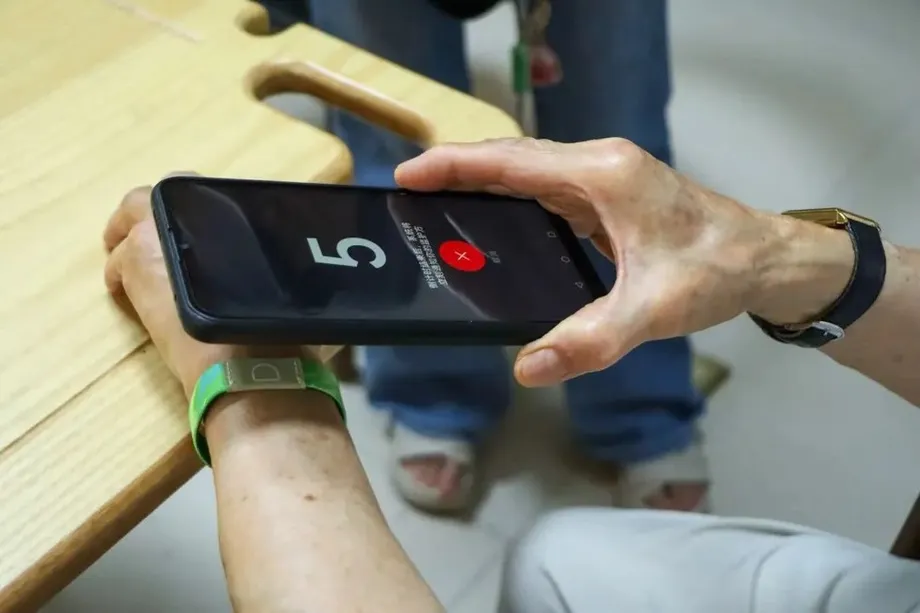
The 99 yuan annual system lets a resident request help when feeling unwell or facing another problem. A button on the phone's home screen triggers calls, text messages and location information for designated contacts, who can include children, a partner, community workers and volunteers. Navigation information helps them reach the resident.
The 199 yuan system adds monitoring intended mainly for subdistrict and community staff. With the user's permission, it examines signals such as prolonged lack of movement, no phone operation or an extended period with the phone switched off. Community screens show residents' status in green, yellow or red so workers can identify people needing attention.
Lyu said these paid functions had not been sold to the general public and were being introduced through collective government purchases, with assistance installing them for older residents. Another founder, identified as Mr Guo, said government bodies were currently the main customers and that a relatively high proportion of registered users had paid service coverage. He gave no percentage or contract breakdown.
For a resident enrolled through a government purchase, the advertised annual fee is therefore a cost to the purchasing authority rather than a personal subscription bill. The price also reflects the company's move toward selling an organised community service instead of relying on individual app downloads.
How an ordinary day becomes a safety signal
Zaime Zaime's original design required users to check in. The current platform instead supports automatic check ins based on ordinary smartphone activity, reducing the number of tasks an older person must remember.
Guo said users do not need to open the app each day or take an extra action. After obtaining permission, the system analyses information about phone movement, operation and switching on or off. He said relevant data is encrypted before being uploaded to cloud servers for analysis.
The default AIP Safety Net settings turn a person's status yellow after two days without active data and red after three days or more. Subdistricts and communities can adjust those thresholds. The May introduction in Nanxing also described an alert to children or emergency contacts after two consecutive days without a check in.
Green means the system currently shows a normal status. Yellow signals a possible problem requiring attention, while red calls for urgent follow up. The practical response is to contact the person or arrange a visit. The system is using phone behaviour as a signal of possible trouble, rather than taking a medical measurement.
Why Nanxing became an early testing ground
Nanxing subdistrict has eight communities, about 13,000 residents aged 60 to 80, and more than 2,000 older than 80. Hu Hangdong, deputy director of its social governance service centre, said home safety and emergency support for older people living alone or without children at home had long been difficult parts of local welfare work.
Community workers and volunteers previously relied mainly on home visits, often separated by two or three days. That left gaps between one visit and the next, particularly when a resident became ill unexpectedly.
The first internal trial took place in Zihuabu community. More than 40 older residents were participating by late May, when a broader launch was expected in June. The interface used large lettering, few buttons and simple operations, with an SOS function alongside automatic check ins.
Guo described the wider staffing problem in concrete terms: a subdistrict might have only a dozen or so workers covering tens of thousands of older people, while one worker could visit at most 20 households a day. A screen that flags unusual inactivity gives those workers a way to decide whom to contact first.
An alert still needs a person to answer
Nanxing's initial SOS arrangement called the first designated guardian, usually a spouse, then a second guardian, usually a child, if the first could not be reached. If neither answered, it contacted the assigned community worker. Hu said community workers would respond within five minutes and coordinate a visit within 15 minutes, connecting with community health services and emergency resources.
The newer product description gives a broader notification model: calls, messages, location and navigation information are sent to several designated contacts. The local sequence described in May and the later notification system show how the service has developed from its early trial.
Guo also recounted a case in which the AIP Safety Net flagged an older resident as being at high risk. Community staff went to the home but could not open the door. The resident's children initially said they were busy and could not come immediately. After further contact, family members arrived and entered with the community workers. The resident had died at home.
Guo said entry into a home requires relatives and community staff to follow the relevant procedures together. The case places the human part of the service at the centre of its work: a warning must lead to contact, access and a check on the resident.
Options for people without smartphones
The platform also offers physical devices so that residents without smartphones can request assistance. During the Nanxing trial, the subdistrict and company introduced a safety button that could be worn or kept within easy reach. A necklace version was also available.
The current product range includes a pendant using 4G mobile communications. Guo said a long press sends a request for help, and the device also assists with identifying the wearer's safety status. It includes three years of communications service, without requiring the resident to obtain a separate SIM card or top up a phone account.
NFC safety stickers provide another route for smartphone users. NFC, or near field communication, allows a phone to interact with a nearby tag when brought close to it. A sticker placed by a bed, toilet or entrance can trigger a request for help when touched with a compatible phone.
Guo said the stickers need neither an electricity connection nor home broadband and do not require a technician to install them. The company has not specified whether the advertised software fees include these devices or how hardware is priced.
The platform receives several dozen requests for help a day, according to Guo. Some are tests by residents or requests about minor matters. Community staff therefore have to assess the circumstances of each call as well as respond to possible emergencies.
From a controversial name to a community service
Sileme, roughly meaning "Are you dead?", first attracted attention with its blunt name and a simple promise: if a person stopped checking in, an emergency contact would receive a warning. The early version needed only a contact's name and email address, then sent an email after two missed days.
The later name, Zaime Zaime, roughly asks "Are you there?" Its arrival followed several months of changes in branding, location and intended users:
- January 8: The app launched and reached the top of Apple's paid app chart in China about 36 hours later.
- January 13 and 14: Its verified social media account announced a planned change to Demumu, then sought naming suggestions after saying the attempt had fallen short.
- January 15: The app was removed from the store.
- January 29: Shangcheng's data resources management bureau emailed Lyu to explore cooperation.
- February: The team established its financing company in Hangzhou.
- May 24: Shangcheng's publicity department announced the Zaime Zaime platform and its use in Nanxing.
- October 22: The annual prices and further commercial details were disclosed.
Lyu said discussions with local communities revealed unmet safety needs among older people living alone. The team then expanded its service focus. At the May trial stage, it also intended to continue serving single women and other people living alone.
What the lower price means for public spending
Guo said some competing arrangements cost around 1,000 yuan per older person annually, often because they include expensive hardware. Against that figure, Zaime Zaime's 199 yuan software price is about one fifth as much, a difference of 801 yuan per person each year.
The 99 yuan price is 100 yuan below the 199 yuan tier. Public buyers choosing between them are also choosing different functions: a resident's active request for help in version 1.0, or additional monitoring and community oversight in version 2.0.
The company's stated aim is to reduce the financial burden on local governments through software. Its use of stickers and pendants also shows why procurement decisions involve more than an app price. Authorities must consider how residents will request help and which staff will receive and act on notifications.
For older people, the most immediate benefit of the government purchase model is access without paying the subscription themselves. For community teams, the service adds a shared list of residents, contact information and warnings to support their existing visits and calls.
Users, financing and expansion plans
Guo put registered users at about 700,000, mainly people aged over 60. He said the business had roughly reached the point where revenue covered expenses and was beginning to turn a profit. He described its external valuation as between 150 million and 200 million yuan.
Guo also said 5 million yuan from a first financing round had arrived, with further funding still under discussion. The financing entity, Yuejing Weilai (Hangzhou) Technology Co., Ltd., was established on February 13, 2026, with Lyu as its legal representative and registered capital of 1.055 million yuan. The operating company, Yuejing Tansuo (Hangzhou) Technology Co., Ltd., was established on March 10, 2025, with Guo Mengchu as its legal representative and registered capital of 1 million yuan.
Hangzhou and the wider Zhejiang area remain the main base. Guo said cooperation was also developing in Jiayuguan in Gansu, Shandong, Zhuhai in Guangdong, and Shanghai, although coverage there was smaller than in Hangzhou.
The company is targeting 800,000 to 900,000 users during the year. Guo also set ambitions to lead Hangzhou's market by year end and Zhejiang's by the middle of the following year. Those growth plans would extend a model whose daily work remains local: registering residents, keeping emergency contacts current and arranging a response when someone may need help.
Key Points
- Version 1.0 costs 99 yuan annually; the AIP Safety Net version 2.0 costs 199 yuan.
- Lyu says government purchases allow participating older residents living alone to install and use the service free.
- Default monitoring settings flag two days without active data in yellow and three days or more in red, with local adjustments possible.
- Nanxing's early trial involved more than 40 older residents in a subdistrict where 44.4% of residents are aged 60 or above.
- Safety stickers, physical buttons and 4G pendants provide additional ways to request help.
- Guo reports about 700,000 registered users and a business beginning to turn a profit.
- Relatives and community workers remain responsible for responding to warnings and checking residents' condition.