A tenfold difference points to the crystal itself
Five crystals of the same insulating material carried heat equally well along their length, yet their sideways response to a magnetic field differed by about ten times. That contrast is the central finding of research into NiPS3, a layered magnetic crystal that offers a way to understand a physics puzzle dating to 2005: why heat carried by electrically neutral vibrations can turn sideways in a magnetic field.
Contents
- A tenfold difference points to the crystal itself
- How can heat turn without an electric charge?
- What the strong magnetic fields measured
- Why comparing five samples mattered
- The magnetic direction that tracked the signal
- How vibrations could borrow a magnetic response
- Black phosphorus supplied an earlier clue
- Heating another crystal helped separate disorder from origin
- A research effort stretching from 2005 to 2026
- Key Points
The collaboration brings together researchers at Huazhong University of Science and Technology's National Pulsed High Magnetic Field Science Center in Wuhan and ESPCI Paris in France. Their measurements connect the sideways heat response to the crystal's magnetic properties rather than to the distance its heat carriers travel between collisions.
The researchers interpret that connection as evidence for an intrinsic mechanism, meaning one rooted in the material's own coupled magnetic and vibrational behavior. The finding gives scientists an experimental test for separating that explanation from mechanisms in which impurities or other scattering centers generate the sideways response.
The NiPS3 research paper, whose second arXiv version is dated October 1, 2024, records a peak sideways thermal conductivity of about -1.63 watts per meter per kelvin at 25 kelvin and 14 tesla. The temperature is approximately minus 248 degrees Celsius. The minus sign records the direction of the sideways response under the experiment's measurement convention.
The work was announced in connection with publication in Science on October 23, 2026, Beijing time, corresponding to October 22 locally, and was described as a cover article. Its detailed experimental argument was already present in the 2024 manuscript.
How can heat turn without an electric charge?
The ordinary electrical Hall effect occurs when a magnetic field pushes moving electric charges sideways. Charges accumulate across a conductor, creating a voltage perpendicular to the original current.
NiPS3 is an electrical insulator. Heat moves through it mainly as vibrations of its crystal lattice, the orderly arrangement of atoms. Physicists describe packets of these vibrations as phonons, much as they describe packets of light as photons.
A phonon carries energy without carrying a net electric charge. It therefore lacks the conventional magnetic force that bends an electron's motion. Yet a temperature difference can appear across an insulating crystal when heat flows along it and a magnetic field is applied perpendicular to that flow. Scientists call this the phonon thermal Hall effect.
The first experimental evidence appeared in 2005. The central debate since then has concerned the mechanism: whether the sideways response arises from the crystal's collective behavior or from asymmetric scattering when phonons encounter impurities, defects or other disturbances. Both are physical explanations for a measured signal, but they assign its origin to different processes.
What the strong magnetic fields measured
NiPS3 contains nickel, phosphorus and sulfur. Its nickel atoms form honeycomb layers, and its magnetic moments develop a zigzag antiferromagnetic arrangement below 155 kelvin, approximately minus 118 degrees Celsius. Antiferromagnetism means that moments arrange in opposing patterns rather than all pointing together.
The team grew single crystals using chemical vapor transport and measured heat flow along and across them simultaneously with one heater and three thermocouples. This allowed the researchers to compare the main heat current with the smaller sideways temperature response.
Magnetization measurements reached 55 tesla at 4.2 kelvin using pulsed magnetic fields. No magnetic transition appeared over that range. The thermal Hall measurements described in the manuscript extended to 14 tesla, where the sideways response varied linearly with the applied field.
The main thermal conductivity peaked at 274 watts per meter per kelvin. Its temperature dependence was nearly identical at zero field and 14 tesla, and it peaked at the same temperature as the sideways conductivity. The researchers identify phonons as the dominant heat carriers, with magnetic excitations contributing little to the main heat current.
Why comparing five samples mattered
The five NiPS3 crystals offered a useful comparison because their ordinary heat transport was effectively unchanged. Their longitudinal conductivity curves lay on top of one another, and their heat capacities were also alike.
The phonon mean free path, the average distance a vibration travels before scattering, was consequently essentially the same across the samples. A simple analogy is five roads on which traffic can travel equally far between interruptions.
The sideways response behaved very differently. Its peak was about ten times larger in one crystal than in another, despite their similar ability to carry heat forward. That gave the team a way to compare magnetic behavior while keeping ordinary heat transport nearly constant.
Several proposed scattering mechanisms predict that the sideways response should grow with the phonon mean free path. One model discussed in the paper makes longitudinal conductivity proportional to that distance and transverse conductivity proportional to its square. The NiPS3 experiments instead found a large change in transverse conductivity while the mean free path stayed effectively fixed.
The authors, researchers investigating thermal transport in NiPS3, state their conclusion in the paper's abstract:
The relevance of a thermodynamic property, combined with the irrelevance of the mean free path, points to an intrinsic origin.
The magnetic direction that tracked the signal
The sideways conductivity followed the crystals' magnetic anisotropy, meaning their magnetic response depended on direction. Magnetization along the direction labeled a was almost identical across the five samples. Along the b direction, it varied by approximately 30% between the most and least anisotropic samples.
Crystal twinning helps explain that variation. A twinned crystal contains regions whose lattices are rotated relative to one another. In this material, those regions can share a common axis while being rotated by 120 degrees. Different mixtures of the regions change the magnetic response measured along a chosen direction.
The sample closest to a crystal with one dominant orientation had the largest thermal Hall response. The sample with nearly equal populations of three possible orientations had the smallest. The magnetic arrangement and the crystal arrangement therefore mattered even when forward heat transport remained the same.
Torque measurements supplied another check. They tracked how magnetic free energy changed as the field direction rotated. Free energy describes the energy available to a system under specified conditions; here, its directional variation measures how strongly the crystal favors certain magnetic orientations. That equilibrium property tracked the sideways heat signal, giving the study its thermodynamic argument.
How vibrations could borrow a magnetic response
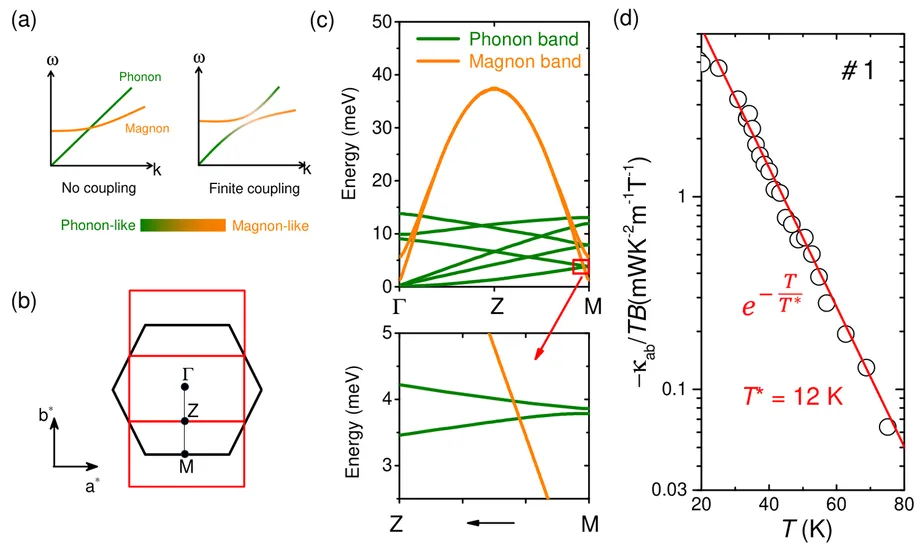
The proposed microscopic explanation involves magnons, collective waves in the arrangement of magnetic moments. Phonons describe atomic vibrations; magnons describe magnetic motion. Coupling allows the two kinds of motion to influence one another.
The researchers compared a calculated phonon spectrum with a magnon spectrum obtained from neutron scattering measurements. These spectra show the energies available to waves traveling through the crystal. Several phonon and magnon branches intersect, with the lowest identified crossing near 3.7 millielectronvolts.
At such a crossing, coupling can create two mixed modes containing both vibrational and magnetic motion. The magnetic component provides a route for the combined excitation to respond to a field, while its vibrational component carries heat.
The crossings occur along the reciprocal space direction corresponding to the crystal's b axis, linking the proposed mechanism to the direction that mattered in the magnetization measurements. The authors also extracted an energy scale of about 1 millielectronvolt from the temperature dependence of the Hall response. They present these connections as support for magnon and phonon hybridization; the detailed microscopic mechanism remains a subject for further testing.
Black phosphorus supplied an earlier clue
A related result appeared in Nature Communications on February 23, 2023. The black phosphorus study examined an elemental material without magnetic order, allowing researchers to investigate a simpler setting for the phonon thermal Hall effect.
Its longitudinal and transverse conductivities peaked at nearly the same temperature, as they do in NiPS3. At 12 tesla, the measured thermal Hall angles in two configurations were approximately 0.005 and 0.0012, equivalent to 0.5% and 0.12%. The angle expresses the sideways temperature gradient relative to the main temperature gradient.
Across the insulating materials compared in that paper, a characteristic length calculated from the Hall response stayed between about 2 and 7 angstroms, a scale comparable to distances between atoms. Meanwhile, phonon mean free paths varied by more than three orders of magnitude, or a factor exceeding 1,000.
The black phosphorus researchers proposed that coupling between acoustic vibration branches and an uneven distribution of electrical charge around bonds could provide a magnetic response. They also retained scattering explanations among the possibilities. NiPS3 adds a different experimental handle: five samples with nearly identical forward transport but strongly different magnetic and transverse responses.
Heating another crystal helped separate disorder from origin
A further study, published in npj Quantum Materials on March 24, 2026, examined four strontium titanate crystals from different suppliers. The disorder and annealing study included Xiaokang Li, Kamran Behnia and Zengwei Zhu, who also participated in the NiPS3 research.
The better quality strontium titanate samples produced thermal Hall angles reaching 0.3% and 0.15% at 9 tesla. More disordered crystals produced virtually no signal. Heating the disordered crystals in air at 1,000 degrees Celsius partially restored the response, reaching about 0.1% at 9 tesla, while barely changing their longitudinal thermal conductivity.
Annealing, controlled heating followed by cooling, can make internal strain more uniform. The authors identify disorder and uneven strain as factors that suppress an intrinsic response. Their results show why the presence of defects can matter greatly even when defects are not the proposed source of the Hall effect.
The team also compared metallic silver paste contacts with insulating grease contacts on the same sample and obtained indistinguishable measurements. For experiments measuring very small signals, such as angles below 0.02% at 10 tesla, they recommended further checks on possible contact contributions.
A research effort stretching from 2005 to 2026
The NiPS3 collaboration was led by researchers in Wuhan and Paris. Liang Li, director of the National Pulsed High Magnetic Field Science Center, worked with Zengwei Zhu and ESPCI Paris physicist Kamran Behnia. Doctoral student Qingkai Meng and associate researcher Xiaokang Li were joint first authors.
Several dated milestones show how the experimental argument developed:
- 2005: Researchers published the first experimental evidence for a phonon Hall effect in an insulating crystal.
- February 23, 2023: The black phosphorus study connected the effect to acoustic vibrations and identified a lack of correlation with phonon mean free path.
- October 1, 2024: Version two of the NiPS3 manuscript appeared on arXiv.
- March 24, 2026: The strontium titanate study documented the effects of disorder, annealing and contact materials.
- October 23, 2026, Beijing time: The NiPS3 work was announced in connection with its online publication in Science.
Together, the experiments shift attention toward magnetic orientation, coupled vibrations and internal strain as controls on sideways heat transport. For laboratories trying to reproduce the effect, measuring how well a crystal carries heat forward is only part of the task. Its magnetic and structural arrangement also needs close examination.
Key Points
- Five NiPS3 crystals showed roughly a tenfold variation in sideways thermal conductivity while their longitudinal heat transport remained effectively unchanged.
- The Hall response tracked magnetic anisotropy and directional magnetic free energy, supporting an intrinsic origin.
- The thermal Hall conductivity peaked near -1.63 watts per meter per kelvin at 25 kelvin and 14 tesla.
- Magnon and phonon crossings near 3.7 millielectronvolts provide a possible route for heat carrying vibrations to respond to magnetic fields.
- Black phosphorus and strontium titanate experiments also connect the response to properties beyond phonon travel distance, including vibration coupling, disorder and strain.