A hidden opening leads to a forest 120 meters below
A sinkhole nearly two hectares across at its opening and 120 meters deep has been publicly announced in the Cha Noi - Khe Gat area of Phong Nha - Ke Bang National Park in central Vietnam. A survey team found large trees, monkey bones and vast deposits of snail shells inside, but no clear passage into the cave systems below.
Contents
- A hidden opening leads to a forest 120 meters below
- How a dark patch became an expedition
- Why getting there was so difficult
- A cavity that grows wider below the rim
- What the team found on the floor
- Where does the water go?
- What 400 million years means here
- A new feature in a park of 472 recorded caves
- What the next survey would examine
- Key Points
Le Luu Dung, director of adventure tourism company Jungle Boss, announced the findings on October 22, 2026. The detailed survey took place from July 23 to 29, 2025, when 24 cave specialists, company technical staff and forest rangers crossed more than 20 kilometers of difficult terrain before descending on ropes.
The unnamed formation lies in the national park's limestone mountains in Quang Tri Province. Its oval opening measures approximately 190 meters by 140 meters, while the space below widens to about 250 meters by 200 meters. Dense forest canopy conceals much of the opening from above.
Dung explained the gap between the expedition and the announcement:
"The sinkhole was surveyed a year ago, but is only now being publicly announced, and it has not yet been named," Dung said.
Pham Hong Thai, director of Phong Nha - Ke Bang National Park, described the discovery as scientifically valuable for studying geology and landforms. Jungle Boss has submitted its field measurements and a detailed report to the park management board, along with proposals for further research and new access routes.
How a dark patch became an expedition
Kevin Ditamore, a member of the United States National Speleological Society, first noticed an unusually large dark patch while examining Google Earth satellite images. The surrounding forest made the feature difficult to identify from imagery alone.
Ditamore, other specialists and Jungle Boss staff then carried out three drone surveys to pinpoint its location. Those flights gave the team a target for an expedition through the limestone forest, where knowing a location and reaching it are very different tasks.
Nguyen Van Uy, Jungle Boss deputy director and safety director, helped with the drone checks. After more than 20 years exploring the forests of Phong Nha - Ke Bang, he described the formation as one of the largest sinkholes he had encountered.
The discovery developed through several stages:
- Before the ground expeditions: Ditamore spotted the dark patch on satellite imagery, followed by three drone surveys.
- April 27, 2025: A preliminary team of 10 people, including two local forest rangers, began searching for a route to the sinkhole.
- The third day of that approach: The team reached the rim but turned back amid difficult terrain and shortages of food and drinking water.
- July 23 to 29, 2025: A larger team of 24 conducted the detailed survey and descended to the floor.
- October 22, 2026: Jungle Boss publicly announced the findings.
Why getting there was so difficult
The April expedition revealed the practical challenge of working in this part of the park. The team reached the edge of the opening, but scarce water and supplies forced a retreat before a descent could begin.
The July expedition brought together specialists from the National Speleological Society, Jungle Boss technical personnel and local rangers. Their route crossed more than 20 kilometers of forest and sharp limestone ridges, with serious shortages of water during the dry season.
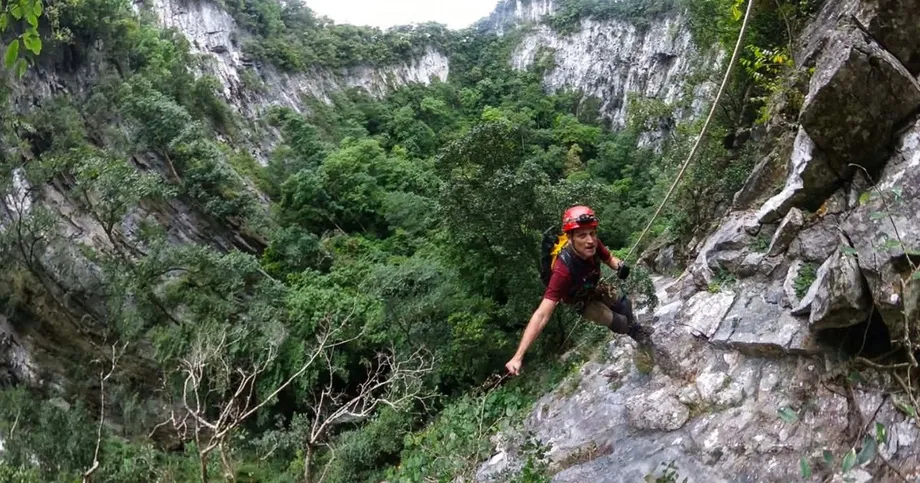
At the rim, the team installed a safety rope system to descend the steep rock walls. Reaching the bottom required both a difficult forest approach and a controlled descent into a space roughly 120 meters below the opening.
Those conditions also shape the next stage of research. Any return visit needs supplies for the approach, equipment for the descent and enough time to examine the walls and floor before making the journey out.
A cavity that grows wider below the rim
The survey recorded an unusual shape: the sinkhole expands downward, resembling an upside down bowl. Its opening is approximately 190 meters along one axis and 140 meters along the other. Farther down, the interior reaches about 250 meters long and 200 meters wide.
The lower space is therefore about 60 meters longer and 60 meters wider than the opening, using the team's approximate measurements. Someone looking down from the rim would see only part of a much broader cavity beneath the surrounding rock.
The description of an opening covering nearly two hectares is consistent with its oval shape. An ellipse measuring 190 meters by 140 meters would cover about 20,900 square meters, or roughly 2.1 hectares. That is an estimate based on the stated dimensions; the actual boundary follows an irregular natural rock edge.
The newly surveyed formation joins about five large sinkholes recorded in Phong Nha - Ke Bang. It is smaller and shallower than the park's Kong sinkhole, according to the survey information.
What the team found on the floor
Large limestone blocks lay scattered beneath the walls, recording earlier rockfalls. The team also observed traces of stalactites on the rock faces and lush vegetation, including large old trees, across the bottom.
Stalactites are mineral formations that grow as water drips from a cave roof and leaves behind small amounts of dissolved material. Their traces, together with the fallen blocks and the shape of the cavity, give researchers features to examine when reconstructing how the site developed.
Monkey bones and skulls were found on the ground. During the survey, the team also heard monkeys in the area, adding evidence of living wildlife to the remains recorded below.
Snail shells were particularly abundant, with large accumulations near the walls. Jungle Boss estimated that the number could reach into the millions. Their distribution gives future researchers specific places to examine alongside the vegetation, animal remains and rock deposits.
Where does the water go?
Hundreds of cracks and cavities cut through the limestone floor near the center of the sinkhole. The team recorded heavy erosion there, with openings through which water could drain underground.
Ditamore said water appeared to leave through numerous small cracks and holes rather than through one large passage. That helps explain how water can move below the floor even where explorers cannot find an entrance large enough to follow.
The team examined a fissure approximately five meters high and extending 12 to 15 meters into the rock. No airflow was detected inside it. Researchers also found that soil and rock from earlier collapses covered sections at the foot of the walls and places associated with water movement.
A direct connection to a deeper cave system remains unconfirmed. Further research is needed to determine the sinkhole's formation history, the origin and age of the shell deposits, and whether accessible passages exist beyond the surveyed area.
What 400 million years means here
Park director Pham Hong Thai placed the discovery within Phong Nha - Ke Bang's karst geological system, whose history extends back approximately 400 million years. Karst is a landscape in which water gradually dissolves soluble rock, especially limestone, creating cracks, caves and underground drainage routes.
Water can enlarge small openings over long periods. Where cavities develop beneath the surface, the rock above may eventually lose support and collapse, creating a sinkhole. The new survey documented several features useful for studying that process: fallen limestone, mineral traces on the walls and an eroded floor with many openings.
The approximately 400 million year figure describes the wider geological history of the area. Researchers still need to establish when this particular cavity formed and how its present shape developed.
Thai called for further studies of the discovery. For the park, the scientific work involves connecting the measurements of the opening and interior with evidence from the rocks, drainage and living environment below.
A new feature in a park of 472 recorded caves
Phong Nha - Ke Bang's management board records 472 caves with a combined surveyed length of more than 254 kilometers. The network is divided into seven main areas, including the Phong Nha, Vom and Nuoc Mooc systems.
The park received UNESCO World Heritage recognition in 2003, and its recognized area was expanded in 2015. Its limestone landscape includes well known caves such as Son Doong, Hang En and Pygmy.
The Cha Noi - Khe Gat discovery adds a different set of measurements to that inventory: an extensive opening hidden by canopy, a wider interior, forest at depth and a floor that drains through many small openings.
For park managers, the field records bring together information about landforms and wildlife in a place that is difficult to reach. Future visits can build on the measured dimensions and mapped observations rather than starting again with a dark patch on a satellite image.
What the next survey would examine
Jungle Boss has proposed further research in Cha Noi - Khe Gat and surveys to identify additional access routes from outside the sinkhole. Such routes could help teams approach parts of the surrounding terrain that were difficult to investigate during the descent.
The company's submission to the park management board includes the expedition report and field data. The proposed work would continue the examination of geology and the ecosystem while searching for further access points.
The immediate task is to turn the initial observations into a fuller account of the site: how water travels through it, how the rock structure developed and what its vegetation and animal deposits reveal about conditions at the bottom.
Key Points
- The unnamed sinkhole lies in Cha Noi - Khe Gat, inside Phong Nha - Ke Bang National Park in Quang Tri Province.
- Its opening measures about 190 by 140 meters, and the interior widens to about 250 by 200 meters, with a depth of 120 meters.
- A team of 24 surveyed it from July 23 to 29, 2025; the findings were publicly announced on October 22, 2026.
- The team found large trees, fallen limestone, monkey remains and snail shells estimated to number in the millions.
- Water appears to drain through many small openings; no clear entrance into a deeper cave system was found.
- Jungle Boss has submitted its findings to park managers and proposed further research and access surveys.