A sharper picture of ancient losses
An artificial intelligence model trained on nearly four million fossils suggests that three of Earth's five most famous mass extinctions unfolded as gradual declines in biodiversity rather than sudden collapses. The reconstruction, called OneStrata, brings a vast collection of fossil observations to a debate about how quickly life disappeared during the planet's greatest biological crises.
Contents
- A sharper picture of ancient losses
- How rocks become a timeline
- What the AI model does differently
- The earlier breakthrough behind OneStrata
- Why five became the familiar number
- Why the length of an extinction matters
- Counting losses changes the picture too
- What the debate means for today's biodiversity crisis
- Key Points
Shuzhong Shen, a palaeontologist at Nanjing University in China, presented the research at a Geological Society of America meeting in Denver, Colorado, on 12 October. His colleagues at Zhejiang Lab, an institution focused on artificial intelligence in Hangzhou, developed the model using a database assembled through about two decades of work.
The central issue is timing. A large loss of species spread across hundreds of thousands of years tells a different story from a comparable loss concentrated in a short burst. Scientists need to distinguish those patterns to understand how environmental disturbances turned into widespread extinction.
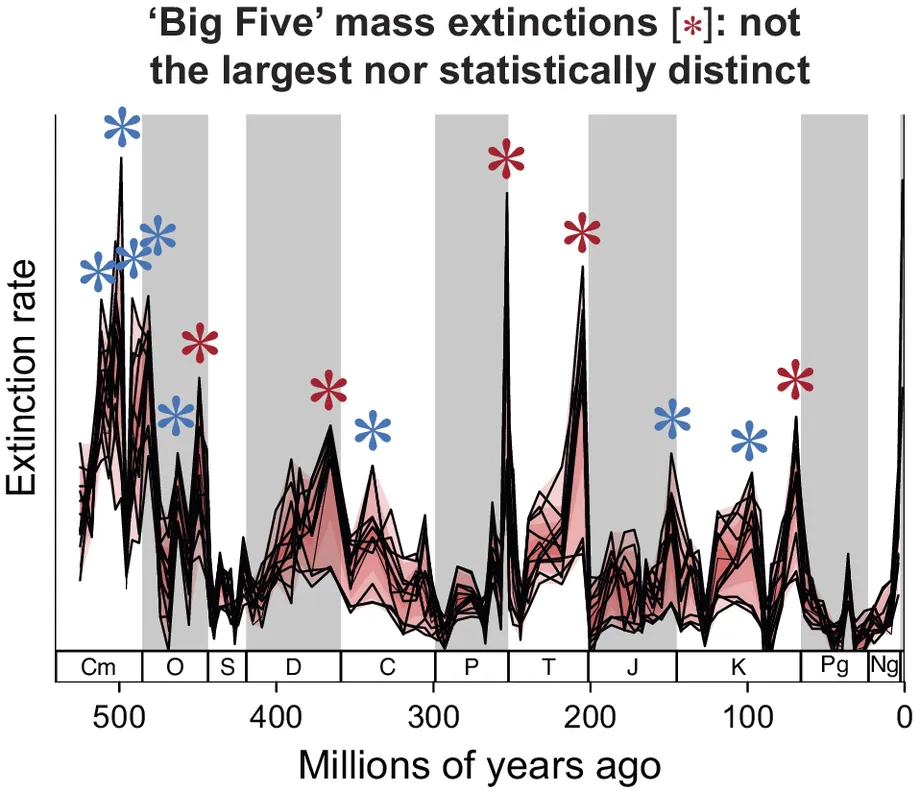
The findings also enter a debate that predates artificial intelligence. An academic review published in Cambridge Prisms: Extinction concludes that the Big Five remain the five largest extinction events since the early Ordovician, but sit within a continuous range of extinction intensities rather than forming a statistically separate category.
How rocks become a timeline
OneStrata draws on OneStratigraphy, a collection containing the recorded depths of millions of fossil specimens in rock sequences from tens of thousands of sites worldwide. Each observation helps locate an organism within the history preserved at a particular place.
Sedimentary rocks accumulate in layers called strata. The position of a fossil within those layers helps researchers work out when an organism lived relative to others. Combining many sequences allows them to estimate when species appeared, how long they persisted and when they disappeared.
Researchers face a huge matching problem when they bring those local records together. A species found at several sites can help connect their sequences, but the full task involves tens of thousands of species and many incomplete stretches of rock. Finding a coherent order across all those observations demands substantial computing power.
Traditional reconstructions simplify the task by grouping fossils into intervals lasting millions of years. Those broad intervals make global comparisons manageable, while compressing shorter changes into a much larger span. A brief extinction pulse and a prolonged decline can become difficult to separate.
What the AI model does differently
Zhejiang Lab's researchers trained their model to recognize statistical patterns in fossil records. The approach has a broad similarity to the way a large language model learns patterns in text, although its task concerns geological observations rather than sentences.
A language model uses learned relationships to predict a likely next word. OneStrata uses patterns in its training data to predict when a particular fossil was most likely deposited. Those estimates support a reconstruction of biodiversity across geological time.
Shen described the approach as a major advance for the study of rock layers and changing diversity:
a real revolution for studying stratigraphy and past diversity change
The model's developers say its reconstruction suggests that three of the Big Five were gradual biodiversity declines. The research description does not identify which three events or provide their estimated durations. Those details are essential for comparing its results with evidence from individual fossil sites.
OneStrata's practical promise is scale. Researchers previously reached a point where adding more species and shortening the intervals between estimates required an impractical amount of computation. Learning patterns from a large database offers another way to tackle that constraint.
The earlier breakthrough behind OneStrata
Shen and his colleagues had already demonstrated the value of combining large fossil datasets in 2020. Their reconstruction used a supercomputer and an algorithm to estimate the appearances and extinctions of about 11,000 marine species across roughly 300 million years, reaching a time resolution of about 26,000 years.
The Cambridge review describes the Chinese analysis more precisely: 3,112 measured rock sections, 11,268 species and a resolution of 0.026 million years, with reported variation of 0.0149 million years. The method, known as CONOP, seeks an order of fossil appearances and disappearances that best fits the observations across different sections.
The development of these reconstructions spans several milestones:
- 1982: David Raup and Jack Sepkoski identified the Big Five through a statistical analysis of marine fossil data.
- 2020: Shen and colleagues reconstructed about 300 million years of marine diversity using thousands of rock sequences and a supercomputer.
- 12 October: Shen presented the newer OneStrata research at the Geological Society of America meeting in Denver.
The improvement in resolution is substantial. The original 1982 analysis used geological stages averaging 7.4 million years. Dividing 7.4 million by 26,000 gives roughly 285, illustrating how much shorter the intervals in the 2020 reconstruction were. Applying such fine resolution across larger datasets is the challenge OneStrata seeks to address.
Why five became the familiar number
The Big Five are the end Ordovician, Late Devonian, end Permian, end Triassic and end Cretaceous extinctions. Their familiar grouping reflects their size in the marine animal fossil record and the statistical methods used to study them.
The Cambridge Prisms: Extinction review of mass extinctions explains that subsequent research has revised the original interpretation. The five events remain the largest since the early Ordovician, including in analyses that adjust for gaps in the fossil and rock records. However, extinction intensity forms a continuum from smaller losses to the largest crises.
The review also identifies intervals in the Cambrian and early Ordovician with extinction rates higher than those of the Big Five. Calling out exactly five events therefore involves a choice about which part of geological history to compare and how to measure the losses.
Some events happened relatively suddenly, while others extended over hundreds of thousands of years or longer, according to the review. OneStrata adds a new reconstruction to an existing scientific discussion about how differently these crises unfolded.
Why the length of an extinction matters
The end Triassic illustrates how the chosen timescale can change the apparent speed of a crisis. The Cambridge review notes that the final stage of the Triassic may have lasted as long as seven million years. Research cited in the review places an associated ocean oxygen crisis at about 50,000 years, less than 1% of that span.
That crisis was connected to the Central Atlantic Magmatic Province, a vast episode of volcanic activity. Waters described as anoxic contain little or no oxygen, creating dangerous conditions for animals that depend on oxygen dissolved in seawater.
Spreading the losses across an entire geological stage produces a much lower calculated extinction rate than concentrating them within the shorter crisis. The review estimates that the true rate could have been roughly 100 times the rate derived from the broader global intervals.
Missing fossils create another difficulty. The last fossil found for a species can come from before its actual extinction because later remains were never preserved, exposed or collected. Across many species, those gaps can spread the apparent disappearance times backward, making a concentrated event look more gradual. Palaeontologists call this the Signor–Lipps effect.
Matthew Clapham, a palaeontologist at the University of California, Santa Cruz, gave a measured assessment of OneStrata's potential, pointing to the detailed reconstructions already available from particular locations:
We could do some extra things with it, but I don't know if it would be Earth shattering,
Local rock sections and global models answer related questions at different scales. Individual sites can preserve fine detail about a crisis, while a global reconstruction seeks a consistent pattern across many places. Comparing the two is central to understanding whether a gradual decline reflects biological history, gaps in preservation or the way records are combined.
Counting losses changes the picture too
The end Permian extinction shows why the unit being counted matters alongside the timescale. The Cambridge review gives estimates of losses ranging from 56% to 69% at the genus level, depending on the analysis. A genus is a group of related species, so losing one genus and losing one species represent different amounts of biological diversity.
Palaeontologists often count genera because fossils preserve only part of an organism's anatomy, making species harder to identify consistently. A genus can survive even when several of its species disappear, provided at least one remains.
The review cites a calculation estimating that 81% of species vanished in the end Permian event, compared with the often repeated upper estimate of 96% from an older analysis. Both describe an enormous loss, but the difference shows how methods of converting genus losses into species losses affect the final figure.
Database entries also measure different things. At the time of the review, the Paleobiology Database held more than 1.5 million occurrences from 225,000 fossil collections and 82,000 publications. OneStratigraphy's millions of specimens and their positions within rock layers provide another kind of information. The usefulness of a dataset depends on its observations, coverage and precision as well as its size.
What the debate means for today's biodiversity crisis
The Cambridge review connects the discussion of ancient extinctions to present losses. It describes the current extinction rate as potentially the second fastest in the past half billion years, after the end Cretaceous asteroid impact, while judging the absolute number of extinctions so far to be relatively small beside the largest ancient crises.
Rate and total loss describe different parts of the problem. Rate measures how quickly species are disappearing. Total loss measures how much diversity has already gone. A rapid rate can demand urgent action while a large share of species still survives.
The review proposes the phrase "incipient Anthropocene mass extinction" as an alternative to "sixth mass extinction." Incipient means beginning to develop. The wording conveys its conclusion that the crisis is underway and that action can still prevent it from reaching the scale of the greatest ancient losses.
OneStrata brings the discussion back to a concrete scientific task: reconstructing when organisms lived and disappeared with enough precision to understand the pace of change. Its reported results challenge a simple picture of five sudden catastrophes. The wider fossil literature already describes a more varied history, with events differing in speed, scale and the environments affected.
Key Points
- OneStrata was trained on nearly four million fossils and suggests that three of the Big Five extinction events were gradual biodiversity declines.
- The model uses OneStratigraphy, which records fossil positions in rock sequences from tens of thousands of sites worldwide.
- A 2020 reconstruction tracked about 11,000 marine species across roughly 300 million years at a resolution of about 26,000 years.
- The Cambridge review finds that the Big Five remain the largest events since the early Ordovician, within a continuous range of extinction intensities.
- Gaps in preservation, the timescale used and the biological groups counted all affect estimates of extinction speed and severity.
- The review describes today's extinction rate as exceptionally high while concluding that action can still prevent losses on the scale of the greatest ancient crises.