A mobile ocean laboratory moves into construction
China's planned floating research island entered construction in Shanghai on March 28, 2026, bringing a platform designed to support experiments at depths of 10,000 meters a step closer to operation. Shanghai Jiao Tong University, which is responsible for the project, says the facility is expected to be completed in 2030.
Contents
- A mobile ocean laboratory moves into construction
- What makes this an island rather than a ship?
- The scale of the platform
- Three systems must work together
- Testing heavy equipment at great depth
- Why scientists want to stay across seasons
- Typhoon research is another central mission
- A decade of planning and a national project
- The milestones toward 2030
- Key Points
The university's construction launch announcement describes a research base capable of testing large marine equipment in the open ocean while supporting studies of ecosystems, marine resources and typhoons. Its combination of mobility, heavy equipment capacity and extended stays at sea is central to the design.
Known as the Open-Sea Floating Island, the facility has a reported construction bid value of 2.763 billion yuan, approximately $414 million. Shanghai Waigaoqiao Shipbuilding, a subsidiary of China State Shipbuilding Corporation, is the construction contractor.
The March 2026 start updates an earlier timetable that put the beginning of construction in 2028. Earlier project details also specified delivery in June 2030; the university's latest announcement gives 2030 as the completion target without specifying a month.
For researchers, the planned change is practical: a large base that can travel to a study area, stay through changing seasons and handle equipment too heavy for many ordinary research operations. For developers of mining and offshore energy equipment, it would provide a place to test machinery in the conditions where it is intended to work.
What makes this an island rather than a ship?
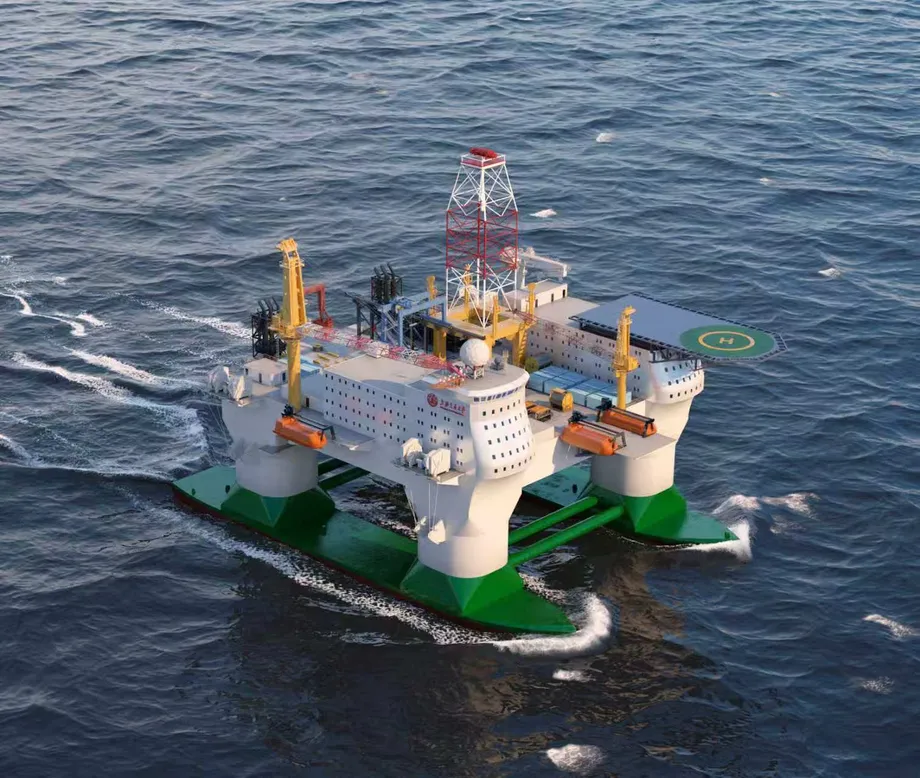
Shanghai Jiao Tong University calls the facility MOST, short for Mobile-facility of Ocean Science and Technology. Its official project description presents it as a large platform with its own propulsion, designed for rapid navigation, extended offshore residence and scientific work in harsh seas.
The island label describes its intended role as a substantial research base at sea. The structure itself will float and move, using a semi-submersible design with two hulls. Part of a semi-submersible structure sits below the water surface, helping provide stability for work above it.
Shanghai Jiao Tong University researcher Yang Jianmin has described the operating sequence: the facility would travel to a designated area with mobility comparable to a research vessel, then use ballast to settle into a more stable research configuration. Ballast is weight, commonly water held in tanks, used to adjust how a vessel sits in the sea.
The university describes MOST as the world's first platform of its kind. The proposed combination is what matters to its scientific mission: movement between research areas, the ability to carry large loads and the endurance to remain offshore for extended observations.
The scale of the platform
The planned platform measures 138 meters long and 85 meters wide, with a stated main deck height of 45 meters. Its reported maximum displacement is approximately 74,000 tonnes, and it is designed to accommodate 238 people.
Displacement describes the weight of water pushed aside by a floating structure, which equals the structure's total weight at that loading condition. The figure gives readers a sense of the platform's scale; the separate equipment specifications describe the machinery it is intended to handle.
A designed cruising speed of 11 knots, about 20 kilometers per hour, would allow the facility to change research areas under its own power. Its purpose combines travel with long periods of scientific work in a chosen area.
The weather specifications call for operations in sea state 7 and survival during a typhoon rated at level 17. Sea state describes the condition of the sea surface, while the typhoon rating concerns wind strength. Working through rough seas and surviving an extreme storm are separate engineering requirements, each relevant to keeping people and equipment safe during lengthy offshore deployments.
Three systems must work together
MOST consists of three connected systems: the main floating platform, laboratories aboard it and support facilities on land. The university's project description assigns each a role in keeping scientific work running far from shore.
Six shipboard laboratories and one offshore operations support center are planned. Their research areas include heavy marine equipment and systems technology, marine disasters and meteorological observation, extended monitoring of ecosystems, and the underwater physical environment.
The shore facilities are planned for Changxing in Shanghai and Sanya in Hainan. Their responsibilities include operational control, measurement, data exchange, scientific research, sample storage, maintenance and repair support.
That arrangement connects activity offshore with the people and facilities needed on land. Samples collected at sea need storage, instruments need maintenance, and observations need to reach researchers who may be working elsewhere. The support center and shore bases are part of the research infrastructure rather than optional additions to the floating platform.
Testing heavy equipment at great depth
The university says MOST will support real ocean trials of equipment weighing hundreds of tonnes and scientific exploration down to 10,000 meters. A narrower published description puts the equipment figure at about 100 tonnes; detailed limits for individual lifting and testing operations have not been specified publicly in the project descriptions.
The floating platform would remain at the surface while instruments and equipment carry out work below. At a depth of 10,000 meters, roughly 10 kilometers beneath the surface, equipment must function under immense water pressure and communicate with or return information to researchers above.
Deep sea mining systems, key equipment for ships and offshore engineering, and marine oil and gas equipment are among the intended test subjects. The university's March announcement explicitly connects the facility to the commercial development and use of ocean resources.
Full scale trials mean testing actual equipment at its intended size. For engineers, an open ocean test site can bring machinery, support systems and operating procedures together under real conditions. The planned load capacity and extended deployments would allow larger experiments and longer trials than a brief research visit could accommodate.
Why scientists want to stay across seasons
Marine ecosystems change over time, and the project is designed to support observations across seasons. Shanghai Jiao Tong University lists the seasonal evolution of ocean ecosystems among the questions the facility is intended to investigate.
A short expedition records a limited period. Returning to, or remaining in, a study area for longer allows researchers to follow changes rather than rely on a single visit. MOST's planned ability to stay offshore is therefore as important to ecological research as its machinery capacity is to engineering trials.
The university also identifies research into the origins and evolution of life, while project descriptions include the origins of deep sea biodiversity. Those goals would draw on observations and samples collected from marine environments, supported by the laboratories and storage facilities that form part of the project.
Marine resources and marine ecosystems appear side by side in the research plan. The facility is intended both to help develop equipment for using ocean resources and to study the environments where that work could take place. Its scientific program will consequently involve questions about living systems as well as machinery and materials.
Typhoon research is another central mission
Marine meteorology is one of MOST's stated research fields, and the university says the facility is expected to help improve typhoon forecasting. Its laboratory program includes observation and research on weather associated with marine disasters.
Typhoons develop over the ocean, where sustained observations can be difficult to maintain. A platform designed to remain offshore through harsh conditions could give researchers longer records of weather and ocean conditions in its operating area.
The project's weather resistance supports that research ambition by helping the facility continue its mission in difficult conditions. Any improvement in forecasting would come from the observations, analysis and forecasting work carried out using those measurements.
For coastal communities, the intended benefit is better information for disaster prevention and response. The university presents improved forecast accuracy as a research goal, alongside the platform's engineering and ecological work.
A decade of planning and a national project
Shanghai Jiao Tong University signed the facility's design contract with China State Shipbuilding Corporation's No. 708 Research Institute in Shanghai on December 13, 2024. The university's design contract announcement identified it as a major national science and technology infrastructure project under China's 14th Five Year Plan.
Project leader Lin Zhongqin, a member of the Chinese Academy of Engineering, said the university had spent ten years planning the facility and had no international precedent to use as a reference. Executive vice president Xi Lifeng described it as the largest individual scientific research investment in the university's history.
Lu Lin, director of the No. 708 Research Institute, identified the facility as the institute's top project. The institute's role is research and design, while Shanghai Waigaoqiao Shipbuilding holds the platform construction contract. Those responsibilities connect the university's scientific requirements with specialist ship design and construction work.
Shanghai Jiao Tong University also inaugurated an institute for deep sea science and engineering on March 27, 2026, the day before the construction launch. The institute adds an organisational base for work in the same field as the new facility.
The milestones toward 2030
The project's public milestones show a progression from planning and design to construction. The March 2026 launch is the latest dated step, with completion still targeted for 2030.
- December 13, 2024: Shanghai Jiao Tong University and the No. 708 Research Institute signed the design contract in Shanghai.
- March 27, 2026: The university inaugurated its institute for deep sea science and engineering.
- March 28, 2026: Construction of the floating research facility formally began in Shanghai.
- 2030: The university expects the facility to be completed. Earlier construction details specified June delivery.
The university also announced the platform construction contract with Waigaoqiao Shipbuilding on October 20. That agreement followed the design stage and assigned construction of the main platform to the Shanghai shipbuilder.
The planned result is a research base that brings heavy engineering trials, sustained ocean observation and weather research into one operating system. Its value to scientists will depend on how effectively the floating platform, laboratories and shore facilities work together once construction and testing are complete.
Key Points
- Construction began in Shanghai on March 28, 2026, with completion expected in 2030.
- Shanghai Jiao Tong University leads the project, and Shanghai Waigaoqiao Shipbuilding is the construction contractor.
- The reported construction bid was 2.763 billion yuan, approximately $414 million.
- The platform is designed to accommodate 238 people and support research at depths of 10,000 meters.
- Six laboratories, an offshore operations support center and shore facilities will support extended missions.
- Planned research includes marine equipment trials, seasonal ecosystem observations, ocean resources and typhoon forecasting.