Eight aircraft bring Ban Keun into focus
Eight aircraft, a runway about 2,000 metres long and continuing construction have put a newly opened China-Laos military aviation facility at the centre of a regional security debate. The installation at Ban Keun, about 50 kilometres north of Vientiane, gives China a new point of military access in mainland Southeast Asia, while offering Laos a dedicated centre for training air force pilots.
Contents
- Eight aircraft bring Ban Keun into focus
- What China says the centre will do
- What the aircraft and runway reveal
- A new facility on an old airstrip
- Why analysts disagree about calling it a base
- Vietnam watches both its western border and the sea
- The railway gives Laos benefits and obligations
- Thailand and Cambodia show the importance of access rules
- What could change beyond Laos
- Key Points
China's Ministry of National Defense said the China-Laos Joint Support and Training Centre was inaugurated on September 29, 2026, and would be jointly maintained and operated. The development also includes the China-Laos Friendship Aviation Academy. Chinese firms built the new facility in just under 11 months, using an airfield with a history stretching back to covert American operations during the Vietnam War.
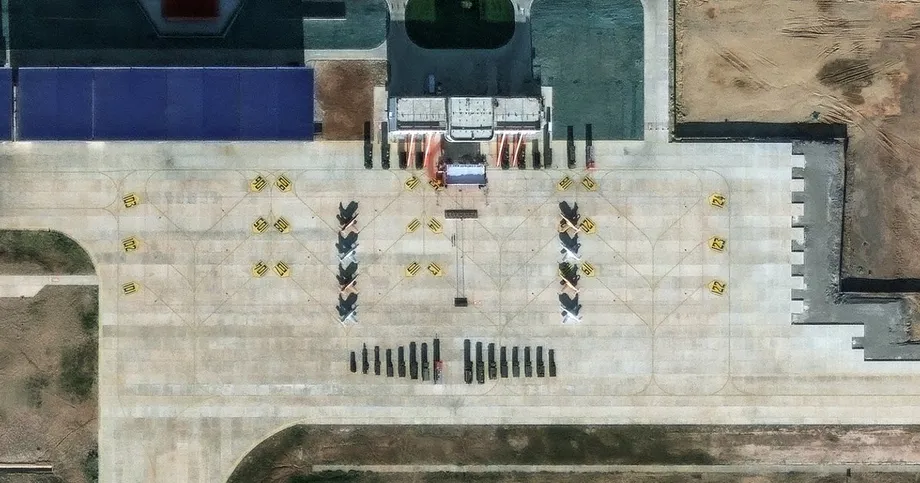
Commercial satellite images taken on September 30 showed eight aircraft identified by analysts as Hongdu JL-8s, also known as K-8s, alongside support vehicles. The International Institute for Strategic Studies lists Laos as having four of these aircraft. The eight visible at Ban Keun therefore amount to twice that listed fleet, making their ownership and operating arrangements a central issue.
Beijing describes the project as practical military cooperation. Security specialists see possible uses extending to refuelling, intelligence gathering and support for Chinese aircraft. Vietnam and Thailand must now assess a facility whose present training role and possible future capabilities carry different consequences. The development follows the opening examined in the October 8 assessment of Ban Keun's runway, aircraft and regional reach.
What China says the centre will do
China's defence ministry has identified two purposes: training Lao air force pilots and providing logistical support for joint exercises. Logistics means the movement and supply of people, fuel, equipment and other necessities that allow military activities to continue.
The ministry described the operating arrangement and purpose in its announcement:
The centre, jointly maintained and operated by both sides, is aimed at helping Laos strengthen the training of its air force pilots.
The ministry also said the facility was "not directed against any third party" and would contribute to regional peace and stability. Laos's government news agency described the opening as a new step in military aviation cooperation.
China and Laos have conducted eight joint military exercises in Laos since 2017. A permanent support centre gives those activities a regular location and could make training and equipment support easier to organise. For Lao pilots, the most immediate benefit is access to instruction and facilities that a small air force may struggle to provide alone.
Neither government gave staffing numbers, a detailed equipment list or the terms governing Chinese access. Those arrangements will determine how much of the centre's daily activity serves Lao training and how much supports the People's Liberation Army, China's military.
What the aircraft and runway reveal
The K-8 is an aircraft with two seats, used to teach pilots to fly jets and perform more advanced tasks. It can also carry weapons for light attack missions. Its presence fits an aviation academy, while giving the aircraft a potential combat role.
Vantor satellite imagery showed eight such aircraft and more than two dozen support vehicles. Construction was continuing around the runway, including work associated with a possible extension. Satellite images provide a useful view of buildings, pavement and parked aircraft; operating schedules and access agreements will provide the fuller picture of how the centre functions.
David Vallance, a research associate with the Lowy Institute's International Security Program, assessed the runway as too short for People's Liberation Army Air Force bombers, which he said require about 3,000 metres. Ban Keun's approximately 2,000 metres is about two thirds of that length.
Alexander Neill, an adjunct fellow at the Pacific Forum, said the layout appeared to allow expansion:
It looks like the airfield has been engineered to accommodate a runway extension allowing larger aircraft to operate.
A longer runway would widen the range of aircraft that could use Ban Keun. Sustained operations would also require suitable parking space, maintenance facilities, fuel supplies and, for combat missions, ammunition storage. Those supporting features matter alongside runway length.
A new facility on an old airstrip
Ban Keun's military history predates China's involvement by decades. During the Vietnam War, the airfield was known as Lima Site 44 and was used by Air America, the airline secretly owned by the US Central Intelligence Agency.
Ryan Wolfson-Ford, a Southeast Asia specialist at the Library of Congress, identified that history through records of the airfield. Its reuse places a Chinese-supported military project on ground once associated with American covert operations in Laos.
The development has moved quickly, while the transport links surrounding it have taken years to build:
- 2016: Construction began on the China-Laos Railway.
- 2017 onward: China and Laos conducted eight joint military exercises in Laos.
- December 2021: The China-Laos Railway opened.
- Late 2025: Satellite imagery showed construction beginning on the new Ban Keun facility.
- September 29, 2026: China announced the inauguration of the joint support and training centre.
- September 30, 2026: Satellite images showed eight aircraft at the airfield, with construction continuing.
The timeline connects two developments: years of closer military cooperation and a transport network that makes Laos more accessible from China. Ban Keun adds an aviation facility to that relationship.
Why analysts disagree about calling it a base
Collin Koh, a senior fellow at Singapore's S. Rajaratnam School of International Studies, considers Ban Keun a likely future Chinese military foothold. He said the airfield could support refuelling and resupply, as well as intelligence gathering, surveillance and reconnaissance. Those last three activities involve collecting information, watching an area and examining potential military activity.
Koh also suggested the site would probably be used mainly by the Lao air force and the People's Liberation Army Air Force, rather than becoming a commercial airport widely open to foreign users. Joshua Kurlantzick, a Southeast Asia specialist at the Council on Foreign Relations, has described it as China's first air force base abroad.
Olli Pekka Suorsa, an assistant professor at Rabdan Academy in Abu Dhabi, takes a narrower view of its present military value. He points to the space and infrastructure required for sustained operations far from home: extensive aircraft parking areas, shelters, fuel and ammunition storage.
Chinese military affairs commentator Song Zhongping says the facility belongs entirely to Laos and has neither an independent Chinese garrison nor exclusive Chinese use rights. His description, Koh's forecast and Suorsa's assessment address different parts of the issue: ownership, access and operational capacity.
For neighbouring countries, the practical questions are how often Chinese aircraft arrive, how long personnel stay and what supporting infrastructure appears. Those patterns will shape Ban Keun's military role more directly than its official name.
Vietnam watches both its western border and the sea
Vietnam has longstanding political and military ties with Laos, rooted in wartime cooperation and close relations between their ruling parties. A greater Chinese military presence in Laos adds a western dimension to Hanoi's security planning, alongside its territorial disputes with Beijing in the South China Sea.
Hunter Marston, director of the Lowy Institute's Southeast Asia Program, sees political influence as part of the concern. He argues that China's stronger position in Laos and Cambodia reduces Vietnam's room to shape its regional surroundings.
A Vietnamese official familiar with internal discussions described Hanoi's assessment more cautiously, saying the facility was primarily focused on training and humanitarian relief, while also viewing it as a means of strengthening China's influence in Laos. The official spoke anonymously because they were not authorised to discuss the matter publicly.
Vietnam's response therefore involves more than estimating the distance Chinese aircraft could fly. Hanoi also has to preserve its relationship with Vientiane, where public pressure over sovereign decisions could make cooperation harder. Reliable transport projects, investment and trade connections offer another way to maintain that relationship.
The railway gives Laos benefits and obligations
The China-Laos Railway helps explain why Chinese cooperation appeals to Lao leaders. Construction began in 2016, and the line opened in December 2021 at a cost of approximately US$5.9 billion, around one third of Laos's gross domestic product at the time. Gross domestic product measures the value of goods and services an economy produces in a year.
For a country without a coastline, faster access to foreign markets has practical value. The railway carries passengers and goods across mountainous territory where travel was previously slower and less predictable. It also creates substantial financial obligations and strengthens China's place in Laos's economy.
Rachel Vandenbrink, a senior analyst at the Australian Strategic Policy Institute, identified the connection between geography and access:
Laos does have some geostrategic value as an accessible foothold in mainland Southeast Asia, given its shared border with China and infrastructure links, including (its) railway.
Ban Keun lies near the railway corridor, creating a possible route for moving personnel and equipment from China. Vietnam's proposed Vientiane-Vung Ang railway would give Laos another connection to international markets through the Vietnamese coast, but financing difficulties have complicated its development.
Laos's choice is consequently shaped by what partners can deliver. Chinese infrastructure brings transport and investment benefits, while closer military cooperation increases the importance of the relationship. Vietnam faces competition over concrete economic opportunities as well as diplomatic influence.
Thailand and Cambodia show the importance of access rules
Thailand, a US treaty ally that also maintains close relations with China, has taken a measured public position. Thai Defence Ministry spokesperson Rear Admiral Surasant Kongsiri said permission for a Chinese facility was Laos's sovereign right.
Surasant also set out Bangkok's continuing interest:
Nevertheless, Thailand will continue to closely monitor developments and how the matter proceeds, particularly with regard to building mutual trust.
Cambodia's Ream Naval Base offers a useful comparison because China financed its expansion and a joint training centre there. Cambodia says the base remains under its control and open to friendly countries. Japanese and Vietnamese naval vessels visited in April 2025, followed by a US Navy ship in January 2026.
Those visits show how access arrangements can affect the strategic meaning of infrastructure built with Chinese support. Cambodia's Constitution, under Article 53, commits the country to permanent neutrality and bars foreign military bases. Ban Keun's joint operation has generated a different debate, centred on the terms of Chinese military use.
Sereysovathana Mogn, a junior researcher and lecturer at the Royal University of Phnom Penh, argues that Laos and Cambodia should be able to improve their defence capabilities and choose partners. His argument highlights a regional tension: neighbours seek reassurance about Chinese access, while smaller states seek control over their own security decisions.
What could change beyond Laos
Ban Keun could eventually give Chinese aircraft another place to refuel, receive supplies or gather information across mainland Southeast Asia. Its location also diversifies China's access beyond Cambodia's coast and the logistics base in Djibouti.
Su Tzu-yun of Taiwan's Institute for National Defence and Security Research has suggested that, during a conflict over Taiwan or in the South China Sea, a developed facility could help China intercept US aircraft crossing Indochina from Diego Garcia in the Indian Ocean. That is a forecast about a possible wartime role, dependent on the aircraft and supporting capabilities stationed there.
Marston has similarly argued that an expanded runway capable of hosting larger aircraft could affect military planning across Thailand, Cambodia and Vietnam, including decisions about multinational exercises in Thailand. Neill sees possible future use by aircraft that collect electronic signals and conduct surveillance.
Laos gains an aviation training facility now. China gains a jointly operated site with room for further development. The next meaningful changes will be physical and operational: runway work, fuel and maintenance capacity, aircraft deployments and patterns of Chinese personnel use. These will determine how far Ban Keun's role grows beyond its announced training mission.
Key Points
- China and Laos inaugurated the Ban Keun joint support and training centre on September 29, 2026, about 50 kilometres north of Vientiane.
- China says the jointly operated facility will train Lao pilots and support military cooperation.
- Satellite images showed eight apparent K-8 aircraft, support vehicles and a runway approximately 2,000 metres long.
- Analysts identify possible future logistics and intelligence roles, while disagreeing about its present capacity as a Chinese air base.
- Vietnam is weighing security concerns alongside economic competition for influence in Laos; Thailand says it will monitor developments.
- Future aircraft deployments, construction and access arrangements will shape the facility's regional importance.