One control line, five qubits and a fix for unwanted interference
Researchers at Japan's RIKEN Center for Emergent Matter Science and their collaborators have operated five silicon quantum bits through a single shared microwave line while keeping the accuracy of their individual operations at about 99.9% or higher. When up to three qubits operated together, accuracy exceeded 99.99% for each, addressing a problem that has made larger silicon quantum processors difficult to control.
Contents
- One control line, five qubits and a fix for unwanted interference
- What the accuracy figures mean
- How the silicon device works
- Why qubits cannot simply take turns
- The microwave effect behind the errors
- Pairwise measurements replace a growing calibration burden
- Smoother pulses helped preserve precision
- What still limits operation of all five qubits
- From the first manuscript to a larger research goal
- Key Points
The study, published in Nature Physics on October 15, 2026, identifies microwave signals themselves as a major source of interference. Signals intended for one qubit shift the operating conditions of others. The team measured those unwanted changes between pairs of qubits, then adjusted the control signals to compensate.
The result connects two problems that must be solved together: keeping quantum operations accurate and reducing the amount of wiring needed to control a growing processor. A shared microwave line simplifies the control architecture, while the calibration method helps preserve accuracy when several qubits work at once.
Leon Camenzind, a RIKEN research scientist and co-first author who supervised the experiments, described the advance in RIKEN's English press release, dated October 16.
This shows that high-fidelity control can be maintained even when several qubits are operated at the same time and represents an important step toward scaling up silicon-based quantum processors.
What the accuracy figures mean
The Nature Physics paper, titled "Simultaneous High-Fidelity Single-Qubit Gates in a Spin Qubit Array," reports measurements of basic operations called gates. A gate changes a qubit's quantum state. Fidelity describes how closely that operation matches the intended result.
All five qubits individually achieved gate fidelities well above 99.99%, with some approaching 99.999%. The team preserved fidelity above 99.99% during simultaneous operation of up to three qubits. For all five operating together, the paper reports performance at 99.9% or higher; RIKEN summarizes that result as approximately 99.9%.
The extra decimal places matter. Subtracting fidelity from 100% gives an average gate error measure: 99.9% corresponds to 0.1%, while 99.99% corresponds to 0.01%. Moving between those levels reduces that measure by a factor of ten. Quantum error correction depends heavily on keeping such errors small across many operations.
The team measured basic X and Y gates, which rotate an individual qubit's state around different axes. These are building blocks for quantum circuits. Operating several of these gates simultaneously lets different parts of a processor work together rather than wait in a queue.
How the silicon device works
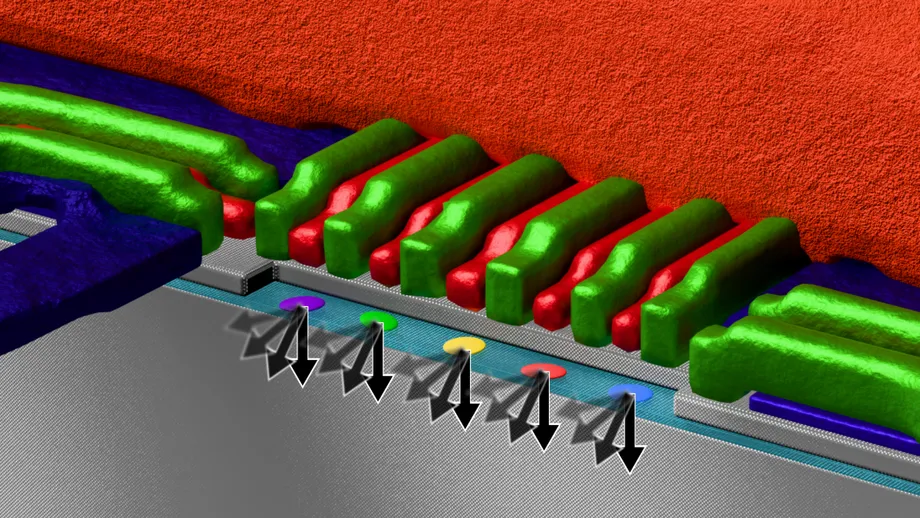
The five qubits occupy tiny regions called quantum dots in a structure made from silicon and silicon germanium. Metal electrodes create and control these confined regions. Information is encoded in electron spin, a quantum property that can be manipulated using microwave signals.
The device uses silicon enriched in the isotope silicon-28. RIKEN's Japanese research announcement explains that silicon-28 has no nuclear spin, helping provide a quieter magnetic environment for the electron spins that carry information.
Three overlapping layers of aluminum gates define the array. A small cobalt magnet creates a magnetic field that varies across the device, giving neighboring qubits operating frequencies separated by about 150 megahertz. Those frequency differences allow the researchers to address individual qubits even though they share the microwave electrode.
The shared line carries combined microwave pulses intended for different qubits. Separate electrodes still perform other jobs, including shaping the quantum dots and adjusting interactions between them. The wiring reduction concerns the microwave control infrastructure, one of the difficult parts of expanding this type of processor.
Why qubits cannot simply take turns
Silicon spin qubits lose the precise relationships within their quantum states while waiting. This loss, called dephasing, can spoil information before the next operation begins. In this device, the average idle dephasing time was about 10.3 microseconds, or 10.3 millionths of a second.
The paper reports coherence times during driven operation of roughly 100 microseconds, around ten times the idle dephasing time. A Hahn echo measurement, which uses a control sequence to counter some forms of dephasing, gave an average of about 60 microseconds. Each measurement describes the qubits under a different operating condition.
Those short times make parallel control a practical necessity. If a large processor operated each qubit in turn, many others would spend valuable time idle. Quantum error correction also needs coordinated operations across groups of qubits to detect and manage errors.
Parallel control has carried its own accuracy penalty. The Nature Physics paper cites earlier silicon and silicon germanium experiments in which fidelity fell from 99.95% to 99.5% when just two qubits operated simultaneously. RIKEN's team investigated the physical cause of that deterioration and a way to compensate for it.
The microwave effect behind the errors
The researchers identified the AC Stark shift as the dominant source of the loss of accuracy during parallel control. A microwave field can change a qubit's effective energy levels even when its frequency is different from the frequency used to address that qubit.
A qubit's phase describes a relationship between the components of its quantum state. Changing its energy separation changes how that phase develops over time. An unexpected phase shift means the next control pulse acts on a state that has moved away from where the researchers intended it to be.
The team measured this interference directly between qubits labeled Q3 and Q4. Driving Q4 produced a phase shift of about 0.0379 radians on Q3, while driving Q3 produced a shift of about minus 0.0026 radians on Q4. The unequal effects reflected the different microwave powers needed to operate the two qubits at the same speed.
The phase shifts grew approximately with the square of the drive amplitude. In simple terms, doubling the amplitude could produce roughly four times the phase shift under the measured relationship. Stronger control signals therefore increased the need for careful compensation.
Pairwise measurements replace a growing calibration burden
Yi-Hsien Wu, the first author who carried out the experiments during his PhD research, explained how the team reduced the amount of calibration needed as more qubits operated together.
Rather than requiring an entirely separate calibration procedure for every possible combination of qubits, our method uses calibrations between pairs of qubits to compensate for the unwanted phase shifts.
The researchers measured how operating one qubit changed the phase of another. They then added those individual contributions to calculate the correction needed when several qubits operated together. Adjusting the microwave phases canceled the dominant unwanted shifts. The team also calibrated pulse amplitudes to correct rotations that were too large or too small.
A test involving Q2, Q3 and Q4 supported that approach. The phase accumulated on Q3 when its two neighbors operated together agreed with the sum of the effects measured from each neighbor separately. During operation of all five qubits, pairwise calibration performed as well as a full calibration that measured each qubit while the other four were driven.
The team's July 2025 preprint describes the calibration workload as growing quadratically with qubit number, rather than exponentially. Roughly, doubling the number of qubits would multiply the pairwise workload by about four. Measuring every possible operating combination would grow much faster, making calibration increasingly difficult for larger arrays.
Smoother pulses helped preserve precision
The calibration worked alongside carefully shaped microwave pulses. The researchers used Kaiser-window pulses, which have a smoother envelope than conventional rectangular pulses. Their shape suppresses unwanted frequency components that can disturb neighboring qubits.
The preprint reports individual primitive gate fidelities of about 99.98% with rectangular pulses. Switching to Kaiser-window pulses raised all five above 99.99%, with some approaching 99.999%. That comparison shows how the form of a control signal can matter alongside its frequency and strength.
The team assessed performance through randomized benchmarking. This method applies sequences of randomly selected operations and measures how quickly the probability of obtaining the intended result decreases as the sequences get longer. That decline provides an estimate of average gate fidelity.
Gate speed also required a balance. Slow gates leave qubits exposed to dephasing for longer, while very fast gates require stronger microwave driving that can introduce more noise. The study used a minimum gate duration of 83 nanoseconds for individual control and set simultaneous gates in the three-qubit experiment to 250 nanoseconds to reduce peak driving amplitude.
What still limits operation of all five qubits
Driving all five qubits together required more microwave power, and fidelity fell toward 99.9%. The researchers attributed the remaining loss primarily to drive-induced decoherence, a weakening of the quantum coherence needed for computation.
The phase correction addresses a predictable shift that can be measured and offset. Decoherence requires changes that better preserve the quantum state during operation. Device design, including the micromagnet, is therefore a focus for further improvement.
Camenzind described that remaining constraint and the team's proposed response.
This is a limitation, but further improvements to device design could help mitigate this source of error.
The paper explains that the fidelity required for fault tolerance depends on the error correction protocol and the types of noise present. Values above 99.9% are widely targeted for practical operation. A functioning system must also combine accurate gates with reliable measurement and repeated error correction across a much larger array. The team has not given a timetable for reaching that stage.
From the first manuscript to a larger research goal
The work developed through a preprint and a journal publication before RIKEN announced the result. Its main dates are:
- July 16, 2025: The researchers posted the first preprint, arXiv:2507.11918v1.
- October 15, 2026: Nature Physics published the study, with DOI 10.1038/s41567-026-03466-2.
- October 16, 2026: RIKEN dated its English press release describing the findings.
The collaboration includes researchers from RIKEN, National Taiwan University, ETH Zurich and QuTech in the Netherlands. Japan's Science and Technology Agency supported the work through Moonshot Goal 6 project JPMJMS256H, which focuses on technologies for a silicon quantum computer with fault tolerance.
Silicon's compatibility with established semiconductor manufacturing gives the approach a route toward dense integration. The experiment adds a control strategy to that manufacturing advantage: several qubits can share a microwave line, and their unwanted phase interactions can be corrected using measurements between pairs.
Seigo Tarucha, project manager of the silicon quantum computing project under JST's Moonshot Goal 6, set out the longer term objective.
Our long-term goal is to build a fault-tolerant quantum computer based on silicon spin qubits, and reliable parallel control is an essential step toward that goal.
Key Points
- RIKEN and collaborators controlled five silicon spin qubits through one shared microwave line.
- Individual gate fidelities exceeded 99.99%, with some approaching 99.999%.
- Up to three qubits retained fidelity above 99.99% during simultaneous operation; all five operated at about 99.9% or higher.
- Pairwise calibration compensated for unwanted phase shifts caused by the AC Stark effect.
- Greater microwave power introduced decoherence during operation of all five qubits, making device improvements the next technical focus.
- The study was published in Nature Physics on October 15, 2026.