A flying display meets Taiwan's road rules
Taiwan's Ministry of Transportation and Communications said on October 16, 2026, that Tesla's new Roadster would have to meet domestic vehicle safety standards before using public roads, while any flying capability would also need to satisfy applicable civil aviation requirements.
Contents
- A flying display meets Taiwan's road rules
- What happened during the demonstration?
- What Taiwan will examine
- Three versions, three different uses
- Why the FAA says it is not an aircraft
- Would drivers need a pilot licence?
- Taiwan's deposits reach NT$7.55 million
- A project stretching from 2017 to 2028
- City airspace is another constraint
- Key Points
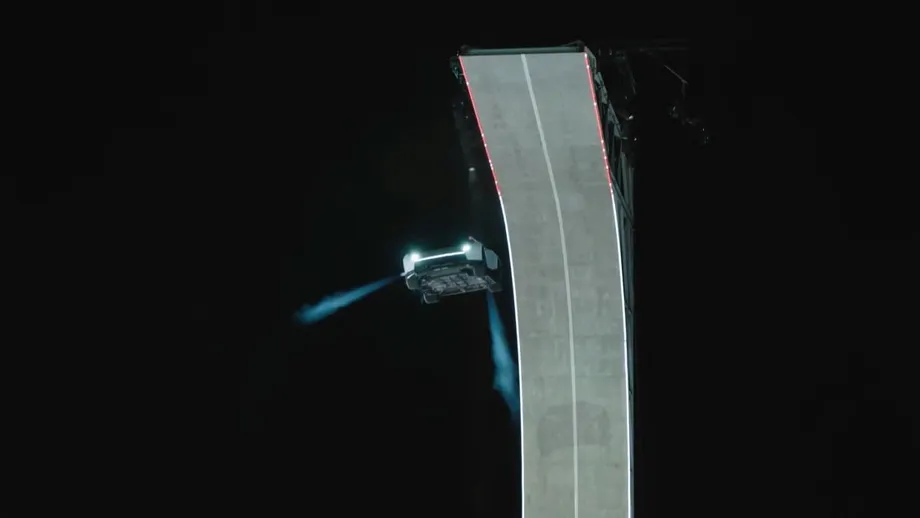
The response followed an October 15 demonstration in Texas, October 16 in Taiwan, in which a Roadster prototype climbed a curved ramp, travelled upside down and rotated through the air before landing. Tesla describes the most extreme version, Rocket, as a vehicle with a full flight system, offered by invitation only and not approved for public road use.
Chao Chin-wei, a specialist in the ministry's Department of Public Transportation and Supervision, said the ministry would ask the Vehicle Safety Certification Center to examine the car's functions and its approval status in the United States before discussing the matter with other responsible agencies.
The American response adds a complication. The Federal Aviation Administration says the Tesla vehicle falls outside its definition of an aircraft. Taiwan's ministry, meanwhile, has said that actual flying functions would in principle bring civil aviation requirements into consideration. The two governments are approaching the vehicle through their own rules, and Taiwan's review will examine both its road equipment and its unusual propulsion system.
For prospective buyers, three matters sit alongside the airborne spectacle: which Roadster version they reserve, what their payment covers and where the finished vehicle could legally operate. Tesla has announced a production target of 2028, while its reservation terms leave delivery uncertain.
What happened during the demonstration?
Tesla presented the new Roadster at a SpaceX test facility in Texas. The demonstration used a specially curved ramp that carried the car into an inverted position before it left the surface, turned through roughly 180 degrees and landed on its wheels. The presentation also showed brief hovering and airborne movement.
The car operated without anyone inside during the stunt for safety reasons. Its single seat Rocket configuration combines a system of fans beneath the body with cold gas thrusters positioned around the vehicle.
A fan suction system draws air from beneath a car to pull it toward the surface. Cold gas thrusters do a different job: they release compressed gas through nozzles to push the vehicle in the opposite direction. Tesla says the thrusters can assist acceleration and control movement away from the ground.
Tesla chief executive Elon Musk described the project as a collaboration with SpaceX and said the proposed equipment would include about 10 small cold gas rocket nozzles. The company also claims acceleration to around 100 kilometres per hour in less than a second. Those figures describe Tesla's intended performance; the vehicle remains under development.
What Taiwan will examine
Taiwan's existing vehicle safety requirements cover equipment such as lighting and brakes. Chao said a vehicle intended for road use must satisfy those standards, whatever additional technology it carries.
The Vehicle Safety Certification Center will be asked to examine the propulsion equipment, hovering capability and the conditions under which American authorities have approved its use, if any. The ministry then plans discussions with relevant bodies, including the Civil Aviation Administration.
The practical task is to match the finished vehicle's capabilities to the rules governing each activity. Driving on a road involves vehicle safety requirements. Operating a flying function brings questions about aviation rules, the operator's qualifications and the places where that function could be used.
The ministry has given no timetable for completing that assessment. Its announced next step is technical fact finding and consultation, rather than a decision granting Taiwanese road access.
Three versions, three different uses
Tesla's Taiwan reservation information lists Performance, Thrust and Rocket, with different seating arrangements and equipment. Treating them as a single flying model would overlook substantial differences in what buyers are being offered.
- Performance has two seats, active aerodynamic equipment and a system of fans for suction against the surface. Tesla describes it as suitable for road driving.
- Thrust also has two seats and adds acceleration thrusters to the Performance equipment. Tesla describes it as a track specification.
- Rocket has one seat and adds the full hovering and flight propulsion system. It is available by invitation only, with a public road use warning.
Performance's road driving description is Tesla's stated product positioning. Registration in Taiwan would still depend on the applicable local approval process. Thrust's track description leaves its eventual road use status unresolved, while Rocket carries the explicit warning about public roads.
The equipment split matters to anyone attracted by the launch footage. The full flight system belongs to Rocket, while the publicly reservable versions have different configurations. A reservation for Performance therefore concerns a different product from the single seat machine used to promote the most dramatic capabilities.
Why the FAA says it is not an aircraft
FAA spokesperson Rick Breitenfeldt gave the agency's position on the Tesla vehicle in a written response:
The Tesla vehicle does not meet the FAA's definition of an aircraft.
Under that position, the FAA would not need to certify the vehicle as airworthy. Airworthiness certification is the process through which an aviation authority assesses whether an aircraft meets the safety standards required for flight.
The FAA's response concerns the vehicle's classification. A follow up question about the agency's broader authority over the airspace had not received an immediate answer. Separately, a senior official at the U.S. Department of Transportation acknowledged uncertainty about the division of oversight and expressed skepticism about the vehicle's ability to take off.
American road safety oversight remains relevant. A spokesperson for the National Highway Traffic Safety Administration explained the manufacturer's responsibility:
While the vehicle may appear to defy the laws of physics, the manufacturer must ensure that it does not defy applicable Federal Motor Vehicle Safety Standards and drivers must obey all local traffic laws.
NHTSA said it would monitor the situation and act to protect the driving public. In the United States, manufacturers generally certify that their vehicles meet the applicable federal road safety standards, while NHTSA oversees compliance.
Would drivers need a pilot licence?
Michael McCormick, a former FAA official who leads an air traffic management programme at Embry-Riddle Aeronautical University, said an aviation certification process could take at least a year if a vehicle of this kind were brought under aviation regulation. He also suggested that an operator might need a recreational pilot licence.
McCormick's assessment is conditional on aviation rules applying. The FAA's stated classification of this Tesla vehicle follows a different starting point, so buyers have no announced American pilot licensing requirement for Rocket to rely on.
Scott Miller, a lecturer in aviation and technology at San Jose State University, pointed to another practical restriction: many U.S. states limit where aircraft may take off and land, generally directing them to airports or designated facilities.
Taiwan's review will likewise need to address the activity a driver proposes to carry out. Permission to drive a car and permission to operate a flying function concern different skills and environments. The ministry's response places aviation compliance alongside vehicle approval if the Roadster's actual functions require it.
Taiwan's deposits reach NT$7.55 million
Tesla's Taiwan reservation information asks for NT$1.51 million for Performance. For the limited Thrust version, buyers must pay NT$150,000 initially and another NT$7.4 million within 10 days, bringing the reservation payment to NT$7.55 million. Thrust reservations are limited to one vehicle per person.
The Thrust payment is exactly five times the Performance payment: NT$7.55 million compared with NT$1.51 million. Rocket's price has not been published, and access is restricted to invited buyers.
These payments reserve a place in the process. Tesla's reservation agreement says the final purchase price will be set closer to production, with the company still determining options, features and hardware. The reservation money would count toward the eventual vehicle price.
The Taiwan information says Performance reservations can be refunded in full before the vehicle configuration is completed. It also lists imports, certification and testing, regulatory compliance, production and logistics among the factors affecting delivery.
Similar financial commitments accompanied the Hong Kong reservation launch, where Performance required HK$390,000 and Thrust HK$1.95 million. Buyers there also faced unresolved registration questions because Tesla listed the car with its steering wheel on the left.
A project stretching from 2017 to 2028
Tesla first collected reservations for the next generation Roadster in 2017. That earlier presentation promised a more conventional electric sports car capable of reaching 60 miles per hour in 1.9 seconds. The proposed vehicle then spent years in development without entering production.
The new presentation revives that long running project with a different set of capabilities. Musk now names 2028 as the expected start of production, while Tesla's agreement says it cannot guarantee when a reserved vehicle will be delivered, or whether it will be delivered.
- 2017: Tesla unveiled the earlier next generation Roadster and began taking reservations.
- October 15, 2026, in Texas: Tesla demonstrated the new Roadster and its airborne stunt capabilities.
- October 16, 2026, in Taiwan: The transport ministry outlined the road safety requirements and proposed examining the vehicle's flying functions.
- Within 10 days of a Taiwan Thrust reservation: The remaining NT$7.4 million reservation payment is due.
- 2028: Tesla's current target for the start of production.
Musk said at the Texas demonstration that the Roadster would eventually be Tesla's only model driven manually. That places an unusually demanding performance vehicle within a company increasingly focused on automated driving.
City airspace is another constraint
Pegatron chairman Tung Tzu-hsien, speaking on October 16 at a forum marking TECO's 70th anniversary, welcomed the concept of combining road travel and flight but said routes for air traffic were not yet mature.
Tung cited Taipei, Shanghai, Beijing and Washington as major cities that tightly control drone operations. He identified route planning and security as central concerns, including the danger of falling equipment and the possibility of drones being used to carry explosives.
His comments connect the Roadster debate to a practical issue beyond the car itself: cities must manage the space above roads and buildings. Tung said drones delivering parcels or meals could reduce pressure on ground transport, while explaining why authorities remain cautious about opening urban skies.
Tesla's own language also leaves room for substantial restrictions. When discussing whether the car would be legal across different places, Musk said he was unsure. Asked about street legality, the Tesla chief executive replied:
Depends on your street. But it'll be a viable car.
Taiwan's immediate task is more specific than opening its skies to a new category of commuter. Officials will examine the Roadster's actual equipment, establish which rules apply and assess what uses could satisfy them. Buyers face a reservation decision now, with production, delivery and legal operation dependent on later steps.
Key Points
- Taiwan says the Roadster must meet vehicle safety standards for road use, with applicable aviation requirements for flying functions.
- The transport ministry plans a technical examination and discussions with relevant agencies.
- Tesla's single seat Rocket is offered by invitation only and carries a warning that it is not approved for public road use.
- The FAA says the Tesla vehicle does not meet its definition of an aircraft; NHTSA says federal vehicle safety standards still apply.
- Taiwan reservation payments are NT$1.51 million for Performance and NT$7.55 million for Thrust, with final purchase prices unsettled.
- Tesla targets production in 2028, while its reservation terms do not guarantee delivery.