A balloon flight reveals a 7.9 sigma signal
A telescope carried above Australia in 2018 has produced a direct image of gamma ray emission from the center of the Milky Way, detecting a signal 7.9 standard deviations above background radiation in the 150 to 600 keV energy band. The result demonstrates a new imaging method for an energy range that has long resisted precise astronomical observation.
Contents
- A balloon flight reveals a 7.9 sigma signal
- What the camera changes
- Five hours looking toward the Galactic center
- A strong detection is not a detailed map
- Why twice the flux does not mean a contradiction
- Direct imaging still needs background corrections
- How sharp was the new image?
- The antimatter source remains unidentified
- SMILE-3 targets the next measurement
- Key Points
JAXA, Kitasato University, Japan's National Institute of Advanced Industrial Science and Technology, and Kyoto University announced the findings on October 6, 2026. Their joint research announcement describes the work as the first use of linear imaging based on geometrical optics principles to obtain a precise spectrum of positron annihilation emission from the Galactic center at these energies.
The distinction matters. This is not the first detection of gamma rays or antimatter annihilation in that region. It is a demonstration of a different way to assign arriving gamma rays to positions in an image, making measurements of brightness and energy less dependent on assumptions about the arrangement of celestial sources.
The research also produced a positronium related emission estimate roughly twice the earlier INTEGRAL measurement. However, the uncertainty is substantial, and the paper describes the two measurements as statistically consistent. The result does not establish that the Galactic center has become brighter or that dark matter has been detected.
The team includes Professor Toru Tanimori of Kitasato University, a Kyoto University emeritus professor; researcher Tomonori Ikeda of the National Institute of Advanced Industrial Science and Technology; Associate Professor Atsushi Takada of Kyoto University; and Assistant Professor Yoshitaka Mizumura of JAXA's Institute of Space and Astronautical Science. Their next proposed experiment, SMILE-3, is being prepared as a candidate for a JAXA balloon flight opportunity in Australia in 2028.
What the camera changes
The instrument is an electron tracking Compton camera, or ETCC. Instead of collecting gamma rays with a conventional optical lens, it reconstructs their arrival directions from interactions inside its detectors.
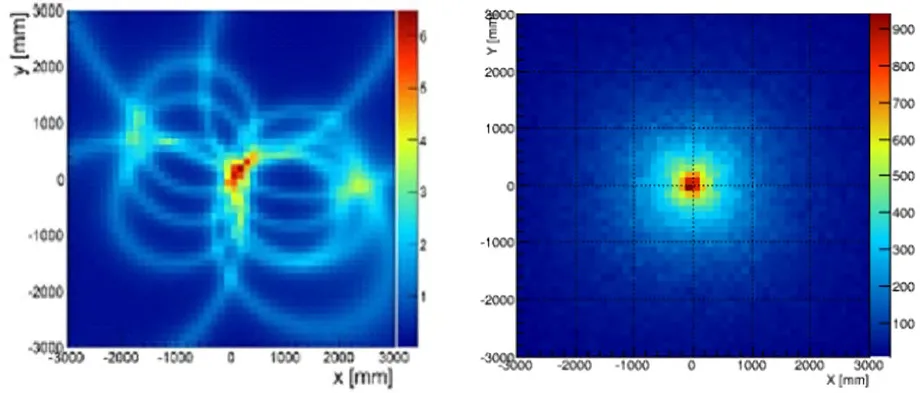
When a gamma ray undergoes Compton scattering, it transfers some of its energy to an electron and continues in a different direction. A conventional Compton camera measures the scattered photon but lacks a sufficiently complete measurement of the recoil electron's direction. An individual event therefore points back to a ring of possible locations on the sky rather than one localized direction.
The ETCC records the electron's track as well as the scattered photon's energy and position. Together, those measurements allow the incoming direction to be reconstructed and assigned a localized position in the image, subject to the instrument's angular uncertainty.
This enables linear imaging. In simple terms, the measured contribution of one source should remain consistent whether it is observed alone or alongside other sources. Images can then support quantitative measurements of brightness rather than relying principally on a complex reconstruction of overlapping rings.
The comparison with optical astronomy concerns this imaging principle, not the hardware or the sharpness of the resulting picture. The ETCC does not focus gamma rays through a glass lens, and its image of the Galactic center remains broad. Its advance is a more direct and measurable relationship between detected events and sky positions.
Five hours looking toward the Galactic center
The SMILE-2+ balloon launched from Alice Springs in central Australia on April 7, 2018, at 06:24 Australian Central Standard Time. Its flight lasted about one day, but the useful viewing time for the Galactic center was much shorter.
According to the research manuscript, the Galactic center entered the selected field of view at about 01:00 on April 8 and remained observable for approximately five hours. Images used data from the stable altitude period, when the balloon floated at about 39.6 kilometers.
The telescope's field of view was 3.1 steradians. A steradian measures angular area rather than a flat surface. Compared with the full sky's approximately 12.6 steradians, the instrument could cover roughly one quarter of the sky at a time, although the analysis restricted viewing directions to limit atmospheric contamination.
The chronology separates the original flight from the later scientific analysis:
- April 7, 2018: SMILE-2+ launched from Alice Springs.
- April 8, 2018: The Galactic center was observable for approximately five hours.
- 2022: The team published an initial account of the Galactic center detection in the Astrophysical Journal.
- August 11, 2026: The new imaging and spectroscopy study was published in Physical Review D.
- October 6, 2026: The four Japanese institutions jointly announced the results.
- 2028: JAXA plans an Australian balloon flight opportunity for which SMILE-3 is a candidate.
A strong detection is not a detailed map
The Physical Review D paper, published as volume 114, article 043026, reports a 7.9 sigma excess in the Galactic center image. Sigma expresses the size of a signal relative to the statistical fluctuations expected from the estimated background.
That is strong evidence for emission in the image under the analysis used. It does not, by itself, identify the objects producing the radiation or determine whether the emission is concentrated in a small source or spread across a large region.
The authors tested three descriptions of the emission: a single source at the Galactic center, a structure with several components, and a smooth symmetric distribution described by a two dimensional Gaussian. The structure with several components included a narrow bulge, a broad bulge, a faint disk, and a central source.
Ikeda and his fellow authors, the researchers who conducted the study, state in the paper's abstract that the observations could not distinguish decisively among these descriptions:
All three were found to be statistically consistent with the data.
The Gaussian fit yielded a width of 26 ± 12 degrees, equivalent to a full width at half maximum of 61 ± 28 degrees. Yet the statistical test did not establish that an extended source was required. The team therefore detected the region reliably without resolving its physical structure conclusively.
Why twice the flux does not mean a contradiction
The estimate associated with positronium was (3.2 ± 1.4) × 10 to the power of minus 2 photons per square centimeter per second. Positronium is a temporary bound system consisting of an electron and its antimatter counterpart, a positron. Its annihilation produces gamma rays, including a continuum that contributes within the observed energy band.
The paper compares that estimate with an INTEGRAL value of (1.4 ± 0.3) × 10 to the power of minus 2 photons per square centimeter per second. Dividing the central values, 3.2 by 1.4, gives approximately 2.3, supporting the announcement's description of a result about twice as high.
The central values differ, but their uncertainty must remain part of the comparison. The authors describe the measurements as consistent within one sigma. The new result should therefore be read as a higher estimate requiring better measurement, not a confirmed disagreement with INTEGRAL.
The positronium value was also not obtained by counting only photons uniquely identified as coming from positronium. For the model with several components, the total measured flux across 150 to 600 keV was (5.8 ± 1.2) × 10 to the power of minus 2 photons per square centimeter per second.
The researchers then estimated and subtracted an inverse Compton contribution of (2.6 ± 0.7) × 10 to the power of minus 2 in the same units. Inverse Compton emission occurs when energetic electrons transfer energy to photons. Uncertainty in that modeled contribution enters the final positronium estimate.
Direct imaging still needs background corrections
The camera's directional measurements reduce ambiguity, but they do not eliminate every model or correction. The manuscript explicitly says that limited event counts prevented a fully independent reconstruction of the diffuse emission distribution.
Atmospheric gamma rays dominated the background in the observed energy range. Cosmic ray events and accidental coincidences between unrelated detector signals also contributed. Even at balloon altitude, radiation from space can be absorbed or scattered before reaching the telescope.
The researchers simulated these atmospheric effects and calibrated background normalization using a period when the Galactic center was outside the field of view. They also estimated contributions from known bright sources using Swift and INTEGRAL catalogs.
In the 450 to 600 keV band, about 92% of detected events in the Galactic center analysis bin were assigned to background. The paper gives a signal to noise ratio of 8.8% for that band. This percentage describes the composition of the selected events, not the 7.9 sigma significance of the image detection.
Comparisons with other observatories need care for another reason: they do not all measure the same patch of sky or subtract sources in the same way. The ETCC analysis used a central region extending approximately 33 degrees on either side of the Galactic center in both Galactic longitude and latitude.
The cited COSI and INTEGRAL analyses used different regions. The paper scaled their intensity values to account for different angular areas, while warning that comparisons of diffuse emission remain approximate because they also depend on the assumed distribution of radiation.
How sharp was the new image?
The ETCC used a gas detector with an active volume of 30 × 30 × 30 centimeters to record electron tracks, surrounded by 108 scintillator arrays to detect scattered gamma rays. The researchers also used a convolutional neural network to improve reconstruction of recoil electron directions.
At 511 keV, the characteristic energy of the electron and positron annihilation line, the instrument's half power radius was 20 degrees. This means that half of the reconstructed events from a point source fall within an angular radius of 20 degrees.
Its energy resolution at 511 keV was 14%, expressed as the full width at half maximum of its response. That measures how widely events from a single photon energy spread in the recorded spectrum.
These specifications explain why direct imaging and precise source identification are separate achievements. The camera can assign directions through a defined imaging response, yet its broad angular resolution cannot reliably separate individual objects crowded into the Galactic center region.
The instrument is therefore a demonstration of a method rather than a finished solution to the region's structure. A stronger signal, more observing time, and improved performance would help determine which spatial description best matches the sky.
The antimatter source remains unidentified
The Galactic center is a prominent source of the 511 keV annihilation line, but the origin of its positrons remains uncertain. The research manuscript notes that the observed distribution does not match any known astrophysical population neatly and has little correlation with emission at other wavelengths.
Possible conventional sources discussed in the paper include radioactive nuclei produced by massive stars and supernovae. Neutron stars and black holes are also candidates because energetic photon interactions around compact objects can create electrons and positrons.
Other hypotheses include dark matter annihilation or decay and low mass primordial black holes. Primordial black holes would have formed in the early universe rather than through the collapse of stars. The proposed positron production mechanism discussed in the paper is Hawking radiation.
None of those explanations is established by the new image. The unresolved spatial distribution, uncertainty in flux, and modeled subtraction of other emission limit what can be concluded about the origin.
The useful advance is observational: an instrument that can measure the direction and energy of gamma rays through a linear response creates another way to test competing explanations. It does not turn an unexplained signal into proof of exotic physics.
SMILE-3 targets the next measurement
Takada is leading preparation for SMILE-3, which would use an ETCC with improved sensitivity. JAXA's announcement describes it as a candidate experiment for the next Australian balloon opportunity planned for 2028. It does not announce a completed selection or a confirmed launch date.
Simulations discussed in the research material suggest that upgrades could raise the signal to noise ratio in the 450 to 600 keV band from 8.8% to about 32%. That would be roughly 3.6 times the present ratio, calculated from those two figures, but it is a projection rather than a demonstrated flight result.
The institutions also identify longer balloon observations and possible satellite observations as ways to extend the technique. Beyond the Galactic center, proposed targets include supernova remnants, active galactic nuclei, and gamma ray bursts.
These targets connect the imaging method to specific scientific measurements: radioactive emission can trace nuclear reactions and element production, while other gamma ray signals can probe the acceleration of energetic particles. The immediate task, however, is narrower: improve the instrument and collect enough data to measure the Galactic center's brightness and shape more decisively.
Key Points
- SMILE-2+ detected Galactic center emission at 150 to 600 keV with a 7.9 sigma excess in its image.
- The result demonstrates linear imaging using an electron tracking Compton camera, not the first discovery of gamma rays from the region.
- The positronium related flux estimate was about 2.3 times INTEGRAL's central value, but the paper describes the measurements as statistically consistent.
- Three different spatial models fit the data, so the emission's detailed structure remains unresolved.
- The observations do not establish dark matter or primordial black holes as the source of the positrons.
- SMILE-3 is being prepared as a candidate for JAXA's planned 2028 Australian balloon opportunity.