A Small Standby Current Protects a Crucial Catalyst
A copper catalyst that lost its ability to make useful chemicals after just three shutdown cycles stayed productive through more than 750 hours of changing operation when researchers kept a small protective voltage applied during pauses. The finding offers a practical way to match carbon monoxide electrolysis with electricity supplies that fluctuate with sunshine, wind and prices.
Contents
- A Small Standby Current Protects a Crucial Catalyst
- Why Switching Off Caused Trouble
- Two Different Ways Copper Deteriorated
- How the Protective Pause Works
- What the Month of Testing Showed
- What the Cost Figures Actually Show
- Why Electricity Prices Matter as Much as Weather
- A Change in Operation Rather Than Catalyst Design
- From July Publication to October Announcement
- Key Points
The study, published in Nature Catalysis on July 8, 2026, describes an operating strategy that protects copper while an electrolyser waits to resume production. Its economic analysis estimates that making acetic acid could cost up to 26% less when production shifts to periods of cheaper electricity.
Pohang University of Science and Technology, known as POSTECH, announced the work on October 22. The international team included Kwon Soon-Ho, a professor in POSTECH's Department of Materials Science and Engineering, Feng Jiao of Washington University in St. Louis, William Goddard of the California Institute of Technology, and researchers at Peking University.
The central finding in the Nature Catalysis study is that the electrical conditions during a production pause can determine whether the equipment works properly when it restarts. Keeping the copper surface protected required much less electricity than normal chemical production.
Why Switching Off Caused Trouble
Carbon monoxide electrolysis uses electricity to turn carbon monoxide, including gas released by facilities such as steel mills, into chemical ingredients. Possible products include ethylene, used to make plastics, and acetic acid, the acid found in vinegar and an industrial chemical feedstock.
A copper catalyst helps these reactions happen at the cathode, the electrode where carbon monoxide receives electrons. Its surface provides places where molecules can react. When those places become covered or the copper changes chemically, the device can stop making the intended products.
Electricity accounts for more than half the production cost in this process, making cheaper renewable power attractive. Solar and wind generation, however, change with daylight and weather. Equipment designed for continuous operation must cope with pauses if it is to follow that changing supply.
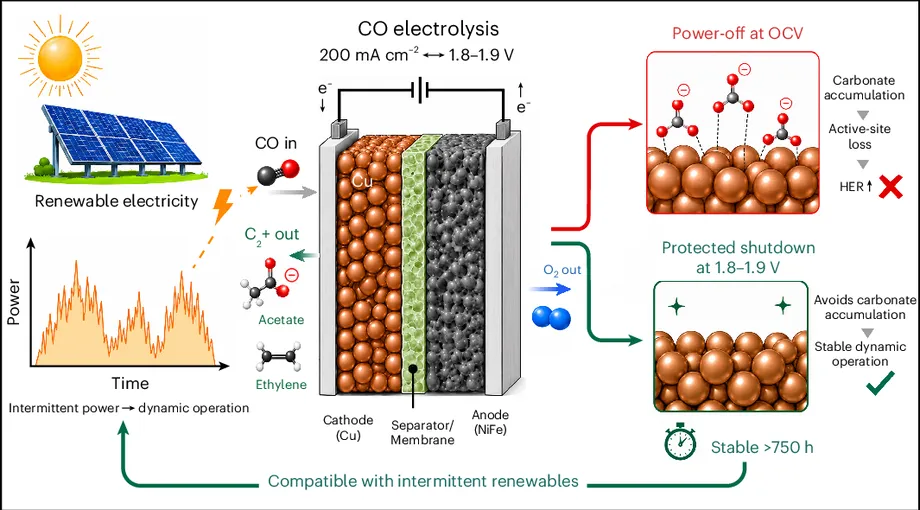
The researchers repeatedly switched their electrolyser off and on to investigate that problem. After only three cycles, it produced hydrogen instead of the desired chemical feedstocks. Hydrogen can be useful elsewhere, but here it meant electricity was being directed away from the products the device was designed to make.
Two Different Ways Copper Deteriorated
The team replaced components one at a time to locate the failure. Replacing the copper catalyst restored performance, directing attention to what happened on its surface while the electricity was off.
Raman spectroscopy and computer simulations helped explain the damage. Raman spectroscopy uses scattered light to identify chemical substances. Under conditions rich in carbon monoxide, material remaining on the copper surface formed carbonate deposits during shutdown. Those deposits covered the places needed for the desired reactions.
Replacing the carbon monoxide atmosphere with argon created another problem. The paper identifies oxidation of copper to Cu2O, or copper(I) oxide, under argon conditions. In simple terms, the copper changed into an oxide rather than retaining the surface needed for production.
The experiments therefore identified two routes to failure: carbonate accumulation when carbon monoxide was present, and copper oxidation under argon. Protecting the equipment required control of the copper's electrical state during the pause, rather than simply changing the surrounding gas.
How the Protective Pause Works
The researchers kept a weak electrical input applied instead of allowing a complete shutdown. The study describes the protective setting as a cathode potential slightly more negative than its open circuit potential, the electrical potential it reaches when no current flows through the external circuit.
The operating description accompanying the research gives a standby voltage of about 1.8 to 1.9 volts, compared with an open circuit voltage of about 1.5 volts. The paper describes the cathode's potential, while those operating figures describe the voltage applied to the device. The practical requirement is to hold the copper in a protective electrical condition during the pause.
Under that protection, the rate of carbonate formation fell to about one millionth of its previous level. The controlled pause also prevented the copper oxidation identified in the argon experiments.
Standby electricity cost less than 1% of total production cost in the reported analysis. The approach trades a small continuing expense during a pause for the ability to resume chemical production with a functioning catalyst.
The comparison with a phone in standby mode is useful: the main activity pauses, but the device remains partly powered. For the electrolyser, that small electrical input protects a chemically active surface.
What the Month of Testing Showed
The team ran 31 cycles between normal operation and standby over roughly 750 hours to imitate a month of solar generation. The paper reports stable dynamic operation for more than 750 hours without significant performance loss. Dynamic operation means that the device changes its operating state over time instead of running continuously at one setting.
The desired products maintained a reported production share of about 75%. The device also recovered its performance after a pause lasting a week, adding a longer interruption to the repeated shorter pauses tested during the simulated solar schedule.
Those results address a practical operating problem: a plant following renewable generation must be able to restart repeatedly, rather than perform well only during one uninterrupted run. The contrast was substantial, from failure after three ordinary shutdown cycles to sustained operation through 31 protected cycles.
The tests focused on a carbon monoxide electrolyser and its copper catalyst. Applying the method commercially would involve maintaining that protective condition whenever normal production pauses. The researchers gave no timetable for commercial deployment.
What the Cost Figures Actually Show
The economic analysis used electricity pricing in South Australia to examine whether production could be shifted into cheaper periods. The region was described as obtaining more than 70% of its electricity from renewables, making it a relevant setting for studying a process that can respond to changing electricity supply and prices.
The researchers reported an acetic acid production cost falling from $2.13 per kilogram to $1.63 per kilogram. Those stated figures represent a saving of $0.50 per kilogram, or about 23.5%, while the paper gives a maximum modeled reduction of 26%. The maximum and the displayed price pair therefore represent different numerical descriptions of the potential saving.
The 26% figure concerns the modeled cost of producing acetic acid. The mechanism is economic scheduling: make the chemical when electricity is cheaper, then use the protective standby setting during pauses.
At the stated prices, making 1,000 kilograms would cost $2,130 in the higher cost case and $1,630 in the lower cost case, a difference of $500. This calculation shows why a modest standby expense can be worthwhile when electricity makes up more than half the production bill.
Why Electricity Prices Matter as Much as Weather
The team compared electricity costs across 10 countries and found larger potential savings where prices varied more sharply by time. A flexible electrolyser has more opportunity to save money when it can avoid expensive periods and concentrate production in cheaper ones.
South Australia's calculation connects two parts of the research. The catalyst protection makes repeated pauses workable, while variable electricity prices give the operator a financial reason to pause. Both are needed for the proposed operating strategy to deliver the modeled benefit.
A producer would still pay for the small amount of electricity used in standby. The benefit comes from avoiding enough expensive production hours to outweigh that expense. Where electricity prices change little, the same scheduling strategy offers less room for savings.
The research therefore ties the value of flexible operation to local electricity markets. The reported maximum is connected to the prices and operating assumptions used in the analysis, with the comparison across 10 countries showing why the size of the saving changes by location.
A Change in Operation Rather Than Catalyst Design
Kwon Soon-Ho, the POSTECH materials science professor involved in the study, said identifying the changes during shutdown allowed the team to protect the catalyst through voltage control.
By identifying at the atomic level what happens on the catalyst surface when the power is turned off, we were able to find a solution that protects the catalyst using nothing more than simple voltage control,
Kwon also described the commercial aim of changing how existing equipment is operated.
Without developing new catalysts or equipment, we can accelerate the commercialization of renewable-energy-based carbon conversion technologies simply by changing the operating method.
The proposed advantage is concrete: operators could preserve the copper catalyst through pauses without first developing a replacement catalyst material. The research connects surface chemistry, electrical control and electricity purchasing in one operating strategy.
The work received support from South Korea's Ministry of Science and ICT and the National Research Foundation of Korea, the Gates Foundation, and the Liquid Sunlight Alliance supported by the United States Department of Energy.
From July Publication to October Announcement
The study appeared online in July before being assigned to the journal's August issue. POSTECH's research repository record lists Nature Catalysis, volume 9, issue 8, pages 823 to 833, with the DOI 10.1038/s41929-026-01574-z.
- July 8, 2026: The study was published online in Nature Catalysis.
- August 2026: The journal issue containing the paper was issued, according to POSTECH's repository.
- October 22, 2026: POSTECH announced the research and its potential use with fluctuating renewable electricity.
The findings place attention on an easily overlooked part of chemical production: what happens while a machine waits. In this case, a small protective electrical input kept the catalyst ready for the next period of production and made cheaper operating schedules possible in the economic analysis.
Key Points
- Ordinary shutdowns caused a copper catalyst to lose its intended chemical production function after three cycles.
- Carbonate deposits and copper oxidation were identified as two causes of deterioration.
- A protective standby setting enabled more than 750 hours of stable operation, including 31 production and standby cycles.
- Standby electricity accounted for less than 1% of total production cost.
- The study modeled acetic acid production cost savings of up to 26%; the stated prices of $2.13 and $1.63 per kilogram imply about 23.5%.
- A comparison across 10 countries found greater savings where electricity prices varied more by time.