A quantum material just 0.7 nanometres thick
A research team led by Seoul National University has created an atomically thin kagome material called kagomene, reporting a flat band electron density more than 220 times that of existing artificial systems made by overlapping atomic layers. The material, about 0.7 nanometres thick, gives scientists a new way to study electrons whose motion is strongly suppressed by the arrangement of atoms around them.
Contents
- A quantum material just 0.7 nanometres thick
- What the published study establishes
- Why triangles and hexagons slow electrons
- How the team reached a single layer
- Voltage provides a way to control the material
- Why the electron density matters
- Understanding the 280 kelvin forecast
- What anyons could offer quantum computing
- Key Points
The results were published on 15 October 2026 in Nature Physics. The team includes Min Goo Kang of Seoul National University's Department of Physics and Astronomy, Gil Young Cho of the Korea Advanced Institute of Science and Technology, and Jae Hoon Park of Pohang University of Science and Technology.
The researchers directly measured the material's unusual electronic structure and changed its electrical state using an external voltage. Their longer goal is to develop quantum devices that can operate at much higher temperatures than those used for related experiments today.
The headline figure behind that ambition is 280 kelvin, about 6.9 degrees Celsius. That temperature is above freezing but below a typical indoor room temperature. It comes from an estimate of the material's energy scales; experiments to establish whether anyons and the proposed quantum states can exist at such temperatures are still needed.
What the published study establishes
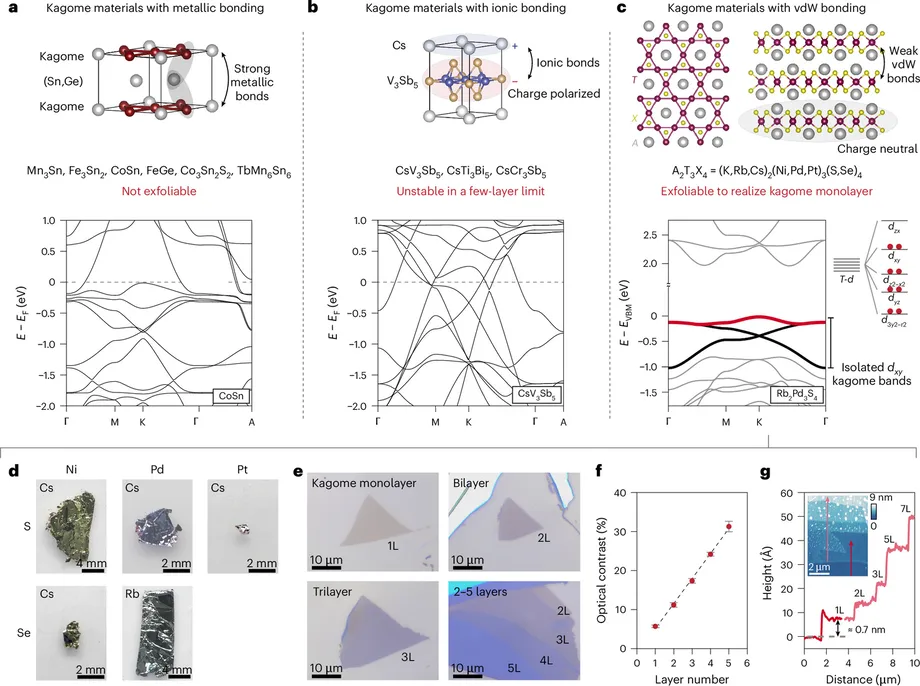
The team's Nature Physics paper, titled Monolayer van der Waals kagome lattice for high-temperature flat-band physics, describes a family of compounds written as A2T3X4. In that formula, A represents an alkali metal, T a transition metal and X a chalcogen.
The study reports an ideal two dimensional kagome lattice that survives down to a single layer. Its flat band sits just below the Fermi level, an energy reference that helps physicists describe which electron states are occupied. Applying a voltage can bring that band to the Fermi level, giving researchers access to a regime in which the flat band is partly filled.
Those findings connect three practical steps: making the thin material, measuring the electronic structure that makes it unusual, and adjusting that structure electrically. Together, they provide an experimental platform for investigating stronger interactions between electrons.
The key dates are:
- From around 1980: theoretical work explored the unusual electron behaviour associated with kagome flat bands.
- 15 October 2026: the research was published in Nature Physics.
- 21 October 2026: Seoul National University announced the team's results.
Why triangles and hexagons slow electrons
Kagomene takes its name from the kagome pattern, a repeating network of connected triangles and hexagons. Graphene, another material that can be only one atom thick, has a honeycomb arrangement of carbon atoms. Kagomene's different geometry produces a different set of possible electron behaviours.
Electrons in a crystal behave partly like waves. In a kagome network, the waves travelling along different routes can interfere with one another, suppressing movement. The geometry therefore helps create a flat band, a range of states in which electron energy changes very little as momentum changes.
Physicists describe that behaviour using effective mass. This measures how an electron responds inside a material, where surrounding atoms and other electrons affect its motion. Near an ideally flat band, the effective mass becomes extremely large, reaching infinity in the ideal mathematical description.
The electron's own mass stays the same. Inside this particular atomic environment, however, its response resembles that of something extremely difficult to move. This is the meaning of the description of kagomene as containing electrons with infinite effective mass.
How the team reached a single layer
Earlier kagome research largely focused on bulk materials with many atomic layers. Coupling between those layers and complicated electronic structures made it difficult to isolate the behaviour expected from an ideal two dimensional kagome lattice.
The team worked with a family of van der Waals materials, whose layers are held together by relatively weak forces. That allows researchers to separate a very thin sheet from a thicker crystal. Their single layer was approximately 0.7 nanometres thick, less than one billionth of a metre.
To examine the electrons, researchers used synchrotron facilities in the United States and Britain and a technique called nanofocused angle resolved photoemission spectroscopy, or nano-ARPES. Light releases electrons from a sample, and measurements of their energy and direction reveal its electronic structure.
The small light spot makes the method useful for examining tiny flakes. Measurements showed that the kagome flat band remained present at the single layer limit. The result brings a theoretical lattice design into a material thin enough for direct electrical control.
Voltage provides a way to control the material
An external voltage gave the researchers a second tool beyond the atomic pattern itself. Through electrostatic gating, they could adjust the electronic conditions and bring the flat band to the Fermi level.
A partly filled flat band is especially useful because electrons have room to rearrange while their usual freedom of motion is restricted. Under those conditions, interactions between electrons can play a larger role in deciding how the material behaves.
The team observed a transition from an insulating state, in which electricity flows poorly, to a metallic state. Further changes in voltage produced another insulating state. Researchers suggested that interactions between electrons could help explain the newly observed insulating behaviour, whose precise origin requires further investigation.
For future devices, electrical control offers a practical advantage: scientists can explore several electronic states in the same material by changing a voltage. That gives them a way to search for useful quantum behaviour without preparing a different compound for every setting.
Why the electron density matters
Kagomene's flat band electron density was more than 220 times that of the existing artificial flat band systems used for comparison. Those systems use moiré patterns, formed when thin atomic layers are stacked with a slight twist or mismatch.
A moiré pattern creates a larger repeating structure that can reshape electron motion. Kagomene instead gets its flat band from the material's own atomic lattice. The much smaller underlying pattern allows flat band electrons to be packed more densely.
When electron motion is suppressed, the forces between electrons become more important relative to their movement. The researchers see the high density as a route to collective quantum states with larger characteristic energy scales, making them more resistant to thermal disruption.
The comparison is specific: it concerns electrons in the flat band of the systems examined. Its practical value is that kagomene combines this dense electronic environment with a single layer structure and voltage control, bringing several useful properties into one experimental platform.
Understanding the 280 kelvin forecast
The team's theoretical analysis considered a fractional quantum anomalous Hall state, an unusual collective electronic state associated with a fractional electrical response across a material. Such states are of interest because they can support exotic excitations called anyons.
The calculated energy gap was about 14 to 29 millielectronvolts, compared with roughly 1 to 5 millielectronvolts in the moiré materials used for comparison. An energy gap is the energy needed to create certain excitations out of a quantum state. A larger gap can help a state resist disturbance from heat.
The temperature forecast comes from relating those small energy values to a thermal energy scale. Kang explained that this calculation motivated the estimate reaching around 280 kelvin. Establishing an operating temperature requires experiments that test how the collective state actually behaves as the material warms.
The original comparison placed earlier anyon demonstrations at 2.5 kelvin or below, approximately minus 270.7 degrees Celsius. Reaching 280 kelvin would represent an enormous increase from those conditions. The immediate research task is to connect the promising calculated energy gap with measurable quantum behaviour.
What anyons could offer quantum computing
Anyons are quasiparticles: collective disturbances in a material that behave like particles. They can arise in certain two dimensional electronic systems, where their behaviour differs from that of familiar particles such as electrons.
Some kinds of anyons are candidates for topological quantum computing. In that approach, information can be stored in collective properties associated with how the excitations are arranged and exchanged. The attraction is that certain local disturbances may have less ability to damage the stored information.
Kang identified the difficulty of finding suitable materials as a major obstacle to developing this approach. Kagomene gives researchers a new candidate in which they can adjust the electron population and investigate the conditions needed for the relevant collective states.
A working quantum computer would require much more than a promising host material. Researchers would need to create suitable excitations, control them, read information from them and manage errors. The team's stated next steps are to build quantum devices based on kagomene and pursue key quantum phenomena and technologies at room temperature.
Key Points
- The team created kagomene about 0.7 nanometres thick and directly measured its flat electronic band.
- The Nature Physics study was published on 15 October 2026.
- The material has more than 220 times the flat band electron density of the existing moiré systems used for comparison.
- External voltage moved the material between insulating and metallic states and tuned the flat band to the Fermi level.
- Calculations gave a proposed quantum state's energy gap as 14 to 29 millielectronvolts, larger than the comparison range of 1 to 5.
- The 280 kelvin prospect equals about 6.9 degrees Celsius. Demonstrating the proposed states at higher temperatures is a future experimental goal.