Four Decades of Growth Bring a New Research Challenge
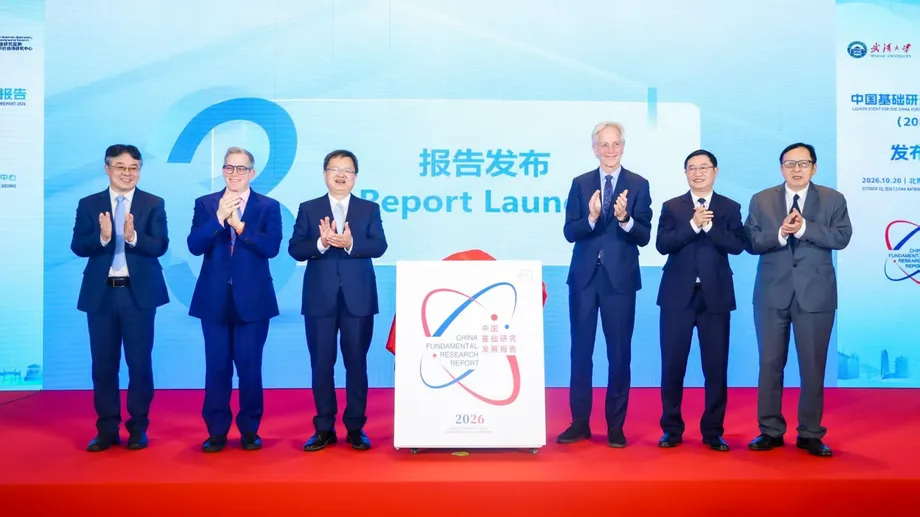
China produced 32.6% of the world's basic research papers in 2024, up from 0.9% in 1985, according to the China Fundamental Research Report (2026), released in Beijing on October 20, 2026. Its spending on fundamental research nearly doubled between 2018 and 2023, rising from $16.5 billion to $31.9 billion.
Contents
- Four Decades of Growth Bring a New Research Challenge
- What the Research Assessment Covers
- How the Geography of Scientific Publishing Changed
- Why Citations Give a Different Picture
- More Funding and a Larger Research Workforce
- Younger Researchers Gain More Support
- International Cooperation Remains Central
- Protecting Research Without an Immediate Payoff
- From Counting Papers to Understanding Their Value
- Key Points
The report also identifies a difference between China's share of publications and its reach through international citations. China received 20.8% of worldwide citations in 2024 when domestic citations were included. When citations from within the same country were excluded, its share was 9.5%. The United States recorded 24.4% and 24.9%, respectively.
China's next priority, the report argues, is to turn its expanding research capacity into a stronger ability to generate original discoveries. It calls for greater support for research that takes many years and explores uncertain ideas, alongside continued investment in people and shared scientific resources.
Basic research, also called fundamental research, seeks to understand how things work. Its immediate goal is knowledge, such as explaining a material's properties, rather than producing a finished device. Practical uses may follow much later, which makes decisions about funding and evaluation especially important.
What the Research Assessment Covers
The assessment examines nearly 40 years of change across 24 major countries and the European Union, giving it 25 country and regional entries. Drawing on more than 20 data sources, it considers investment capacity, researcher development, the influence of scientific output and the institutions that govern research.
The NSFC-Wuhan University Observatory for Global Fundamental Research led the work with nine Chinese universities and research institutions. Wuhan University hosted the launch under the guidance of the National Natural Science Foundation of China, or NSFC. Thirteen international experts and 39 domestic experts reviewed the report, a total of 52 reviewers.
Wuhan University President Zhang Pingwen said the project followed two principles: looking beyond simple rankings to understand research systems, and making its data, methods and limitations transparent. He said countries have different research histories, institutions and development paths, and contribute to science in different ways.
The report and its accompanying datasets and analytical tools have been made available through an official platform. That gives researchers and policymakers access to the material behind the assessment, allowing them to examine how its comparisons were constructed.
How the Geography of Scientific Publishing Changed
China's share of basic research publications rose by 31.7 percentage points between 1985 and 2024. Over the same period, the US share fell from 39.9% to 18.9%, while the EU share declined from 25.8% to 22.3%. India's share increased from 2.8% to 7.3%.
Those figures describe a substantial widening of where scientific knowledge is produced. In 1985, China accounted for fewer than one in every 100 papers in the report's measure. By 2024, it accounted for roughly one in three. India's share more than doubled during the same period.
A publication share measures a country's portion of the world's output. If research elsewhere expands faster, that portion can shrink even while the country continues producing more papers. The figures therefore describe the changing distribution of publishing activity; absolute publication totals would be needed to calculate each country's growth in paper numbers.
China's particular strengths include materials, engineering, energy and the environment, according to the assessment. These fields connect questions about the underlying behavior of matter and physical systems with practical needs, including how to develop materials and use energy.
Why Citations Give a Different Picture
China's 32.6% publication share sits alongside a 20.8% share of worldwide citations received in 2024. A citation occurs when one research paper refers to another. It helps show how published work is being used in later scientific discussion and investigation.
The US received 24.4% of citations worldwide when domestic references were included, compared with China's 20.8%. With domestic citations removed, the US share was 24.9% and China's was 9.5%. Under that second measure, the US share was about 2.6 times China's.
The two calculations answer different questions. The first includes references made by researchers within the same national research community. The second focuses on references crossing national borders, giving a more specific view of international reach.
China's large publishing community creates many opportunities for researchers within the country to refer to work produced there. International citations track another part of the picture: how frequently research is taken up abroad. Presenting both measures helps explain why a country can lead in publication volume while another has a larger share of citations from other countries.
More Funding and a Larger Research Workforce
China's fundamental research spending increased by $15.4 billion between 2018 and 2023, from $16.5 billion to $31.9 billion. Calculated from those figures, the increase was about 93%, bringing spending close to twice its earlier level.
The report also records an expansion in China's research workforce from 1.21 million full time equivalent researchers in 2010 to 3 million in 2023, an increase of approximately 148%. That amounts to 1.79 million additional full time equivalents over 13 years.
Full time equivalent is a way to measure working time rather than simply count people. Two researchers who each spend half their working time on research together count as one full time equivalent. The measure helps compare research capacity where people divide their time among research, teaching and other duties.
The main milestones show how the expansion unfolded:
- 1985: China accounted for 0.9% of global basic research publications.
- 2010: China's research workforce stood at 1.21 million full time equivalents.
- 2018: Fundamental research spending reached $16.5 billion.
- 2023: Spending reached $31.9 billion, and the research workforce reached 3 million full time equivalents.
- 2024: China's publication share reached 32.6%, with more than 130,000 papers involving international coauthors.
- October 20, 2026: The report was launched in Beijing.
Younger Researchers Gain More Support
The NSFC has expanded support for researchers at the beginning of their careers. Among the group whose academic careers began in 2000, roughly 50% had at least one early publication with high influence that was funded by the foundation. For the group beginning in 2019, the proportion was nearly 80%.
That is an increase of about 30 percentage points between the two career groups. The measure follows a specific outcome, the presence of at least one qualifying publication, rather than the amount of money awarded to each researcher.
China's community of leading scientists also has a younger academic age profile than those of Japan, the US and the EU, the report says. Academic age refers to the stage of a research career, rather than simply a person's age.
The report identifies investment in young researchers as a driver of China's continuing basic research growth. For universities and funding bodies, its recommendation to support original exploration puts attention on the conditions those researchers face: whether they have the time and resources to pursue difficult questions whose answers may arrive slowly.
International Cooperation Remains Central
Researchers in China produced more than 130,000 papers with international coauthors in 2024. These publications show a substantial volume of work involving researchers across national borders, alongside China's expanding domestic scientific activity.
Robbert Dijkgraaf, president-elect of the International Science Council, described China as an increasingly important contributor to global scientific knowledge. He pointed to its publication output, rising investment and emerging generation of scientists. He also stressed the value of exchanging discoveries:
"Knowledge is the only resource that grows when it's shared," he said.
Dijkgraaf said major discoveries are often unexpected, their benefits can take decades to appear and their effects extend beyond national borders. He argued that no country can predict where the next breakthrough will occur or capture every benefit from it.
In explaining why countries have a practical reason to work together, Dijkgraaf said:
International cooperation is therefore not simply an expression of goodwill, it's our shared self-interest.
Protecting Research Without an Immediate Payoff
Magdalena Skipper, editor-in-chief of Nature, said her quarter-century as an editor had allowed her to observe China's growing contribution to publications, the research community and global knowledge. She also described a broader spread of scientific activity across the world.
Skipper warned that attention in many places is shifting toward applied science and faster returns on investment. Applied research addresses a defined practical problem, while fundamental research begins with a question about how something works. Explaining why both matter, she said:
"Applied science is absolutely crucial, but fundamental science really lies at the heart of scientific inquiry," she said.
The report's call for sustained support for uncertain research addresses that pressure for quick results. A project exploring an unfamiliar scientific question may require years of investigation before researchers know whether their approach will succeed.
China's growing funding and workforce give it more capacity to pursue such questions. The report's recommendation is to direct that capacity toward original work and a research system capable of supporting it, rather than treating publication totals as the main destination.
From Counting Papers to Understanding Their Value
The assessment brings several measures together because each captures a different part of research activity. Funding shows resources committed. Workforce figures describe available research time. Papers record published findings, while citations help track how those findings enter subsequent work.
China's results are strongest in publication scale and the expansion of research resources. Its smaller share of citations crossing national borders points to a different stage in the international reach of its work. Reading those figures together provides a more useful account than a single league table.
The report also identifies progress in scientific data platforms and resource sharing. Giving researchers access to data and analytical tools supports the same approach Zhang described for the assessment itself: allowing others to inspect methods, test findings and build further work on a shared foundation.
The central policy recommendation is therefore specific. China should convert its accumulated scale into a stronger capacity for original discovery, with sustained backing for young researchers and exploration carrying a high risk of failure. The release did not set out a new funding commitment or a timetable for implementing those recommendations.
Key Points
- China's share of global basic research publications rose from 0.9% in 1985 to 32.6% in 2024.
- Fundamental research spending increased from $16.5 billion in 2018 to $31.9 billion in 2023, about 93%.
- China's research workforce grew from 1.21 million to 3 million full time equivalents between 2010 and 2023.
- China received 20.8% of worldwide citations in 2024, or 9.5% when domestic citations were excluded.
- More than 130,000 papers involved international coauthors in 2024.
- The report calls for greater attention to original discovery, sustained research support and shared scientific resources.